

Master Korea’s Cafe Protocol: How to Navigate Outlets, Seats, and ‘Nunchi’ Like a Local
Phase 1: Empathy (Welcome to the K-Cafe Universe! ☕️)
안녕하세요! (Annyeonghaseyo!) It’s your K-culture bestie and Daily Hangul’s editor here!
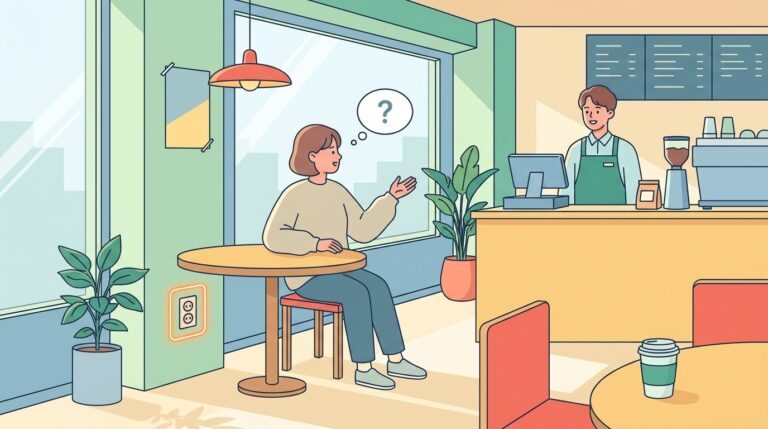
Imagine this: You’ve just walked into a stunning, multi-story cafe in Hapjeong. The aesthetics are immaculate, the smell of freshly brewed espresso fills the air, and you’re ready to open your laptop to study or edit your travel photos. You spot a power outlet, but wait—is it okay to plug in your charger here? There’s a bag sitting on a chair with nobody around. Can you take the seat?
If you’ve felt a sudden wave of hesitation in a Korean cafe, you are not alone! Many of our intermediate (B2) learners tell us that while they can order an ‘Ah-Ah’ (iced americano) with confidence, navigating the unwritten social contract of Korean cafes—especially when it comes to power outlets, studying (카공 – kagong), and leaving belongings unattended—makes them sweat.
Today, we’re going to elevate your Korean from “textbook perfect” to “locally respected.” Let’s dive into the cozy, plug-in world of Korean cafe etiquette!
Phase 2: Deep-Dive Into 3 Key Expressions
To navigate cafes like a pro, you need to master these three crucial intermediate expressions. Let’s break them down!
1. 콘센트 좀 써도 될까요? (Konsenteu jom sseodo doelkkayo?)
- Pronunciation: Kon-sen-teu (sounds like “concentric” without the ‘ric’) jom sseodo doelkkayo?
- Meaning: “May I use the outlet/socket?”
- K-Culture Moment: You are in a cozy, independent cafe. The outlets aren’t visibly open, or they are located near the counter. You politely ask the barista before plugging in your laptop.
- Editor’s Insight: Konsenteu comes from “concentric plug,” a classic Konglish (Korean-English) word for electrical outlet. While Korea is exceptionally generous with free Wi-Fi and outlets, asking first in smaller, independent shops is a sign of ultimate respect (yeeui).
- Situation Spectrum: Casual ⚠️ | Semi-formal ✅ | Formal ✅
- 🤔 Think About It: In some cultures, plugging in your device without asking is seen as taking free electricity. In Korea, it’s generally expected, but asking shows high social awareness. How does this compare to your home country?
2. 여기 자리 있어요? (Yeogi jari isseoyo?)
- Pronunciation: Yeogi (yo-gee) jari (jah-ree) isseoyo (ees-suh-yo)?
- Meaning: “Is this seat taken?” / “Is anyone sitting here?”
- K-Culture Moment: You see a table with a jacket on a chair, but no person. Or, a chair is empty next to someone. You ask to make sure you aren’t invading someone’s claimed territory.
- Editor’s Insight: Koreans often leave expensive laptops, iPads, and wallets on tables to “reserve” them while they go to the restroom or order. While theft is incredibly rare, claiming seats this way is standard. Always look for these “markers” and ask nearby patrons if you’re unsure.
- Situation Spectrum: Casual ✅ | Semi-formal ✅ | Formal 🚫
- 🤔 Think About It: Leaving a $2,000 laptop unattended to save a seat is a unique aspect of Korea’s high-trust society. Would you feel safe doing this in your city?
3. 혹시 노트북 작업 해도 괜찮을까요? (Hoksi noteubuk jageop haedo gwenchaneulkkayo?)
- Pronunciation: Hok-shi (hope-she) no-teu-buk (notebook) ja-geop (jah-geop) haedo gwen-chan-eul-kkayo?
- Meaning: “By any chance, is it okay if I do some laptop work?”
- K-Culture Moment: You enter a small aesthetic cafe with limited seating. You want to make sure they don’t have a “no-laptop” policy (노노트북존).
- Editor’s Insight: Notice the use of Hoksi (“by any chance”) and jageop (“work”). This softens the request, making you sound extremely polite and considerate of the cafe’s business flow.
- Situation Spectrum: Casual ⚠️ | Semi-formal ✅ | Formal ✅
- 🤔 Think About It: Why do you think some aesthetic cafes in Korea are transitioning to “No-Laptop Zones”? How do business owners balance atmosphere and customer utility?
Phase 3: Textbook Korean vs. Real-Life Korean
Let’s compare the sterile phrases from grammar books with the vibrant, natural language locals actually use.
Scenario A: Asking about outlet availability
- 📖 Textbook Korean: “전기 콘센트가 어디에 있습니까?” (Jeongi konsenteuga eodie isseumnikka? – “Where is the electrical outlet?”)
- 🗣️ Real-Life Korean: “혹시 저쪽 콘센트 자리 써도 돼요?” (Hoksi jeojjok konsenteu jari sseodo dweyo? – “By any chance, can I use that outlet seat over there?”)
- 💡 Why the difference? The textbook version sounds like a robot searching for power. The real-life version focuses on the “seat” (jari) with access to the outlet, which is how Koreans conceptualize cafe layout.
Scenario B: Checking if someone is using a seat
- 📖 Textbook Korean: “이 의자에 사람이 앉아 있습니까?” (I uijae sarami anja isseumnikka? – “Is a person sitting in this chair?”)
- 🗣️ Real-Life Korean: “여기 자리 비었나요?” (Yeogi jari bionnnayo? – “Is this spot empty/free?”)
- 💡 Why the difference? Asking if a “person is sitting” is too literal (and obvious if empty!). Asking if the spot is “empty/free” (bi-eot-da) sounds incredibly natural and conversational.
Phase 4: K-Culture Deep Dive & Non-Verbal Manners
4-1. The Art of Cafe ‘Nunchi’ (눈치)
Nunchi is Korea’s superpower of situational reading. In a cafe, nunchi dictates your volume, your space usage, and your stay duration.
* The 2-Hour Unwritten Rule: If you order one drink (around 5,000 KRW), the polite maximum stay for studying or working is about 2 to 3 hours. If you plan to stay longer, it’s customary to order a second drink or a dessert.
* The Keyboard Clatter: If you are in a quiet “study cafe” vibe, using noisy mechanical keyboards or clicking mouse buttons excessively is a major faux pas. Many locals use silicone covers or silent mice to keep the peace.
* Non-verbal Signalling: When leaving your seat temporarily to go to the restroom, leave a notebook or a water bottle on the table. This is a universal Korean signal that says, “This space is occupied, but I’ll be right back.”
4-2. The Rise of ‘Kagong-j족’ (카공족)
Kagong-jok (Cafe Study Tribe) is a massive cultural phenomenon in Korea. With high-speed internet and beautiful spaces, cafes have become secondary offices. This has led to a fascinating tug-of-war between students who want to study for hours and owners who need table turnover. Understanding this dynamic helps you choose the right cafe: chain cafes (like Ediya, Twosome Place, or Starbucks) are perfect for long study sessions, while tiny, trendy Instagrammable cafes are best kept for short chats and quick photos.
Phase 5: Real-Life Roleplay Scenario
Meet Min-su (민수), a friendly barista at a trendy cafe in Sangsu-dong. He’s used to digital nomads but appreciates customers who respect his cozy space.
Dialogue (The Laptop Dilemma)
- You: 🎭 (Approaching the counter with your laptop bag) 저… 혹시 노트북 작업하기 좋은 자리가 있을까요?
(Jeo… hoksi noteubuk jageophagi joeun jariga isseulkkayo?)
“Excuse me… by any chance, is there a good seat for working on a laptop?” -
Min-su: 아, 저희 안쪽 창가 테이블 아래에 콘센트가 있어요. 거기 이용하시면 편하실 거예요!
(Ah, jeohui anjjok changga teibeul araee konsenteuga isseoyo. Geogi iyonghasimyeon pyeonhasil geoyeyo!)
“Ah, we have outlets under the inner window tables. It’ll be comfortable if you use those!” -
You: 🎭 (Smiling warmly) 아, 다행이네요! 감사합니다. 혹시 오래 앉아 있어도 괜찮을까요?
(Ah, dahaengineyyeo! Gamsahamnida. Hoksiorae anja isseodo gwenchaneulkkayo?)
“Oh, what a relief! Thank you. By any chance, is it okay if I stay for a while?” -
Min-su: 그럼요, 괜찮습니다! 다만 주말이라 두 시간 정도 이용 제한이 있긴 해요.
(Geureomyo, gwenchansumnida! Daman jumalira du sigan jeongdo iyong jehani itgin haeyo.)
“Of course, that’s fine! However, since it’s the weekend, we do have a two-hour limit.” -
You: 🎭 (Nodding understandingly) 아, 네! 두 시간이면 충분해요. 아메리카노 한 잔이랑 바스크 치즈케이크 하나 주세요.
(Ah, ne! Du siganimyeon chungbunhaeyo. Amerikanohanjanirang baseukeu chijeukeikeu hana juseyo.)
“Ah, yes! Two hours is plenty. One Americano and one Basque cheesecake, please.” -
Min-su: 네, 감사합니다. 진동벨 울리면 받으러 와주세요!
(Ne, gamsahamnida. Jindongbel ullimyeon badeureo wajuseyo!)
“Yes, thank you. Please come collect them when the buzzer rings!” -
You: 🎭 (Taking the buzzer) 네, 감사합니다. 혹시 와이파이 비밀번호는 어디에 있나요?
(Ne, gamsahamnida. Hoksi waipai bimilbeonhoneun eodie innayo?)
“Great, thank you. By any chance, where is the Wi-Fi password?” -
Min-su: 영수증 맨 아래에 적혀 있습니다!
(Yeongsujeung maen araee jeokhyeo isseumnida!)
“It’s printed at the very bottom of your receipt!”
🔀 Interactive Choice Point
You’ve been working for exactly 2 hours. Your coffee is gone, but you have 30 more minutes of work left. What do you do?
- Choice A: Keep working anyway. No one has explicitly asked you to leave.
- Choice B: Pack your things politely, leave, and find another spot or head home.
- Choice C: Go to the counter and order an additional herbal tea to extend your stay.
Feedback:
- Choice A (Risk ⚠️): While Min-su might not kick you out, staying past the weekend limit without ordering more creates silent friction. Your “nunchi” score drops!
- Choice B (Bad 🚫): You don’t have to leave stressed! You have other options to finish your work comfortably.
- Choice C (Best 💖): Ordering another cheap drink shows incredible manners. Min-su will love you, and you can finish your project stress-free!
Phase 6: 10-Second Emotion Shadowing Drill
Practice matching your tone to these emotional cues to sound like a native speaker! The / represents a natural, brief pause.
-
[😊 Polites & Considerate]
저… / 혹시 / 콘센트 좀 / 써도 될까요?
(Jeo… / hoksi / konsenteu jom / sseodo doelkkayo?) -
[🥺 Slightly Aphetic & Soft]
혹시 / 노트북 작업 / 오래 하면 / 안 되나요?
(Hoksi / noteubuk jageop / orae hamyeon / an doenayo?) -
[🙌 Cheerful & Grateful]
아! / 콘센트 자리가 / 있네요! / 다행이다!
(Ah! / Konsenteu jariga / inneyo! / Dahaengida!)
Phase 7: K-Culture Mini Dictionary
- 카공족 (Kagong-jok) | Cafe Study Tribe | Students or workers who study in cafes for hours. Derived from 카페 (Cafe) + 공부 (Study) + 족 (Tribe).
- 진동벨 (Jindong-bel) | Vibrating Bell / Buzzer | The pager given to you after ordering. When it vibrates and lights up, your order is ready at the counter.
- 콘센트 (Konsenteu) | Power Outlet | A classic Konglish term for an electrical wall socket. Crucial for digital nomads.
- 노노트북존 (No-Notebook Zone) | No-Laptop Zone | Cafes that restrict the use of laptops, tablets, or heavy study materials to keep tables free for socializing.
Phase 8: Traveler’s Survival Kit
Survival Expressions TOP 3
- **
Frequently Asked Questions (FAQ)
Q: What does "콘센트 좀 써도 될까요? (Konsenteu jom sseodo doelkkayo?)" mean in Korean and how do you pronounce it?
A: In Korean, "콘센트 좀 써도 될까요? (Konsenteu jom sseodo doelkkayo?)" is pronounced [Kon-sen-teu (sounds like "concentric" without the 'ric'] and means: "May I use the outlet/socket?"
Q: What does "여기 자리 있어요? (Yeogi jari isseoyo?)" mean in Korean and how do you pronounce it?
A: In Korean, "여기 자리 있어요? (Yeogi jari isseoyo?)" is pronounced [Yeogi (yo-gee] and means: "Is this seat taken?" / "Is anyone sitting here?"
Q: What does "혹시 노트북 작업 해도 괜찮을까요? (Hoksi noteubuk jageop haedo gwenchaneulkkayo?)" mean in Korean and how do you pronounce it?
A: In Korean, "혹시 노트북 작업 해도 괜찮을까요? (Hoksi noteubuk jageop haedo gwenchaneulkkayo?)" is pronounced [Hok-shi (hope-she] and means: "By any chance, is it okay if I do some laptop work?"







