

Finding the Cafe Restroom Code: The Ultimate Korean Cafe Survival Guide ☕️
Phase 1: Empathy (스토리 몰입형 오프닝)
안녕하세요! Welcome back to Daily Hangul (매일한글), your personal local culture navigator!
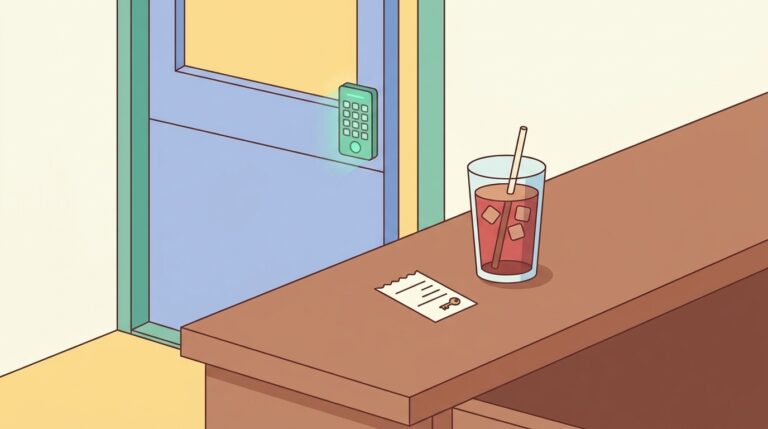
Imagine this: You are sitting in a gorgeous, Instagram-worthy cafe in Hongdae. You’ve just finished a delicious Iced Americano (아아 – A-A), and nature calls. You look around, find the restroom door, but wait—there is a glowing digital keypad locking you out. 🛑
You look back at the busy barista. Asking them directly feels a bit intimidating, right? But here is a local secret: in Korea, the key to your relief is almost always printed at the very bottom of your tiny paper receipt!
Today, we’re going to unlock the mystery of the Korean cafe restroom code. You will learn how to find this hidden code on your receipt, what to ask the barista if you can’t find it, and the subtle cultural etiquette of Korean cafe spaces. Let’s dive in! 🚀
Phase 2: Core Expressions (핵심 표현 3선 심층 분석)
1. 영수증에 비밀번호 있어요? (Yeong-su-jeung-e bi-mil-beon-ho isseo-yo?)
- Pronunciation: Young-soo-jung-eh bee-meel-bun-ho eet-suh-yo? (Sounds like “young” + “sue” + “jung” with a soft ‘o’ sound at the end)
- Meaning: “Is the password on the receipt?”
- K-Culture Moment: In modern K-Dramas, you often see characters frantically scanning a crumpled piece of paper under the dim lights of a trendy Seoul cafe. This is the exact phrase they mutter to themselves or ask the staff.
- Editor’s Insight: Bi-mil-beon-ho (비밀번호) literally translates to “secret number” (password). Koreans often shorten this to 비번 (bi-beon) in casual conversations.
- Situation Spectrum: Casual (⚠️ Yeong-su-jeung-e bi-beon isseo?) | Semi-formal (✅ Yeong-su-jeung-e bi-mil-beon-ho isseo-yo?) | Formal (✅ 영수증에 비밀번호가 있습니까?)
- 🤔 Think About It: In many Western countries, restrooms are either completely open or require a physical key. Why do you think Korea heavily relies on digital door locks and receipt codes? (Hint: It’s connected to Korea’s high-tech infrastructure and the concept of space management!)
2. 화장실 비밀번호가 뭐예요? (Hwa-jang-sil bi-mil-beon-ho-ga mwo-yeo-yo?)
- Pronunciation: Hwa-jahng-sheel bee-meel-bun-ho-gah mwoh-yuh-yo?
- Meaning: “What is the restroom password?”
- K-Culture Moment: Use this when the receipt didn’t print properly or you accidentally threw it away. It’s direct, polite, and gets straight to the point.
- Editor’s Insight: Hwa-jang-sil (화장실) means restroom. If you want to sound incredibly natural and polite, add a soft “저기요” (Jeo-gi-yo / Excuse me) before asking this.
- Situation Spectrum: Casual (⚠️ 화장실 비번 뭐야?) | Semi-formal (✅ 화장실 비밀번호가 뭐예요?) | Formal (✅ 화장실 비밀번호를 여쭤봐도 될까요?)
3. 영수증 버리지 마세요. (Yeong-su-jeung beo-ri-ji ma-se-yo.)
- Pronunciation: Young-soo-jung buh-ree-jee mah-seh-yo.
- Meaning: “Please don’t throw away the receipt.”
- K-Culture Moment: Baristas in busy areas (like Gangnam or Myeongdong) will often say this to you proactively when handing over your drink, tapping the bottom of the paper with a pen.
- Editor’s Insight: The pattern -ji ma-se-yo (지 마세요) means “Please do not [verb]”. Memorizing this pattern will help you understand many daily warnings in Korea!
- Situation Spectrum: Casual (⚠️ 영수증 버리지 마) | Semi-formal (✅ 영수증 버리지 마세요) | Formal (✅ 영수증은 버리지 말아주시기 바랍니다)
Phase 3: Textbook vs. Real Korean (교과서 한국어 vs 진짜 한국어)
Situation 1: Asking for the restroom location
- 📖 Textbook Korean: “화장실이 어디에 있습니까?” (Hwa-jang-sil-i eo-di-e is-seumni-ka? – “Where is the restroom?”)
- 🗣️ Real Korean: “저기, 화장실 비밀번호 영수증에 있어요?” (Jeo-gi, hwa-jang-sil bi-mil-beon-ho yeong-su-jeung-e isseo-yo? – “Excuse me, is the restroom password on the receipt?”)
- 💡 Why the difference? Textbook Korean teaches highly formal, grammatically rigid forms. In reality, most modern cafes have digital locks, so asking where the restroom is without asking for the code or checking your receipt will only result in a two-step conversation.
Situation 2: When you need the receipt
- 📖 Textbook Korean: “영수증을 주십시오.” (Yeong-su-jeung-eul ju-sip-si-o. – “Give me the receipt.”)
- 🗣️ Real Korean: “영수증 같이 주세요!” (Yeong-su-jeung gat-i ju-se-yo! – “Please give me the receipt as well!”)
- 💡 Why the difference? Saying “주십시오” sounds like a military command. Using “같이 주세요” (Please give it together with my order) is warm, friendly, and natural.
Phase 4: K-Culture Deep Dive & Non-verbal Manners (K-Culture 딥다이브)
4-1. The Art of “Nunchi” (눈치) at the Cafe Counter
When you receive your receipt, don’t just shove it in your pocket.
* The Gesture: Take the receipt with two hands as a sign of respect to the barista.
* The Quick Scan: Before leaving the counter, cast a quick glance (눈치 – Nunchi) at the bottom of the receipt. Look for the words 화장실 (Restroom), W.C., or a key symbol (🔑) followed by a 4-digit number and often the star key () or hash key (#). If you see it, give a polite nod and say “감사합니다” (Gam-sa-ham-ni-da*).
4-2. Why is the Restroom Password Locked?
In Korea, space is premium. Cafes in bustling areas like Seoul often lock their restrooms to prevent non-customers from using them, maintaining cleanliness and security for paying guests. It’s part of the urban “sharing economy” of private spaces!
Phase 5: Real-Life Roleplay Scenario (실전 롤플레이 시나리오)
Setting: A highly aesthetic cafe in Yeonnam-dong called “Cafe Forest”. You’ve just received your signature matcha latte from Min-woo, the friendly barista, but you realize you need to use the restroom.
Characters:
- Min-woo (민우): The polite, trendy barista.
- You (유): A thirsty traveler who needs the restroom code.
Script:
- Min-woo: 🎭 Hands over the tray with a smile
주문하신 말차 라떼 나왔습니다. (Ju-mun-ha-sin mal-cha ra-tte na-wat-seumni-da. / “Your matcha latte is ready.”) - You: 감사합니다! 저기… 혹시 화장실이 어디예요? (Gam-sa-ham-ni-da! Jeo-gi… hok-si hwa-jang-sil-i eo-di-yeo-yo? / “Thank you! Excuse me… by any chance, where is the restroom?”)
- Min-woo: 🎭 Points towards the exit on the left
건물 반 계단 위로 올라가시면 있어요. 비밀번호 누르셔야 해요. (Geon-mul ban gye-dan wi-ro ol-la-ga-si-myeon isseo-yo. Bi-mil-beon-ho nu-reu-syeo-ya hae-yo. / “Go up half a flight of stairs in the building. You need to press the password.”) - You: 아, 비밀번호요? 혹시 번호가 어떻게 돼요? (Ah, bi-mil-beon-ho-yo? Hok-si beon-ho-ga eo-tteo-ke dwae-yo? / “Ah, the password? What is the number by any chance?”)
- Min-woo: 🎭 Taps the paper paper paper with a finger
영수증 맨 밑에 나와 있어요! (Yeong-su-jeung maen mit-e na-wa isseo-yo! / “It’s written at the very bottom of the receipt!”) - You: 🎭 Looks down at the empty tray
앗… 제가 영수증 안 받았는데, 다시 받을 수 있을까요? (At… je-ga yeong-su-jeung an bad-at-neun-de, da-si ba-deul su isseu-kka-yo? / “Ah… I didn’t receive the receipt. Could I get it again?”) - Min-woo: 아, 네! 여기 있습니다. 맨 밑에 별표 있고 ‘1234’ 누르시면 돼요. (Ah, ne! Yeo-gi is-seumni-da. Maen mit-e byeol-pyo it-go ‘1-2-3-4’ nu-reu-si-myeon dwae-yo. / “Ah, yes! Here it is. There is a star sign at the bottom, just press ‘1234’.”)
- You: 🎭 Takes the receipt with both hands
아, 확인했어요! 감사합니다! (Ah, hwa-gin-haet-seo-yo! Gam-sa-ham-ni-da! / “Ah, I checked it! Thank you!”)
🔀 Interactive Choice Point!
What would you say if you went up to the door and the code didn’t work?
* A. “안 돼요!” (An dwae-yo! / “It doesn’t work!”)
* B. “저기요, 비밀번호를 눌렀는데 문이 안 열려요.” (Jeo-gi-yo, bi-mil-beon-ho-reul nul-reot-neun-de mun-i an yeol-ryeo-yo. / “Excuse me, I pressed the password but the door won’t open.”)
* C. “문이 고장 났어요.” (Mun-i go-jang nat-seo-yo. / “The door is broken.”)
Feedback:
- Best Choice: B — Polite, clear, and explains the situation perfectly without sounding accusatory.
- Bad Choice: A — Too blunt. It might sound like you are complaining or panicking unnecessarily.
- Risk Choice: C — Assuming the door is broken might confuse the staff when you might have just pressed the star key (*) in the wrong order!
Phase 6: 10-Second Emotion Shadowing Drill (10초 감정 섀도잉 드릴)
Practice saying these out loud with the correct emotional tone! The / represents a natural pause.
- [🥺 Urgent & Polite]
- 저기요… / 화장실 / 비밀번호가 / 어떻게 돼요?
- Jeo-gi-yo… / hwa-jang-sil / bi-mil-beon-ho-ga / eo-tteo-ke dwae-yo?
- [💡 Relieved & Realizing]
- 아! / 영수증 밑에 / 있구나!
- Ah! / Yeong-su-jeung mit-e / it-gu-na!
- [😊 Cheerful & Thankful]
- 네, / 영수증 / 같이 주세요!
- Ne, / yeong-su-jeung / gat-i ju-se-yo!
Phase 7: K-Culture Mini Dictionary (K-Culture 미니 사전)
- 도어락 (Do-eo-rak) | Digital Door Lock
- Almost all apartment doors and commercial restrooms in Korea use digital locks instead of physical keys.
- 영수증 (Yeong-su-jeung) | Receipt
- Often printed automatically, but baristas will ask “영수증 필요하세요?” (Do you need a receipt?). Always say “네” (Yes) if you plan to use the restroom!
- 와이파이 비밀번호 (Wa-i-pa-i bi-mil-beon-ho) | Wi-Fi Password
- Just like the restroom code, the Wi-Fi name and password are also almost always printed on the receipt.
- 별표 (Byeol-pyo) / 우물 정 (U-mul-jeong) | Star (*) / Hash (#)
- Used on door lock keypads. Many locks require you to press
*or#before or after entering the numbers (e.g.,*1234*or1234#).
- Used on door lock keypads. Many locks require you to press
Phase 8: Traveler’s Survival Kit (여행자를 위한 생존 키트)
Survival Expressions TOP 3
- 화장실 급해요! (Hwa-jang-sil geup-hae-yo!)
- Pro Tip: “It’s an emergency!” Use this only when you genuinely cannot wait.
- 비밀번호가 안 맞아요. (Bi-mil-beon-ho-ga an ma-ja-yo.)
- Pro Tip: “The password is incorrect.” Use this if you tried the code on the receipt but it keeps making an error sound.
- 영수증 재발행해 주세요. (Yeong-su-jeung jae-bal-haeng-hae ju-se-yo.)
- Pro Tip: “Please reprint the receipt.” Great if you lost yours.
Editor’s Travel Note 🗺️
If you are traveling in Seoul, always have the Naver Map App downloaded on your phone. It shows cafe locations and user reviews which sometimes mention if a cafe has an internal (cleaner) or external (shared) restroom.
(Note: Local door codes can change frequently due to security reasons, so always check the latest printed receipt!)
Phase 9: Deepening Your Mindset (한 발 더 깊이)
In many countries, public infrastructure is funded by local councils. In Korea, however, private cafes act as pseudo-public spaces. Because Koreans love spending hours in cafes studying, working, or socializing, the cafe restroom has evolved into a highly private, clean, and secure zone for paying customers. By locking these spaces, cafes ensure they remain hygienic. This shows how highly Korean society values shared, respectful boundaries in high-density urban environments.
💬 Your Turn: Have you ever experienced a locked restroom in your country? How did you get the code? Let us know in the comments below!
Phase 10: FAQ & Common Mistakes (FAQ & 오해 방지)
Q: Why does the keypad make a loud noise when I press the numbers?
A: Digital door locks in Korea have sound effects to let you know a button was registered. If you want to enter quietly, press the * (star) key once before entering the numbers to activate “Silent Mode” on most standard models!
Q: Is the restroom code the same for the men’s and women’s rooms?
A: Not always! Look closely at your receipt. It will often list 남 (Nam / Men) and 여 (Yeo / Women) with different codes next to them.
Q: I bought a coffee but didn’t get a receipt. What should I do?
A: Simply say: “영수증 한 장 뽑아주세요” (Yeong-su-jeung han jang ppoba-ju-se-yo / Please print a receipt for me).
🚨 Common Mistakes Alert!
- Mistake 1: Throwing away the receipt before checking for a lock.
- Correct Action: Always keep the receipt until you’ve successfully visited the restroom.
- Mistake 2: Forgetting to press
*or#at the end.- Correct Action: If the receipt says
*1234*, you must press star, the numbers, and star again.
- Correct Action: If the receipt says
- Mistake 3: Pushing the door too hard.
- Correct Action: Wait for the chime/unlock sound before pushing or pulling the handle.
Phase 11: Action Mission (액션 미션)
- 🥉 Bronze Mission: Take a receipt from any local store and find where the “영수증” text is.
- 🥈 Silver Mission: Write down the phrase “영수증 같이 주세요” on your phone notes and practice saying it.
- 🥇 Gold Mission: Next time you are in a Korean cafe (or a Korean town cafe nearby), order in Korean and actively look for the restroom code at the bottom of your receipt!
- 🎮 K-Culture Mission: Watch a modern K-Drama slice-of-life scene in a cafe. See if you can spot a digital door lock in the background!
Phase 12: Interactive Quiz Challenge (인터랙티브 퀴즈 챌린지)
1. What does “비밀번호” (Bi-mil-beon-ho) mean?
- A) Receipt
- B) Password
- C) Cafe Latte
2. True or False: You should always throw your receipt in the trash bin immediately after ordering to keep the cafe clean.
- True / False
🔍 Click here to reveal the Answers & Explanations!
- Answer: B) Password. Bi-mil means secret, and beon-ho means number. Together, they make “password”!
- Answer: False. Keep it! The restroom code or Wi-Fi password is often printed at the bottom.







