

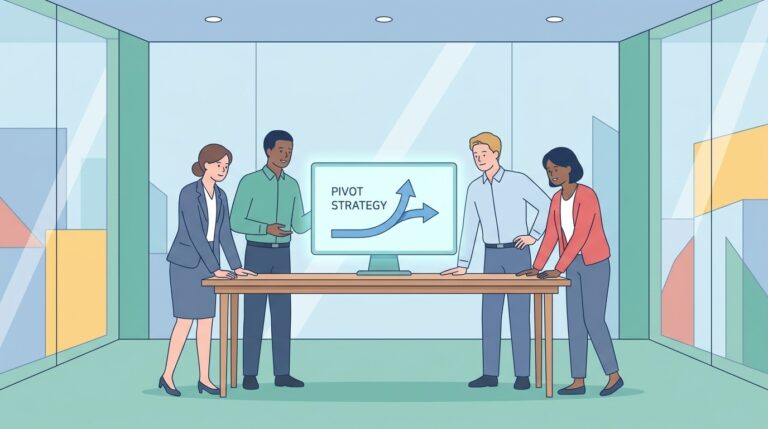
Master the Pivot: How to Navigate Strategic Shifts in Korean Startups (C1)
Phase 1: Empathy (스토리 몰입형 오프닝)
안녕하세요! Your loyal Korean culture and language navigator here from Daily Hangul (매일한글)!
Imagine this: You’ve poured your heart, soul, and endless cups of Ice Americano (아아) into your Seoul-based tech startup. Your app is sleek, your team is passionate, but the market response is… lukewarm. In the dynamic, hyper-speed world of Korean business, there comes a moment when every founder must face the ultimate question: Do we push forward, or is it time to pivot (피벗)?
Deciding to pivot is incredibly stressful. In Korea’s unique startup ecosystem—where respect, face (chemyeon / 체면), and consensus are highly valued—announcing a major strategic shift requires not just business acumen, but immense linguistic and cultural tact.
Our advanced (C1) learners often tell us: “I know the business metrics, but I don’t know how to deliver this pivot decision to my Korean co-founders and investors without sounding defeated or chaotic.”
Don’t worry! Today, we are diving deep into the exact vocabulary, subtext, and cultural nuances you need to lead a successful pivot in Korea with absolute confidence. Let’s get started!
Phase 2: Key Expressions Deep Dive (핵심 표현 3선 심층 분석)
1. 피벗을 단행하다 (pi-beot-eul dan-haeng-ha-da)
- Pronunciation: pi-beot-eul dan-haeng-ha-da (Sounds like “pee-but-ool dahn-haeng-hah-dah”)
- Meaning: To decisively execute a pivot / To take resolute action on a pivot.
- K-Culture Moment: You’ll hear this in realistic Korean startup K-dramas like Start-Up (스타트업) or Search: WWW (검색어를 입력하세요 WWW) when a CEO stands before a board of skeptical investors to announce a high-stakes direction change.
- Editor’s Insight: The verb 단행하다 (to carry out resolutely) carries massive weight. It’s not just “doing” something; it implies taking a bold, necessary risk despite potential opposition or difficulty. Using this phrase shows your team that you aren’t wavering; you are leading with conviction.
- Situation Spectrum: Casual 🚫 | Semi-formal ⚠️ | Formal ✅
- 🤔 Think About It: Why do you think Korean business culture values “resolute action” (단행) over simple “change” (변경) during crises? How does this reflect the traditional leadership expectations in Korea?
2. 사업 방향을 선회하다 (sa-eop bang-hyang-eul seon-hoe-ha-da)
- Pronunciation: sah-up bahng-hyang-ool suhn-hoe-hah-dah (Think of “seon-hoe” sounding like the first syllable of seon-bae combined with way)
- Meaning: To veer/steer the business direction.
- K-Culture Moment: Commonly used in economic editorials, tech podcasts, or during formal quarterly reviews when explaining a change in target audience or product offering.
- Editor’s Insight: 선회하다 is a sophisticated Hanja (Sino-Korean) term meaning “to rotate” or “to wheel around” (often used for airplanes changing course). In business, it sounds much more professional and strategic than simply saying “바꾸다” (to change).
- Situation Spectrum: Casual 🚫 | Semi-formal ✅ | Formal ✅
- 🤔 Think About It: How does using metaphorical navigation terms (like “steering/veering”) soften the psychological blow of admitting a previous strategy didn’t work?
3. 시장의 반응이 미온적이다 (si-jang-ui ban-eung-i mi-on-jeok-i-da)
- Pronunciation: shee-jahng-ee bahn-eung-ee mee-ohn-juhk-ee-dah
- Meaning: The market response is lukewarm/tepid.
- K-Culture Moment: Used behind closed doors by product managers and startup founders when analyzing user acquisition data that didn’t meet KPIs.
- Editor’s Insight: 미온적 (lukewarm/tepid) is the perfect, diplomatic C1-level word. Instead of saying “our product failed” or “users hate it” (망했다/반응이 최악이다), saying the market response is lukewarm saves face (chemyeon) for the product team while objectively stating the need for change.
- Situation Spectrum: Casual ⚠️ | Semi-formal ✅ | Formal ✅
- 🤔 Think About It: How does saving face (chemyeon) influence how bad news is delivered in your native culture compared to Korea?
Phase 3: Textbook Korean vs. Real-World Korean
Situation 1: Explaining why we need to change our strategy
- 📖 Textbook Korean: “우리는 다른 비즈니스 모델이 필요합니다.” (We need a different business model.)
- 🗣️ Real-World Korean: “현재 모델로는 스케일업에 한계가 있어, 수익 모델의 다변화를 모색해야 할 때입니다.” (Since there are limits to scaling up with our current model, it is time to seek diversification of our revenue model.)
- 💡 Why the difference? Textbook phrases can sound too simple or even desperate. Real-world C1 Korean utilizes precise startup terminology like scale-up (스케일업) and revenue model diversification (수익 모델의 다변화) to sound highly professional.
Situation 2: Informing the team about the pivot decision
- 📖 Textbook Korean: “계획을 바꾸기로 결정했습니다.” (I have decided to change the plan.)
- 🗣️ Real-World Korean: “지속 가능한 성장을 위해, 이번 기회에 피벗을 단행하기로 최종 결정을 내렸습니다.” (For sustainable growth, we have made the final decision to execute a pivot at this juncture.)
- 💡 Why the difference? Saying “we changed plans” can make a leader look indecisive. Framing the pivot around “sustainable growth” (지속 가능한 성장) and using the formal “단행하기로 최종 결정” asserts strong, strategic leadership.
Phase 4: K-Culture Deep Dive & Non-Verbal Etiquette
4-1. Nunchi (눈치) & Gesture Etiquette for Pivoting
When delivering pivot news to your Korean team or investors, your body language must balance humility with unwavering resolve.
* The “Two-Handed” Respect: When showing data slides or handing over revised business plans, always gesture with both hands or support your right forearm with your left hand.
* Tone and Eye Contact: Maintain steady, calm eye contact. Lowering your gaze too much makes you look defeated; staring too aggressively might look defensive. Speak in a low, measured tone.
* Nunchi (눈치) Rule: Read the room before you speak. If the atmosphere is heavy, start by validating your team’s hard work first (“그동안의 노고에 진심으로 감사드립니다” – I sincerely thank you for your hard work so far) before delivering the pivot announcement.
4-2. The Korean Startup Ecosystem Spirit
If you watch Korean dramas like Start-Up, you’ll see that the Korean startup scene is fueled by intense passion, but also heavily bound to venture capital (VC) networks. In Korea, a pivot isn’t just a technical adjustment; it affects trust with early-stage investors who often invest in the team rather than just the product. Therefore, pivoting is viewed as an act of responsibility to protect investor capital and team livelihoods.
Phase 5: Real-Life Roleplay Scenario
Characters & Setting
- You (Ji-hun /지훈): Co-founder and CEO of a fintech startup.
- Hye-won (혜원): Lead Developer and Co-founder. She has spent 6 months building the current product.
[Setting: A small meeting room in a shared office space in Teheran-ro, Gangnam.]

지훈: (조심스럽게 아이스 아메리카노를 건네며) 혜원 씨, 요즘 지표 보면서 고민이 많았죠?
      Ji-hun: (Carefully handing over an Ice Americano) Hye-won, you've had a lot on your mind looking at the metrics lately, right?

혜원: (한숨을 쉬며) 네, 지훈 대표님. 초기 유입은 좋은데 재방문율이 계속 떨어지네요.
      Hye-won: (Sighing) Yes, CEO Ji-hun. Initial acquisition is good, but the retention rate keeps dropping.

지훈: 맞아요. 솔직히 말해서 시장의 반응이 다소 미온적인 것이 사실입니다.
      Ji-hun: Agreed. To be honest, it's true that the market response is somewhat lukewarm.

혜원: (초조한 듯 손가락을 만지며) 그럼, 우리가 준비한 다음 업데이트도 소용이 없을까요?
      Hye-won: (Fidgeting nervously) Then, will the next update we prepared be useless too?

지훈: 아니요, 그동안의 개발 리소스가 헛된 건 아닙니다. 다만, 이제는 사업 방향을 선회해야 할 타이밍인 것 같아요.
      Ji-hun: No, our development resources so far haven't gone to waste. However, I think it's now time to steer our business direction.

혜원: (놀라며) 선회요? 혹시... 피벗을 말씀하시는 건가요?
      Hye-won: (Surprised) Steer? Are you... talking about a pivot?

지훈: 네, 더 늦기 전에 더 큰 시장성이 보이는 B2B 솔루션 쪽으로 피벗을 단행하려고 합니다.
      Ji-hun: Yes, before it's too late, I intend to decisively execute a pivot toward B2B solutions, which show greater market viability.

혜원: (생각에 잠긴 듯 고개를 끄덕이며) 쉽지 않은 결정이셨을 텐데, 지훈 대표님 의견에 동의해요. 함께 돌파구를 찾아봐요.
      Hye-won: (Nodding thoughtfully) It must have been a tough decision, but I agree with you, CEO Ji-hun. Let's find a breakthrough together.
🔀 Interactive Choice Point
How do you respond to Hye-won’s supportive statement?
- Option A: “고마워요, 혜원 씨. 당장 내일부터 개발팀 전체 회의를 소집해서 일정을 다시 짜죠.”
- Feedback: Risk. While proactive, pushing your team into an immediate scheduling meeting right after delivering shock news might overwhelm them. Give them 24 hours to process.
- Option B: “그렇게 말해줘서 정말 든든해요. 이번 피벗을 통해 우리의 진짜 저력을 보여줍시다.”
- Feedback: Best! Highly encouraging. It acknowledges her emotional support, builds solidarity (“우리”), and frames the pivot as an opportunity to showcase the team’s true potential.
- Option C: “어차피 B2C 시장은 가망이 없었으니 잘된 일이에요.”
- Feedback: Bad. Discrediting your previous direction entirely can demoralize your team who spent months building it.
Phase 6: 10-Second Emotion Shadowing Drill
Practice reading these with realistic startup-founder emotions!
- [😔 Calmly admitting reality with regret]
- “시장의 반응이 / 생각보다 / 미온적인 것이 / 사실입니다.”
- si-jang-ui ban-eung-i / saeng-gak-bo-da / mi-on-jeok-in geo-si / sa-sil-im-ni-da.
- [🔥 With strong, inspiring resolve]
- “더 늦기 전에 / 수익 모델의 다변화를 위해 / 피벗을 단행합시다!”
- deo neut-gi jeon-e / su-ik mo-del-ui da-byeon-hwa-reul wi-hae / pi-beot-eul dan-haeng-hap-si-da!
Phase 7: K-Culture Mini-Dictionary
- 데스밸리 (De-seu-bae-lli) | Death Valley | The critical early stage of a startup (usually years 1-3) where they face cash flow issues before generating revenue.
- 스케일업 (Seu-ke-il-eop) | Scale-up | Rapidly expanding a startup’s market size and business volume.
- 투자 유치 (Tu-ja yu-chi) | Attracting Investment | Securing funding/capital from VCs or angel investors.
- 돌파구 (Dol-pa-gu) | Breakthrough | A solution or way out of a dead-end business scenario.
Phase 8: Traveler’s Survival Kit (For Business Travelers)
Survival Expressions for Gangnam (Teheran-ro) Meetings
- “근처에 조용한 미팅룸 예약할 수 있는 카페가 있을까요?”
- Is there a cafe nearby where I can reserve a quiet meeting room?
- “법인카드로 결제해 주세요.”
- Please charge it to the corporate card.
- “명함 한 장 드리겠습니다.”
- Let me give you my business card. (Always hand it over with both hands!)
Editor’s Travel Note
If you are visiting Seoul for business, skip the noisy general cafes. Download the Naver Map App and search for “모임 공간” (meeting spaces) or “공유 오피스” (shared offices like Fastfive or Sparkplus) in Gangnam or Yeouido to rent professional, quiet rooms by the hour. Note: Prices and availability are subject to change depending on peak hours.
Phase 9:
Frequently Asked Questions (FAQ)
Q: What does "피벗을 단행하다 (pi-beot-eul dan-haeng-ha-da)" mean in Korean and how do you pronounce it?
A: In Korean, "피벗을 단행하다 (pi-beot-eul dan-haeng-ha-da)" is pronounced [pi-beot-eul dan-haeng-ha-da (Sounds like "pee-but-ool dahn-haeng-hah-dah"] and means: To decisively execute a pivot / To take resolute action on a pivot.
Q: What does "사업 방향을 선회하다 (sa-eop bang-hyang-eul seon-hoe-ha-da)" mean in Korean and how do you pronounce it?
A: In Korean, "사업 방향을 선회하다 (sa-eop bang-hyang-eul seon-hoe-ha-da)" is pronounced [sah-up bahng-hyang-ool suhn-hoe-hah-dah (Think of "seon-hoe" sounding like the first syllable of seon-bae combined with way] and means: To veer/steer the business direction.
Q: What does "시장의 반응이 미온적이다 (si-jang-ui ban-eung-i mi-on-jeok-i-da)" mean in Korean and how do you pronounce it?
A: In Korean, "시장의 반응이 미온적이다 (si-jang-ui ban-eung-i mi-on-jeok-i-da)" is pronounced [shee-jahng-ee bahn-eung-ee mee-ohn-juhk-ee-dah] and means: The market response is lukewarm/tepid.







