

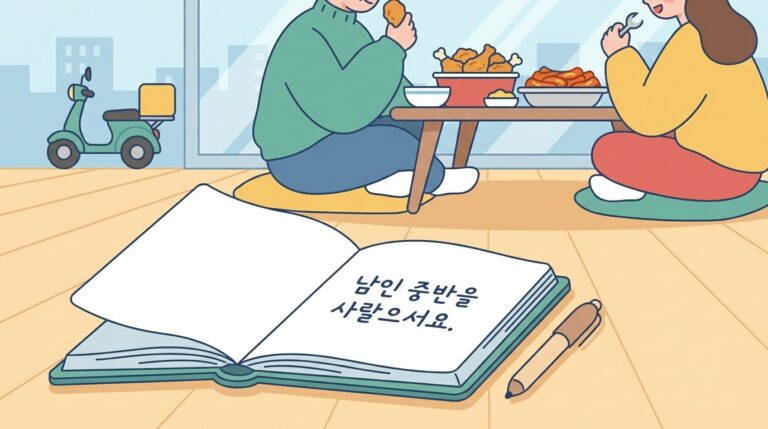
Master K-Delivery: How to Ask Your Korean Friends for Menu Recommendations Like a Pro
Phase 1: Empathy (Welcome to the K-Delivery Universe! 🛵)
안녕하세요! (An-nyeong-ha-se-yo!) I’m your lead editor at Daily Hangul, your trusty cultural navigator.
Imagine this: It’s a rainy Friday night in Seoul. You’re cozying up in your Airbnb, watching your favorite K-Drama, and your stomach starts to growl. You open a Korean food delivery app like Baemin (배달의 민족), but you are immediately overwhelmed. There are fifty different types of fried chicken, endless options of tteokbokki, and a dizzying array of side dishes.
Your Korean friend is sitting next to you (or on Kakaotalk), and you want to ask them: “Hey, what’s good here? What do you recommend?”
If you only know the textbook phrase “무엇을 추천합니까?” (Mu-eot-eul chu-cheon-hap-ni-kka?), you might sound a bit like a robot reading a manual. Don’t worry! Today, we are going to learn how real Koreans ask for food recommendations. By the end of this guide, you’ll be ordering delivery like a local and sharing a perfect meal with your friends. Let’s dive in! 🎉
Phase 2: Deep Dive into 3 Essential Expressions
Let’s look at the three most natural ways to ask for menu recommendations.
1. 뭐 먹을까? (Mwo meog-eul-kka?)
- Pronunciation: Mwo meog-eul-kka? (Sounds like: “Mwo mug-ul-kah?”)
- Meaning: “What should we eat?”
- K-Culture Moment: You will hear this in almost every K-Drama when friends sit on the living room floor, grabbing their phones to order late-night chicken (yasik, 야식).
- Editor’s Insight: This is the ultimate, friendly go-to phrase. It uses the
-(으)ㄹ까grammar ending, which suggests doing something together. It invites the other person into a shared decision. - Situation Spectrum: Casual (✅) / Semi-formal (⚠️ – change to 뭐 먹을까요?) / Formal (🚫)
- 🤔 Think About It: In many Western cultures, people often order their own individual plates. In Korea, sharing a delivery meal is a communal experience. How does this “sharing culture” affect the way we choose a menu?
2. 여기서 뭐가 제일 맛있어? (Yeo-gi-seo mwo-ga je-il mas-is-seo?)
- Pronunciation: Yeo-gi-seo mwo-ga je-il mas-is-eo? (Sounds like: “Yeo-gi-suh mwo-ga jay-il mah-shi-suh?”)
- Meaning: “What is the most delicious thing here?”
- K-Culture Moment: Used when you have chosen a specific restaurant on a delivery app but cannot decide on the actual dish.
- Editor’s Insight: This phrase is great because it asks for a personal opinion rather than a generic recommendation. The word
제일(je-il) means “most” or “best.” - Situation Spectrum: Casual (✅) / Semi-formal (⚠️ – change to 여기서 뭐가 제일 맛있어요?) / Formal (🚫)
- 🤔 Think About It: Why do you think Koreans care so much about their friends’ personal recommendations over star ratings on an app?
3. 요즘 뭐 많이 먹어? (Yo-jeum mwo man-i meo-geo?)
- Pronunciation: Yo-jeum mwo man-i meo-gaw? (Sounds like: “Yo-jum mwo mah-nee mug-aw?”)
- Meaning: “What are people eating a lot lately?” / “What’s trendy these days?”
- K-Culture Moment: Perfect for asking about the latest food trends, like “Rose Tteokbokki” or “Mara-flavored” dishes that frequently take over Korean social media.
- Editor’s Insight: Korea’s food scene moves incredibly fast. Asking what is popular now (
요즘) shows you are interested in the current trend. - Situation Spectrum: Casual (✅) / Semi-formal (⚠️ – change to 요즘 뭐 많이 먹어요?) / Formal (🚫)
- 🤔 Think About It: How does social media influence food trends in your country compared to Korea?
Phase 3: Textbook Korean vs. Real-Life Korean
Let’s compare what textbooks teach you versus how native speakers actually talk when ordering delivery.
Scenario 1: Asking for a general recommendation
- 📖 Textbook Korean: “메뉴를 추천해 주세요.” (Me-nyu-reul chu-cheon-hae ju-se-yo.) – “Please recommend a menu.”
- 🗣️ Real-Life Korean: “여기서 뭐가 잘 나가?” (Yeo-gi-seo mwo-ga jal na-ga?) – “What sells well here?” / “What’s the bestseller?”
- 💡 Why the difference? While the textbook version is grammatically correct, “잘 나가다” (to sell well/be popular) is a highly natural, colloquial expression used by locals to find the crowd-pleasing option instantly.
Scenario 2: Asking a friend for their preference
- 📖 Textbook Korean: “당신은 어떤 음식을 좋아합니까?” (Dang-sin-eun eo-tteon eum-sig-eul jo-a-hap-ni-kka?) – “What kind of food do you like?”
- 🗣️ Real-Life Korean: “너 오늘 뭐 당겨?” (Neo o-neul mwo dang-gyeo?) – “What are you craving today?”
- 💡 Why the difference? The verb
당기다(dang-gi-da) literally means “to pull,” but in casual speech, it means a food is “pulling” your appetite—meaning you are craving it. It is incredibly common and cozy!
Phase 4: K-Culture Deep Dive & Non-verbal Manners
4-1. The Art of “Menu Decision Making” (Nunchi & Harmony)
In Korea, ordering food is rarely a solo act of self-expression; it’s an exercise in Nunchi (눈치 – tact/situational reading).
* When your friend asks you what you want, saying “아무거나” (a-mu-geo-na – “anything”) too many times can actually make them feel pressured to make all the decisions.
* Instead, narrow it down! You can say: “나 매운 거 당기는데, 치킨 어때?” (I’m craving something spicy, how about chicken?). This shows you have a preference but are open to coordination.
4-2. The Delivery Culture (배달 문화)
Did you know that Koreans order delivery to parks, Han River banks, and even the beach? Delivery drivers (Riders) use precise GPS. When ordering with friends, the non-verbal cue of setting up the table is crucial. As soon as the doorbell rings, everyone jumps up to lay down newspaper (to prevent spills), open the containers, and set up the wooden chopsticks. Participating in this “set-up ritual” is the ultimate polite guest behavior!
Phase 5: Real-Life Roleplay Scenario
Meet Ji-a (지아), your energetic Korean friend, and Min-jun (민준), her brother who is obsessed with late-night snacks. You are all sitting in their living room on a lazy Saturday.
- Ji-a: 아, 배고프다! 우리 배달 시켜 먹을까? (Ah, bae-go-peu-da! U-ri bae-dal si-kyeo meog-eul-kka?)
(Ah, I’m hungry! Should we order delivery?) - You (🎭 Excitedly): 좋아! 근데 나 한국 배달 잘 몰라. 여기서 뭐가 제일 맛있어? (Jo-a! Geun-de na han-guk bae-dal jal mol-ra. Yeo-gi-seo mwo-ga je-il mas-is-eo?)
(Sounds great! But I don’t know Korean delivery well. What’s the best thing here?) - Min-jun: 배달은 역시 치킨이지! 반반 치킨 어때? (Bae-dal-eun yeog-si chi-kin-i-ji! Ban-ban chi-kin eo-tteon?)
(Delivery has to be chicken! How about half-and-half chicken?) - Ji-a: 야, 요즘은 로제 떡볶이가 대세야. 요즘 그거 진짜 많이 먹어. (Ya, yo-jeum-eun ro-je tteok-bok-ki-ga dae-se-ya. Yo-jeum geu-geo jin-짜 man-i meo-geo.)
(Hey, Rose Tteokbokki is the trend these days. People eat that a lot lately.) - You (🎭 Puzzled but curious): 로제 떡볶이? 신기하다. 그럼 너 오늘 뭐 당겨? (Ro-je tteok-bok-ki? Sin-gi-ha-da. Geu-reom neo o-neul mwo dang-gyeo?)
(Rose Tteokbokki? Interesting. Then what are you craving today?) - Ji-a: 나는 로제 떡볶이랑 튀김 세트! (Na-neun ro-je tteok-bok-ki-rang twi-gim se-teu!)
(I want the Rose Tteokbokki and fried food set!) - Min-jun (🎭 Laughing): 그럼 타협하자. 둘 다 시키자! 내가 쏜다! (Geu-reom ta-hyeop-ha-ja. Dul da si-ki-ja! Nae-ga sson-da!)
(Then let’s compromise. Let’s order both! My treat!) - You (🎭 Cheering): 대박! 민준이 최고! 잘 먹을게! (Dae-bak! Min-jun-i choe-go! Jal meog-eul-ge!)
(Awesome! Min-jun is the best! I will enjoy the food!)
🔀 Interactive Choice Points
How do you respond when Min-jun says “내가 쏜다!” (My treat!)?
- Choice A: “고맙습니다. 돈을 보낼게요.” (Thank you. I will send you money.)
- Choice B: “우와, 진짜? 다음에는 내가 살게!” (Wow, really? Next time is on me!)
- Choice C: “안 돼요, 제가 계산할게요.” (No, I will pay.)
Feedback:
- Best Choice: Choice B! In Korean culture, if someone offers to treat you warmly, accepting it with high energy (“우와, 진짜?”) and promising to buy the next round (“다음에는 내가 살게!”) is the most natural way to build friendship and maintain the social cycle.
- Bad Choice: Choice A. Sending money immediately after someone proudly says “내가 쏜다” can sometimes feel a bit cold and transactional among close friends.
- Risk Choice: Choice C. While polite, fighting too hard for the bill after someone already announced they are paying can create awkward tension.
Phase 6: 10-Second Emotion Shadowing Drill
Practice saying these phrases with real feelings! The / represents a natural pause.
- [😊 Bright and excited]
우리 / 뭐 먹을까? (U-ri / mwo meog-eul-kka?) - [🥺 Curious and longing]
너 오늘 / 뭐 당겨? (Neo o-neul / mwo dang-gyeo?) - [😋 Hungry and teasing]
여기서 / 뭐가 / 제일 잘 나가? (Yeo-gi-seo / mwo-ga / je-il jal na-ga?)
Phase 7: K-Culture Mini-Dictionary
- 반반 (Ban-ban) | Half-and-Half | Usually refers to half fried chicken and half seasoned (yangnyeom) spicy chicken.
- 야식 (Ya-sik) | Late-night snack | Eating meals after 10 PM. A core pillar of Korean lifestyle.
- 치맥 (Chi-maek) | Chicken + Beer | The ultimate culinary pairing in Korea, loved by all generations.
- 소확행 (So-hwak-haeng) | Small but certain happiness | Often used to describe ordering delicious food after a hard day’s work.
Phase 8: Survivor Kit for Travelers
Survival Phrases TOP 3
- 배달 돼요? (Bae-dal dwae-yo?) | Does this place deliver? | Pro Tip: Use this when asking a small local shop if they deliver to your nearby guesthouse.
- 젓가락 챙겨주세요. (Jeot-ga-rak chaeng-gyeo-ju-se-yo.) | Please include chopsticks. | Pro Tip: Many apps now have a default “No disposable plastic” checked, so write this in the request box if you need them.
- 문 앞에 두고 벨 눌러주세요. (Mun ap-e du-go bel nul-reo-ju-se-yo.) | Please leave it at the door and ring the bell. | Pro Tip: Perfect for contact-free delivery.
Editor’s Travel Note ✈️
To order food like a local, you need the right tools. Download the Baemin (배달의민족) app or the Yogiyo (요기요) app. While they require a Korean phone number for full payment authentication, travelers can often use foreigner-friendly services like Shuttle Delivery or ask their accommodation host to help order using the phrases above!
Phase 9: “Going One Step Deeper” (Reflections on Food and Friendship)
In Korea, food is the ultimate love language. Instead of “How are you?”, Koreans often greet each other with “밥 먹었어?” (Have you eaten?). Asking your friend what they want to eat, sharing a single box of chicken, and arguing over whether to dip or pour the sweet-and-sour sauce (Bumeok vs. Jjumeok) is how friendships are cemented in Korea.
💬 Your Turn: What is your ultimate comfort delivery food in your country? Let us know in the comments below! Let’s chat!
Phase 10: FAQ & Common Mistakes
Q: Can I use “추천해 주세요” (Chu-cheon-hae ju-se-yo) to my friends?
A: Yes, you can! However, it sounds a bit formal and distant. Use “뭐가 맛있어?” (Mwo-ga mas-is-eo?) or “뭐가 잘 나가?” (Mwo-ga jal na-ga?) to sound much warmer and closer.
Q: What does “아무거나” (A-mu-geo-na) really mean?
A: It means “anything.” But beware! If you say this too much, your friend might feel stressed trying to please you. It’s always better to name at least one food category you want.
Q: Is tipping required for delivery riders in Korea?
A: No, tipping is not expected or customary in Korea. The delivery fee is already calculated and paid through the app.
🚨 Common Mistakes Alert!
- Mistake 1: Calling your friend “당신” (Dang-sin) when asking what they want to eat.
- Correction: Never use “당신” in casual speech; it sounds like you are arguing or speaking to a stranger. Use their name or “너” (neo – you) instead.
- Mistake 2: Forgetting to say “잘 먹겠습니다!” (Jal meog-get-seub-ni-da) before taking the first bite.
- Correction: Always show appreciation before eating shared food!
Phase 11: Action Mission
- Bronze Medal 🥉: Speak “오늘 뭐 먹을까?” out loud 5 times in front of the mirror with your hungriest face.
- Silver Medal 🥈: Send a text to a friend or write on your social media: “오늘 떡볶이 당긴다!” (I’m craving Tteokbokki today!).
- Gold Medal 🥇: The next time you order food with a Korean speaker, ask them: “여기서 뭐가 제일 잘 나가?” and follow their recommendation!
Phase 12: Interactive Quiz Challenge
Test your knowledge! Click on the toggle to see the answers.
1. Which phrase means “What are you craving today?”
- A) 요즘 뭐 먹어?
- B) 너 오늘 뭐 당겨?
- C) 아무거나 먹자.
Reveal Answer & Explanation
Correct Answer: B!
“당기다” (dang-gi-da) is the colloquial way to express a food craving. A means “What do you eat lately?” and C means “Let’s eat anything.”
2. True or False: Tipping the delivery rider in Korea is mandatory.
- A) True
- B) False
Reveal Answer & Explanation
Correct Answer: B (False)!
Delivery fees are included in the app checkout, and tipping is not part of Korean culture.







