

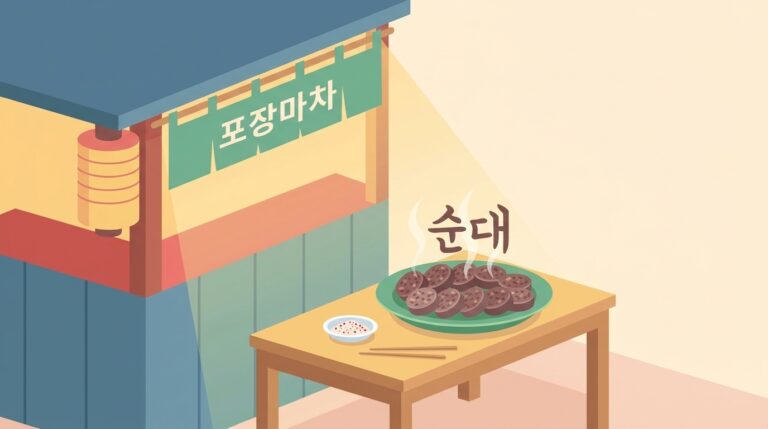
Why Do Koreans Dip Sundae in Salt? Master the Art of Korean Street Food!
Phase 1: Empathy (Welcome to the Street Food Paradise!)
안녕하세요! (Annyeonghaseyo!) Hello! It’s your K-culture bestie and Daily Hangul editor here.
Imagine this: You are standing in front of a cozy, steaming Pojangmacha (포장마차 – street food tent) on a chilly night in Seoul. The warm steam smells amazing. You want to try Sundae (순대 – Korean blood sausage), but as the friendly Imo (이모 – auntie/owner) hands you a plate, you see a tiny dish of salt with red chili flakes and a pile of green leaves.
“Wait, do I put salt on it? Or do I dip it? Is that sesame leaf?”
Don’t worry! Many of our learners have stood there feeling super confused. Today, we are going to learn how to order and eat Sundae like a true Seoulite, with the perfect phrases and local table manners! Let’s dive in!
Phase 2: Deep Dive into 3 Key Phrases
1. 소금에 찍어 드세요 (Sogume jigeo deuseyo)
- Pronunciation: So-goom-eh jjeek-eo deu-seh-yo (Sounds like: “So-goom-eh” as in room + “jeek-oh” + “deu-say-yo”)
- Meaning: Please dip it in salt.
- K-Culture Moment: You will hear this from the Imo at the street food stall when she serves you a fresh, steaming plate of Sundae.
- Editor’s Insight: The word “찍다” (jiktda) means “to dip” or “to dab.” In Korea, salt for Sundae is not just plain salt; it is usually mixed with a bit of red pepper powder (gochutgaru) and sesame seeds for an extra kick!
- Situation Spectrum: Casual ✅ | Semi-formal ✅ | Formal ⚠️
- 🤔 Think About It: In your country, do you dip savory snacks in salt, or do you prefer sweet sauces like ketchup?
2. 내장도 섞어 주세요 (Naejangdo seokeo juseyo)
- Pronunciation: Nay-jang-do suk-uh joo-say-yo (Sounds like: “Nay-jang-dough” + “suck-uh” + “joo-say-yo”)
- Meaning: Please mix in the organ meats (liver/lungs) too.
- K-Culture Moment: When ordering Sundae, the seller will always ask if you want “internal organs” (naejang). True locals love the chewy texture of the liver (gan) and lung (허파 – heopa)!
- Editor’s Insight: If you only want the sausage, you can say: “순대만 주세요” (Sundae-man juseyo – Just Sundae, please).
- Situation Spectrum: Casual ✅ | Semi-formal ✅ | Formal 🚫
- 🤔 Think About It: Eating organ meats is very common in Korean food culture because of the rich textures. Are you brave enough to try them?
3. 소금 조금만 더 주세요 (Sogum jogeum-man deo juseyo)
- Pronunciation: So-goom jo-geum-man duh joo-say-yo (Sounds like: “So-goom” + “joe-geum-mahn” + “duh” + “joo-say-yo”)
- Meaning: Please give me a little more salt.
- K-Culture Moment: If you dropped your salt dish or need a fresh batch of that spicy-salty goodness.
- Editor’s Insight: “조금만” (jogeum-man) means “just a little.” It is a very polite and natural way to ask for small refills in Korea.
- Situation Spectrum: Casual ✅ | Semi-formal ✅ | Formal ✅
- 🤔 Think About It: How does asking for “just a little” sound more polite than saying “Give me more salt”?
Phase 3: Textbook Korean vs. Real Korean
Situation 1: Asking if they have salt
- 📖 Textbook Korean: 소금이 있습니까? (Sogumi isseumnikka? – Do you have salt? – Too formal for a street stall!)
- 🗣️ Real Korean: 소금 좀 주세요. (Sogum jom juseyo. – Salt, please.)
- 💡 Why the difference? Street food stalls are fast-paced and friendly. Using “좀” (jom – please/a bit) makes your request sound soft, natural, and friendly.
Situation 2: Saying you don’t eat organ meats
- 📖 Textbook Korean: 저는 내장을 먹지 않습니다. (Jeoneun naejangeun meokji anseumnida. – I do not eat organs.)
- 🗣️ Real Korean: 내장은 빼고 주세요. (Naejangeun ppaego juseyo. – Please leave out the organs.)
- 💡 Why the difference? “빼고 주세요” (ppaego juseyo – leave it out, please) is the standard, polite way to customize your order in Korea without sounding too dramatic.
Phase 4: K-Culture Deep Dive & Non-verbal Manners
4-1. Nunchi & Street Food Manners
- The Double Dip Rule: Just like with salsa, never double-dip your Sundae into the shared salt dish if you are sharing with friends. Dab once, eat, and repeat on a fresh piece!
- The Hot Breath: Sundae is served extremely hot. It is totally normal to blow on it gently (hoo-hoo) before popping it into your mouth.
4-2. The Great Regional Salt Debate!
Did you know that dipping Sundae in salt is a Seoul/Gyeonggi province thing?
* In Busan, they dip it in Makjang (막장 – savory soybean paste).
* In Gwangju, they dip it in Chojang (초장 – sweet and sour chili paste).
* In Jeju, they sometimes dip it in Soy Sauce (간장 – ganjang).
Wherever you travel in Korea, the dipping sauce changes!
Phase 5: Real-Life Roleplay Scenario
Meet the Characters
- Imo (이모): The friendly, energetic owner of the street food stall.
- You (Alex): A hungry traveler wanting to try Sundae for the first time.
[Scene: A bright Pojangmacha with steam rising from a large metal tray]
- Imo: 어서 오세요! 뭐 드릴까요?
(Eoseo oseyo! Mwo deurilkkayo?)
🎭 Welcoming with a warm smile and tongs in hand. - You: 순대 일인분 주세요.
(Sundae irinbun juseyo.)
🎭 Pointing politely at the steaming Sundae tray. - Imo: 내장도 섞어 드릴까요?
(Naejangdo seokeo deurilkkayo?)
🎭 Lifting a big piece of liver, looking at you. - You (Option A chosen): 네, 섞어 주세요!
(Ne, seokeo juseyo!)
🎭 Nodding enthusiastically. - Imo: 여기 있습니다. 뜨거우니까 소금에 찍어 드세요.
(Yeogi isseumnida. Tteugeounikka sogume jigeo deuseyo.)
🎭 Handing over a hot paper plate with a small mound of salt. - You: 와, 맛있겠다! 감사합니다!
(Wa, masitgetda! Gamsahamnida!)
🎭 Bow slightly and take the toothpicks. - Imo: 맛있게 드세요! 소금 모자라면 더 말해요!
(Masitge deuseyo! Sogum mojarayeon deo marhaeyo!)
🎭 Wiping the counter with a friendly laugh. - You: 네! 잘 먹겠습니다!
(Ne! Jal meokgetseumnida!)
🎭 Carefully dipping the first piece into the salt.
🔀 Interactive Choice Point
How do you respond when Imo asks if you want organ meats (Naejang)?
* A. “네, 섞어 주세요!” (Yes, mix it in!)
* Feedback: BEST! You get to try the authentic local style. Imo will love your adventurous spirit!
* B. “아니요, 내장은 빼고 주세요.” (No, please leave the organs out.)
* Feedback: GOOD! Perfect if you are hesitant about liver or lungs. You will get only the delicious noodle sausage.
* C. “내장 싫어요!” (I hate organs!)
* Feedback: RISK! Saying “싫어요” (I hate/dislike) can sound a bit childish or rude in Korean. Stick to Option B for a polite refusal.
Phase 6: 10-Second Emotion Shadowing Drill
Let’s practice speaking with real Korean emotion! Pronounce the slashes / as natural pauses.
- [😊 Excited & Hungry]
- “순대 / 진짜 / 맛있겠다!”
(Sundae / jin-jja / ma-sit-get-da!)
-> “Wow, Sundae looks so delicious!”
- “순대 / 진짜 / 맛있겠다!”
- [🥺 Polite & Gentle]
- “이모, / 소금 좀 / 더 주세요.”
(Imo, / so-gum jom / duh joo-say-yo.)
-> “Auntie, could I have a little more salt, please?”
- “이모, / 소금 좀 / 더 주세요.”
Phase 7: K-Culture Mini-Dictionary
- 순대 (Sundae): Korean blood sausage made by stuffing pig’s intestines with glass noodles (dangmyeon), barley, and pork blood.
- 이모 (Imo): Literally “maternal aunt,” but used to call middle-aged female owners of casual restaurants and street stalls.
- 포장마차 (Pojangmacha): Small tented spots on wheels or street stalls selling popular street foods and alcohol.
- 내장 (Naejang): Internal organs (usually pork liver, lungs, and heart) served steamed alongside Sundae.
Phase 8: Survivor Kit for Travelers
Survival Phrases TOP 3
- 이거 얼마예요? (Igeo eolmayeyo?) – How much is this?
- 포장해 주세요. (Pojang-hae juseyo.) – Please wrap it up / To-go, please.
- 떡볶이 국물 좀 묻혀 주세요. (Tteokbokki gungmul jom muthyeo juseyo.) – Please put some Tteokbokki sauce on top. (Pro Tip: Locals love dipping Sundae in spicy Tteokbokki sauce!)
Editor’s Travel Note
When navigating the busy streets of Seoul for food, make sure to use Naver Map App instead of Google Maps, as it is much more accurate for finding tiny local Pojangmacha spots. Also, note that some street stalls only accept cash or bank transfers, so keep a few 1,000 KRW bills handy!
Phase 9: “Going Deeper” (Cultural Reflection)
In Western cultures, salt is often seen as a basic table seasoning that you sprinkle over the top. In Korea, however, dipping food into a shared or personal dish of salt is a deliberate action of flavor control. Eating street food is also a communal experience. Standing together around a hot plate, sharing stories with strangers, and calling the seller “Imo” (Auntie) shows the warm, affectionate culture known as Jeong (정).
💬 Your Turn: Would you try Sundae with the salt, or would you prefer to travel to Busan to try it with the savory soybean paste? Let us know in the comments below!
Phase 10: FAQ & Common Mistakes
Q: Is Sundae very spicy?
A: No, Sundae itself is not spicy at all! It is savory and earthy. However, the salt served with it has a tiny bit of red pepper powder, which adds a very mild kick.
Q: Can I eat Sundae if I don’t eat pork?
A: Traditionally, Sundae uses pork intestines and blood, so it is not vegetarian or Halal. However, some modern shops offer seafood or vegetable alternatives!
Q: Do I have to pay with cash at street stalls?
A: While many modern stalls accept cards, smaller tent stalls (Pojangmacha) often prefer cash or domestic bank transfers. It’s always safe to carry about 10,000 KRW in cash.
🚨 Common Mistakes Alert!
- Mistake 1: Grabbing the Sundae with your bare hands.
Correct Action: Always use the toothpicks or wooden skewers provided by the owner. - Mistake 2: Pouring the salt directly all over the Sundae plate.
Correct Action: Keep the salt in its tiny corner or dish and dip each piece individually to keep it from getting too salty.
Phase 11: Action Mission
- Bronze Mission 🥉: Say “소금 좀 주세요” (Sogum jom juseyo) out loud 3 times in your room!
- Silver Mission 🥈: Share this post on your social media and tag a friend you want to eat Korean street food with!
- Gold Mission 🥇: Next time you visit Korea or a local K-town market, order Sundae and ask for “내장도 섞어 주세요” (Naejangdo seokeo juseyo)!
Phase 12: Interactive Quiz Challenge
1. What does “찍어 드세요” mean?
a) Please wrap it up.
b) Please dip it.
c) Please steam it.
2. If you do NOT want organ meats, what should you say?
a) 내장 많이 주세요.
b) 내장은 빼고 주세요.
c) 소금 주세요.
🔍 Click here to reveal the Answers & Explanations!
-
Answer: b) Please dip it.
Explanation: “찍다” (jiktda) means to dip. Imo will tell you “소금에 찍어 드세요” (Please dip it in salt). -
Answer: b) 내장은 빼고 주세요. (Please leave out the organs.)
Explanation: “빼고” (ppaego) means to exclude or leave out. Use this to get only the delicious noodle sausage!







