

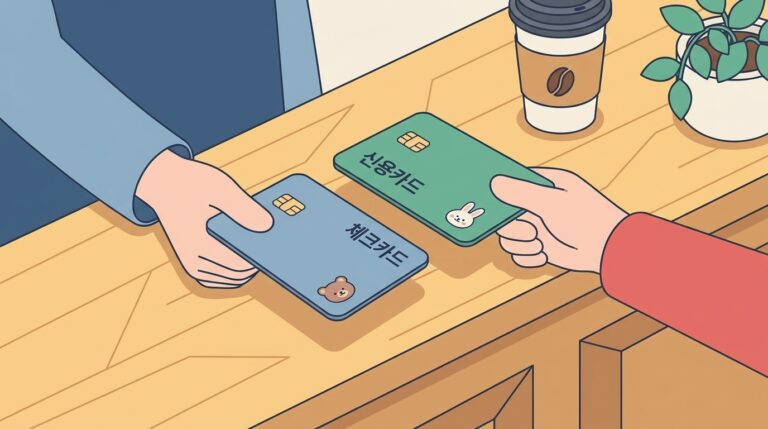
Master Your Wallet: Decoding the Real Difference Between ‘Check Cards’ and ‘Credit Cards’ in Korea
Phase 1: Empathy (스토리 몰입형 오프닝)
안녕하세요! Daily Hangul (매일한글)‘s Senior Editor and your local culture navigator here! 😊
Picture this: You are standing in a chic, bustling cafe in Hongdae. You just ordered a delicious Strawberry Soufflé Pancake. You confidently pull out your plastic card and hand it over. The barista smiles warmly and asks:
“체크카드로 결제해 드릴까요, 아니면 신용카드로 하실래요?”
(Should I process this with a check card or a credit card?)
Suddenly, your mind freezes. “Wait, I know what a debit card is, but what exactly is a Check Card (체크카드)? Is it different from a Credit Card (신용카드)? Do they work the same way here?”
If you have felt this sudden spike in anxiety at a Korean register, you are not alone! Many of our B2-level learners share that navigating Korea’s highly digitized financial system can feel like learning a whole new language. In a country where cashless is the absolute norm (even street food carts sometimes prefer bank transfers!), understanding the linguistic and cultural nuances of 체크카드 (Check Card) vs. 신용카드 (Credit Card) is your ticket to living like a true local.
Today, we will untangle these terms, learn how to talk about card payments smoothly, and dive into the cultural context of Korean spending habits. Let’s get into it!
Phase 2: Core Expressions Deep Dive (핵심 표현 3선 심층 분석)
Let’s break down the three most crucial terms you will hear and use at any register or bank teller window.
1. 체크카드 (Che-keu Ka-deu)
- Pronunciation: Che-keu Ka-deu (Sounds like “check” + “card” with a soft “eu” sound at the end of each word. Think of the “oo” in “good” but very short.)
- Meaning: Debit Card (directly linked to your Korean bank account).
- K-Culture Moment: In K-Dramas, university students and young adults almost always pull out their sleek, character-themed 체크카드 (like Kakao Friends or Line Friends designs) to split the bill (N-빵, N-bbang) at a chicken-and-beer place.
- Editor’s Insight: While Westerners use “debit card,” Koreans borrowed the German/European concept of “check,” calling it 체크카드. It deducts funds instantly from your connected Korean bank account (통장, tong-jang).
- Situation Spectrum:
- Casual: ✅ | Semi-formal: ✅ | Formal: ✅ (Universal term)
- 🤔 Think About It: Why do you think cute character designs are so incredibly popular on Korean financial cards compared to your home country? How does this reflect the Korean lifestyle of expressing personal identity through daily objects?
2. 신용카드 (Sin-yong Ka-deu)
- Pronunciation: Seen-yong Ka-deu (Say “seen” with a bright ‘i’, and “yong” rhymes with “song”.)
- Meaning: Credit Card.
- K-Culture Moment: You have definitely seen this in dramas: a wealthy CEO dramatically slides a matte-black 신용카드 across the table to pay for a luxury shopping spree.
- Editor’s Insight: 신용 (sin-yong) literally translates to “trust” or “credit.” In Korea, having a local credit card requires a stable visa status and proof of income. It unlocks the magical world of 할부 (hal-bu), or interest-free monthly installments, which is a massive part of Korean shopping culture.
- Situation Spectrum:
- Casual: ✅ | Semi-formal: ✅ | Formal: ✅
- 🤔 Think About It: In Korea, credit cards are heavily tied to tax deduction benefits (소득공제). How does your government incentivize card usage vs. cash usage?
3. 일시불로 해주세요 (Il-si-bul-lo hae-ju-se-yo)
- Pronunciation: Eel-shee-bool-lo hae-joo-seh-yo (Run “il-si-bul” together. The “l” at the end of “il” rolls smoothly into “si”.)
- Meaning: Please charge it as a single/one-time payment.
- K-Culture Moment: When paying for something slightly expensive at a department store, the cashier will ask, “몇 개월로 해 드릴까요?” (How many months installment?). Replying with “일시불이요” is the ultimate adulting flex.
- Editor’s Insight: If you use a 신용카드, you can split payments. But if you want to pay the full amount at once, or if you are using a 체크카드 (which only allows single payments), you say 일시불 (single payment).
- Situation Spectrum:
- Casual: ⚠️ (A bit too formal for a tiny convenience store purchase, but fine) | Semi-formal: ✅ | Formal: ✅
- 🤔 Think About It: Why does Korean consumer culture normalize splitting even small purchases (like $50) into monthly installments? How does this compare to your country’s installment options?
Phase 3: Textbook Korean vs. Real Korean (교과서 한국어 vs. 진짜 한국어)
Let’s compare what textbooks teach you with how Koreans actually speak at the counter.
Situation 1: Choosing how to pay
- 📖 Textbook: “체크카드로 결제하겠습니다.” (I will pay with a check card.)
- 🗣️ Real Korean: “체크카드로 할게요.” (I’ll do check card.) or simply “체크요!” (Check [card], please!)
- 💡 Why the difference? Koreans value speed and efficiency (빨리빨리, ppalli-ppalli). Saying “결제하겠습니다” sounds like you are signing a corporate merger. “~로 할게요” is friendly, polite, and punchy.
Situation 2: Asking if a card is accepted
- 📖 Textbook: “이 카드를 사용할 수 있습니까?” (Is it possible to use this card?)
- 🗣️ Real Korean: “이거 돼요?” (Does this work? / Can I use this?) while lightly holding up the card.
- 💡 Why the difference? “사용할 수 있습니까” is grammatically correct but incredibly stiff. “돼요?” (from 되다, to be okay/possible) is the absolute king of conversational verbs in Korea.
Phase 4: K-Culture Deep Dive & Non-Verbal Manners
4-1. The Art of Handing Over Your Card
When paying in Korea, how you hand over your card is just as important as what you say.
* The Two-Hand Rule: Always present and receive your card (and receipt) with both hands, or with your right hand supported gently at the elbow/wrist by your left hand. It shows immense respect to the cashier. Giving a card with a single hand, especially throwing it onto the counter, is considered quite rude!
* Eye Contact: Make brief eye contact, give a slight head nod (not a full 90-degree bow, just a polite tilt), and say “감사합니다” (Thank you).
4-2. The “N-빵” (N-Bbang) and Card Slapping Culture
In K-dramas or reality shows, you might see friends fighting over who pays the bill. Sometimes, they all throw their 체크카드 into a pile and let the server randomly pick one. This is called 카드 뽑기 (Card Lottery)! It’s a fun, modern twist on splitting the bill. If you want to split it evenly, you can ask the server:
“카드로 나눠서 결제할 수 있을까요?”
(Could we split the payment across different cards?)
Most modern Korean POS systems handle this effortlessly!
Phase 5: Real-Life Roleplay Scenario (실전 롤플레이)
Setting: A trendy boutique store in Sinsa-dong. You are buying a beautiful cardigan.
NPC Character: 민지 (Min-ji), a stylish and fast-talking store clerk.
- 민지: 손님, 골라오신 가디건 정말 예쁘네요! 결제 도와드릴게요.
(Customer, this cardigan you chose is so pretty! Let me help you with the payment.) - You (B2): 🎭 [Politely holding out your card with both hands]
네, 감사합니다. 이거 체크카드인데 결제 돼요?
(Yes, thank you. This is a check card, does it work?) - 민지: 아, 그럼요! 당연히 되죠. 혹시 일시불로 해드릴까요?
(Ah, of course! Absolutely. Should I do it as a single payment?) - You (B2): 🎭 [Smiling warmly]
네, 체크카드니까 일시불로 해주세요.
(Yes, since it’s a check card, please do a single payment.) - 민지: 🎭 [Tapping the screen]
아! 죄송해요, 손님. 저희 단말기에 IC칩 에러가 계속 나네요. 혹시 실물 카드 말고 삼성페이나 카카오페이 같은 간편 결제도 있으신가요?
(Ah! I’m sorry, customer. Our terminal keeps getting an IC chip error. By any chance, do you have mobile easy payments like Samsung Pay or Kakao Pay instead of the physical card?) - You (B2): 아, 그래요? 음… 카카오페이는 없는데, 다른 체크카드가 하나 더 있어요. 이걸로 해볼게요.
(Oh, really? Hm… I don’t have Kakao Pay, but I have another check card. Let’s try this one.) - 민지: 🎭 [Taking the second card with both hands and sliding it in]
앗, 이건 잘 되네요! 여기 카드랑 영수증 받으세요. 봉투 필요하신가요?
(Ah, this one works great! Here are your card and receipt. Do you need a bag?) - You (B2): 🎭 [Receiving the card with both hands]
아니요, 괜찮아요. 가방에 넣을게요. 수고하세요!
(No, it’s okay. I’ll put it in my bag. Have a nice day!)
🔀 Interactive Decision Point (선택 분기점)
Imagine Min-ji asked you: “할부로 해드릴까요, 일시불로 해드릴까요?” (Would you like installments or a single payment?) but you are using a foreign-issued Debit card. How do you respond?
- Option A: “3개월 할부로 해주세요.” (Please do 3 months installment.)
- Option B: “일시불로 해주세요.” (Please do a single payment.)
- Option C: “그냥 대충 해주세요.” (Just do it whatever way.)
💡 Feedback Table:
| Choice | Result | Rating | Editor’s Explanation |
|---|---|---|---|
| Option A | Card gets declined instantly. | BAD (🚫) | Foreign debit cards and Korean 체크카드 cannot do installment (할부) payments. It will result in an awkward error screen! |
| Option B | Smooth transaction, lovely smile from Min-ji. | BEST (✅) | Perfect! Check cards must always be processed as 일시불 (single payment). |
| Option C | Minor confusion; clerk will likely default to single payment anyway. | RISK (⚠️) | Saying “대충” (roughly/whatever) sounds a bit uninterested or slightly impolite in a retail setting. |
Phase 6: 10-Second Emotional Shadowing Drill
Let’s practice speaking with real Korean emotion. Pay attention to the pauses (/) and the emotional cues!
- [😊 Friendly and Confident]
- Sent: “이거 / 체크카드인데 / 결제 돼요?”
- Rom: I-geo / che-keu-ka-deu-in-de / gyeol-je dwae-yo?
- Eng: “This is a check card, does it work?”
- [😎 Cool and Decisive]
- Sent: “네, / 일시불로 / 해주세요!”
- Rom: Ne, / il-si-bul-lo / hae-ju-se-yo!
- Eng: “Yes, please make it a single payment!”
Phase 7: K-Culture Mini Dictionary
- 통장 (Tong-jang) | Bankbook / Account
- Usage: Physical bankbooks are still widely used in Korea, especially by older generations, though youngsters use banking apps (모바일 뱅킹).
- 공인인증서 (Gong-in-in-jeung-seo) | Joint Certificate
- Usage: The legendary digital certificate required for online banking and card payments in Korea. It’s infamous for being secure but slightly complicated to install!
- 영수증 (Yeong-su-jeung) | Receipt
- Usage: Cashiers will ask “영수증 드릴까요?” (Would you like a receipt?). You can say “버려주세요” (Please throw it away) if you don’t need it.
- 할부 (Hal-bu) | Installment Payment
- Usage: Paying for high-ticket items over 2 to 12 months. Often comes with “무이자” (no interest) promotions.
Phase 8: Traveler’s Survival Kit
Survival Phrases TOP 3:
- “카드 결제 돼요?” (Ka-deu gyeol-je dwae-yo?)
- Pro Tip: Use this at small local shops, traditional markets, or taxis before boarding to ensure they accept cards.
- “영수증은 안 주셔도 돼요.” (Yeong-su-jeung-eun an ju-syeo-do dwae-yo.)
- Pro Tip: “You don’t need to give me the receipt.” Super useful to save paper at convenience stores.
- “카카오페이 돼요?” (Ka-ka-o-pei dwae-yo?)
- Pro Tip: Essential if you forgot your wallet and only have your smartphone.
📝 Editor’s Travel Note:
Korea is almost 99% cashless now. In fact, many metropolitan buses in Seoul no longer accept cash! If you are traveling, we highly recommend getting a travel-friendly card like WOWPASS or NAMANE Card before arriving. These function exactly like a Korean 체크카드 (Check Card) and also double as a transit card (교통카드)! You can easily manage them via the official WOWPASS App on your phone.
Phase 9:
Frequently Asked Questions (FAQ)
Q: What does "체크카드 (Che-keu Ka-deu)" mean in Korean and how do you pronounce it?
A: In Korean, "체크카드 (Che-keu Ka-deu)" is pronounced [Che-keu Ka-deu (Sounds like "check" + "card" with a soft "eu" sound at the end of each word. Think of the "oo" in "good" but very short.] and means: Debit Card (directly linked to your Korean bank account).
Q: What does "신용카드 (Sin-yong Ka-deu)" mean in Korean and how do you pronounce it?
A: In Korean, "신용카드 (Sin-yong Ka-deu)" is pronounced [Seen-yong Ka-deu (Say "seen" with a bright 'i', and "yong" rhymes with "song".] and means: Credit Card.
Q: What does "일시불로 해주세요 (Il-si-bul-lo hae-ju-se-yo)" mean in Korean and how do you pronounce it?
A: In Korean, "일시불로 해주세요 (Il-si-bul-lo hae-ju-se-yo)" is pronounced [Eel-shee-bool-lo hae-joo-seh-yo (Run "il-si-bul" together. The "l" at the end of "il" rolls smoothly into "si".] and means: Please charge it as a single/one-time payment.







