

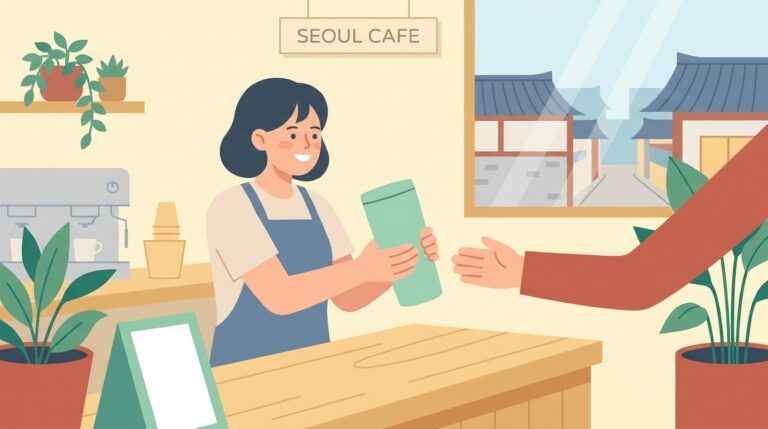
Bring Your Own Cup! How to Save 300 Won (and the Planet) at Korean Cafes
Phase 1: Empathy (Welcome to the Daily Hangul Cafe!)
안녕하세요! (Annyeonghaseyo!) I’m your Daily Hangul editor and your personal cultural navigator.
Imagine this: You walk into a trendy, minimalist cafe in Seoul. The espresso machine is humming, the aroma of freshly roasted beans fills the air, and you’ve got your favorite reusable tumbler in hand. You want to do your part for the environment and, let’s be honest, grab that sweet 300 won discount (텀블러 할인 – teumbleo harin).
But as you approach the counter, your heart beats a little faster. How do you ask for the discount without sounding awkward? Does the barista wash the cup for you?
Many of our intermediate learners (B1) tell us they often chicken out at the last second and just accept a paper cup because they lack the specific “cafe confidence.” Don’t worry! Today, we’re going to master the exact phrases, cultural nuances, and hidden gestures that will make you look like a seasoned Seoulite saving 300 won with ease. Let’s dive in!
Phase 2: Deep-Dive into 3 Essential Expressions
1. 텀블러에 담아 주세요 (Teumbleoeo dama juseyo)
- Pronunciation: Tum-bleor-eh dam-ah joo-seh-yo (Sounds like “Tumbler-eh” + “dah-ma” as in damaging + “joo-seh-yo”)
- Meaning: Please put it in my tumbler.
- K-Culture Moment: In K-Dramas, you’ll often see environmentally conscious characters handing over their pastel-colored tumblers at local coffee shops. It’s a small but powerful statement of chic eco-friendliness.
- Editor’s Insight: The verb 담다 (damda) means “to put/fill into a container.” Using this instead of simply saying “주세요” (give me) shows you understand the precise mechanics of cafe service.
- Situation Spectrum: Casual (✅) | Semi-formal (✅) | Formal (⚠️)
- 🤔 Think About It: In your country, do baristas have a specific verb for putting drinks in personal cups, or do you just say “in my cup”?
2. 텀블러 할인 되나요? (Teumbleo harin doenayo?)
- Pronunciation: Tum-bleor ha-rin doe-nah-yo? (“Harin” sounds like harness + rinse. “Doenayo” sounds like doe-nah-yo)
- Meaning: Can I get a tumbler discount?
- K-Culture Moment: Korea is highly systemized. Almost all major franchises (Starbucks, Twosome Place, Paul Bassett) and even small indie cafes offer a 300 to 500 won discount for using reusable cups.
- Editor’s Insight: The word 되나요? (Doenayo?) is the ultimate magic word in Korean retail. It literally means “Is it possible/does it work?” It’s incredibly polite yet direct.
- Situation Spectrum: Casual (✅) | Semi-formal (✅) | Formal (⚠️)
- 🤔 Think About It: Why do you think Korea, a country famous for its fast-paced “Ppalli-ppalli” (hurry, hurry) culture, is embracing the slightly slower process of handling personal tumblers?
3. (빨대 없이) 그냥 마실게요 ((Ppaldae eopsi) geunyang masilgeyo)
- Pronunciation: Ppal-dae eop-shi geun-yang mah-shil-geh-yo
- Meaning: I’ll just drink it (without a straw).
- K-Culture Moment: With the ban on plastic straws in many Korean cafes, you’ll often be given a paper straw or a lid designed for sipping directly.
- Editor’s Insight: 그냥 (geunyang) is one of those versatile Korean words meaning “just” or “as is.” Saying “그냥 마실게요” shows you’re ready to sip right away without wasting extra accessories.
- Situation Spectrum: Casual (✅) | Semi-formal (✅) | Formal (🚫)
- 🤔 Think About It: How does refusing a straw change your interaction with the server? It shows high mindfulness (눈치 – Nunchi)!
Phase 3: Textbook Korean vs. Real Korean
Let’s compare what textbooks teach you versus how real Koreans actually talk at the counter.
Scenario A: Asking for the discount
- 📖 Textbook: “텀블러를 사용하면 할인을 해 주십니까?” (Do you provide a discount if I use a tumbler? – Too formal, sounds like a written questionnaire.)
- 🗣️ Real Korean: “텀블러 할인 되죠?” (I get the tumbler discount, right? – Friendly, natural, and assumes the system is in place.)
- 💡 Why is it different? Koreans prefer efficient, soft-ending questions like “~되죠?” (It works, right?) over stiff, grammatical structures.
Scenario B: Presenting your cup
- 📖 Textbook: “제 개인 컵에 음료를 채워 주십시오.” (Please fill my personal cup with the beverage. – Sounds like a robot ordering oil.)
- 🗣️ Real Korean: “여기(텀블러)에 담아 주세요.” (Please put it in here/this tumbler. – Friendly and casual while pointing or handing over the cup.)
- 💡 Why is it different? Deictic words like 여기 (yeogi – here) combined with physical gestures make communication 10x smoother in busy cafes.
Phase 4: K-Culture Deep-Dive & Non-Verbal Manners
4-1. The “Tumbler Handover” Etiquette (눈치 – Nunchi)
When handing over your tumbler, never just set it on the counter and slide it.
* The Gesture: Hold the tumbler with both hands (or support your right elbow/wrist with your left hand) as you hand it to the barista. This is a sign of deep respect in Korean culture.
* The Lid Rule: Always take the lid off yourself before handing it over! Baristas love this because they don’t have to touch your mouthpiece, keeping things hygienic and fast.
4-2. Korea’s Cozy Cafe Obsession
Korea has the highest density of cafes per capita in the world. It’s not just about caffeine; it’s about the “space” (공간 – gonggan). By bringing a tumbler, you are participating in a massive national green movement led by the trendy MZ Generation (Millennials and Gen Z) who value sustainable living (친환경 – chinhwangyeong).
Phase 5: Real-Life Roleplay Scenario
Setting: A bustling, aesthetic cafe in Hongdae, Seoul.
Characters:
* Min-ji (민지): The friendly, fast-working barista (NPC).
* You: A cool coffee lover trying to save 300 won.
Min-ji: 어서 오세요! 주문 도와드릴까요?
        (Eoseo oseyo! Jumun dowa-deurilkkayo?)
        [😊 Smiling warmly behind the register]
        "Welcome! May I take your order?"

You: 아이스 아메리카노 한 잔 주세요.
     (Aiseu americano han jan juseyo.)
     [☕ Pointing to the menu, holding your tumbler]
     "One iced americano, please."

Min-ji: 매장에서 드시고 가세요, 아니면 테이크아웃 하세요?
        (Maejangeoseo deusigo gaseyo, animyeon teikeu-aut haseyo?)
        "Are you having it here, or to-go?"

You: 테이크아웃 할 건데, 텀블러에 담아 주세요.
     (Teikeu-aut hal geonde, teumbleoeo dama juseyo.)
     [✨ Handing over the cup with the lid removed using both hands]
     "To-go, but please put it in my tumbler."

Min-ji: 네, 확인했습니다. 텀블러 할인 300원 적용해 드릴게요.
        (Ne, hwaginhaessseumnida. Teumbleo harin sambagwon jeogyonghae deurilgeyo.)
        [💻 Tapping the screen efficiently]
        "Sure, noted. I'll apply the 300 won tumbler discount."

You: 아, 감사합니다!
     (Ah, gamsahamnida!)
     [😊 Bowing your head slightly]
     "Ah, thank you!"

Min-ji: 진동벨 가지고 잠시만 대기해 주세요.
        (Jindongbel gajigo jamsiman daegihae juseyo.)
        [📟 Handing you a buzzer]
        "Please take the buzzer and wait a moment."

You: 네, 수고하세요!
     (Ne, sugohaseyo!)
     [👋 Stepping aside politely]
     "Okay, keep up the good work!"
🔀 Interactive Choice Point
What do you say if your tumbler is a bit dusty inside and you want them to rinse it quickly?
- Option A: “이거 좀 씻어 주세요.” (Igeo jom ssiseo juseyo. – Please wash this.)
- Feedback (Risk): A bit demanding if the cafe is super busy. Use only if necessary, with a very polite tone.
- Option B: “물로 한번 헹궈 주실 수 있나요?” (Mullo hanbeon henggwo jusil su innayo? – Could you rinse it once with water?)
- Feedback (Best!): Extremely polite and highly realistic. Baristas will gladly rinse it for you.
- Option C: “그냥 더러운데 그냥 쓰세요.” (Geunyang deoreounde geunyang sseuseyo. – It’s dirty but just use it anyway.)
- Feedback (Bad): Yikes! This is bad for hygiene and makes the barista very uncomfortable.
Phase 6: 10-Second Emotional Shadowing Drill
Practice speaking like a native by pausing at the slashes (/) and channeling the emotion!
- [😊 Cheerful and Confident]
- 텀블러에 / 담아 주세요! (Teumbleoeo / dama juseyo!)
- [🙋♀️ Curious and Friendly]
- 혹시 / 텀블러 할인 / 되나요? (Hoksi / teumbleo harin / doenayo?)
- [🙏 Polite and Considerate]
- 물로 한번만 / 헹궈 주실 수 있나요? (Mullo hanbeonman / henggwo jusil su innayo?)
Phase 7: K-Culture Mini-Dictionary
- 아아 (Ah-Ah) | Iced Americano | The unofficial national drink of Korea. Even in freezing winter, Koreans drink “Ah-Ah” (short for Ice Americano).
- 할인 (Harin) | Discount | A word you will see everywhere in Korea. Look for “할인” tag in convenience stores and cafes.
- 진동벨 (Jindong-bel) | Buzzer/Vibrating Bell | The small device given to you after ordering. It vibrates when your drink is ready.
- 개인 컵 (Gaein keop) | Personal Cup | The formal/official term used on signs referring to tumblers and reusable mugs.
Phase 8: Survivor Kit for Travelers
Survival Phrases TOP 3
- 빨대 안 주셔도 돼요. (Ppaldae an jusyeodo dwaeyo.) – You don’t have to give me a straw.
- 영수증은 버려 주세요. (Yeongsujeungeun beoryeo juseyo.) – Please throw away the receipt.
- 캐리어에 담아 주세요. (Kaerieoeo dama juseyo.) – Please put it in a cardboard drink carrier.
📌 Editor’s Travel Note: To locate the coolest independent cafes that support eco-discounts nearby, download the Naver Map App. It provides real-time user reviews and precise walking directions in English!
Phase 9: “One Step Deeper” (Cultural Reflection)
In Korea, saving 300 won isn’t just about the money. It’s about showing that you respect the shared environment and are a conscious participant in the local community. By prepping your cup (removing the lid beforehand) and using polite verb endings like “~해 주실 수 있나요?”, you show high emotional intelligence. This mutual respect is what makes Korean cafe culture so delightful.
💬 Your Turn: Have you ever used a tumbler in a foreign country? How do baristas react there compared to Korea? Let us know in the comments below!
Phase 10: FAQ & Avoiding Common Mistakes
Q: Can I get a discount with a plastic reusable cup, or does it have to be a thermal tumbler?
A: Any reusable cup qualifies! As long as it is not a single-use disposable cup, you will receive the discount.
Q: Do they wash my tumbler for me if it’s dirty?
A: Most cafes will do a quick water rinse if you politely ask (“한번 헹궈 주세요”). However, they will not do a full soapy wash, so try to bring a clean cup!
Q: Can I use my tumbler for hot drinks too?
A: Yes, but make sure your tumbler is heat-resistant. If you bring a cheap plastic bottle for a hot latte, the barista might decline for safety reasons.
🚨 Common Mistakes Alert!
- Mistake 1: Handing over the tumbler with the lid still on.
- Correct Action: Take the lid off first and keep it in your hand or bag.
- Mistake 2: Saying “컵 주세요” (Give me a cup) when you mean you want your drink in your tumbler.
- Correct Action: Use the specific word “텀블러” (teumbleo) or “개인 컵” (gaein keop).
- Mistake 3: Not saying “테이크아웃” (takeout) first when using a tumbler.
- Correct Action: Clarify that you want it to-go in your tumbler so they don’t prepare it in a glass mug.
Phase 11: Action Mission
- 🥉 Bronze Mission: Read the expressions in Phase 2 out loud 3 times in front of a mirror.
- 🥈 Silver Mission: Take a photo of your favorite tumbler and post it on Instagram tagging
#DailyHangulwith the caption: “여기에 담아 주세요!” - 🥇 Gold Mission: Go to a Korean cafe (or any local Asian-run cafe) and successfully order your drink using: “텀블러에 담아 주세요.”
Phase 12: Interactive Quiz Challenge
Test your cafe Korean skills!
1. Which phrase means “Please put it in my tumbler”?
a) 테이크아웃 해 주세요
b) 텀블러에 담아 주세요
c) 여기서 먹을게요
👉 Click to reveal Answer & Explanation
Correct Answer: b) 텀블러에 담아 주세요
Explanation: “텀블러에 담아 주세요” means “Please put it in my tumbler.” Option a is for takeout, and option c is for eating inside.
2. True or False: You should hand over your tumbler with the lid firmly closed.
- True
- False
👉 Click to reveal Answer & Explanation
Correct Answer: False
Explanation: For hygiene and efficiency, always remove the lid before handing your tumbler to the barista!







