

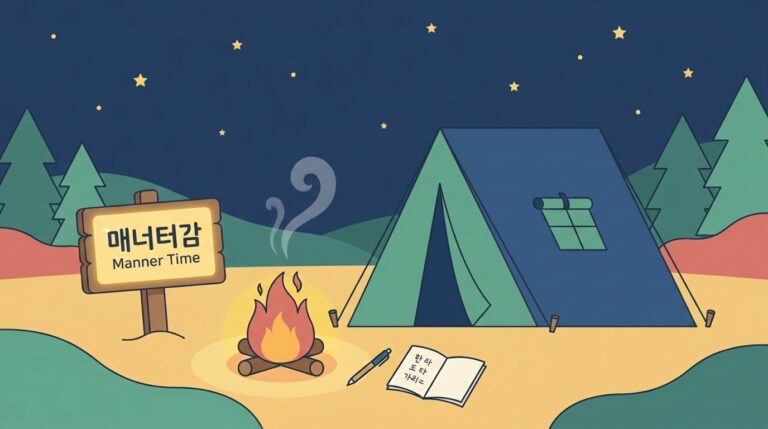
Shhh! Respecting ‘Manner Time’ (매너 타임) at Korean Campsites
Phase 1: Empathy (공감) — The Midnight Whispers
안녕하세요! It’s your friendly neighborhood Korean editor from Daily Hangul (매일한글)!
Imagine this: You’ve set up your perfect tent under the starlit sky of Gangwon-do. The air is crisp, the Bulmeong (불멍 – fire-staring) is incredibly relaxing, and you are sipping a warm cup of instant ramyeon. Suddenly, the clock strikes 10:00 PM. A serene hush falls over the entire campsite. No loud music, no roaring laughter—just the gentle crackle of dying embers.
Welcome to Manner Time (매너 타임), one of the most sacred unwritten (and often written!) rules of Korean camping culture.
As camping has exploded in popularity across Korea, keeping the peace during quiet hours has become the ultimate test of camping etiquette. If you’ve ever worried about accidentally being “that loud foreigner” or struggled with how to politely ask neighboring campers to lower their voices, you are in the right place. Based on real-world feedback from our intermediate learners, this guide will equip you with natural, polite B2-level phrases to navigate campsite etiquette like a true local.
Phase 2: Key Expressions Deep Dive (핵심 표현 3선)
1. 매너 타임이 몇 시부터예요? (Ma-neo ta-im-i myeot si-bu-teo-yae-yo?)
- Pronunciation: Ma-ner (like “manner”) time-ee myeot (rhymes with “cut” but with a soft ‘t’) shi-bu-teo-yeo-yo?
- Meaning: “What time does Manner Time start?”
- K-Culture Moment: You will hear this expression the second you check in at any trendy campsite in Gapyeong or Taean. The camp manager will point to a sign and explain the rules.
- Editor’s Insight: While “quiet hours” is the global term, Koreans Konglish-ified it into 매너 타임 (Manner Time). It carries a psychological nuance: asking this shows you are a thoughtful, respectful guest who values collective harmony.
- Situation Spectrum: Casual (✅) | Semi-formal (✅) | Formal (⚠️)
- 🤔 Think About It: How does your home country’s camping etiquette differ from Korea’s highly structured “Manner Time”?
2. 조금만 목소리를 낮춰 주실 수 있을까요? (Jo-geum-man mok-so-ri-reul nat-chwo ju-sil su isseul-kka-yo?)
- Pronunciation: Jo-geum-man (soft ‘j’) mok-so-ri-reul nat-chwo (like “not-chwo”) ju-shil su eet-seul-kka-yo?
- Meaning: “Could you lower your voice just a little bit, please?”
- K-Culture Moment: It’s 11:30 PM. Your tent neighbors are still happily playing a drinking game. Instead of confronting them aggressively, you zip open your tent and deliver this ultra-polite request.
- Editor’s Insight: The key word here is 조금만 (just a little). Even if they are being very loud, saying “just a little” softens the blow, saving their * 체면 (face/honor) while getting your point across effectively.
- Situation Spectrum: Casual (⚠️) | Semi-formal (✅) | Formal (✅)
- 🤔 Think About It: Why does Korean culture place such a heavy emphasis on softening requests with words like “just” or “a little bit”?
3. 소란스럽게 해서 죄송합니다. (So-ran-seureop-ge hae-seo joe-song-ham-ni-da.)
- Pronunciation: So-ran-seu-reop-gae hae-seo jway-song-ham-nee-da.
- Meaning: “I apologize for causing a disturbance / being noisy.”
- K-Culture Moment: You didn’t realize how much your laughter echoed through the valley. A camp manager or neighbor gently knocks on your tent pole. This is your immediate, graceful go-to response.
- Editor’s Insight: 소란스럽다 means to be noisy, bustling, or disruptive. Using this instead of a simple “sorry” shows a high-level command of Korean social manners and sincere accountability.
- Situation Spectrum: Casual (🚫) | Semi-formal (✅) | Formal (✅)
- 🤔 Think About It: In your culture, is it common to apologize directly to neighbors, or do you prefer going through a property manager?
Phase 3: Textbook Korean vs. Real Korean (교과서 vs. 진짜 한국어)
Situation A: Telling your friend to quiet down because it’s past 10 PM.
- 📖 Textbook: 조용히 하세요. 이제 밤입니다. (Jo-yong-hi ha-se-yo. I-je bam-im-ni-da.) – “Be quiet. It is night now.” (Sounds like a strict school teacher!)
- 🗣️ Real Korean: 이제 매너 타임이니까 소리 좀 줄이자. (I-je ma-neo ta-im-i-ni-kka so-ri jom ju-ri-ja.) – “It’s Manner Time now, so let’s quiet down a bit.”
- 💡 Why the difference? Real friends use
-니까(since/because) to explain the reason naturally and the friendly suggestion form-자(let’s) to maintain a warm vibe.
Situation B: Asking the campsite manager if you can still use the campfire.
- 📖 Textbook: 불을 계속 피워도 됩니까? (Bu-reul gye-sok pi-wo-do doem-ni-kka?) – “Is it permissible to keep the fire going?” (Way too formal and rigid.)
- 🗣️ Real Korean: 혹시 지금 장작 더 태워도 돼요? (Hok-si ji-geum jang-jak deo tae-wo-do dwae-yo?) – “By any chance, is it okay if we burn some more firewood now?”
- 💡 Why the difference? 혹시 (by any chance) is the ultimate politeness lubricant in Korean. Using 장작을 태우다 (burn firewood) is also much more natural than the textbook “피우다”.
Phase 4: K-Culture Deep Dive & Non-Verbal Manners
4-1. Nunchi (눈치) & Body Language
When asking someone to lower their voice, how you stand is just as important as what you say.
* The Head Tilt & Hand Rub: Tilt your head slightly (about 15 degrees) to show hesitation. Rub your hands together or clasp them gently in front of your waist. This body language signals, “I hate to bother you, but…” and immediately lowers the tension.
* Eye Contact: Avoid glaring directly into their eyes. Soften your gaze and look slightly to the side to avoid looking confrontational.
4-2. The
Frequently Asked Questions (FAQ)
Q: What does "매너 타임이 몇 시부터예요? (Ma-neo ta-im-i myeot si-bu-teo-yae-yo?)" mean in Korean and how do you pronounce it?
A: In Korean, "매너 타임이 몇 시부터예요? (Ma-neo ta-im-i myeot si-bu-teo-yae-yo?)" is pronounced [Ma-ner (like "manner"] and means: "What time does Manner Time start?"
Q: What does "조금만 목소리를 낮춰 주실 수 있을까요? (Jo-geum-man mok-so-ri-reul nat-chwo ju-sil su isseul-kka-yo?)" mean in Korean and how do you pronounce it?
A: In Korean, "조금만 목소리를 낮춰 주실 수 있을까요? (Jo-geum-man mok-so-ri-reul nat-chwo ju-sil su isseul-kka-yo?)" is pronounced [Jo-geum-man (soft 'j'] and means: "Could you lower your voice just a little bit, please?"
Q: What does "소란스럽게 해서 죄송합니다. (So-ran-seureop-ge hae-seo joe-song-ham-ni-da.)" mean in Korean and how do you pronounce it?
A: In Korean, "소란스럽게 해서 죄송합니다. (So-ran-seureop-ge hae-seo joe-song-ham-ni-da.)" is pronounced [So-ran-seu-reop-gae hae-seo jway-song-ham-nee-da.] and means: "I apologize for causing a disturbance / being noisy."







