

Master the Art of Korean Glamping: How to Respect ‘Manner Time’ Like a Local
Phase 1: Empathy (Welcome to the Daily Hangul Campfire!)
안녕하세요! (Annyeonghaseyo!) Welcome back to Daily Hangul, your cozy corner for mastering real-world Korean and culture. I’m your resident culture navigator.
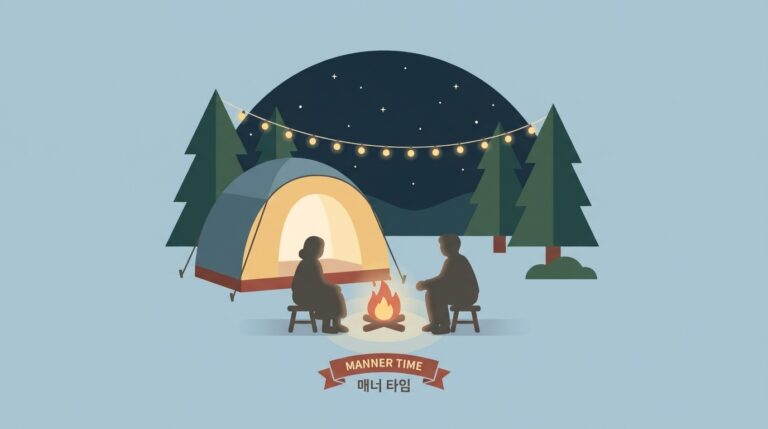
Picture this: You’ve booked a breathtaking dome-shaped luxury glamping site in Gapyeong (가평). The air is crisp, the barbecue was perfect, and you are staring up at a sky full of stars. But as night falls, you notice a sudden shift. The roaring laughter from the adjacent tents drops to a whisper. It’s 10:00 PM.
In Korea, this is the sacred ‘매너 타임’ (Manner Time).
Many intermediate and advanced learners tell me they feel incredibly anxious during Korean glamping trips. They ask: “How do I politely ask my neighbors to keep it down without sounding like a party pooper?” or “What are the exact words to show my host that I respect their quiet hours?” Today, we are unlocking the sophisticated C1-level Korean phrases and cultural nuances you need to navigate these exact social tightropes with grace, empathy, and absolute confidence.
Phase 2: Deep-Dive Into the Top 3 Premium Expressions
At the C1 level, we move beyond simple commands like “조용히 하세요” (Be quiet). We use indirect, socially intelligent framing.
1. 매너 타임이라 이제 슬슬 목소리를 낮춰야 할 것 같아요 (한글)
- Pronunciation: Maeneotaim-ira ije seul-seul moksorireul natchweoya hal geot gat-atyo (Sounds like: “Mae-nuh-time-ee-rah ee-jeh seul-seul mok-so-ree-reul naht-chwo-yah hahl guht gaht-ah-yo”)
- Meaning: “Since it’s Manner Time, I think we should gradually lower our voices.”
- K-Culture Moment: In the healing travel variety show In the SOOP, you often see the cast naturally whispering to one another as midnight approaches, using soft hedges like “슬슬” (gradually/slowly) to avoid sounding bossy.
- Editor’s Insight: The magic word here is 슬슬 (seul-seul). It softens the transition and makes your suggestion feel cooperative rather than demanding.
- Situation Spectrum: Casual ✅ | Semi-formal ✅ | Formal ⚠️
- 🤔 Think About It: Why does Korean culture value indirect suggestions (e.g., “~할 것 같아요” / “It seems like…”) over direct commands when enforcing group boundaries?
2. 주변 텐트에 방해되지 않게 도란도란 얘기 나눠요 (한글)
- Pronunciation: Jubyeon tenteue banghaedeji an-ge doran-doran yaegi nanyeoyo (Sounds like: “Joo-byun ten-teu-eh bahng-hae-de-jee ahn-gae doh-rahn-doh-rahn yae-ghee nah-nwo-yo”)
- Meaning: “Let’s chat quietly and cozily so we don’t disturb the neighboring tents.”
- K-Culture Moment: This is a classic phrase you’ll find on the aesthetic signage of luxury glamping sites in Gangwon-do, promoting a serene, communal ambiance.
- Editor’s Insight: 도란도란 (doran-doran) is a beautiful Korean mimetic word (의태어) that describes a close group of people whispering and chatting happily in a low, warm tone.
- Situation Spectrum: Casual ✅ | Semi-formal ✅ | Formal 🚫
- 🤔 Think About It: How does using warm, sensory words like doran-doran completely change the emotional temperature of a rule or restriction?
3. 혹시 소리가 너무 크게 새어 나가면 편하게 말씀해 주세요 (한글)
- Pronunciation: Hoksi soriga neomu keuge saeeo nagamyon pyeonhage malsseumhae juseyo (Sounds like: “Hok-shee soh-ree-gah nuh-moo keu-gae sae-uh nah-gah-myuhn pyuhn-hah-gae mahl-sseum-hae joo-seh-yo”)
- Meaning: “If our voices happen to carry too much, please feel free to let us know.”
- K-Culture Moment: A polite camper says this to their campsite neighbor right after checking in, paving the way for mutual respect before any issue even arises.
- Editor’s Insight: Using the word 새어 나가다 (saeeo nagada – to leak out) shows high linguistic maturity, treating sound as an accidental liquid spill rather than an aggressive noise.
- Situation Spectrum: Casual ⚠️ | Semi-formal ✅ | Formal ✅
- 🤔 Think About It: How does preemptively offering this boundary show the Korean concept of Nunchi (social sensing)?
Phase 3: Textbook Korean vs. Real-World Korean
Scenario 1: Asking your friends to be quieter at night
- 📖 Textbook Korean: “시끄러우니 조용히 해 주세요.” (Sikkeureouni joyonghi hae juseyo. – “Because it is loud, please be quiet.”)
- 🗣️ Real-World Korean: “우리 목소리 조금만 깔까? 옆 텐트에 다 들릴 것 같아.” (Uri moksori jogeumman kkalka? Yeop tenteue da deullil geot gata. – “Should we lower our voices a bit? I think the next tent can hear everything.”)
- 💡 Why the Difference? “조용히 해 주세요” sounds like a teacher lecturing a student. In real life, saying “목소리를 깔다” (literally: to lay down/lower one’s voice) is a trendy, highly natural slang phrase used among peers to keep things chill.
Scenario 2: Politely asking a noisy neighbor to keep it down
- 📖 Textbook Korean: “떠들지 마세요. 매너 타임입니다.” (Teodeulji maseyo. Maeneotaim-imnida. – “Do not make noise. It is Manner Time.”)
- 🗣️ Real-World Korean: “실례지만 매너 타임이라 조금만 살살 말씀해 주실 수 있을까요?” (Sillyejiman maeneotaim-ira jogeumman salsal malsseumhae jusil su isseulkkayo? – “Excuse me, but since it’s Manner Time, would you mind speaking just a little softer?”)
- 💡 Why the Difference? Direct prohibitions cause immediate defensive reactions. Using “살살” (softly/gently) makes the request incredibly polite and impossible to get angry at.
Phase 4: K-Culture Deep-Dive & Non-Verbal Manners
4-1. The Body Language of Korean Respect
- The Head Tilt (목례): When making a request or giving a friendly warning at a campsite, tilt your head slightly (about 15 degrees) while clasping your hands in front of you. This physical softening completely defuses potential conflict.
- The Whispering Palm: When telling your group to quiet down, gently cup your hand near your mouth as you say “쉿” (shh) or “목소리 깔자” to emphasize that you are actively keeping a secret from the surrounding forest.
4-2. The Glamping Subculture in South Korea
Glamping (글램핑) in Korea is not just camping; it is an aesthetic movement. Search the hashtag #글램핑 on Instagram, and you’ll see fairy lights, custom fire-pit setups (불멍 – bulmeong, staring at the fire), and high-end outdoor cookery (e.g., grilled pork belly paired with premium makgeolli). Because these campsites are densely designed to optimize mountain views, sound travels fast. “Manner Time” (usually starting between 10:00 PM and 11:00 PM) is heavily enforced by camp managers to preserve this romantic, quiet escape. Violating it is considered a massive social faux pas.
Phase 5: Real-World Roleplay Scenario
Setting: A luxurious, star-lit glamping resort in Gapyeong. You are sitting outside your tent around a dying fire with your camp neighbor, Min-ho (민호), who is starting to speak a little too loudly after a few drinks.
Characters:
* You (C1 Korean Expert)
* Min-ho (민호 – Friendly but enthusiastic neighbor)
Dialogue
- 민호: “아, 진짜 오늘 별 대박이다! 기분 너무 좋은데 맥주 한 캔 더 마실래요?”
(Ah, jinjja oneul byeol daebak-ida! Gibun neomu joeunde maekju han kaen deo masillae-yo?)
“Wow, the stars are insane tonight! I’m in such a great mood, do you want to have another beer?” -
You: “(Smile and nod) 좋죠! 저도 정말 힐링되네요. 그런데 벌써 10시가 넘었네요?”
(Jochyo! Jeodo jeongmal hilling-doeneyo. Geureonde beolsseo yeol-siga neomeonneyo?)
“I’d love to! I’m really healing too. By the way, is it already past 10 o’clock?” -
민호: “벌써요? 시간 진짜 빠르네. 음악 볼륨 조금 더 키울까요?”
(Beolsseoyo? Sigan jinjja pparene. Eumak bollyum jogeum deo kiulkkayo?)
“Already? Time flies. Should I turn up the music volume a bit more?” -
You: “🎭 (Gently waving hands) 아, 음악은 그대로 두는 게 좋을 것 같아요. 매너 타임이라 이제 슬슬 목소리도 낮춰야 할 것 같고요.”
(Ah, eumag-eun geudaero duneun ge joeul geot gat-atyo. Maeneotaim-ira ije seul-seul moksorido natchweoya hal geot gatgoyo.)
“🎭 (Gently waving hands) Ah, I think it might be better to keep the music as it is. Since it’s Manner Time, I think we should probably start lowering our voices too.” -
민호: “아! 맞다, 여기 매너 타임이 있었죠? 제가 분위기에 취해 깜빡했네요.”
(Ah! Matda, yeogi maeneotaim-i isseotjyo? Jega bunwigie chwihae kkamppakhaenneyo.)
“Ah! That’s right, there was Manner Time here, wasn’t there? I totally forgot, getting carried away by the vibe.” -
You: “괜찮아요, 원래 캠핑 오면 다 그렇죠. 우리 소리 안 새어 나가게 도란도란 얘기 나눠요.”
(Gwaenchanayo, wonlae kaemping omyeon da geureotjyo. Uri sori an saeeo nagage doran-doran yaegi nanyeoyo.)
“No worries, everyone gets like that when camping. Let’s chat quietly so our voices don’t leak out.” -
민호: “네, 그래요. 블루투스 스피커는 아예 끌게요. 배려해 주셔서 감사해요!”
(Ne, geuraeyo. Beullutuseu seupikeoneun aye kkeulgeyo. Baeryeohae jusyeoseo gamsahaeyo!)
“Yes, let’s do that. I’ll turn off the Bluetooth speaker entirely. Thank you for being so considerate!” -
You: “아니에요, 말씀 잘 이해해 주셔서 제가 더 감사하죠. 자, 짠 할까요?”
(Anieyo, malsseum jal ihaehae jusyeoseo jega deo gamsahajyo. Ja, jjan halkkayo?)
“Not at all, I’m more grateful that you understood so well. Shall we clink our cans?”
🔀 Interactive Choice Point
Min-ho’s speaker suddenly plays a loud notification sound. How do you respond?
- A: “여기 전세 낸 거 아니잖아요. 소리 좀 줄여주세요.”
- Feedback: Bad (⚠️ Risk of conflict). This means “You didn’t rent this whole place. Turn down the sound.” It is highly aggressive and will instantly ruin the camp vibe.
- B: “어머, 깜짝이야! 민호 씨, 스피커 진동으로 바꾸셔야겠어요~ (웃음)”
- Feedback: Best (😊 Smooth and witty). This means “Oh, you startled me! Min-ho, you should probably switch your speaker to vibrate~ (laughs).” It points out the issue playfully without being accusatory.
- C: (Ignore it and pretend you didn’t hear anything)
- Feedback: Passive (🚫 Missed opportunity). While it avoids conflict, the noise might continue to bother other campers, making you look complicit.
Phase 6: 10-Second Emotion Shadowing Drill
Train your vocal muscles to sound warm, polite, and natural. Pay attention to the pauses (/) and emotional cues!
[😊 Softly and considerately]- 매너 타임이라 / 이제 슬슬 / 목소리 낮춰야 할 것 같아요.
- Maeneotaim-ira / ije seul-seul / moksori natchweoya hal geot gat-atyo.
[🥺 Warmly and whispering]- 주변 텐트에 / 방해되지 않게 / 도란도란 얘기해요 우리.
- Jubyeon tenteue / banghaedeji an-ge / doran-doran yaegi-haeyo uri.
[🙏 Politely setting boundaries]- 혹시 소리가 / 너무 크게 새어 나가면 / 말씀해 주세요.
- Hoksi soriga / neomu keuge saeeo nagamyon / malsseumhae juseyo.
Phase 7: K-Culture Mini-Dictionary
- 불멍 (Bul-meong): Fire-gazing. The act of staring into a campfire blankly to clear your mind. A core healing ritual of Korean camping.
- 소확행 (So-hwak-haeng): Small but certain happiness. Used to describe cozy moments like eating instant ramen inside a warm glamping tent while listening to the rain.
- 캠린이 (Kaem-rini): Camping beginner. A combination of “Camping” and “Eorini” (child). Often used to excuse minor mistakes made by beginners.
- 힐링 (Hilling): Healing. Used constantly in Korea to describe mental rejuvenation, nature escapes, and peaceful social gatherings.
- 매너 타임 (Maeneotaim): Manner Time. The designated quiet hours (usually 10 PM to 7 AM) enforced at Korean campsites to ensure all guests get undisturbed rest.
Phase 8: The Traveler’s Survival Kit
Survival Phrases for Glamping
- “사장님, 장작 추가할 수 있을까요?” (Sajangnim, jangjak chugahal su isseulkkayo?)
- “Manager, could we buy some more firewood?”
- “혹시 개수대 온수 잘 나오나요?” (Hoksi gaesudae onsu jal naonayo?)
- “Excuse me, does the shared sink have hot water?”
- “음쓰(음식물 쓰레기)는 어디에 버려야 해요?” (Eumsseuneun eodie beoryeoya haeyo?)
- “Where should I throw away food waste?”
💡 Editor’s Travel Note:
To secure the most aesthetic and peaceful glamping spots in Korea, download the 네이버 지도 (Naver Map App) or check bookings on 야놀자 (Yanolja). Make sure to double-check the ‘매너 타임’ policy listed on their notice boards upon arrival!
Phase 9: “Going Deeper” (Reflections on Korean Collectivism)
At the heart of the Korean “Manner Time” (매너 타임) lies the deep-seated cultural value of 배려 (Baeryeo – consideration for others) and 눈치 (Nunchi). Korean society operates heavily on collective harmony. A campsite is viewed not just as a private rented space, but as a shared temporary village. When you proactively lower your voice, you are communicating: “I care about your peaceful night as much as mine.” It’s a beautiful, quiet contract of mutual respect.
💬 Your Turn: Does your country have a strict concept like “Manner Time” at campsites, or is it more casual? Tell us in the comments below!
Phase 10: FAQ & Common Mistakes
Q: Can I play low-volume music during Manner Time?
A: Generally, no. Even low-frequency bass can easily vibrate through thin tent walls. It is highly recommended to use headphones or turn off speakers entirely after 10:00 PM.
Q: Is it okay to use the shared shower facilities during Manner Time?
A: Many luxury glamping sites lock communal shower rooms or request no usage during Manner Time due to water pipe noises. It is best to wash up before 10:00 PM.
Q: What should I do if a neighboring tent is extremely loud past midnight?
A: Do not confront them aggressively. The safest and most polite method is to text or call the campsite host (사장님) and let them handle the situation.
🚨 Common Mistakes Warning Board
- Mistake: Yelling “조용히 하세요!” (Be quiet!) across the camp.
- Correct Action: Walk over politely and use: “죄송한데 매너 타임이라 조금만 조용히 해주실 수 있을까요?”
- Mistake: Leaving trash outside the tent overnight, hoping to clean it in the morning.
- Correct Action: Wild stray cats (길고양이) will rip open the bags at night, creating noise and mess. Always tie up and store your trash properly before sleeping.
Phase 11: Action Missions for C1 Learners
- 🥉 Bronze Mission: Practice saying “도란도란 얘기 나눠요” 5 times in front of the mirror using a warm, whispering tone.
- 🥈 Silver Mission: Write a mock Instagram caption in Korean using the terms #글램핑, #불멍, and #매너타임 to describe your dream camping trip.
- 🥇 Gold Mission: Next time you visit a Korean guesthouse or campsite, proactively tell the host: “매너 타임 잘 지킬게요!” (I will respect the Manner Time!) upon check-in.
Phase 12: Interactive Quiz Challenge
Q1. Which word is used to describe whispering happily in a cozy group?
- A) 시끌벅적 (Sikkeul-beok-jeok)
- B) 도란도란 (Doran-doran)
- C) 왁자지껄 (Wak-ja-ji-kkeol)
👉 Click to reveal Answer & Explanation
Correct Answer: B
도란도란 is the warm mimetic word for chatting quietly and cozily. A and C both describe very loud and chaotic environments!
Q2. Translate this phrase to Korean: “Since it’s Manner Time, I think we should start lowering our voices.”
👉 Click to reveal Answer & Explanation
Answer: “매너 타임이라 이제 슬슬 목소리를 낮춰야 할 것 같아요.”







