

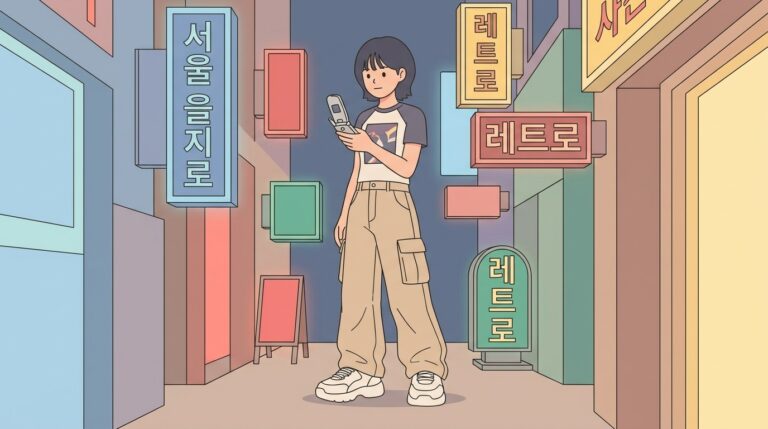
Hello, retro lovers! Welcome back to Daily Hangul!
안녕하세요! 매일한글 에디터입니다. (Annyeonghaseyo! Maeil Hangul editeorimnida.) As your trusted cultural navigator, I am absolutely thrilled to dive into today’s topic. Have you noticed how Seoul’s trendiest streets—like Seongsu-dong and Euljiro—are suddenly swimming in low-rise cargo pants, beaded phone straps, and silver headphones?
Yes, the Y2K aesthetic (세기말 감성) is back with a vengeance in Korea! But as a C2 learner, you don’t just want to say “It’s cool.” You want to articulate the deep, nostalgic yearning for an era you might not even have lived through in Korea, using the precise, sophisticated vocabulary that native trendsetters use.
Today, we are moving beyond basic textbook Korean to master the high-level, nuanced discourse of the Newtro (뉴트로) phenomenon and Y2K nostalgia (Y2K 감성). Let’s get retro!
Phase 2: Deep-Dive into 3 Essential Expressive Powerhouses
To speak like a true cultural critic, you need words that capture the exact emotional texture of Korean retro appreciation. Here are three high-level expressions analyzed in-depth.
1. 세기말 감성 (Segimal Gamseong)
- Pronunciation: Se-gi-mal Gam-seong (Think “Say-ghee-mal” + “Gam-seong” like ‘sentimental’ without the ‘al’)
- Meaning: Late-90s/Turn-of-the-century aesthetic; apocalyptic yet optimistic millennium vibes.
- K-Culture Moment: Think of NewJeans’ iconic “Ditto” music video—that lo-fi, camcorder-shot, slightly haunting high school memory aesthetic. That is the epitome of 세기말 감성.
- Editor’s Insight: 세기말 literally means “end of the century.” Combined with 감성 (sensitivity/sentiment), it refers to that unique blend of analog warmth and futuristic anxiety that characterized the years 1998–2002.
- Situation Spectrum: Casual (✅) | Semi-formal (✅) | Formal (✅ – in cultural journalism)
- 🤔 Think About It: Why does a generation born after the year 2000 feel nostalgic for an era they never experienced? How does this concept of “imagined nostalgia” exist in your native language?
2. 향수를 자극하다 (Hyangsureul Jageukhada)
- Pronunciation: Hyang-su-reul Ja-geuk-ha-da (“Hyang-su” like perfume + “reul” + “Ja-geuk” like ‘stimulate’ + “ha-da”)
- Meaning: To trigger nostalgia; to evoke a yearning for the past.
- K-Culture Moment: When K-pop groups like tripleS or NCT Dream release merchandise featuring cassette tapes and CD players, they are actively 향수를 자극하는 (triggering nostalgia in) millennials while intriguing Gen Z.
- Editor’s Insight: While 향수 (hyangsu) can mean perfume, here it represents nostalgia (鄕愁). When paired with the active verb 자극하다 (to stimulate/trigger), it elevates your speech from simple description to active cultural analysis.
- Situation Spectrum: Casual (⚠️ – a bit formal for casual banter) | Semi-formal (✅) | Formal (✅)
- 🤔 Think About It: What specific sensory trigger—a smell, a song, a brand—most violently stimulates your nostalgia (향수를 자극하나요)?
3. 온고지신 (Ongojishin)
- Pronunciation: On-go-ji-shin (“On” as in ‘on’ + “go” + “jee” + “sheen”)
- Meaning: Keeping the old while learning the new; finding new wisdom in ancient/past ways.
- K-Culture Moment: This four-character idiom (사자성어) perfectly explains how Korean designers took traditional Hanbok patterns or 90s streetwear and fused them with modern tech-wear cuts.
- Editor’s Insight: This is a C2-level classic. Utilizing Hanja-based idioms (溫故知新) in casual-intellectual discussions about pop culture shows an incredibly deep mastery of Korean philosophy applied to modern trends.
- Situation Spectrum: Casual (⚠️ – sounds playful or highly intellectual) | Semi-formal (✅) | Formal (✅)
- 🤔 Think About It: How does the balance between preserving history (온고) and innovating (지신) manifest in your country’s current fashion scene?
Phase 3: Textbook Korean vs. Real-Life Korean
Let’s refine your phrasing. Textbook Korean often sounds dry and analytical, whereas real-life trendsetters use punchy, evocative metaphors.
Situation 1: Describing a vintage item that looks cool
- 📖 Textbook: 이 옷은 옛날 스타일이라서 아주 멋집니다. (This clothing is an old style, so it is very cool.)
- 🗣️ 진짜 한국어: 와, 이 자켓 레트로 감성 장난 아니다! 완전 Y2K 그 자체야. (Wow, this jacket’s retro vibe is insane! It’s literally Y2K itself.)
- 💡 Why the difference? Saying “옛날 스타일” feels like you’re pointing at an old, dusty museum piece. Using “Y2K 그 자체” (Y2K itself) or “감성 장난 아니다” (the vibe is no joke) shows you understand the emotional currency of the trend.
Situation 2: Explaining why young people love retro
- 📖 Textbook: 젊은이들은 옛날 문화를 신선하게 생각합니다. (Young people think old culture is fresh.)
- 🗣️ 진짜 한국어: 요즘 MZ세대는 단순히 과거를 복제하는 게 아니라, ‘뉴트로’로 재해석해서 소비하더라고요. (Young people these days don’t just copy the past; they consume it by reinterpreting it as ‘Newtro’.)
- 💡 Why the difference? C2 speakers use sociological verbs like “소비하다” (to consume/embrace) and portmanteaus like “뉴트로” (New + Retro) to explain cultural movements with precision.
Phase 4: K-Culture Deep-Dive & Non-Verbal Manners
4-1. The “Cyber-Y2K” Attitude & Aesthetics
When discussing Y2K fashion in Korea, non-verbal cues matter. True retro-enthusiasts adopt a relaxed, slightly detached, yet confident posture.
* The “Peace Sign” Evolution: Instead of the standard cute peace sign, try the “Gyaru Peace” (갸루피스)—turning your hand upside down and extending it toward the camera, a classic early-2000s subculture pose resurrected by K-pop idols.
* The Eye Contact: Look slightly away from the camera, or peer over a pair of tiny, tinted rimless sunglasses. It’s all about that “cool, effortless tech-optimist” vibe of the late 90s.
4-2. Cultural Analysis: Why Korea fell in love with Y2K again
Korea’s obsession with Y2K is fundamentally tied to the “IMF Crisis” (1997) recovery period. It was a time of rapid technological explosion (the birth of PC bangs, the internet, flip phones) mixed with economic anxiety. Today’s youth, facing modern anxieties, look back at the raw, unpolished, yet colorful optimism of that digital dawn. When you talk about Y2K in Korea, you are talking about the transition from analog to digital—a sweet spot of human connection and technology.
Phase 5: Real-Life Roleplay Scenario
Setting: A hip vintage shop in Euljiro (을지로), Seoul. You are browsing rare vintage items with Min-jun, a stylish Korean friend who runs a local streetwear brand.
Characters:
- 민준 (Min-jun): A trend-sensitive fashion designer who is obsessed with late-90s Seoul aesthetics.
- You (C2 Speaker): A culturally savvy friend who can critique fashion trends using sophisticated vocabulary.
Dialogue:
- 민준: 와, 너 오늘 착장 대박이다! 완전 그 시절 세기말 테크웨어 감성인데?
(Wow, your outfit today is insane! It’s totally that turn-of-the-century techwear vibe.) -
You: 🎭 (씨긋 웃으며 선글라스를 고쳐 쓰고) 고마워! 일부러 동묘 구제시장에서 뒤져서 찾은 자켓이야. 요즘 이런 게 계속 눈에 들어오더라고.
(Thanks! I purposely dug through Dongmyo Flea Market to find this jacket. Lately, these kinds of things keep catching my eye.) -
민준: 역시 안목 있네. 이 샵도 봐봐. 사장님이 디지몬 시절 감성을 온전히 고증해 놓으셨어. 이 폴더폰 장식들 좀 봐!
(As expected, you have great taste. Look at this shop too. The owner completely reconstructed the Digimon-era aesthetic. Look at these flip-phone decorations!) -
You: 🎭 (소품을 만지며 감탄하듯) 진짜네! 이거 보니까 옛날에 걸리버폰 쓰던 생각나면서 완전 향수를 자극한다.
(Indeed! Seeing this reminds me of using those old Gulliver phones; it completely stimulates my nostalgia.) -
민준: 맞아. 요즘 애들한테는 이게 단순한 복고가 아니라 아예 새로운 ‘힙함’인 거지.
(Right. To kids these days, this isn’t just retro; it’s a completely new kind of ‘hip’.) -
You: 🎭 (고개를 끄덕이며 진지한 표정으로) 응, 전형적인 온고지신의 예시지. 과거의 촌스러움을 현대적으로 재해석해서 가장 트렌디한 문화로 만드는 거잖아.
(Yeah, it’s a textbook example of ‘Ongojishin’. Reinterpreting past tackiness in a modern way to make it the trendiest culture.) -
민준: 대박… ‘온고지신’이라는 단어를 여기서 쓰다니. 너 진짜 한국인 다 됐구나?
(Wow… using the term ‘Ongojishin’ here. You’ve really become fully Korean, haven’t you?) -
You: 🎭 (어깨를 으쓱하며 장난스럽게) 에이, 이 정도 가지고 뭘. 우리 세대의 세기말 감성은 국경을 초월하잖아!
(Oh, come on, this is nothing. Our generation’s late-90s vibe transcends borders anyway!)
🔀 Choose Your Next Move!
Scenario: Min-jun asks you, “What do you think is the ultimate Y2K item that needs a comeback?”
- A: “가로본능 폰처럼 화면이 돌아가는 가전제품이 다시 나오면 재밌을 것 같아.”
(I think it’d be fun if home appliances or electronics with rotating screens, like the Garobonning phone, came back.)
👉 Best! (C2 Level): Highly specific, culturally rich reference. “가로본능” (Horizontal Instinct) is a legendary 2004 Samsung phone. Using this shows legendary historical knowledge of Korean tech. -
B: “그냥 옛날 청바지가 최고야.”
(Just old jeans are the best.)
👉 Bad: Too simple for a C2 speaker. It drops the analytical momentum of the conversation. -
C: “싸이월드가 완전히 부활해서 전국민이 미니홈피를 다시 꾸몄으면 좋겠어.”
(I wish Cyworld would completely revive so everyone would decorate their mini-hompy again.)
👉 Risk (High Return): Excellent cultural touchstone (Cyworld was Korea’s Myspace). However, make sure you can explain “일촌평” (guestbook comments) or “도토리” (acorns/currency) if Min-jun asks follow-up questions!
Phase 6: 10-Second Emotional Shadowing Drill
To sound native, you must master the rhythm of casual intellectualism. Practice these sentences with the specified emotional undertone and pausing points (/).
- [😊 Expressing excited nostalgia]
“와 진짜 / 이 디자인 보니까 / 내 학창 시절 / 향수를 제대로 자극한다!”
(Wa jin-jja / i di-ja-in bo-ni-kka / nae hak-chang si-jeol / hyang-su-reul je-dae-ro ja-geuk-han-da!) -
[🤓 Delivering a confident cultural analysis]
“단순한 복고가 아니라 / 과거와 현재를 융합한 / 온고지신의 정석이죠.”
(Dan-sun-han bok-go-ga a-ni-ra / gwa-geo-wa hyeon-jae-reul yung-hap-han / on-go-ji-shin-ui jeong-seok-i-jyo.)
Phase 7: K-Culture Mini-Dictionary
- Y2K 감성 (Y2K Gamseong) | Turn-of-the-millennium vibe | Characterized by metallic colors, chunky sneakers, low-rise pants, and cybernetic optimism.
- 세기말 (Segimal) | End of the century | Specifically used in Korea to denote the unique aesthetic/mood of the years 1997–1999.
- 뉴트로 (Newtro) | New + Retro | A Korean portmanteau describing the trend of Gen Z reinterpreting retro elements in a modern way.
- 구제 (Guje) | Vintage/Second-hand | Usually refers to imported or vintage clothing found in traditional markets like Dongmyo or Hwanghak-dong.
Phase 8: The Traveler’s Survival Kit
Survival Expressions for Vintage Shopping:
- “이거 진짜 빈티지예요, 아니면 새 상품인데 빈티지 가공을 한 거예요?”
(Is this authentic vintage, or is it a new product with vintage processing?)
Pro Tip: Essential for distinguishing high-end curated vintage from cheap fast-fashion retro imitations. - “혹시 데드스탁(미사용 신품) 제품도 따로 모아두신 섹션이 있나요?”
(Do you happen to have a separate section for deadstock/unused new products?)
Pro Tip: Shows you are a serious collector. - “폴더폰 충전기나 젠더도 같이 구매할 수 있을까요?”
(Can I also purchase a flip phone charger or gender adapter together?)
Pro Tip: If you are buying old digital cameras or phones in Euljiro.
Editor’s Travel Note:
If you are hunting for true Y2K artifacts in Seoul, skip the mainstream malls. Take the subway to Dongmyo Flea Market (동묘앞역) or wander the hidden third-floor shops of Euljiro 3-ga (을지로3가). To navigate these maze-like vintage alleys, make sure you download the Naver Map App rather than Google Maps, which often lacks detailed pedestrian paths in old Seoul neighborhoods. Note: Store operating hours in vintage markets can be highly irregular, so check their Instagram pages before visiting.
Phase 9: “Going One Step Deeper” (Cultural Insight)
In the West, retro trends often circulate every 20 to 30 years as a natural cycle of fashion. However, in Korea, the Y2K boom is deeply connected to a collective longing for “the last era of analog intimacy.” Before smartphones homogenized our daily interactions, Korean youth culture revolved around decorating paper diaries (다꾸), sending alphanumeric pager codes (like 1004 for ‘Angel’), and taking low-res sticker photos (스티커 사진). Today’s digital natives embrace Y2K because it represents a time when technology felt like a playful toy rather than an omnipresent, anxiety-inducing necessity.
💬 Your Turn: Does your country have a specific era that youth culture is currently obsessing over? Let us know in the comments below!
Phase 10: FAQ & Common Mistakes
Q: Can I use “온고지신” to describe high-tech gadgets?
A: Yes, but only if the gadget clearly incorporates traditional design philosophies or structural elements. For example, a modern digital air purifier made to look like a traditional charcoal stove can be described as “온고지신의 멋이 있다.”
Q: What is the difference between 복고 (Bokgo) and 뉴트로 (Newtro)?
A: 복고 is pure retro—reproducing the past exactly as it was, usually targeting older generations who actually lived through it. 뉴트로 (Newtro) is the modern reinterpretation of those elements, made cool and fresh for Gen Z.
Q: Is “세기말” a negative word since it means ‘end of the world’?
A: Historically, it had a gloomy, apocalyptic nuance. However, in modern pop culture, it has been completely rebranded to mean







