

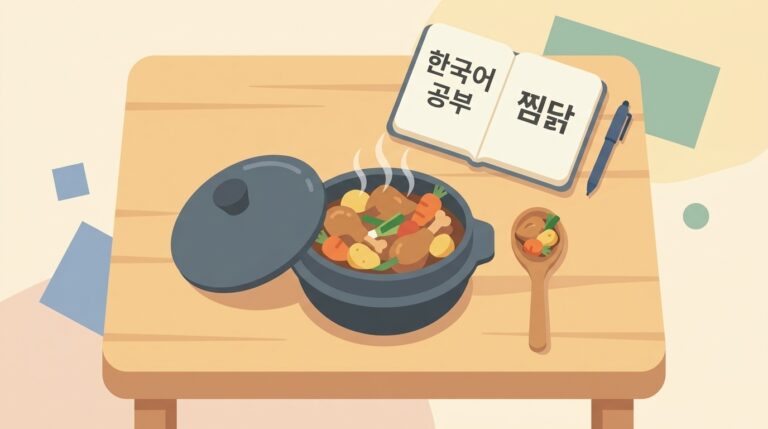
How to Talk About Korean Steamed Dishes (Jjim) Like a Local
Phase 1: Empathy (Welcome to the Warm World of Jjim!)
안녕하세요! It’s your K-culture navigator and Daily Hangul editor.
Picture this: It’s a chilly Friday evening in Seoul. You and your Korean friends are gathered around a steaming, massive metal pot of Galbi-jjim (갈비찜 – braised short ribs) or Andong Jjimdak (안동찜닭 – soy-sauce braised chicken). The rich, sweet, and savory aroma fills the air, and everyone is eagerly waiting for the glass noodles to soak up that gorgeous sauce.
You want to ask your friend how they make this magic happen at home, or maybe you want to share your own secret ingredient. But then you freeze. “Is this ‘steaming’ or ‘boiling’? What’s the difference between Jjigae (찌개) and Jjim (찜)?”
Many of our B2-level learners tell us that while they can order food easily, discussing cooking methods, textures, and sharing personal recipes feels like a steep mountain to climb.
Today, we are going to master the vocabulary of Korean “Jjim” (steamed/braised) dishes so you can confidently share recipes, talk about your culinary adventures, and sound like a seasoned Korean home cook! Let’s dive in.
Phase 2: Deep Dive into 3 Essential Expressions
1. 양념이 잘 베다 (Yang-nyeom-i jal be-da)
- Pronunciation: Yang-nyeom-i jal bae-da (Sounds like “yahng-nyum-ee jahl bay-dah”)
- Meaning: The sauce/seasoning has soaked in perfectly.
- K-Culture Moment: You’ll hear this constantly in Korean food vlogs and cooking shows like Baek Jong-won’s Baek Class. When the host takes a bite of radish from a fish jjim and sighs happily, they always praise how the sauce has “soaked in.”
- Editor’s Insight: Beda (베다/배다) means to be saturated or deeply infused. In Jjim dishes, the ultimate test of success is whether the dense ingredients (like potatoes or radish) have absorbed the sauce all the way to the core.
- Situation Spectrum: Casual (✅) | Semi-formal (✅) | Formal (⚠️ – feels a bit too casual for a culinary thesis, but perfectly fine in presentations)
- 🤔 Think About It: In English, we often say food is “well-marinated.” However, “양념이 배다” describes the state after cooking, focusing on the deep integration of flavors over time. How does your culture describe food that has fully absorbed its cooking juices?
2. 국물을 자작하게 졸이다 (Guk-mul-eul ja-jak-ha-ge jol-i-da)
- Pronunciation: Gook-mool-eul jah-jahk-hah-ge johl-ee-dah (Rhymes with “gook-mool” as in cool, and “johl-ee-dah”)
- Meaning: To simmer the broth down until it is thick and reduced.
- K-Culture Moment: This is the golden rule of any Jjim recipe. When a Korean grandmother explains her recipe, she won’t give you exact minutes; she’ll say, “Just simmer it jajakhage!”
- Editor’s Insight: Jajakhage (자작하게) is an onomatopoeic-like word describing a liquid level that is shallow—just barely covering the ingredients. Jolida (졸이다) means to boil down. Combined, it means to reduce the sauce until it’s thick, shiny, and concentrated.
- Situation Spectrum: Casual (✅) | Semi-formal (✅) | Formal (✅)
- 🤔 Think About It: Cooking in Korea is deeply sensory. Words like jajakhage rely on visual and tactile intuition rather than precise measurements. Do you prefer recipes with exact milliliters, or do you cook “by feeling” like many Korean chefs?
3. 살이 부드러워서 뼈에서 쏙 빠지다 (Sal-i bu-deu-reo-wo-seo pyeo-e-seo ssok ppa-ji-da)
- Pronunciation: Sahl-ee boo-deu-ruh-wuh-suh ppyuh-eh-suh ssawk ppah-jee-dah
- Meaning: The meat is so tender it falls right off the bone.
- K-Culture Moment: In K-Dramas, whenever a character treats someone to expensive Galbi-jjim, the ultimate compliment from the guest is making a satisfied face because the meat slid off the bone effortlessly.
- Editor’s Insight: Ssok (쏙) is an adverb indicating a smooth, clean extraction. Saying the meat comes off ssok emphasizes that the Jjim was steamed for hours with absolute patience.
- Situation Spectrum: Casual (✅) | Semi-formal (✅) | Formal (🚫 – too expressive/casual)
- 🤔 Think About It: “Falls off the bone” is a direct equivalent in English, showing that appreciation for slow-cooked, tender meat is a universal human joy!
Phase 3: Textbook Korean vs. Real-Life Korean
Situation 1: Describing how soft the food is
- 📖 Textbook: 고기가 아주 연합니다. (Go-gi-ga a-ju yeon-ham-ni-da.)
- “The meat is very tender.”
- 🗣️ Real-Life: 고기가 입에서 그냥 살살 녹아요! (Go-gi-ga ib-e-seo geu-nyang sal-sal nog-a-yo!)
- “The meat literally just melts in my mouth!”
- 💡 Why the difference? While yeon-hada (연하다) is grammatically correct, real-life Koreans prefer the highly sensory and expressive double-adverb sal-sal (살살 – gently/smoothly) with nog-a-yo (녹아요 – melts) to convey genuine culinary ecstasy.
Situation 2: Asking if the sauce has reduced enough
- 📖 Textbook: 국물이 줄어들었습니까? (Guk-mul-i jul-eo-deul-eot-seup-ni-ka?)
- “Has the broth decreased?”
- 🗣️ Real-Life: 국물이 어느 정도 졸았어요? (Guk-mul-i eo-neu jeong-do jol-at-seo-yo?)
- “Has the broth reduced to some extent?”
- 💡 Why the difference? Jol-da (졸다 – to naturally reduce through boiling) is the culinary-specific verb used by native speakers. Jul-eodeulda (줄어들다) is too general and sounds like your phone battery or water levels in a reservoir decreased.
Phase 4: K-Culture Deep Dive & Non-Verbal Manners
4-1. The “Tasting Spoon” Etiquette (숟가락 예절)
When sharing a Jjim recipe or cooking together in a Korean kitchen, you might want to taste the sauce to see if “양념이 잘 뱄는지” (if the flavor has soaked in).
* The Gesture: Never double-dip your personal spoon directly into the main cooking pot when cooking for others. Instead, scoop a tiny amount of broth with a ladle, pour it onto a small individual tasting dish (ap-jeob-si – 앞접시), or onto your spoon held away from the pot, and taste.
* The Look: Blow on it gently while looking slightly down, showing respect for the heat and the food.
4-2. The Soul of “Jjim” (찜)
Unlike western steaming which often uses pure water vapor (like steamed broccoli), Korean Jjim is actually a hybrid of steaming and slow-braising. It requires cooking ingredients with a concentrated sauce over low heat for a long time. This reflects the Korean culinary philosophy of Jeong성 (정성 – sincerity/devotion). A good Jjim cannot be rushed. Making it for someone is a sign of deep love, hospitality, and respect.
Phase 5: Real-Life Roleplay Scenario
The Setup
- Characters:
- Ji-woo (지우): Your Korean friend who is an amazing home cook.
- You (우주 – Wooju): An eager intermediate learner who wants to recreate Ji-woo’s famous Jjimdak.
The Dialogue
- 지우: (냄비 뚜껑을 열며) 우주야, 찜닭เก 거의 다 됐다! 한번 봐봐.
- Ji-woo: (Opening the pot lid) Wooju, the Jjimdak is almost done! Come take a look.
- 우주: (냄새를 맡으며 😊) 와, 냄새 대박이다! 국물이 아주 자작하게 잘 졸았네.
- Wooju: (Smelling the food 😊) Wow, the smell is amazing! The sauce has reduced so beautifully and thickly.
- 지우: 맞아. 찜닭은 국물을 자작하게 졸여야 감자랑 당면에 맛이 깊게 배거든.
- Ji-woo: Exactly. For Jjimdak, you have to reduce the sauce down so the potatoes and glass noodles absorb the deep flavor.
- 우주: (고기를 젓가락으로 떼어보며 😮) 우와, 고기가 진짜 부드러워 보여.
- Wooju: (Poking the meat with chopsticks 😮) Woah, the meat looks incredibly tender.
- 지우: (미소를 지으며) 응, 약한 불로 한 시간 넘게 푹 쪘거든. 살이 뼈에서 쏙 빠질 거야.
- Ji-woo: (Smiling) Yeah, I simmered it on low heat for over an hour. The meat will slide right off the bone.
- 우주: 역시 지우 표 레시피는 대단해! 나도 집에서 해보고 싶은데, 비법 좀 공유해줘.
- Wooju: As expected, Ji-woo’s recipe is amazing! I want to try making it at home too, please share your secret tip.
- 지우: 별거 없어! 처음에는 센 불로 끓이다가, 마지막에 약불로 줄여서 뜸을 들이는 게 포인트야.
- Ji-woo: It’s nothing special! The key is to boil it on high heat first, then reduce to low heat at the end to let it rest and steam thoroughly.
- 우주: (메모하는 시늉을 하며 ✍️) 센 불에서 약불로! 오케이, 접수 완료!
- Wooju: (Pretending to take notes ✍️) High heat to low heat! Okay, got it!
🔀 Interactive Choice Point
Now, Ji-woo asks you: “우주야, 너는 찜닭 만들 때 매콤하게 만드는 걸 좋아해? (Wooju, do you like making Jjimdak spicy?)” How do you respond?
- Option A: “네, 저는 아주 맵게 먹는 것을 선호합니다.” (I prefer eating it very spicy.)
- Option B: “응! 나는 청양고추를 넣어서 칼칼하게 만드는 게 좋더라.” (Yeah! I like putting in Cheongyang chili peppers to make it sharp and spicy.)
- Option C: “매운 것 싫어요. 단맛이 좋습니다.” (I dislike spicy things. Sweet taste is good.)
Feedback on Your Choice:
- Option A (Risk): Grammatically perfect, but too formal for a close friend like Ji-woo. It sounds like you are in a job interview!
- Option B (BEST!): Phenomenal! Using 칼칼하게 (kal-kal-ha-ge – sharp, refreshing spiciness) and referencing 청양고추 (Korea’s spicy chili pepper) makes you sound incredibly natural and culturally fluent.
- Option C (Bad): A bit too blunt and grammatically unnatural. Instead, try: “나는 매운 것보다 단짠단짠한(sweet and salty) 맛이 더 좋더라고!”
Phase 6: 10-Second Emotion Shadowing Drill
To master the natural rhythm, practice saying these with the specified pauses (/) and emotions.
- [😊 Highly Excited & Impressed]
- Sentence: 와! / 국물이 / 진짜 / 자작하게 / 잘 졸았다!
- Romanization: Wa! / Guk-mul-i / jin-jja / ja-jak-ha-ge / jal jol-at-da!
- Guide: Emphasize “진짜” (jin-jja) and drop your tone slightly on “잘 졸았다” to sound satisfied.
- [🥺 Mind-blown by Soft Texture]
- Sentence: 고기가 / 부드러워서 / 뼈에서 / 쏙 / 빠져요!
- Romanization: Go-gi-ga / bu-deu-reo-wo-seo / pyeo-e-seo / ssok / ppa-jyeo-yo!
- Guide: Put a tiny, cute pop of air on “쏙” (ssok) to mimic the sound of meat sliding off the bone.
Phase 7: K-Culture Mini Dictionary
- 단짠단짠 (Dan-jjan-dan-jjan) | Sweet and Salty
- The ultimate flavor profile of Korean Jjim dishes. It describes the addictive loop of tasting something sweet, then salty, then sweet again.
- 뜸 들이다 (Tteum deul-i-da) | To let food sit and steam in its own residual heat
- A crucial step in Korean cooking (rice, stew, jjim) where you turn off the heat and let the steam finish the cooking. Metaphorically, it also means “to stall for time” or “drag your feet.”
- 칼칼하다 (Kal-kal-ha-da) | Crisp, sharp, and throat-tickling spiciness
- Unlike heavy, thick heat, this describes a clean, refreshing spiciness usually achieved with fresh chili peppers or red pepper flakes in a broth.
- 납작당면 (Nap-jak dang-myeon) | Flat glass noodles
- The flat version of sweet potato starch noodles. It is extremely popular in Jjimdak because it has a chewier texture (쫄깃한 식감) and absorbs the sauce beautifully.
Phase 8: Traveler’s Survival Kit
Survival Phrases for Jjim Lovers
- “양념이 너무 맛있는데, 사리 추가 되나요?”
- Yang-nyeom-i neo-mu ma-sit-neun-de, sa-ri chu-ga doe-na-yo?
- “The sauce is delicious, can I add extra noodles/toppings?”
- “남은 국물에 밥 볶아 주실 수 있나요?”
- Nam-eun guk-mul-e bap bok-a ju-sil su in-na-yo?
- “Could you fry rice in the remaining sauce?” (The ultimate finale of eating Jjim!)
- “덜 맵게 해주실 수 있어요?”
- Deol maep-ge hae-ju-sil su it-eo-yo?
- “Can you make it less spicy, please?”
📍 Editor’s Travel Note
When hunting down the best Jjimdak or Galbijjim in Seoul, skip the generic tourist spots. Download the Naver Map App (네이버 지도) and search for words like “소갈비찜 맛집” (beef short rib jjim specialty restaurant) or “로컬 찜닭” (local jjimdak).
Disclaimer: Prices and seat availability change rapidly, so checking recent Naver reviews from local Koreans is highly recommended before visiting.
Phase 9: Go One Step Deeper (Reflection)
In Korean culture, food is rarely an individual affair; it is an act of communion. Jjim dishes, in particular, are served in large communal pots placed in the center of the table. Sharing a Jjim means sharing the same heat, watching the sauce reduce together, and negotiating who gets the last piece of potato or tender rib. This “one-pot” dining style reinforces the Korean sense of Jeong (정 – affection, bonding). It is a delicious reminder that in Korea, eating is a shared journey, not just fuel.
💬 Your Turn: Have you ever cooked or eaten a Korean Jjim dish? What is your favorite comfort food that requires slow cooking? Let us know in the comments below!
Phase 10: FAQ & Avoiding Common Mistakes
Q: What is the difference between Jjim (찜) and 조림 (Jorim)?
A: Excellent question! While both involve simmered-down sauces, Jjim (찜) historically focuses on steaming or slow-cooking thick cuts of meat or heavy ingredients under a closed lid to trap steam. Jorim (조림), like Galu-jorim (braised tofu), involves simmering ingredients in a sauce without necessarily aiming for that tender, fall-off-the-bone steamed texture.
Q: Can I use “줄어들다” to describe the sauce boiling down?
A: It’s better to avoid it. While grammatically correct for “decrease,” using 졸다 (to reduce by boiling) or 졸이다 (to active boil down) is the natural culinary lingo. Saying “국물이 줄어들었다” sounds like the soup magically disappeared, whereas “국물이 졸았다” sounds delicious.
Q: Is Jjimdak always spicy?
A: Traditional Andong Jjimdak has a subtle, sharp kick from dried red peppers (건고추). If you cannot eat spicy food, always ask for “안 맵게” (an maep-ge – not spicy) when ordering.
🚨 Common Mistakes Warning Board
- Mistaking 찜 (Jjim) for 찌개 (Jjigae):
- Wrong: “갈비찌개 먹으러 가요.”
- Correct: “갈비찜 먹으러 가요.” (Jjigae is a stew with lots of broth; Jjim is thick and reduced.)
- Using “싱겁다” (bland) when you mean “not spicy”:
- If you want it non-spicy, say “안 매워요”. Saying “싱거워요” means the dish lacks salt/soy sauce altogether.
Phase 11: Action Mission & Engagement
- 🥉 Bronze Level: Go to a Korean recipe video on YouTube (like Paik’s Cuisine) and type in the comments: “국물이 정말 자작하네요!” (The broth is so wonderfully reduced!)
- 🥈 Silver Level: Take a photo of your next slow-cooked meal, post it on Instagram, and tag us with the caption: “양념이 잘 뱄어요! 😋”
- 🥇 Gold Level: Go to a local Korean restaurant, order a Jjim dish, and politely ask the server: “남은 국물에 밥 볶아 먹을 수 있나요?”
🎮 K-Culture Mission
Watch a food-themed K-Drama (like Let’s Eat or Itaewon Class). Spot a scene where characters eat a steamed dish. Listen closely: did they use the word “부드럽다” (soft/tender) or mention “양념” (sauce)?
Phase 12: Interactive Quiz Challenge
Test your intermediate Korean culinary wits!
1. Which word best describes a sauce that has reduced beautifully and thickly?
- A) 싱겁게 (sing-geop-ge)
- B) 자작하게 (ja-jak-ha-ge)
- C) 연하게 (yeon-ha-ge)
2. Fill in the blank: “고기가 너무 부드러워서 뼈에서 ___ 빠져요!”
- A) 쏙 (ssok)
- B) 펄펄 (peol-peol)
- C) 꽉 (kkwak)
3. True or False: In Korea, it is considered polite to double-dip your spoon into the communal Jjim pot to test the flavor for everyone.
- True / False
🎉 Click here to reveal the Answers & Explanations!
- Answer: B) 자작하게
- Explanation: Jajakhage is the perfect adverb for a shallow, nicely reduced sauce. A means blandly, and C means softly/weakly.
- Answer: A) 쏙
- Explanation: Ssok (쏙) is the magic adverb for something sliding out smoothly and cleanly. B means boiling vigorously, and C means tightly.
- Answer: False
- Explanation: Always use a ladle to scoop broth onto an individual plate (ap-jeob-si) first to maintain hygiene and respect your dining partners!
- Explanation: Always use a ladle to scoop broth onto an individual plate (ap-jeob-si) first to maintain hygiene and respect your dining partners!







