

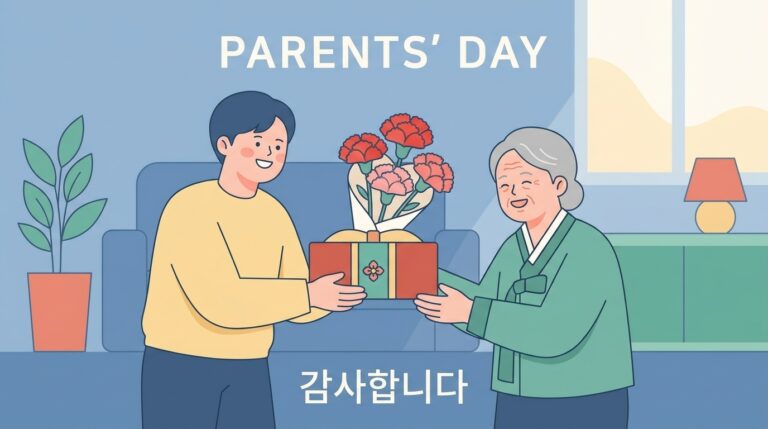
Hello, Daily Hangul Family! 🌸
Imagine this: You are invited to your Korean friend’s house, or you want to show appreciation to your Korean partner’s parents on May 8th—Parents’ Day (어버이날 – Eobeoinal). You want to give a gift, but your hands are sweating. What do I say? How do I present the gift without looking rude?
Don’t worry! Your Korean bestie is here to help. Today, we are going to learn super easy, polite, and heartwarming Korean expressions for giving gifts to parents or elders. You don’t need complicated grammar; even at the A1 level, you can touch their hearts! Let’s dive in! 🚀
Phase 2: Key Expressions for Parents’ Day
1. 감사합니다 (Gamsahamnida)
- Pronunciation: Gahm-sah-hahm-nee-dah (Sounds like “calm-saw-ham-knee-dah”)
- Meaning: Thank you.
- K-Culture Moment: You see this in every K-Drama when a character receives a warm bowl of soup from an elder. It is the absolute gold standard of politeness.
- Editor’s Insight: Even if you know no other Korean, this word shows instant respect. Say it with a slight bow!
- Situation Spectrum: Casual 🚫 | Semi-formal ✅ | Formal ✅
- 🤔 Think About It: Why does Korean have different levels of politeness based on age? How does your native culture show respect to elders?
2. 건강하세요 (Geonganghaseyo)
- Pronunciation: Geon-gang-ha-se-yo (Sounds like “Gun-gang-hah-say-yo”)
- Meaning: Please stay healthy / Be healthy.
- K-Culture Moment: On Parents’ Day, Korean children often write this on carnation cards. It’s the ultimate wish of love.
- Editor’s Insight: In Western cultures, wishing health might sound like you think someone is ill. In Korea, it is a proactive wish for a long, happy life!
- Situation Spectrum: Casual 🚫 | Semi-formal ✅ | Formal ✅
- 🤔 Think About It: Is health a common gift card message in your country?
3. 선물이에요 (Seonmurieyo)
- Pronunciation: Seon-mul-i-e-yo (Sounds like “Sun-mool-ee-ay-yo”)
- Meaning: It’s a gift.
- K-Culture Moment: Handing over a box of red ginseng or a bouquet of carnations with both hands.
- Editor’s Insight: Always hand over the gift with both hands! Giving with one hand is a major cultural faux pas.
- Situation Spectrum: Casual ⚠️ (use ‘선물이야’ for friends) | Semi-formal ✅ | Formal ✅
- 🤔 Think About It: Why do you think using two hands is so important in Korean gift-giving etiquette?
Phase 3: Textbook Korean vs. Real Korean
Let’s compare the rigid sentences from old textbooks with what Koreans actually say!
Situation 1: Giving a gift
- 📖 Textbook: 이것은 당신을 위한 선물입니다. (Igeoseun dangsineul wihan seonmulimnida – This is a gift for you.)
- 🗣️ Real Korean: 선물이에요. (Seonmurieyo. – It’s a gift.)
- 💡 Why the difference? The textbook sentence uses “당신” (dangsin), which can actually sound awkward or even confrontational in real-life speech. Just say “선물이에요” while handing it over!
Situation 2: Expressing love
- 📖 Textbook: 어머니, 아버지를 무척 사랑합니다. (Eomeoni, abeojireul mucheok saranghamnida – Mother, Father, I love you very much.)
- 🗣️ Real Korean: 엄마, 아빠, 사랑해요! (Eomma, Appa, saranghaeyo! – Mom, Dad, I love you!)
- 💡 Why the difference? Even to parents-in-law or close elders, “엄마, 아빠” (Eomma, Appa) or a soft “사랑해요” (Saranghaeyo) sounds much warmer than cold, formal terms.
Phase 4: K-Culture Deep Dive & Non-Verbal Manners
4-1. The “Two-Hand” Rule (두 손)
When giving or receiving a gift in Korea, always use both hands.
* The Gesture: Hold the gift box with both hands, palms facing slightly up.
* The Eye Contact: Give a soft smile, bow your head slightly, and make eye contact after they receive the gift.
4-2. The “Cash” Culture (용돈 박스)
Did you know? The #1 most popular gift for Parents’ Day in Korea is cash (현금)!
But you don’t just hand over bills. Koreans use beautiful “flower cash boxes” (용돈 박스 – Yongdon Box) where cash is rolled around beautiful soap carnations. It’s practical and beautiful!
Phase 5: Real-Life Roleplay Scenario
Meet Ji-min (지민), your Korean friend’s mother. You are visiting her home on Parents’ Day to deliver a small box of Korean traditional snacks (한과 – Hangwa).
- Ji-min (Mother): 어머, 어서 와요! (Eomeo, eoseo wayo!)
🎭 Smiling warmly at the door - You: 안녕하세요, 어머니. (Annyeonghaseyo, eomeoni.)
🎭 Bowing slightly - Ji-min (Mother): 날씨가 많이 덥죠? 들어와요. (Nalssiga mani deopjyo? Deureowayo.)
🎭 Inviting you in - You: 감사합니다. (Gamsahamnida.)
🎭 Taking off your shoes - You: 어머니, 이거 선물이에요. (Eomeoni, igeo seonmurieyo.)
🎭 Handing the box with both hands - Ji-min (Mother): 아이고, 뭘 이런 걸 준비했어요? 고마워요. (Aigo, mwol ireon geol junbihaessoyo? Gomawoyo.)
🎭 Surprised and happy - You: 건강하세요, 어머니! (Geonganghaseyo, eomeoni!)
🎭 Smiling brightly - Ji-min (Mother): 정말 고마워요. 맛있게 먹을게요. (Jeongmal gomawoyo. Masitge meogeulgeyo.)
🎭 Patting your shoulder
🔀 Interactive Choice!
How do you reply when she says “뭘 이런 걸 준비했어요?” (Why did you prepare this?)
* A) “별거 아니에요.” (Byeolgeo anieyo. – It’s nothing special. / It’s a small thing.)
* B) “엄청 비싼 거예요!” (Eomcheong bissan geoyeyo! – It is super expensive!)
* C) No words, just run away.
Feedback:
- Best Choice – A: “별거 아니에요” is a beautifully humble Korean way of saying “I hope you like this small gesture.”
- Risk Choice – B: Bragging about the price is considered rude and will make the recipient feel burdened.
- Bad Choice – C: Please don’t run away! They want to talk to you! 😄
Phase 6: 10-Second Emotion Shadowing Drill
Practice speaking with real Korean emotions! Pause at the / mark.
- [😊 Polite & Respectful]
안녕하세요, / 어머니. / 선물이에요.
(An-nyeong-ha-se-yo, / eo-meo-ni. / Seon-mul-i-e-yo.) -
[🥺 Warm & Heartfelt]
어머니, / 건강하세요. / 감사합니다!
(Eo-meo-ni, / geon-gang-ha-se-yo. / Gam-sa-ham-ni-da!)
Phase 7: K-Culture Mini Dictionary
- 어버이날 (Eobeoinal) | Parents’ Day (May 8th) | A day combining Mother’s and Father’s Day in Korea.
- 카네이션 (Kaneisyeon) | Carnation | The official flower of Parents’ Day, worn on the chest.
- 부모님 (Bumonim) | Parents | A respectful way to say “parents.”
- 효도 (Hyodo) | Filial Piety | The cultural concept of respecting and taking care of one’s parents.
Phase 8: Traveler’s Survival Kit
TOP 3 Survival Phrases
- 이거 어버이날 선물이에요. (Igeo eobeoinal seonmurieyo.) – This is a Parents’ Day gift.
- 카드 써주세요. (Kadeu sseojuseyo.) – Please write a card for me (when buying flowers).
- 이거 인기 많아요? (Igeo ingi manayo?) – Is this popular? (Useful when choosing gifts in a shop).
Editor’s Travel Note:
If you are in Seoul during May, check out the flower markets near Express Bus Terminal Station using the Naver Map App to find cheap, fresh carnations!
Phase 9: “Deepen Your Thoughts”
In Western cultures, gift-giving is often about individual preferences. In Korea, gifts for elders represent 효도 (Hyodo)—a deep-rooted Confucian value of showing gratitude for life and upbringing. By offering a gift with both hands and wishing them health (건강하세요), you are not just giving an item; you are participating in a beautiful, centuries-old social contract of respect.
💬 Your Turn: How do you celebrate your parents in your country? Let us know in the comments below!
Phase 10: FAQ & Common Mistakes
Q: Can I use “고마워” (Gomawo) to parents?
A: No! “고마워” is informal. Always use “감사합니다” (Gamsahamnida) or “고맙습니다” (Gomapsumnida) to show proper respect to parents and elders.
Q: Is it okay to give pocket money (cash) in a plain white envelope?
A: In Korea, white envelopes are often associated with funerals. For Parents’ Day, try to use colorful, bright envelopes, preferably with flower patterns or gold accents!
🚨 Common Mistakes Alert!
- Giving with one hand: ALWAYS use two hands! 👐
- Using “너” (You): Never say “너” to parents. Use “어머니” (Mother) or “아버님” (Father-in-law/Father).
- Opening the gift immediately: In Korea, it is polite to wait until the giver leaves before opening the gift, unless they ask you to open it now.
Phase 11: Action Mission!
- Bronze Medal: Say “감사합니다” aloud 3 times with a slight bow in front of your mirror.
- Silver Medal: Write “어머니, 건강하세요!” on a piece of paper and post it on your Instagram, tagging #DailyHangul.
- Gold Medal: Use these phrases to gift a Korean friend’s family or your partner’s parents this week!
Phase 12: Interactive Quiz Challenge!
1. Which phrase means “Please stay healthy”?
a) 감사합니다
b) 건강하세요
c) 선물이에요
2. True or False: Giving cash in a colorful envelope is a popular gift in Korea.
👉 Click to reveal Answers & Explanations!
- Answer: b) 건강하세요. (Geonganghaseyo is the wish for good health!)
- Answer: True! Cash boxes are the most beloved gift for Parents’ Day in Korea.







