

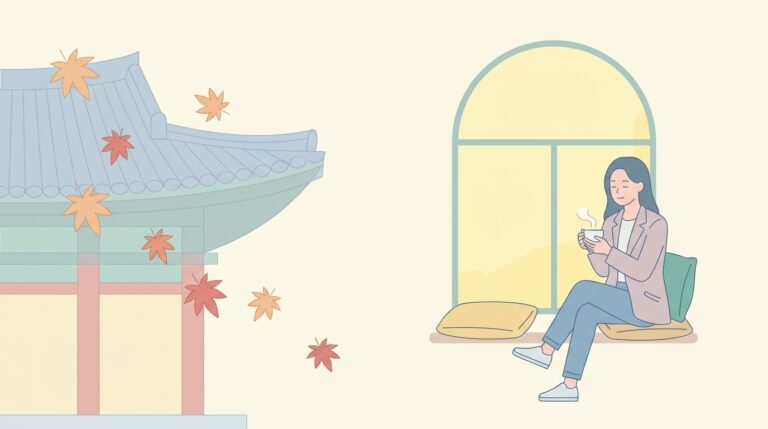
Decoding South Korea’s Silent Temples: Exploring the Secularization Shift (탈종교화) in C2 Korean
안녕하세요! Welcome back, language adventurers! It’s your K-culture navigator and chief editor at Daily Hangul (매일한글). Have you ever noticed while watching your favorite K-dramas that while older generations are often depicted praying at Buddhist temples or attending early morning church services, the younger characters are usually seen visiting tarot cafes in Hongdae or discussing their MBTI personality types over a matcha latte?
This isn’t just a creative choice by scriptwriters; it reflects a massive social shift in Korea. Today, we’re diving into a high-level, intellectually stimulating topic suited for our C2-level scholars: The rise of secularization (탈종교화) and the decline of the religious population in South Korea. We’ll master sophisticated vocabulary, dissect the cultural nuances of “faith without institutional ties,” and practice real-world discussions that will make you sound like a native sociologist over coffee.
Phase 2: Key Expressions for Advanced Discourse
1. 탈종교화 (Tal-jong-gyo-hwa)
- Pronunciation: [Tal-jong-gyo-hwa] (Sounds like tahl-jong-gyoh-wah)
- Meaning: Secularization / De-religionization (The societal shift away from organized religion)
- K-Culture Moment: You will hear this term in deep-dive documentaries like SBS Special or read it in editorials discussing why twenty-somethings are leaving traditional institutions.
- Editor’s Insight: The prefix ‘탈-‘ (tal) means “escape” or “departure.” Combining it with ‘종교’ (religion) and ‘화’ (process of becoming) creates a powerful sociological noun. Use this instead of simply saying “종교가 없어져요” (Religion is disappearing) to instantly elevate your Korean to academic standards.
- Situation Spectrum: Casual (⚠️) | Semi-formal (✅) | Formal (✅)
- 🤔 Think About It: Does your home country use a single, encompassing word like ‘탈종교화’ to describe the shift away from organized religion, or do you rely on phrases like “losing faith”?
2. 무교 (Mu-gyo)
- Pronunciation: [Mu-gyo] (Sounds like moo-gyoh)
- Meaning: Irreligious / Non-religious / Atheist-lite
- K-Culture Moment: In K-beauty or dating shows like Single’s Inferno, when participants fill out their profiles, they often write 무교 under the religion category.
- Editor’s Insight: In Western contexts, not having a religion is often labeled as “Atheist” (무신론자). However, in Korea, 무교 is much softer. It doesn’t mean a dogmatic rejection of God; it simply means “I don’t belong to a specific religious institution, but I might still wish upon a full moon or visit a temple for peace of mind.”
- Situation Spectrum: Casual (✅) | Semi-formal (✅) | Formal (✅)
- 🤔 Think About It: How does the casual nature of “무교” compare to the heavier connotations of the word “Atheist” in your native culture?
3. 영적이지만 종교적이지 않은 (Yeong-jeok-i-ji-man Jong-gyo-jeok-i-ji an-eun)
- Pronunciation: [Yeong-jeok-i-ji-man Jong-gyo-jeok-i-ji ahn-eun]
- Meaning: Spiritual but not religious (SBNR)
- K-Culture Moment: Modern young Koreans who practice mindfulness, collect crystals, or enjoy mountain hikes but refuse to attend church weekly use this exact concept.
- Editor’s Insight: This is a direct translation of the Western sociological term, but in Korean, it captures the growing trend of personal ritualism (개인적 의례) over institutional dogma.
- Situation Spectrum: Casual (✅) | Semi-formal (✅) | Formal (✅)
- 🤔 Think About It: Is personal spirituality replacing structured faith among the youth in your country as well?
Phase 3: Textbook Korean vs. Real-Life Korean
Situation A: Expressing that you don’t belong to any religion
- 📖 Textbook Korean: “저는 종교를 믿지 않는 무신론자입니다.” (Jeon-eun jong-gyo-reul mit-ji an-neun mu-sin-ron-ja-im-ni-da.)
- Translation: “I am an atheist who does not believe in religion.”
- 🗣️ Real-Life Korean: “저 딱히 종교 없어요. 그냥 무교예요.” (Jeo ttak-hi jong-gyo eop-seo-yo. Geu-nyang mu-gyo-yeo-yo.)
- Translation: “I don’t really have a religion. I’m just non-religious.”
- 💡 Why the difference? Calling oneself a “무신론자” (atheist) sounds overly philosophical, confrontational, or academic in casual Korean conversations. “무교” is friendly and perfectly standard.
Situation B: Discussing the trend of young people leaving churches/temples
- 📖 Textbook Korean: “젊은이들이 종교 단체를 기피하고 있습니다.” (Jeolm-eun-i-deul-i jong-gyo dan-che-reul gi-pi-ha-go it-seum-ni-da.)
- Translation: “Young people are avoiding religious organizations.”
- 🗣️ Real-Life Korean: “요즘 젊은 층 사이에서 탈종교화 바람이 불고 있더라고요.” (Yo-jeum jeolm-eun cheung sa-i-e-seo tal-jong-gyo-hwa ba-ram-i bul-go it-deo-ra-go-yo.)
- Translation: “Lately, there seems to be a strong wave of secularization blowing through the younger generation.”
- 💡 Why the difference? Using idiomatic expressions like “바람이 불다” (a wind/trend is blowing) alongside “탈종교화” makes your Korean sound smooth, modern, and highly sophisticated.
Phase 4: K-Culture Deep-Dive & Non-Verbal Manners
4-1. The Nunchi (눈치) of Religion
In Korea, discussing religion can occasionally be a conversational landmine due to historical clashes and intense proselytizing by some groups. When discussing secularization:
* Maintain a neutral tone: Keep your voice even. Avoid mocking traditional beliefs or, conversely, sounding overly preachy.
* The Soft Head Tilt: When someone mentions they go to church or temple, a gentle nod with a slight tilt of the head shows you respect their personal choice, even if you are analyzing the broader societal trend of secularization.
4-2. Cultural Analysis: The Rise of “Insta-Buddhism” and Healing Spaces
While formal membership is down, cultural appreciation of spiritual spaces is booming. Templestay (템플스테이) programs have never been more popular among young Koreans seeking a “digital detox.” Monks like Venerable Beomjeong (popularly known as “Kkot-seunim” or “Flower Monk” due to his handsome appearance) have gone viral on Instagram. This shows that the “decline in religion” is actually a transition from strict theological adherence to a search for 힐링 (healing) and aesthetic peace.
Phase 5: Interactive Roleplay Scenario
Setting: A quiet cafe in Samcheong-dong. You are talking with Ji-won (지원), a 28-year-old Korean graduate student researching modern sociology.
Character Profile:
지원 (Ji-won): Thoughtful, soft-spoken, but highly articulate.
She is curious about how secularization in Korea compares to other countries.
- Turn 1 (Ji-won): “요즘 한국에서는 대형 교회나 절에 가도 젊은 사람들을 찾아보기 정말 힘들더라고요.”
(These days in Korea, even if you go to megachurches or temples, it’s really hard to find young people.) - Turn 2 (You): “맞아요. 한국 사회에서 탈종교화 현상이 아주 빠르게 진행되고 있는 것 같아요.”
(Exactly. It seems the phenomenon of secularization is progressing very rapidly in Korean society.) - Turn 3 (Ji-won): “네, 제 주변 친구들도 거의 다 무교예요. 굳이 종교 집단에 속할 필요성을 못 느낀대요.”
(Yes, almost all my friends are non-religious too. They say they don’t feel the need to belong to a religious group.) - Turn 4 (You): “🎭 (생각에 잠긴 듯 턱을 괴며) 단순한 믿음의 부재라기보다는, 개인의 자유와 치유(healing)를 더 중요시하는 문화적 변화 아닐까요?”
(🎭 Pensive, resting chin on hand: Rather than a simple absence of belief, isn’t it a cultural shift that values personal freedom and healing more?) - Turn 5 (Ji-won): “오, 날카로운 분석이네요! 그래서 그런지 템플스테이 같은 체험형 명상은 오히려 인기가 많아요.”
(Oh, sharp analysis! Perhaps that’s why experiential meditation like Templestays is actually gaining popularity.) - Turn 6 (You): “종교의 형태가 제도권 밖으로 밀려나면서 ‘영적이지만 종교적이지 않은’ 개인들로 채워지는 거군요.”
(So as organized religion is pushed out of the institutional sphere, it is being filled by ‘spiritual but not religious’ individuals.) - Turn 7 (Ji-won): “정확해요! 그쪽 나라의 탈종교화 양상은 한국이랑 좀 비슷한가요, 아니면 다른가요?”
(Exactly! Is the secularization pattern in your country similar to Korea, or is it different?) - Turn 8 (You): (Your choice! See the interactive paths below)
🔀 Choose Your Response:
- Path A: “저희 나라도 완전히 비슷해요. 젊은 세대들은 교리보다는 명상이나 요가 같은 개인적인 마인드풀니스에 집중하고 있거든요.”
- Feedback (Best): Excellent! You answered naturally using advanced vocabulary (“교리” – dogma/doctrine, “마인드풀니스” – mindfulness) that aligns perfectly with a C2 discussion.
- Path B: “종교는 안 중요해요. 사람들이 돈을 더 좋아해요.”
- Feedback (Bad): Too simplistic for a C2 level. It shuts down the sociological depth of the conversation.
- Path C: “글쎄요, 저희 나라는 아직 신을 믿는 사람이 많아서 좀 달라요. 기독교 신자가 여전히 많거든요.”
- Feedback (Risk): Structurally fine, but could be enhanced by using contrasting sociological terms like “여전히 제도적 종교의 영향력이 강합니다” (Institutional religion still holds strong influence) to match Ji-won’s tone.
Phase 6: 10-Second Emotion Shadowing Drill
Practice speaking this sentence aloud with the correct emotional beats and natural pauses (/).
[🧐 분석적이고 차분한 목소리로 / In an analytical, calm voice]
“최근 한국 사회의 / 탈종교화 흐름은 / 단순히 신앙의 상실이라기보다는 / 개인적 영성을 추구하는 / 패러다임의 전환으로 / 볼 수 있습니다.”
(Choe-geun Han-guk sa-hoe-ui / tal-jong-gyo-hwa heu-reum-eun / dan-sun-hi sin-ang-ui sang-sil-i-ra-gi-bo-da-neun / gae-in-jeok yeong-seong-eul chu-gu-ha-neun / pae-reo-da-im-ui jeon-hwan-eu-ro / bol su it-seum-ni-da.)
Translation: “The recent trend of secularization in Korean society can be seen not merely as a loss of faith, but as a paradigm shift toward pursuing personal spirituality.”
Phase 7: K-Culture Mini-Dictionary
- 제도권 종교 (Je-do-gwon Jong-gyo) | Institutional/Organized Religion
- Usage: Used when distinguishing structured, historic churches or temples from private spiritual practices.
- 기복 신앙 (Gi-bok Sin-ang) | Faith for Material/Temporal Blessing
- Usage: Traditionally strong in Korea; praying specifically for worldly success, health, or children’s college admission.
- 마음공부 (Ma-eum-gong-bu) | Mind Study / Mental cultivation
- Usage: A popular, non-religious term for meditation, self-reflection, and psychological healing.
- 개인주의 (Gae-in-ju-ui) | Individualism
- Usage: Often cited by sociologists as the primary driver behind the decline of collectivist religious activities in Korea.
Phase 8: The Traveler’s Spiritual Survival Kit
Survival Expressions for Spiritual Spaces
- “이 사찰은 템플스테이를 운영하나요?”
- Romanization: [I sa-chal-eun tem-peul-su-te-i-reul un-yeong-ha-na-yo?]
- Pro Tip: Use this when visiting historical temples in Gyeongju or Seoul’s Bukhansan to ask if they run overnight spiritual retreats.
- “종교와 상관없이 참여할 수 있나요?”
- Romanization: [Jong-gyo-wa sang-gwan-eop-si cham-yeo-hal su in-na-yo?]
- Pro Tip: Perfect for checking if a meditation class or cultural tea ceremony is open to non-believers.
- “사진 촬영이 가능한가요?”
- Romanization: [Sa-jin chwal-yeong-i ga-neung-ha-na-yo?]
- Pro Tip: Always ask this before taking photos inside a temple’s main hall (대웅전) or during a church service.
📝 Editor’s Travel Note
If you want to experience Korea’s modern spiritual landscape firsthand, do not miss a weekend at a mountain temple. You can easily book a session using the official Templestay Reservation Portal. Make sure to use the Naver Map App to navigate remote mountain routes, as global GPS apps often lose precision in deep Korean valleys.
Phase 9: “Going Deeper” (Thought-Provoking Essay)
한국의 급격한 탈종교화는 단순한 서구화의 결과가 아닙니다. 압축 고도성장을 거치며 생긴 치열한 경쟁 사회 속에서, 전통적인 종교 공동체가 주던 ‘도덕적 의무감’이 청년층에게는 또 다른 ‘사회적 스트레스’로 다가왔기 때문입니다. 오늘날 한국의 청년들은 조직에 얽매이기보다, 스스로 통제할 수 있는 내면의 평화와 소소한 일상적 의례를 추구합니다. 결국 ‘탈종교화’는 믿음의 종말이 아닌, ‘나에게 맞춤화된 영성’을 찾아가는 새로운 여정이라고 볼 수 있습니다.
💬 Your Turn: Do you agree with this perspective? How does the balance between community duty and personal peace play out in your own country’s spiritual practices? Leave a comment below—I’d love to read your thoughts in Korean or English!
Phase 10: FAQ & Common Mistakes
Q: Is calling someone
Frequently Asked Questions (FAQ)
Q: What does "탈종교화 (Tal-jong-gyo-hwa)" mean in Korean and how do you pronounce it?
A: In Korean, "탈종교화 (Tal-jong-gyo-hwa)" is pronounced [Tal-jong-gyo-hwa] and means: Secularization / De-religionization (The societal shift away from organized religion)
Q: What does "무교 (Mu-gyo)" mean in Korean and how do you pronounce it?
A: In Korean, "무교 (Mu-gyo)" is pronounced [Mu-gyo] and means: Irreligious / Non-religious / Atheist-lite
Q: What does "영적이지만 종교적이지 않은 (Yeong-jeok-i-ji-man Jong-gyo-jeok-i-ji an-eun)" mean in Korean and how do you pronounce it?
A: In Korean, "영적이지만 종교적이지 않은 (Yeong-jeok-i-ji-man Jong-gyo-jeok-i-ji an-eun)" is pronounced [Yeong-jeok-i-ji-man Jong-gyo-jeok-i-ji ahn-eun] and means: Spiritual but not religious (SBNR)







