

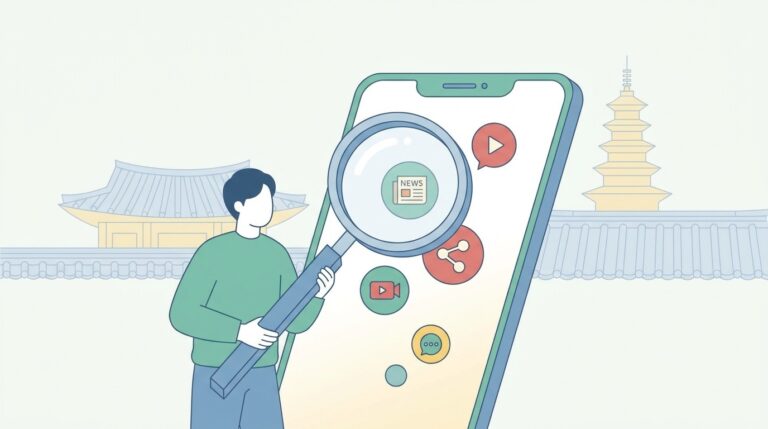
Navigating the Post-Truth Era: Mastering Media Literacy in Korean
안녕하세요! Welcome back to Daily Hangul, your premium cultural navigator. I’m your chief editor, and today we are diving deep into one of the most intellectually stimulating yet highly complex challenges of the digital age: Fake News and Media Literacy (가짜 뉴스와 미디어 리터러시).
At a C2 proficiency level, you aren’t just looking to order food or ask for directions. You want to engage in high-level debates, dissect societal phenomena, and critique the information ecosystem in fluent Korean. Let’s explore how to navigate these critical conversations like a native public intellectual!
Phase 1: Empathy & Real-World Context
Imagine watching a high-stakes Korean political drama like Chief of Staff (보좌관) or a newsroom thriller like Argon (아르곤). A breaking news alert flashes on the screen, causing immediate public panic, only to be revealed minutes later as a coordinated, malicious fabrication designed to manipulate the stock market.
In Korea’s hyper-connected society—boasting some of the fastest internet speeds and highest smartphone penetration rates globally—information spreads like wildfire via KakaoTalk group chats and YouTube algorithms. Navigating this “infodemic” requires more than just basic vocabulary; it requires sharp critical thinking and nuanced linguistic tools. Many advanced learners feel hesitant to join these discussions because they lack the sophisticated, natural phrasing that native speakers use to dissect misinformation without sounding overly academic or confrontational. Today, we bridge that gap.
Phase 2: Deep-Dive into 3 Essential Expressions
Let’s analyze three powerful C2-level expressions that will immediately elevate your media analysis skills.
1. 여론을 호도하다 (Yeo-ron-eul ho-do-ha-da)
- Pronunciation: Yeo-ron-eul ho-do-ha-da (Sounds like yuh-ron-eul ho-do-hah-dah)
- Meaning: To mislead or manipulate public opinion.
- K-Culture Moment: Frequently used by journalists, analysts, and in legal K-dramas when discussing how selective media leaks are designed to shift public focus away from a major government scandal.
- Editor’s Insight: ‘호도(糊塗)하다’ literally means “to plaster over with paste,” meaning to cover up a mistake or truth poorly. Combining it with ‘여론’ (public opinion) describes a deliberate attempt to cloud the public’s judgment.
- Situation Spectrum: Casual (🚫) / Semi-formal (⚠️) / Formal (✅)
- 🤔 Think About It: How does your native language describe the “plastering over” of truth to mislead the masses?
2. 확증 편향에 갇히다 (Hwak-jeung pyeon-hyang-e gat-hi-da)
- Pronunciation: Hwak-jeung pyeon-hyang-e gat-hi-da (Sounds like hwak-jeung pyun-hyang-eh gah-chee-dah)
- Meaning: To be trapped in confirmation bias.
- K-Culture Moment: This phrase is the star of contemporary Korean essays and podcasts discussing why older generations easily fall prey to sensationalist YouTube fake news.
- Editor’s Insight: ‘편향’ (bias/leaning) combined with ‘확증’ (confirmation) captures the psychological phenomenon of only seeking out information that aligns with one’s existing beliefs.
- Situation Spectrum: Casual (⚠️) / Semi-formal (✅) / Formal (✅)
- 🤔 Think About It: Is “trapped” (갇히다) a more active or passive state compared to how you describe confirmation bias in your culture?
3. 무분별하게 수용하다 (Mu-bun-byeol-ha-ge su-yong-ha-da)
- Pronunciation: Mu-bun-byeol-ha-ge su-yong-ha-da (Sounds like moo-boon-byul-hah-geh soo-yong-hah-dah)
- Meaning: To indiscriminately/uncritically accept or consume (information).
- K-Culture Moment: Used by educators and cultural critics advocating for early childhood media literacy programs in Korea.
- Editor’s Insight: ‘무분별(無分別)’ means lacking discernment or discretion. It describes passive consumption without fact-checking.
- Situation Spectrum: Casual (⚠️) / Semi-formal (✅) / Formal (✅)
- 🤔 Think About It: Why is active media consumption considered a civic duty in modern democratic societies?
Phase 3: Textbook Korean vs. Real Native Korean
Let’s compare stiff, textbook-style expressions with the vibrant, natural phrasing used by native Korean speakers.
Situation 1: Pointing out that a news article is fake
- 📖 Textbook: “이 기사는 사실이 아닙니다.” (This article is not true.)
- 🗣️ Real Native: “이거 전형적인 어그로성 지라시네.” (This is a classic piece of clickbait trash-news.)
- 💡 Why it’s different: ‘어그로성’ (aggro-style/provocative) and ‘지라시’ (private newsletters/tabloids) are widely used to dismiss low-quality fake news instantly.
Situation 2: Emphasizing the need for fact-checking
- 📖 Textbook: “우리는 기사를 읽고 사실 여부를 확인해야 합니다.” (We must read articles and confirm whether they are true.)
- 🗣️ Real Native: “일단 중립 기어 박고 팩트 체크부터 해봐야 돼.” (We need to put it in neutral gear first and fact-check.)
- 💡 Why it’s different: ‘중립 기어 박다’ (putting the gear in neutral) is a highly popular modern idiom meaning to withhold judgment until the full truth is revealed.
Phase 4: K-Culture Deep-Dive & Non-Verbal Etiquette
4-1. Gestures and Attitude in High-Level Debates
When discussing sensitive topics like fake news in Korea, maintaining a balance between intellectual sharpness and respect is vital.
* The “Soften-the-Blow” Nod: Before counter-arguing, nod slightly and say “그 말씀도 일리가 있습니다만…” (Your point certainly has merit, but…). This prevents you from sounding dismissive.
* Eye Contact: Avoid glaring intensely. Instead, maintain soft eye contact, occasionally looking slightly down or to the side when synthesizing your thoughts to show you are contemplating deeply, not just reacting.
4-2. The YouTube Algorithm and “Filter Bubbles” in Korea
Korea’s digital space is heavily shaped by algorithmic curation. The term 알고리즘의 노예 (slave to the algorithm) is commonly used to describe how users are pulled into echo chambers. Discussing this phenomenon shows a deep understanding of Korea’s current digital landscape.
Phase 5: Real-World Roleplay Scenario
Scenario: You are attending a graduate-level seminar on digital media at a Korean university. You are discussing the social impact of deepfakes with a classmate, Min-woo (민우).
- Min-woo: 요즘 딥페이크 기술 때문에 가짜 뉴스가 더 정교해진 것 같아요. 육안으로는 도저히 구분이 안 가더라고요.
(These days, because of deepfake technology, fake news seems to have become more sophisticated. It’s impossible to tell with the naked eye.) - You: 맞아요. 기술의 고도화가 오히려 여론을 호도하는 강력한 무기로 악용되는 셈이죠.
(Exactly. It means the advancement of technology is actually being abused as a powerful weapon to mislead public opinion.) - Min-woo: 게다가 사람들이 보고 싶은 것만 보니까 이런 가짜 뉴스가 더 빠르게 확산되는 것 같아요.
(Furthermore, because people only see what they want to see, this kind of fake news seems to spread even faster.) - You: 전적으로 동감합니다. 알고리즘 때문에 다들 확증 편향에 갇혀서 교차 검증을 아예 안 하더라고요.
(I completely agree. Because of algorithms, everyone is trapped in confirmation bias and they don’t do cross-verification at all.) - Min-woo: 맞아요. 미디어 리터러시 교육이 정말 시급한 시점이에요.
(Indeed. Media literacy education is at a truly critical and urgent point right now.) - You: 무분별하게 정보를 수용하기보다, 개개인이 필터 버블의 위험성을 자각해야 합니다.
(Rather than indiscriminately accepting information, individuals must become aware of the dangers of filter bubbles.)
🔀 Choose Your Response!
How would you conclude your argument?
* A) “그냥 유튜브를 삭제하는 게 답이에요.” (Just deleting YouTube is the answer.)
* B) “제도적 규제도 필요하겠지만, 결국 개개인의 미디어 리터러시 역량을 기르는 게 근본적인 해결책이겠죠.” (Institutional regulations are necessary, but ultimately, cultivating individual media literacy skills is the fundamental solution.)
* C) “가짜 뉴스를 만드는 사람들을 전부 구속해야 합니다.” (We must arrest everyone who makes fake news.)
🧐 Feedback on Your Choice:
- Selection A (Bad): Too simplistic. It shuts down a high-level academic debate with an unrealistic, non-intellectual solution.
- Selection B (Best!): Extremely sophisticated. It balances institutional and individual dimensions, showing C2-level conceptual depth.
- Selection C (Risk): Emotional and legally unrealistic. It lacks the nuanced perspective expected in a professional academic setting.
Phase 6: 10-Second Emotional Shadowing Drill
Practice reading these sentences aloud, matching the emotional tone and pauses (/) indicated.
- [Deploring / With analytical concern]
- 대중들이 / 자극적인 헤드라인에 / 휘둘리는 경향이 있어요.
- Dae-jung-deul-i / ja-geuk-jeok-in he-deu-ra-in-e / hwi-dul-ri-neun gyeong-hyang-i isseo-yo.
- (The public / has a tendency / to be swayed by provocative headlines.)
- [Convinced / Suggesting an intellectual solution]
- 정보의 홍수 속에서 / 우리에게 필요한 건 / 비판적인 안목입니다.
- Jeong-bo-ui hong-su sok-eseo / u-ri-e-ge pil-yo-han geon / bi-pan-jeok-in an-mok-im-ni-da.
- (In this flood of information / what we need / is a critical eye.)
Phase 7: K-Culture Mini-Dictionary
- 팩트 체크 (Fact Check) | Fact Check
- Extensively used in Korean media and daily debates to denote the verification of news credibility.
- 선동하다 (Seon-dong-ha-da) | To instigate / To demagogue
- Used to describe political actors provoking the public using false or exaggerated narratives.
- 필터 버블 (Filter Bubble) | Filter Bubble
- The intellectual isolation that can occur when websites use algorithms to selectively guess what information a user would like to see.
- 지라시 (Jirasi) | Tabloid / Scandal sheet
- Unverified, privately circulated newsletters that often contain juicy political, business, or celebrity rumors.
Phase 8: Survivor’s Kit for Intellectual Discussion
Survival Expressions for High-Level Seminars:
- 우려스러운 부분입니다. (U-ryeo-seu-ro-un bu-bun-im-ni-da.)
- “This is a concerning part.” (An elegant way to express worry about a societal trend.)
- 일방적인 주장일 뿐입니다. (Il-bang-jeok-in ju-jang-il ppun-im-ni-da.)
- “It is merely a one-sided claim.” (Used to dismiss unverified accusations politely.)
- 인과관계를 따져봐야 합니다. (In-gwa-gwan-gye-reul tta-jyeo-bwa-ya ham-ni-da.)
- “We must look closely at the cause-and-effect relationship.”
Editor’s Note: If you want to access high-quality Korean journalism and essays for practice, check out the editorial sections on portal apps like Naver. You can download the Naver App to read daily columns and practice your translation skills.
Phase 9:
Frequently Asked Questions (FAQ)
Q: What does "여론을 호도하다 (Yeo-ron-eul ho-do-ha-da)" mean in Korean and how do you pronounce it?
A: In Korean, "여론을 호도하다 (Yeo-ron-eul ho-do-ha-da)" is pronounced [Yeo-ron-eul ho-do-ha-da (Sounds like yuh-ron-eul ho-do-hah-dah] and means: To mislead or manipulate public opinion.
Q: What does "확증 편향에 갇히다 (Hwak-jeung pyeon-hyang-e gat-hi-da)" mean in Korean and how do you pronounce it?
A: In Korean, "확증 편향에 갇히다 (Hwak-jeung pyeon-hyang-e gat-hi-da)" is pronounced [Hwak-jeung pyeon-hyang-e gat-hi-da (Sounds like hwak-jeung pyun-hyang-eh gah-chee-dah] and means: To be trapped in confirmation bias.
Q: What does "무분별하게 수용하다 (Mu-bun-byeol-ha-ge su-yong-ha-da)" mean in Korean and how do you pronounce it?
A: In Korean, "무분별하게 수용하다 (Mu-bun-byeol-ha-ge su-yong-ha-da)" is pronounced [Mu-bun-byeol-ha-ge su-yong-ha-da (Sounds like moo-boon-byul-hah-geh soo-yong-hah-dah] and means: To indiscriminately/uncritically accept or consume (information).







