

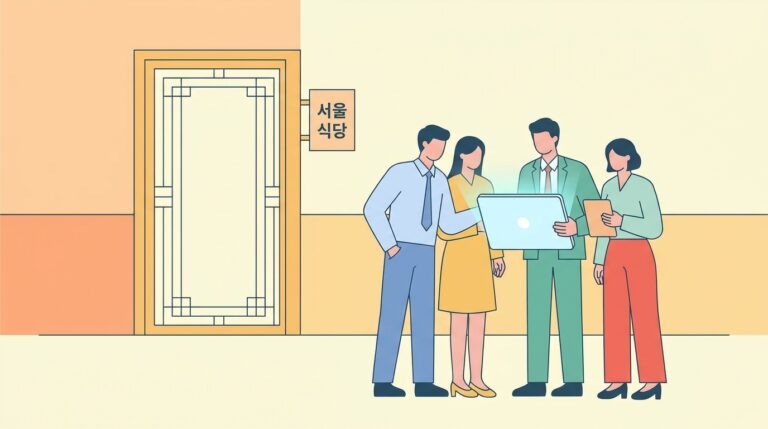
Waiting in Line for a Famous Restaurant During Lunch Break (점심 시간에 맛집 줄 서기)
Phase 1: Empathy (공감)
안녕하세요! (An-nyeong-ha-se-yo!) Your Korean bestie and Daily Hangul Editor is here!
Imagine this: It is 11:50 AM on a Friday. Your stomach is growling, and your Korean coworker looks at you with sparkling eyes and says, “오늘 점심은 무조건 거기 가야 해요!” (Today we must go to that place for lunch!). You rush out of the office, but as you approach the trending gourmet spot, your heart drops. There is already a massive crowd blocking the sidewalk.
In Korea, lunch hour is a sacred, high-stakes sprint. With only 60 minutes on the clock, standing in a mat-jib (맛집, famous/delicious restaurant) queue requires tactical precision, quick communication, and a shared understanding of office lunch culture. This guide is built based on real feedback from expats working in Seoul who struggled to communicate effectively under the high pressure of a ticking lunch clock. By the end of this post, you will master the art of queuing with your coworkers like a true Seoulite!
Phase 2: Core Expressions (핵심 표현 3선)
1. 웨이팅 얼마나 걸려요? (Way-ting ol-ma-na geol-ryeo-yo?)
- Pronunciation: Way-ting (sounds like the English “waiting”) + ol-ma-na (all-mah-nah) + geol-ryeo-yo (guhl-ryuh-yo)
- Meaning: “How long is the wait?”
- K-Culture Moment: You will hear this everywhere from K-Dramas set in busy districts like Euljiro or Yeouido. Coworkers anxiously peek into a restaurant window while asking the staff this exact question.
- Editor’s Insight: Although “대기 시간” (dae-gi si-gan) is the formal translation for “waiting time,” almost everyone in trendy areas uses the Konglish word 웨이팅 (waiting). It sounds natural, friendly, and very modern.
- Situation Spectrum: Casual (✅) | Semi-formal (✅) | Formal (⚠️ – Use “대기 시간이 얼마나 됩니까?” for VIP clients)
- 🤔 Think About It: In many Western countries, people might casually wait at the bar. In Korea, waiting is structured, often involving digital tablets. Why do you think efficiency is so highly valued even during personal break times?
2. 그냥 다른 데 갈까요? (Geu-nyang da-reun de gal-kka-yo?)
- Pronunciation: Geu-nyang (guh-nyahng) + da-reun de (dah-reun deh) + gal-kka-yo (gahl-kah-yo)
- Meaning: “Shall we just go somewhere else?”
- K-Culture Moment: This is the ultimate “polite hesitation” phrase used when the queue looks too intimidating. It is soft but suggests an alternative because everyone is on a tight schedule.
- Editor’s Insight: “그냥” (geu-nyang) means “just” or “simply.” It softens the suggestion, making it sound less like a complaint and more like a considerate compromise for the group’s sake.
- Situation Spectrum: Casual (✅) | Semi-formal (✅) | Formal (🚫 – Avoid using “그냥” with high-ranking executives; instead, say “다른 식당으로 이동할까요?”)
- 🤔 Think About It: Korean workplace relationships rely heavily on collective harmony. Saying “I want to leave” directly can sound selfish. How does “Shall we go somewhere else?” protect team harmony?
3. 제가 줄 서 있을게요 (Je-ga jul seo is-seul-ge-yo)
- Pronunciation: Je-ga (jay-gah) + jul (jool) + seo (suh) + is-seul-ge-yo (ees-seul-geh-yo)
- Meaning: “I will stand in line (for us).”
- K-Culture Moment: This is the ultimate “social hero” move in Korean office culture. Often, the youngest team member (maknae) or a fast-walking coworker will run ahead to secure a spot and say this to the rest.
- Editor’s Insight: Using the future-intent ending -(으)ㄹ게요 shows your active willingness to do something for the benefit of the group. It is guaranteed to earn you major brownie points with your Korean colleagues!
- Situation Spectrum: Casual (✅) | Semi-formal (✅) | Formal (⚠️)
- 🤔 Think About It: Doing small favors like this builds Jeong (정, affection/bonding) in Korean offices. What are equivalent small gestures in your culture?
Phase 3: Textbook vs. Real Korean (교과서 vs. 진짜 한국어)
Situation 1: Asking if you need to write your name on the waiting list
- 📖 Textbook: “대기 명부에 이름을 적어야 합니까?” (Dae-gi myeong-bu-e i-reum-eul jeok-eo-ya hap-ni-ka? – “Must I write my name on the waiting list?”)
- 🗣️ Real Korean: “이름 적어야 돼요?” (I-reum jeok-eo-ya dwae-yo? – “Do we need to write our names down?”)
- 💡 Why the difference? The textbook version is too stiff and grammatically heavy. In real life, restaurant staff are busy, so short, active phrasing like “이름 적어야 돼요?” is much preferred.
Situation 2: Expressing that a line is incredibly long
- 📖 Textbook: “대기하는 사람들이 매우 많습니다.” (Dae-gi-ha-neun sa-ram-deul-i mae-u man-seup-ni-da. – “There are very many waiting people.”)
- 🗣️ Real Korean: “줄 진짜 길다!” (Jul jin-짜 gil-da! – “The line is seriously long!”)
- 💡 Why the difference? Coworkers drop formal sentence endings when talking to themselves or peers in moments of mild shock. “진짜” (jin-jja – really/seriously) adds that authentic emotional punch.
Phase 4: K-Culture Deep Dive & Non-verbal Etiquette
4-1. The Art of Nunchi (눈치) in the Lunch Queue
- The Quick Look-Around: When you arrive, don’t just stand at the back immediately. Check if there is a table/tablet near the door. Many places use digital systems like ‘Tabling’ (테이블링) or ‘Catch Table’ (캐치테이블). Standing in line without registering on the screen is a common expat mistake!
- The Space Saver Etiquette: If one person stands in line, can the other four join later? While common in some cultures, in crowded Korean business districts, having your entire team show up right before entering can cause subtle glares (nunchi). Try to have at least most of the party present when your number is called.
4-2. The “Fast-paced” Lunch Code (빨리빨리 Culture)
Korean lunch hours are notoriously fast. People eat quickly so they can grab a sig-hu coffee (식후 커피, post-meal coffee). If you see a long line, your Korean colleagues will automatically calculate the math: Time to wait + Time to eat + Coffee run = Must be under 60 minutes. If the wait is over 20 minutes, they will likely pivot instantly.
Phase 5: Interactive Roleplay Scenario
Characters:
- Ji-won (지원): Your energetic Korean coworker who loves trendy food.
- You (유): A smart expat working at a Seoul marketing agency (Level B1).
[Scene: Outside a famous Kimchi Jjigae restaurant in Yeouido at 12:05 PM]

지원: (Shocked, looking at the crowd) 헐, 대박. 여기 오늘 왜 이렇게 줄이 길죠?
      (Heol, dae-bak. Yeo-gi o-neul wae i-reoh-ge jul-i gil-jyo?)
      "Oh my gosh. Why is the line so long here today?"

유:   (Sighing) 진짜 장난 아니네요. 우리 뒤에 서야겠어요.
      (Jin-jja jang-nan a-ni-ne-yo. U-ri dwi-e seo-ya-get-eo-yo.)
      "Seriously, it's no joke. We should stand at the back."

지원: (Looking at her watch anxiously) 우리 1시까지 들어가야 하잖아요.
      (U-ri han-si-kka-ji deul-eo-ga-ya ha-jan-a-yo.)
      "We have to be back by 1 o'clock, you know."

유:   (Nodding) 맞아요. 제가 입구에 가서 웨이팅 얼마나 걸리는지 여쭤볼게요.
      (Ma-ja-yo. Je-ga ip-gu-e ga-seor way-ting ol-ma-na geol-ri-neun-ji yeot-jjeo-bol-ge-yo.)
      "Right. I'll go to the entrance and ask how long the wait is."

[You walk to the restaurant staff near the door]

유:   저기요, 사장님! 저희 앞팀 몇 팀 남았어요?
      (Jeo-gi-yo, sa-jang-nim! Jeo-hui ap-tim myeot tim nam-as-eo-yo?)
      "Excuse me, owner! How many teams are left before us?"

사장님: (Checking tablet) 지금 앞에 일곱 팀 대기 있어요. 한 20분 기다리셔야 해요.
      (Ji-geum ap-e il-gop tim dae-gi is-seo-yo. Han i-sip-bun gi-da-ri-syeo-ya hae-yo.)
      "There are seven teams waiting ahead of you. You have to wait about 20 minutes."

유:   (Returning to Ji-won) 앞에 일곱 팀 있고, 20분 정도 걸린대요.
      (Ap-e il-gop tim is-go, i-sip-bun jeong-do geol-rin-dae-yo.)
      "There are seven teams ahead, and they say it takes about 20 minutes."

지원: 20분요? 흐음... 먹는 시간까지 하면 너무 아슬아슬한데 어쩌죠?
      (I-sip-bun-yo? Heu-eum... Meok-neun si-gan-kka-ji ha-myeon neo-mu a-seul-a-seul-han-de eo-jjeo-jyo?)
      "20 minutes? Hmm... Including eating time, it's too tight. What should we do?"
🔀 Your Turn! Choose your response:
- A) “그냥 다른 데 갈까요? 저기 부대찌개 집은 줄 없어요.”
(Geu-nyang da-reun de gal-kka-yo? Jeo-gi bu-dae-jji-gae jib-eun jul eop-seo-yo.) - B) “괜찮아요! 제가 빨리 먹을 수 있어요. 그냥 기다려요.”
(Gwan-chan-a-yo! Je-ga ppal-li meok-eul su is-seo-yo. Geu-nyang gi-da-ryeo-yo.) - C) “지원 씨가 먼저 회사로 돌아가세요. 제가 줄 서 있을게요.”
(Ji-won ssi-ga meon-jeo hoe-sa-ro dol-a-ga-se-yo. Je-ga jul seo is-seul-ge-yo.)
💡 Feedback on Your Choice:
- Best Choice (A): Excellent! This shows you respect the limited lunchtime and offer a highly practical, stress-free alternative. Team lunch is about sharing a comfortable meal, not rushing like crazy.
- Risk Choice (B): While passionate, eating under heavy time pressure might give both of you indigestion. Your coworker might feel uncomfortable rushing her meal just because you wanted to wait.
- Bad Choice (C): Standing in line alone while sending your colleague back defeats the purpose of eating together. It creates awkward boundary issues in a Korean workplace dynamic.
Phase 6: 10-Second Emotion Shadowing Drill
To sound like a native, you need the right rhythm, pauses (/), and emotional coloring. Practice these out loud!
- [🥺 Disappointed and anxious]
- 아… / 줄이 생각보다 / 진짜 기네요… ㅠㅠ
- Ah… / jul-i saeng-gak-bo-da / jin-jja gi-ne-yo…
- “Ah… the line is seriously longer than I thought…”
- [😊 Bright and helpful]
- 제가 / 번호표 뽑아 올게요! / 조금만 기다려 주세요.
- Je-ga / beon-ho-pyo ppop-ah ol-ge-yo! / jo-geum-man gi-da-ryeo ju-se-yo.
- “I’ll go grab a queue number! Please wait just a bit.”
Phase 7: K-Culture Mini Dictionary
- 맛집 (Mat-jib): Lit. “Taste house.” A certified delicious restaurant. In Korea, finding a good mat-jib is a lifestyle and a major source of pride.
- 웨이팅 (Way-ting): Konglish for waiting in line at a restaurant or cafe.
- 대기 번호 (Dae-gi Beon-ho): Waiting number / Queue ticket number.
- 빨리빨리 (Ppal-li-ppal-li): “Hurry, hurry!” The fast-paced culture that defines South Korea’s high-speed services, subway systems, and lunch hours.
Phase 8: Survival Kit for Travelers
Survival Phrases TOP 3
- 여기 대기 명단 어디에 적어요? (Yeo-gi dae-gi myeong-dan eo-di-e jeok-eo-yo?)
- Pro Tip: Use this when you see people standing around but no obvious registration tablet.
- 두 명인데, 얼마나 기다려야 돼요? (Du myeong-in-de, ol-ma-na gi-da-ryeo-ya dwae-yo?)
- Pro Tip: “We are two people, how long is the wait?” Perfect for quick estimation.
- 포장은 바로 나오나요? (Po-jang-eun ba-ro na-o-na-yo?)
- Pro Tip: “Is takeout served immediately?” If the wait is too long, getting takeout to eat at a nearby park or office lounge is a great lifehack.
Editor’s Travel Note 🗺️
Most hot spots in Seoul (Hongdae, Gangnam, Seongsu) no longer use paper lists. They use digital tablets. Download Catch Table (캐치테이블) on the App Store or Naver Maps before your trip. Some apps allow you to register for a remote queue before you even arrive at the physical restaurant!
(Note: App features and foreign card registrations are subject to change over time.)
Phase 9: “Going Deeper” (한 발 더 깊이)
In many Western cultures, dining is a relaxed, slow-paced social event. However, in Korea’s corporate hubs, the 1-hour lunch break is treated like a highly coordinated team mission. Choosing what to eat, securing a table, eating efficiently, and getting a round of coffees requires teamwork. This “lunch solidarity” reflects Korea’s collectivist roots, where sharing a meal (bap) represents closeness and mutual support.
💬 Your Turn: Have you ever queued for food in Korea? Or do you prefer skipping the wait to find an empty spot? Let me know your lunch strategies in the comments below!
Phase 10: FAQ & Common Mistakes
Q: Can I leave the line to use the restroom and come back?
A: Yes, absolutely! Just make sure your coworker or the person behind you in line knows by saying, “화장실 금방 다녀올게요” (Hwa-jang-sil geum-bang da-nyeo-ol-ge-yo – I’ll be right back from the restroom).
Q: What if they call my number but I don’t speak enough Korean to answer?
A: Listen carefully for numbers! Or keep your phone screen showing your KakaoTalk/SMS notification ready to show the staff near the entrance.
Q: Is it okay to use English when asking for wait times?
A: In major tourist areas, yes. But in office districts (like Yeouido or Gasan), using basic Korean phrases like “웨이팅 얼마나 걸려요?” will make the busy staff’s job much easier and get you a faster answer.
🚨 Common Mistakes Alert!
- Mistake: Assuming the queue is physical.
- Correct Action: Always walk right up to the entrance door first to see if there is a digital tablet or clipboard.
- Mistake: Staying in line when your party is not fully there.
- Correct Action: If some coworkers are running late, tell the staff beforehand so they don’t skip your turn when a table opens up.
- Mistake: Forgetting to state the group size.
- Correct Action: In Korea, tables are arranged by 2-person or 4-person configurations. Always say how many people are in your team first!
Phase 11: Action Missions
- 🥉 Bronze Mission: Pronounce “웨이팅 얼마나 걸려요?” out loud 3 times using the shadow coaching guide in Phase 6.
- 🥈 Silver Mission: Screenshot this guide’s survival phrases and save it to your phone’s favorites folder for your next lunch run.
- 🥇 Gold Mission: Use “제가 줄 서 있을게요” in a text or conversation with a friend or colleague when meeting up for dinner this week!
- 🎮 K-Culture Mission: Watch a food-themed K-Drama (like Let’s Eat / 식샤를 합시다) and try to spot how many times characters ask about waiting times outside busy places!
Phase 12: Interactive Quiz Challenge
Test your knowledge before you hit the streets of Seoul!
1. Which expression is the most natural way to ask “How long is the wait?” to busy staff?
- A) 대기 명부에 이름을 적어야 합니까?
- B) 웨이팅 얼마나 걸려요?
- C) 줄 진짜 길다!
Click to view the Answer & Explanation
Correct Answer: B
Explanation: B is the most natural, common, and polite phrase used in real life. A is too textbook-stiff, and C is informal self-talk.
2. True or False: In Korea, you should always stand in physical lines without checking the restaurant door first.
- A) True
- B) False
Click to view the Answer & Explanation
Correct Answer: B (False)
Explanation: Most popular restaurants use electronic waitlist tablets near the door. Always check for a digital screen first!







