

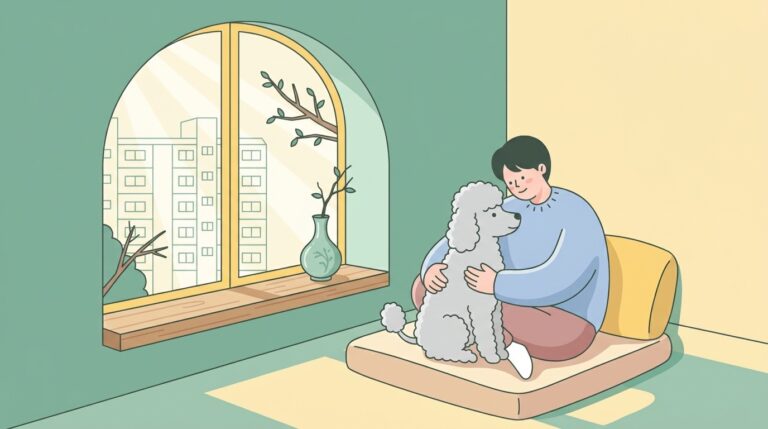
Caring for Our Silver Paws: Deciphering Canine Cognitive Dysfunction and Nutrition in Korea
Phase 1: Empathy (Story-Driven Opening)
안녕하세요! This is your Maeil Hangul (매일한글) Senior Editor and your trusted K-Culture Navigator.
If you have shared your life with a furry companion, you know they aren’t just pets—they are family (가족, gajok). In Korea, the term 반려동물 (banryeodongmul—companion animal) has completely replaced the older, more utilitarian word 애완동물 (aewandongmul—pet).
Imagine this: You are sitting in a cozy living room in Seoul, watching a late-night K-Drama. Your 14-year-old maltese, who used to cuddle by your side, is suddenly staring blankly at the wall, or pacing back and forth in tight circles near the kitchen cabinet. You try calling their name, but they seem to be in another world.
This is a poignant reality for many pet owners—dealing with Canine Cognitive Dysfunction (CCD), commonly known in Korea as 강아지 치매 (gangaji chimdae – dog dementia). As our pets live longer, high-level Korean speakers need to navigate sensitive veterinary consultations, explain complex behavioral symptoms, and discuss advanced nutritional therapies. This guide is crafted to empower your C2-level Korean with the exact linguistic nuances, emotional depth, and cultural insights required to handle these tender moments with absolute grace and precision.
Phase 2: Deep Dive into 3 Essential Expressions
To discuss senior dog care at a C2 level, you must master terms that go beyond simple sickness. Here are three sophisticated expressions used by Korean pet parents and veterinarians.
1. 벽을 멍하니 응시하다 (byeok-eul meong-hani eung-si-hada)
- Pronunciation: Byug-eul mung-ha-ni eung-shi-ha-da (Sounds like “yung” but with a “B” / “meong” as in the sound of a dazed stare)
- Meaning: To stare blankly at a wall (A classic symptom of CCD).
- K-Culture Moment: On popular Korean pet rescue shows like There Are No Bad Dogs in the World (세상에 나쁜 개는 없다), you will often see a tiny, silver-haired Poodle staring into a blank corner. The veterinarian will sigh and say, “강아지가 벽을 멍하니 응시하는 행동은 인지기능 장애의 대표적인 증상입니다.” (The dog staring blankly at the wall is a classic symptom of cognitive dysfunction.)
- Editor’s Insight: The adverb 멍하니 (meong-hani) represents a state of being dazed, spaced out, or completely blank. In modern Korean slang, we call spacing out 멍때리기 (meong-ttaerigi). However, in a medical context, combining it with 응시하다 (eung-si-hada – to gaze/stare intently) elevates the description to a precise, professional observation.
- Situation Spectrum: Casual (⚠️ – too formal for casual chatting, but acceptable) / Semi-formal (✅) / Formal (✅)
- 🤔 Think About It: How does your native language describe the heartbreaking transition of a pet starting to lose their cognitive focus? In Korean, combining a soft, native-Korean word like meong-hani with a sharp, Hanja-based medical verb like eung-si-hada creates a unique blend of emotional empathy and clinical accuracy.
2. 밤낮이 뒤바뀌다 (bam-naji dwi-bak-kwi-da)
- Pronunciation: Bahm-nah-ji dwi-bahk-kwi-da (Notice the liaison: 밤낮이 sounds like bam-na-ji)
- Meaning: To have day and night reversed (Sleep-wake cycle disruption).
- K-Culture Moment: If you are talking to a fellow Korean dog lover on Instagram, you might hear: “우리 애가 치매가 오고 나서 밤낮이 뒤바뀌었는지, 밤만 되면 하울링을 해요.” (Since my baby got dementia, their day and night have flipped, so they howl whenever night comes.)
- Editor’s Insight: 밤낮 literally means “night and day”. The verb 뒤바뀌다 means to be completely reversed or switched. It is much more natural and idiomatic than saying “수면 패턴이 변했어요” (sleep patterns have changed) when describing the exhausting cycle of a senior pet roaming at 3 AM.
- Situation Spectrum: Casual (✅) / Semi-formal (✅) / Formal (✅)
- 🤔 Think About It: Reversing day and night implies a disruption of natural harmony. Why do you think Korean culture places so much emphasis on keeping natural cycles in balance, both for humans and animals?
3. 영양제를 급여하다 (yeong-yang-je-reul geub-yeo-hada)
- Pronunciation: Young-yang-je-reul gub-yo-ha-da (Sounds like “geub” with a tight ‘eu’ sound, followed by “yo”)
- Meaning: To administer/feed nutritional supplements.
- K-Culture Moment: When visiting a high-end pet apothecary in Gangnam, the pet nutritionist will ask: “인지기능 개선 영양제는 어떤 방식으로 급여하고 계신가요?” (In what manner are you administering cognitive improvement supplements?)
- Editor’s Insight: While the verb 먹이다 (meog-ida – to feed) is common, professionals and passionate pet owners use 급여하다 (geub-yeo-hada – to provision/provide food or supplements). It comes from Hanja (給與), showing a high level of respect and structured care for the animal’s regimen.
- Situation Spectrum: Casual (⚠️) / Semi-formal (✅) / Formal (✅)
- 🤔 Think About It: In English, we “give” or “administer” pills. In Korean, using a dedicated term like geub-yeo highlights the highly structured, almost ritualistic care that contemporary Korean pet owners dedicated to their senior companions.
Phase 3: Textbook Korean vs. Real-Life Korean
Let’s elevate your natural phrasing. Here is how standard textbook Korean differs from what high-level native speakers actually say in emotional or professional settings.
Situation 1: Describing a pet pacing aimlessly
- 📖 Textbook Korean: 개가 방 안을 목적 없이 걸어 다녀요. (Gae-ga bang an-eul mok-jeok eops-i georeo danyeoyo.)
- Translation: The dog walks around the room without a purpose.
- 🗣️ Real-Life Korean: 아이가 목적 없이 방 안을 배회하곤 해요. (Ai-ga mok-jeok eops-i bang an-eul bae-hoe-ha-gon haeyo.)
- Translation: My child (pet) tends to wander/wander aimlessly around the room.
- 💡 Why the difference? C2 speakers call their pets 아이 (ai – child/kid) to show deep familial love. Also, the literary verb 배회하다 (bae-hoe-hada – to wander/hover/pace) is much more descriptive of CCD than simply walking.
Situation 2: Asking if a supplement can be mixed with food
- 📖 Textbook Korean: 이 약을 밥이랑 같이 먹여도 돼요? (I yak-eul bap-i-rang gat-i meog-yeo-do dwaeyo?)
- Translation: Can I feed this medicine together with rice?
- 🗣️ Real-Life Korean: 이 영양제를 사료에 토핑으로 얹어서 급여해도 괜찮을까요? (I yeong-yang-je-reul sa-ryo-e to-ping-euro eon-jeo-seo geub-yeo-hae-do gwaen-chanh-eul-kka-yo?)
- Translation: Would it be okay to administer this supplement by placing it as a topping on their kibble?
- 💡 Why the difference? Modern Korean pet culture uses sophisticated English loanwords like 토핑 (to-ping) combined with highly respectful verbs like 얹어서 급여하다 (eon-jeo-seo geub-yeo-hada – to top and administer) to show careful handling of food.
Phase 4: K-Culture Deep Dive & Non-Verbal Manners
4-1. Vet Clinic Etiquette (비언어적 매너)
When discussing sensitive topics like pet dementia in Korea, how you convey your distress and respect matters deeply:
* The “Caring Sigh” (안타까운 한숨): When talking about your pet’s decline, it is common to let out a soft, sympathetic sigh (aigo… / 아휴…) while looking at your pet. This signals your profound emotional bond to the vet.
* Showing Veterinary Respect: Always address the vet as 원장님 (won-jang-nim – Director/Head of clinic) or 선생님 (seon-saeng-nim – Teacher) rather than just “의사” (doctor). Bow slightly when entering and exiting the examination room.
4-2. The “Pet-Fam” (펫팸족) Phenomenon
Korea has entered the era of the 펫팸족 (pet-paem-jok – Pet-Family Tribe). With single-person households soaring, pets are treated with unparalleled luxury. There are specialized senior pet facilities in Korea, including 강아지 유치원 (dog kindergartens) that offer cognitive physical therapy, and 반려동물 한의원 (acupuncture clinics for older dogs). Understanding CCD isn’t just medical; it’s a huge part of the Korean lifestyle landscape.
Phase 5: Real-Life Roleplay Scenario
Setting: A premium veterinary clinic in Cheongdam-dong, Seoul. You are discussing your 15-year-old dog’s deteriorating cognitive functions with Dr. Kim.
Characters:
* 나 (You): An extremely caring and deeply knowledgeable pet parent.
* 김 원장님 (Dr. Kim): A compassionate, highly experienced veterinarian.
나: (걱정스러운 눈빛으로 강아지를 쓰다듬으며)
원장님, 요즘 저희 애가 부쩍 벽을 멍하니 응시하는 시간이 늘어났어요.
(Won-jang-nim, yo-jeum jeo-hui ae-ga bu-jjeok byeok-eul meong-hani eung-si-ha-neun si-gan-i neul-eo-nass-eo-yo.)
"Doctor, lately my baby has spent significantly more time staring blankly at the wall."

김 원장님: (차트를 살피며 든든한 어조로)
아이고, 아이 연세가 열다섯 살이니 인지기능 저하가 올 시기이긴 합니다. 밤에 잠은 잘 자나요?
(Aigo, ai yeon-se-ga yeol-dasot sal-ini in-ji-gi-neung jeo-ha-ga ol si-gi-i-gin ham-ni-da. Bam-e jam-eun jal ja-na-yo?)
"Oh dear, since your child is fifteen years old, it is indeed time for cognitive decline to set in. Do they sleep well at night?"

나: (한숨을 쉬며 고개를 가로젓는다)
아니요, 최근 들어 완전히 밤낮이 뒤바뀐 것 같아요. 새벽만 되면 허공을 보며 하울링을 하네요.
(An-i-yo, choe-geun deul-eo wan-jeon-hi bam-naji dwi-bak-kwin geot gat-ae-yo. Sae-byeok-man doe-myeon heo-gong-eul bo-myeo ha-ul-ring-eul ha-ne-yo.)
"No, lately it seems their day and night have completely reversed. Whenever dawn comes, they stare into empty space and howl."

김 원장님: (고개를 끄덕이며 공감하듯)
전형적인 치매 증상 중 하나입니다. 인지기능 개선 영양제 급여를 시작하시는 게 좋겠어요.
(Jeon-hyeong-jeok-in chi-mae jeung-sang jung hana-im-ni-da. In-ji-gi-neung gae-seon yeong-yang-je geub-yeo-reul si-jak-ha-si-neun ge jok-gess-eo-yo.)
"That is one of the classic symptoms of dementia. I suggest you start administering cognitive improvement supplements."

나: (질문하듯 눈을 반짝이며)
사료에 분말 형태로 토핑처럼 얹어서 급여해도 효능에 지장이 없을까요?
(Sa-ryo-e bun-mal hyeong-tae-ro to-ping-cheo-reom eon-jeo-seo geub-yeo-hae-do hyo-neung-e ji-jang-i eops-eul-kka-yo?)
"If I administer it as a powder topped over their kibble, will it affect its efficacy?"

김 원장님: (미소를 지으며 상세히 설명한다)
네, 전혀 문제없습니다. 기호성을 높이기 위해 부드러운 습식 사료와 섞어 급여하시는 것을 추천해 드립니다.
(Ne, jeon-hyeo mun-je-eops-seum-ni-da. Gi-ho-seong-eul nop-i-gi wi-hae bu-deu-reo-un seup-sik sa-ryo-wa seokk-eo geub-yeo-ha-si-neun geos-eul chu-cheon-hae deu-rim-ni-da.)
"Yes, no problem at all. To increase palatability, I recommend mixing it with soft wet food to administer it."

나: (안도하며 노트를 적는다)
다행이네요. 아이가 거부감 없이 잘 먹어주면 좋겠습니다. 처방 부탁드릴게요.
(Da-haeng-i-ne-yo. Ai-ga geo-bu-gam eops-i jal meog-eo-ju-myeon jok-gess-seum-ni-da. Cheo-bang bu-tak-deu-ril-ge-yo.)
"That's a relief. I hope my baby eats it well without rejecting it. Please write up the prescription."

김 원장님: (따뜻하게 안심시키며)
네, 보호자님의 사랑과 정성이 있다면 아이도 분명 편안해질 겁니다. 약 준비해 드릴게요.
(Ne, bo-ho-ja-nim-ui sa-rang-gwa jeong-seong-i itt-da-myeon ai-do bun-myeong pyeon-an-hae-jil geom-ni-da. Yak jun-bi-hae deu-ril-ge-yo.)
"Yes, with your love and devotion, protector (owner), your child will surely feel more comfortable. I'll get the medicine ready."
🔀 Interactive Choice Point
How do you respond when the vet hands you the prescription?
- Option A: “감사합니다. 얼마예요?” (Gam-sa-ham-ni-da. Eol-ma-ye-yo?)
- Option B: “원장님, 혹시 영양제 급여 시 주의해야 할 부작용이 있을까요?” (Won-jang-nim, hok-si yeong-yang-je geub-yeo si ju-ui-hae-ya hal bu-ja-yong-i is-seul-kka-yo?)
- Option C: “약 안 먹으면 어떡하죠? 환불되나요?” (Yak an meog-eu-myeon eo-tteok-ha-jyo? Hwan-bul-doe-na-yo?)
Selection Feedback:
- Option A (Good, but too transactional): Perfectly polite, but misses the opportunity to display C2-level care inquiry. It makes you look like you’re in a hurry.
- Option B (Best! Highly Pro): Excellent choice! Asking about potential side effects (부작용, bu-ja-yong) during administration shows a highly advanced vocabulary and a genuinely responsible mindset.
- Option C (Bad / Risk): Asking for a refund (환불, hwan-bul) before even trying the medication is culturally perceived as rude in Korean veterinary settings, as medical prescriptions are customized for each pet.
Phase 6: 10-Second Emotional Shadowing Drill
Focus on the rhythm (/ represents natural pauses) and the emotional markers in brackets to sound completely native.
- [🥺 Saddened and deeply worried]
우리 애가 / 요즘 부쩍 / 벽을 멍하니 응시하곤 해요.
(Uri ae-ga / yo-jeum bu-jjeok / byeok-eul meong-hani eung-si-ha-gon hae-yo.)
“My baby… lately… keeps staring blankly at the wall.” -
[😔 Sighing with exhaustion]
밤낮이 완전히 뒤바뀌어서 / 저도 밤새 잠을 못 자요.
(Bam-naji wan-jeon-hi dwi-bak-kwi-eot-seo-seo / jeo-do bam-sae jam-eul mot ja-yo.)
“Their day and night are completely flipped… so I can’t sleep all night either.” -
[🙏 Hopeful and polite]
습식 사료에 섞어 급여하면 / 거부감 없이 잘 먹겠죠?
(Seup-sik sa-ryo-e seokk-eo geub-yeo-ha-myeon / geo-bu-gam eops-i jal meog-get-jyo?)
“If I mix and administer it with wet food… they will eat it without rejection, right?”
Phase 7: K-Culture Mini-Dictionary
- 노령견 (No-ryeong-gyeon) | Senior Dog
- Historically, dogs were just gae (개). Now, senior dogs are formally and respectfully called 노령견 (literally: Elderly/aged dog). This term is used on organic food packages and clinical pamphlets.
- 기호성 (Gi-ho-seong) | Palatability / Preference
- Literally means “propensity/preference characteristics.” In the pet industry, if a food has high gi-ho-seong, it means dogs find it highly delicious and will eat it eagerly.
- 습식 사료 (Seup-sik Sa-ryo) | Wet Food
- Seup (濕) means damp/wet, and sik (食) means food. Used professionally instead of “젖은 밥” (wet rice).
- 하울링 (Ha-ul-ring) | Howling
- Transliterated from English, this is the exact term Koreans use for the long, mournful crying sound made by senior dogs suffering from anxiety or dementia.
Phase 8: Traveler & Expat Survival Kit
Survival Expressions for Pet Parents in Korea
- “아이가 밤새 끙끙 앓아요.” (Ai-ga bam-sae kkeung-kkeung alh-a-yo.)
- Meaning: My baby is whimpering and groaning all night.
- Pro Tip: Use this to explain to the vet that your dog is in discomfort.
- “부작용 없는 영양제로 추천해 주세요.” (Bu-ja-yong eops-neun yeong-yang-je-ro chu-cheon-hae ju-se-yo.)
- Meaning: Please recommend a supplement without side effects.
- “가루약으로 처방해 주실 수 있나요?” (Ga-ru-yak-eu-ro cheo-bang-hae ju-sil su in-na-yo?)
- Meaning: Can you prescribe it in powder medicine form?
Editor’s Travel & Living Note
If you are raising a pet in Korea, download the 포인핸드 (Paw in Hand) app for community support, and use 네이버 지도 (Naver Map) to search for “24시 동물병원” (24-Hour Animal Hospital) to ensure you are covered in case of middle-of-the-night CCD emergencies.
Phase 9: “Going Deeper” (Korean Humanity & Society)
In traditional Korea, dogs were seen as protectors of the yard. However, Korea’s rapid urbanization and the rise of the “solo economy” transformed dogs into 가족 (family). This shift has caused a booming pet-care economy, with some vets offering advanced oriental medicine (한방치료) like acupuncture for dogs with dementia. This reflects the deep-rooted Korean value of 정 (Jeong)—a sticky, lingering bond of affection that grows over years of shared life. To a Korean, neglecting a senior dog is abandoning a piece of one’s own heart.
💬 Your Turn: How does your culture view the aging process of companion animals? Are there specialized senior pet cafes or services where you live? Let us know in the comments below!
Phase 10: FAQ & Common Mistakes
Q: Can I use the word “치매” (Dementia) directly to the vet?
A: Yes, absolutely! While “인지기능 장애 증후군” (Cognitive Dysfunction Syndrome) is the clinical term, vets and owners almost universally use 강아지 치매 (gangaji chimdae) because it conveys the emotional reality instantly.
Q: What is the difference between 먹이다 (meog-ida) and 급여하다 (geub-yeo-hada)?
A: Meog-ida is a general, casual word meaning “to feed.” Geub-yeo-hada is a formal, professional veterinary term used when speaking about doses, schedules, and specific nutrients.
Q: How do I ask if a clinic has experience treating older dogs?
A: You can ask: “혹시 이곳이 노령견 진료 전문인가요?” (Hok-si i-gosi no-ryeong-gyeon jin-ryo jeon-mun-in-ga-yo? – Is this place specialized in senior dog treatment?)
🚨 The 3 Common Mistakes to Avoid
- Calling your dog “그 개” (That dog) to the vet:
- Correct Action: Refer to them by name or as 우리 아이 (uri ai – our child).
- Saying “약 주세요” (Give me medicine) in a demanding tone:
- Correct Action: Always say 처방해 주세요 (cheo-bang-hae ju-se-yo – please prescribe).
- Using “늙은 개” (Old dog) to describe your pet:
- Correct Action: Use the elegant Hanja term 노령견 (no-ryeong-gyeon) to sound respectful and empathetic.
Phase 11: Action Missions
- Bronze Mission (Solo Practice): Say “우리 아이 밤낮이 완전히 뒤바뀌었어요” out loud 5 times using the shadowing drill format.
- Silver Mission (Social Share): Post a picture of your pet on Instagram, use the caption
우리 가족, 오래오래 건강하자(Our family, let’s stay healthy for a long, long time) and tag us at#DailyHangul. - Gold Mission (Real Life): Next time you visit a vet or a pet shop in Korea (or online), ask: “기호성이 뛰어난 인지기능 영양제가 있을까요?” (Is there a highly palatable cognitive supplement?)
Phase 12: Interactive Quiz Challenge
Test your high-level Korean pet care knowledge!
1. Which term is the most professional way to describe “feeding” a prescribed supplement to an older dog?
- A) 기르다 (gireuda)
- B) 급여하다 (geub-yeo-hada)
- C) 마시다 (masida)
👉 Click to reveal Answer & Explanation
Correct Answer: B
Explanation: 급여하다 is the formal, professional verb for administering food or medical supplements. Gireuda means to raise/grow, and masida means to drink.
2. Fill in the blank: “우리 강아지가 밤새 잠을 안 자고 돌아다녀요. 완전히 (____) 뒤바뀐 것 같아요.”
- A) 아침저녁이
- B) 밤낮이
- C) 사계절이
👉 Click to reveal Answer & Explanation
Correct Answer: B
Explanation: 밤낮이 (night and day) completes the idiomatic expression “밤낮이 뒤바뀌다” (day and night reversed), denoting sleep-cycle disruption.






