

How to Summon a Taxi in Korea Like a Local: Mastering Kakao Taxi
Phase 1: Empathy – Your Korean Bestie’s Rescue Guide
안녕하세요! (An-nyeong-ha-se-yo!) Daily Hangul’s Lead Editor here, your trusty Korean culture navigator!
Picture this: You’ve just finished a magical, late-night shopping spree in Dongdaemun. Your arms are loaded with bags, your feet are aching, and the subways have stopped running. You see shiny taxis zoom past, but when you try to wave them down, they just don’t stop. You feel a tiny pinch of panic.
Don’t worry, we’ve all been there! In Korea, waving your hand on the street to catch a cab is quickly becoming a thing of the past. Today, locals use an app called Kakao T (카카오 T). It is Korea’s ultimate ride-hailing app, and knowing just a few simple phrases will make your taxi-booking experience incredibly smooth.
Our Daily Hangul community members often tell us, “Once I learned these three simple words, my travel anxiety completely vanished!” Let’s unlock this superpower together so you can travel around Seoul like a true local!
Phase 2: Key Expressions – Three Magical Phrases
1. 카카오택시 불러 주세요. (Ka-ka-o-taek-si bul-leo ju-se-yo.)
- Pronunciation: Kah-kah-oh-taek-shee bool-ruh joo-seh-yo (Sounds like “bul-leo” as in “bullet” + “love”)
- Meaning: “Please call a Kakao Taxi (for me).”
- K-Culture Moment: You will hear this in almost every modern K-Drama when friends are leaving a late-night dinner party. One friend will pull out their phone and say this to make sure everyone gets home safely.
- Editor’s Insight: If you don’t have the app installed yet, you can politely ask a hotel receptionist or a Korean friend to call one for you using this exact phrase.
- Situation Spectrum: Casual ✅ | Semi-formal ✅ | Formal ⚠️
- 🤔 Think About It: In your home country, do people still wave at taxis, or do they rely entirely on apps? How does technology change the way we interact with strangers?
2. 여기서 세워 주세요. (Yeo-gi-seo se-wo ju-se-yo.)
- Pronunciation: Yuh-ghee-suh seh-wo joo-seh-yo (Sounds like “se-wo” as in “say” + “water”)
- Meaning: “Please stop/pull over here.”
- K-Culture Moment: You’ve reached your destination, or you spot a cool cafe on the way and want to jump out early. You say this to the driver.
- Editor’s Insight: It’s much polite than just pointing and saying “Stop!” It shows respect to the driver, who is often older than you.
- Situation Spectrum: Casual ✅ | Semi-formal ✅ | Formal ✅
- 🤔 Think About It: Koreans highly value polite endings like “~주세요 (~ju-se-yo)”. It softens requests instantly!
3. 카드로 할게요. (Ka-deu-ro hal-ge-yo.)
- Pronunciation: Kah-deu-ro hal-gheh-yo (Sounds like “ka-deu” as in “cod” + “rue”)
- Meaning: “I will pay by card.”
- K-Culture Moment: Korea is practically a cashless society. Even for a short 2-minute taxi ride, paying with a credit card or T-money transit card is completely standard.
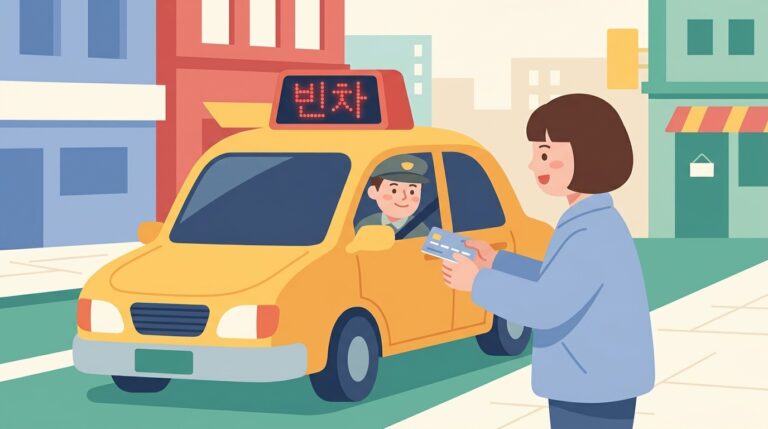
- Editor’s Insight: When the ride ends, simply hand over your card while saying this phrase with a warm smile.
- Situation Spectrum: Casual ✅ | Semi-formal ✅ | Formal ⚠️
Phase 3: Textbook Korean vs. Real-Life Korean
Let’s compare what dry textbooks teach you versus what Koreans actually say in real life.
Situation 1: Asking the driver to go to a destination
- 📖 Textbook Korean: 서울역으로 가 주시겠습니까? (Seo-ul-yeog-eu-ro ga ju-si-get-seup-ni-ka? – “Would you please take me to Seoul Station?”)
- 🗣️ Real-Life Korean: 서울역으로 가 주세요. (Seo-ul-yeog-eu-ro ga ju-se-yo. – “Please go to Seoul Station.”)
- 💡 Why the difference? The textbook version is grammatically correct but overly formal—almost like asking a royal guard. The real-life version is perfectly polite, natural, and easy to pronounce!
Situation 2: Asking if you can pay with a credit card
- 📖 Textbook Korean: 신용카드를 받아 주십니까? (Sin-yong-ka-deu-reul ba-da ju-sip-ni-ka? – “Do you accept credit cards?”)
- 🗣️ Real-Life Korean: 카드 돼요? (Ka-deu dwae-yo? – “Does card work? / Is card okay?”)
- 💡 Why the difference? Modern Korean taxis all accept cards by law. Asking if they accept it sounds like you’re doubting them! “카드 돼요?” is a super quick, friendly check.
Phase 4: K-Culture Deep Dive & Non-Verbal Manners
4-1. The “No-Handshake” Card Exchange (Manners matter!)
In Korea, when you hand your payment card to the driver, never use only one hand with your palm facing down—it can seem dismissive. Instead, hold the card with your right hand and gently touch your right forearm or elbow with your left hand. This is a subtle sign of deep respect! Alternatively, present the card holding it with both hands.
4-2. The Kakao T Revolution
Korea is all about 빨리빨리 (Ppal-li-ppal-li – Hurry, Hurry!) culture. Kakao Taxi allows you to select your destination, see the estimated fare, and pay automatically through the app. This means zero language barrier and zero risk of taxi scams!
Phase 5: Real-Life Roleplay Scenario
Meet Driver Kim (김 기사님), a friendly uncle-style driver who loves K-pop. You are trying to get to Hongdae (홍대).
- Scene: You open the door and step into the taxi.
- Driver Kim: 안녕하세요! 어디로 모실까요? (An-nyeong-ha-se-yo! Eo-di-ro mo-sil-kka-yo?)
- (Hello! Where can I take you?)
- You: 🎭 [Politely smiling] 홍대로 가 주세요. (Hong-dae-ro ga ju-se-yo.)
- (Please go to Hongdae.)
- Driver Kim: 네, 출발합니다! 한국말 잘하시네요! (Ne, chul-bal-ham-ni-da! Han-gug-mal jal-ha-si-ne-yo!)
- (Okay, starting the car! Your Korean is so good!)
- You: 🎭 [Blushing] 아니에요. 조금 해요. (A-ni-e-yo. Jo-geum hae-yo.)
- (No, just a little.)
- Driver Kim: 다 왔습니다. 여기서 내리시면 됩니다. (Da wat-seup-ni-da. Yeo-ghee-seo nae-ri-si-myeon doem-ni-da.)
- (We have arrived. You can get off here.)
- You: 🎭 [Looking out the window] 아, 저기 앞에서 세워 주세요. (Ah, jeo-ghee ap-e-seo se-wo ju-se-yo.)
- (Ah, please pull over in front of that spot.)
- Driver Kim: 알겠습니다. 요금은 만 원입니다. (Al-get-seup-ni-da. Yo-geum-eun man won-im-ni-da.)
- (Got it. The fare is 10,000 won.)
- You: 🎭 [Handing card with both hands] 카드로 할게요. 감사합니다! (Ka-deu-ro hal-ge-yo. Gam-sa-ham-ni-da!)
- (I’ll pay by card. Thank you!)
🔀 Interactive Choice!
How do you want to handle the payment?
* Choice A: You hand over your card with both hands and say: “카드로 할게요. (Ka-deu-ro hal-ge-yo.)”
* Choice B: You put cash on the dashboard and say: “돈 여기요. (Don yeo-gi-yo – Money here.)”
* Choice C: You show your app and say nothing.
Feedback:
- Choice A (Best): 🌟 Excellent! This is incredibly polite, natural, and shows great cultural awareness!
- Choice B (Bad): ⚠️ Putting cash directly on the dashboard or tossing it can feel disrespectful to older drivers. Try to hand it over directly with two hands!
- Choice C (Risk): 🚫 If you pre-paid on the app, you don’t need to do anything, but leaving without saying “감사합니다 (Thank you)” might make the ride feel cold.
Phase 6: 10-Second Emotion Shadowing Drill
Let’s practice speaking with real emotions! The slashes (/) mean “take a short breath.”
- [😊 Excited & Bright]
- “홍대로 / 가 주세요!”
- (Hong-dae-ro / ga ju-se-yo! / Please take me to Hongdae!)
- [🥺 Polite & Urgent]
- “여기서 / 세워 주세요!”
- (Yeo-gi-seo / se-wo ju-se-yo! / Please pull over here!)
- [💖 Warm & Grateful]
- “카드로 할게요 / 감사합니다!”
- (Ka-deu-ro hal-ge-yo / gam-sa-ham-ni-da! / I’ll pay by card, thank you!)
Phase 7: K-Culture Mini Dictionary
- 기사님 (Gi-sa-nim) | Driver / Chauffeur | Always call your taxi driver “기사님” to be instantly respectful. Never call them “아저씨 (Mister)” to their face.
- 빈차 (Bin-cha) | Empty Car | Look at the glowing red LED sign on the windshield. If it says “빈차”, the taxi is available!
- 예약 (Ye-yak) | Reserved | If the windshield sign glows blue/yellow and says “예약”, it means someone booked it via Kakao Taxi. Do not try to wave it down!
- 티머니 (T-money) | Transit Card | The magical card used for subways, buses, and yes—even taxis!
Phase 8: Survivor Kit for Travelers
Survival Vocab TOP 3
- 빨리 가 주세요 (Ppal-li ga ju-se-yo) | Please go quickly. | Pro Tip: Use this if you are running late for a K-pop concert!
- 천천히 가 주세요 (Cheon-cheon-hi ga ju-se-yo) | Please drive slowly. | Pro Tip: Perfect if the traffic feels a bit too fast or scary.
- 영수증 주세요 (Yeong-su-jeung ju-se-yo) | Please give me a receipt. | Pro Tip: Super useful if you need to keep track of travel expenses.
Editor’s Travel Note:
Before you land in Incheon, make sure to download the Kakao T App on Google Play/App Store. You can register your foreign credit card easily, avoiding any payment hiccups during your late-night adventures. Disclaimer: App interfaces and taxi fares may change, so always double-check the latest app updates!
Phase 9: “One Step Deeper” (Cultural Essay)
In many Western cultures, taxi rides are purely transactional. However, in Korea, stepping into a taxi is like entering a mini-living room. Korean drivers are famously chatty and love sharing travel tips, political opinions, or asking where you are from. This stems from 정 (Jeong)—the Korean concept of warm attachment and collective community. Don’t be afraid to try out your basic Korean; they will absolutely shower you with compliments!
💬 Your Turn: Have you ever ridden a taxi in another country? How was the driver? Let us know in the comments below!
Phase 10: FAQ & Common Mistakes
Q: Can I use Kakao Taxi without a Korean phone number?
A: Yes! You can sign up using your KakaoTalk account linked to your home country’s phone number. Just choose “Pay to driver” in the app if you cannot register your foreign card!
Q: What should I do if I leave my bag in a Korean taxi?
A: If you used the Kakao T app, you can easily find the driver’s contact info and license plate inside your ride history. This is why booking via app is a lifesaver!
Q: Is tipping taxi drivers expected in Korea?
A: No, tipping is not a part of Korean culture. Simply pay the exact fare shown on the meter.
🚨 Common Mistakes Alert!
- Mistake 1: Waving frantically at a taxi showing a red “예약” sign.
- Correct Action: Only wave at taxis showing a red “빈차” (Empty Car) sign.
- Mistake 2: Trying to open the door manually before the taxi stops.
- Correct Action: Korean taxis do not have automatic passenger doors like in Japan. Wait until the car fully stops, then open the door yourself.
- Mistake 3: Saying “고마워 (Go-ma-wo)” to the driver.
- Correct Action: “고마워” is casual. Always use the polite version: “감사합니다 (Gam-sa-ham-ni-da)”.
Phase 11: Action Mission & Challenge
- 🥉 Bronze Mission: Pronounce “여기서 세워 주세요” aloud 3 times in front of a mirror!
- 🥈 Silver Mission: Screenshot this guide and share your favorite key phrase on Instagram, tagging
@DailyHangul! - 🥇 Gold Mission: Next time you are in Korea, open Kakao Taxi, summon a cab, and say “안녕하세요, 홍대로 가 주세요” directly to the driver!
🎮 K-Culture Mission: Watch your favorite K-drama today and spot the moment a character gets into a taxi. Check if they pay with a card or say “감사합니다”!
Phase 12: Interactive Quiz Challenge
1. What does the red light “빈차” on a taxi windshield mean?
- A) Reserved
- B) Out of Service
- C) Empty Car (Available)
2. Fill in the blank: “Please stop here” is “여기서 _______ 주세요.”
- A) 가 (ga)
- B) 세워 (se-wo)
- C) 사 (sa)
👉 Click here to reveal the Answers & Explanations!
- Question 1 Answer: C) Empty Car (Available). “빈 (Bin)” means empty, and “차 (Cha)” means car! You can safely hail this taxi.
- Question 2 Answer: B) 세워 (se-wo). “세워 주세요” means “please stop/pull over.”






