

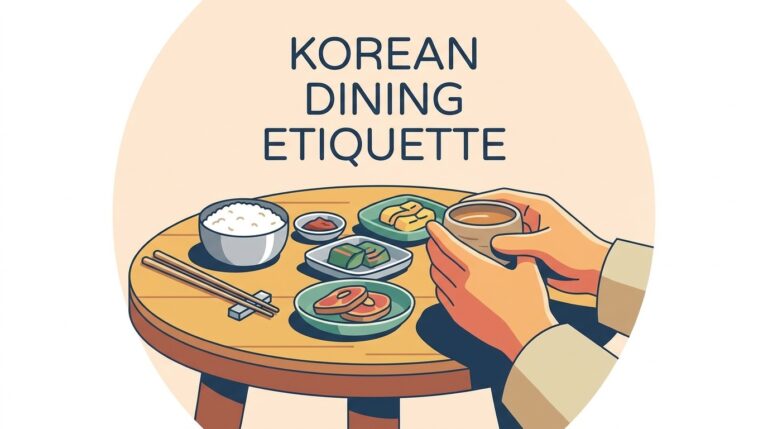
Hold on! Don’t Lift Your Bowl: The Ultimate Guide to Korean Table Etiquette
Phase 1: Empathy (Welcome, My Friend!)
안녕하세요! (An-nyeong-ha-se-yo!) I’m your Daily Hangul editor and your personal cultural navigator.
Imagine this: You are sitting at a cozy, traditional restaurant in Seoul with your new Korean friends or colleagues. The table is filled with delicious, sizzling Samgyeopsal (pork belly) and an array of colorful side dishes (banchan). You are hungry, excited, and ready to dig in. You pick up your rice bowl to eat it comfortably, just like you might do in other Asian countries—but suddenly, you notice a subtle, polite tension in the air. Your friend gently whispers, “Ah, in Korea, we keep the bowl on the table!”
Don’t worry! This is a super common cultural slip-up for many Korean learners. Korean dining is beautiful, communal, and filled with warmth, but it also comes with its own unique set of unwritten rules.
Today, we are going to master Korean Table Etiquette (식사 예절 – Sik-sa Ye-jeol). By the end of this guide, you won’t just know what to say; you’ll understand why these customs exist, making you the most polite and beloved guest at any Korean dinner table. Let’s dig in!
Phase 2: Top 3 Essential Expressions for Dining
1. 잘 먹겠습니다 (Jal meok-ge-sseum-ni-da)
- Pronunciation: Jal meok-ge-sseum-ni-da (Sounds like “Jahl muck-get-sum-nee-dah”)
- Meaning: “I will eat well.” (Similar to “Bon appétit” or saying grace before a meal)
- K-Culture Moment: In almost every K-Drama, before the characters pick up their chopsticks, they clasp their hands together, look at the person who prepared or bought the food, and say this with a bright smile.
- Editor’s Insight: This is a magical phrase of gratitude. It shows respect to the host, chef, or whoever is paying for the meal. Even if you are eating with close friends, saying this makes you look incredibly thoughtful.
- Situation Spectrum: Casual (✅), Semi-formal (✅), Formal (✅)
- 🤔 Think About It: Why does Korean culture place such a high value on expressing gratitude before tasting the food? How does this compare to how you start a meal in your home country?
2. 맛있게 드세요 (Ma-sit-ge deu-se-yo)
- Pronunciation: Ma-sit-ge deu-se-yo (Sounds like “Mah-sheet-gae-deu-sae-yo”)
- Meaning: “Please eat deliciously.”
- K-Culture Moment: You will hear restaurant owners say this as they place a steaming bowl of Kimchi Jjigae in front of you. You can also say this to your older dining companions or colleagues.
- Editor’s Insight: This is the polite way to wish others a good meal. Note that you only say this to others; you do not say it to yourself!
- Situation Spectrum: Casual (⚠️ – use “맛있게 먹어” with close friends), Semi-formal (✅), Formal (✅)
- 🤔 Think About It: The word “맛있게” literally means “deliciously.” Isn’t it charming that Koreans wish for your actual physical experience of the food to be joyful?
3. 잘 먹었습니다 (Jal meok-eot-seum-ni-da)
- Pronunciation: Jal meok-eot-sum-ni-da (Sounds like “Jahl muck-ut-sum-nee-dah”)
- Meaning: “I have eaten well.”
- K-Culture Moment: After a satisfying K-BBQ feast, characters in dramas will pat their stomachs, lean back, and say this to the person who paid.
- Editor’s Insight: This is the essential closing bracket to your meal. Never leave a table without saying this! It acknowledges that the food was wonderful and that you appreciate the effort or money spent on it.
- Situation Spectrum: Casual (✅ – “잘 먹었어”), Semi-formal (✅), Formal (✅)
- 🤔 Think About It: In some cultures, leaving a clean plate is the ultimate compliment. In Korea, saying this phrase out loud is just as important as finishing your food!
Phase 3: Textbook Korean vs. Real-Life Korean
Let’s look at how textbooks teach dining and how Koreans actually talk at the table.
Scenario 1: Asking if the food is good
- 📖 Textbook Korean: “음식이 맛있습니까?” (Eum-sig-i ma-sit-seum-ni-ka? – Is the food delicious? – Very stiff and robotic)
- 🗣️ Real-Life Korean: “입맛에 맞으세요?” (Im-ma-se ma-jeu-se-yo? – Does it fit your taste?)
- 💡 Why the difference? Koreans prefer asking if the food “fits your taste” rather than asking objectively if the food is “good.” It is a softer, more polite, and caring way to check on your guest.
Scenario 2: Declining more food because you are full
- 📖 Textbook Korean: “저는 배가 부릅니다.” (Jeo-neun bae-ga bu-reup-ni-da. – I am full. – Sounds like a military report)
- 🗣️ Real-Life Korean: “정말 맛있는데, 너무 배불러서요.” (Jeong-mal ma-sin-neun-de, neo-mu bae-bul-leo-seo-yo. – It’s really delicious, but I’m just so full…)
- 💡 Why the difference? Just saying “I’m full” can sound a bit abrupt. By adding “It’s really delicious, but…” first, you protect the host’s feelings while politely declining more food.
Phase 4: K-Culture Deep-Dive & Non-Verbal Manners
4-1. The Art of “Nunchi” (눈치) at the Table
Nunchi is Korea’s super-power of sensing other people’s feelings and needs without them saying a word. At a Korean dining table, Nunchi is in full play:
1. The Eldest Eats First: Never pick up your spoon or chopsticks until the oldest person at the table has picked up theirs. This is a crucial sign of respect.
2. The Bowl Stays on the Table: Unlike in China or Japan, lifting your rice bowl while eating is traditionally seen as bad manners. Keep it firmly on the table and use your spoon to eat the rice.
3. Spoon vs. Chopsticks: Do not hold both in one hand at the same time. Use the spoon for rice and soup, and the chopsticks for dry side dishes.
4-2. Sharing is Caring: Communal Dishes
In Korean culture, food is sharing. Many dishes like Budae Jjigae (army stew) or Galbi are served in one big pot or grill in the middle.
* Pro Tip: Use the serving utensils if provided. If not, it is culturally acceptable to use your own spoon to scoop soup, but make sure not to double-dip excessively if you want to be extra polite. When in doubt, watch how your Korean friends do it (Nunchi in action!).
Phase 5: Real-Life Roleplay Scenario
Setting: You are invited to dinner by your Korean team leader, Mr. Kim (김 부장님), at a traditional Korean restaurant. You want to make a fantastic impression!
Characters:
- Mr. Kim: A warm but traditional Korean manager.
- You: An eager-to-learn A2 student.
The 8-Turn Dialogue:
- Mr. Kim: (Gestures to the food) 자, 많이 드세요! 오늘 고생 많았어요.
(Ja, ma-ni deu-se-yo! O-neul go-saeng ma-na-sseo-yo.)
“Go ahead, eat a lot! You worked hard today.” -
You: 🎭 (Clasping hands together politely with a smile) 네, 부장님! 잘 먹겠습니다!
(Ne, bu-jang-nim! Jal meok-ge-sseum-ni-da!)
“Yes, Manager! I will eat well!” -
Mr. Kim: 🎭 (Smiling, watching you wait for him to eat first) 오, 예의가 바르시네요. 먼저 드셔도 되는데.
(O, ye-ui-ga ba-reu-si-ne-yo. Meon-jeo deu-syeo-do dwen-neun-de.)
“Oh, you have great manners. You could have started first.” -
You: 🎭 (Shaking head gently, showing respect) 아닙니다. 먼저 드세요!
(A-nip-ni-da. Meon-jeo deu-se-yo!)
“No, please. You go first!” -
Mr. Kim: 🎭 (Takes a bite, then nods) 그래요. 자, 삼겹살도 좀 먹어봐요. 입맛에 맞아요?
(Geu-rae-yo. Ja, sam-gyeop-sal-do jom meo-geo-bwa-yo. Im-ma-se ma-ja-yo?)
“Alright. Here, try some pork belly too. Does it fit your taste?” -
You: 🎭 (Chewing, then widening eyes in delight) 와, 정말 맛있어요! 입맛에 딱 맞아요.
(Wa, jeong-mal ma-si-sseo-yo! Im-ma-se ttak ma-ja-yo.)
“Wow, it’s really delicious! It fits my taste perfectly.” -
Mr. Kim: (Laughs happily) 하하, 다행이네요. 많이 먹어요!
(Ha-ha, da-haeng-i-ne-yo. Ma-ni meo-geo-yo!)
“Haha, I’m glad. Eat a lot!” -
You: 🎭 (Bowing slightly at the end of the meal) 부장님, 정말 잘 먹었습니다. 감사합니다!
(Bu-jang-nim, jeong-mal jal meok-eot-seum-ni-da. Gam-sa-ham-ni-da!)
“Manager, I really ate well. Thank you!”
🔀 Interactive Choice Point
Mr. Kim offers to pour you a glass of traditional Korean beverage (Soju or plum juice), but you already have your hands full holding your cup with one hand. What do you do?
- A. Accept the pour with one hand while smiling brightly.
- B. Hold your cup with both hands, bowing your head slightly.
- C. Say “No thanks, I’ll pour it myself!” and grab the bottle.
Feedback:
- If you chose A (Bad): ⚠️ Oh no! Receiving a drink with one hand from an older/higher-status person is considered disrespectful in Korea.
- If you chose B (Best): 🎉 Perfect! Holding your cup with both hands (or supporting your right forearm with your left hand) shows excellent respect and manners. Mr. Kim will be highly impressed!
- If you chose C (Risk): 🚫 Double trouble! Pouring your own drink (맞잔/Mat-jan) when someone offers to pour for you is a social faux pas, and rejecting the offer too bluntly can break the harmony.
Phase 6: 10-Second Emotion Shadowing Drill
Practice these sentences with the right rhythm and emotion to sound natural!
- [😊 Expressing bright excitement before eating]
- “네! / 잘 먹겠습니다!” (Ne! / Jal meok-ge-sseum-ni-da!)
- Rhythm Tip: Say ‘Ne’ briefly, pause, and say ‘Jal meok-ge-sseum-ni-da’ with an upbeat, rising tone at the end.
- [😋 Showing genuine appreciation for the flavor]
- “와! / 진짜 / 맛있어요!” (Wa! / Jin-jja / ma-si-sseo-yo!)
- Rhythm Tip: Put energy into ‘Wa!’, stress ‘Jin-jja’ (really), and say ‘ma-si-sseo-yo’ smoothly.
- [🙇♂️ Expressing heartfelt gratitude after a great meal]
- “부장님, / 정말 / 잘 먹었습니다!” (Bu-jang-nim, / jeong-mal / jal meok-eot-sum-ni-da!)
- Rhythm Tip: Keep a respectful, steady tone. Bow your head slightly as you say ‘Jal meok-eot-sum-ni-da’.
Phase 7: K-Culture Mini Dictionary
- 식사 예절 (Sik-sa Ye-jeol) | Table Manners
- The collective set of rules, both traditional and modern, that guide polite dining behavior in Korea.
- 공기밥 (Gong-gi-bap) | Stainless Steel Rice Bowl
- The classic, covered metal bowl in which individual portions of rice are served at Korean restaurants. Always keep it on the table!
- 반찬 (Banchan) | Side Dishes
- The small dishes served alongside the main meal. They are usually refillable for free! Feel free to ask: “반찬 좀 더 주시겠어요?” (Banchan jom deo ju-si-ge-sseo-yo? – Could we have some more side dishes?)
- 건배 (Geon-bae) | Cheers
- Literally means “empty glass.” When clinking glasses, make sure the rim of your glass is slightly lower than your senior’s glass to show respect.
Phase 8: Survivor Kit for Travelers
Survival Phrases TOP 3
- 여기요, 물 좀 주세요.
- Yeo-gi-yo, mul jom ju-se-yo.
- Pro Tip: “Excuse me, please give us some water.” (Korean restaurants usually provide water for free, but sometimes you need to ask or get it yourself from a ‘셀프’ self-service corner).
- 이거 앞접시 좀 주세요.
- I-geo ap-jeop-si jom ju-se-yo.
- Pro Tip: “Please give me an extra small plate.” (An ap-jeop-si is essential for sharing communal stews cleanly).
- 계산해 주세요.
- Gye-san-hae ju-se-yo.
- Pro Tip: “Please check/bill.” (In Korea, you usually pay at the counter near the exit rather than at your table. Take the table slip with you to the counter!).
Editor’s Travel Note
When traveling in Korea, finding the restaurant and navigating the menu can be tricky. Skip global maps which are not fully functional in Korea due to security regulations. Instead, download the Naver Map App for flawless walking directions, and use the Kakao T App if you need to hail a taxi to your dining destination.
Note: App user interfaces and local transport policies are subject to updates by providers.
Phase 9: A Step Deeper (Reflection)
In many Western cultures, dining etiquette is focused heavily on individual mechanics—how you hold your fork, which spoon to use first, and keeping personal space. In Korea, however, table manners are a direct reflection of collectivism and age-based hierarchy (존댓말 문화).
Waiting for the eldest to eat, keeping the bowl on the table (so you don’t look rushed or greedy), and pouring drinks for others before yourself are acts designed to prioritize the group’s harmony over individual comfort. Eating is not just consuming food; it is an act of building community (Jeong – 정).
💬 Your Turn: Have you ever noticed a table manner in your own country that might surprise a Korean friend? Let us know in the comments below!
Phase 10: FAQ & Common Mistakes
Q: Can I use my fingers to eat certain Korean foods?
A: Generally, no. Even for foods like Korean fried chicken or ribs, Koreans prefer using mini plastic gloves, tongs, or chopsticks. Keep your hands clean and use the tools provided!
Q: What should I do if I can’t eat spicy food or have allergies?
A: It is perfectly polite to state this beforehand! You can say: “저는 매운 것을 잘 못 먹어요” (Jeo-neun mae-un geo-seul jal mot meo-geo-yo – I can’t eat spicy food well) or “알레르기가 있어요” (Al-le-reu-gi-ga i-sseo-yo – I have an allergy).
Q: Is it okay to blow my nose at the dining table?
A: Absolutely not! Blowing your nose at the table is considered highly impolite in Korea. If you need to blow your nose, step away to the restroom or outside.
🚨 Common Mistakes Alert!
- Sticking chopsticks straight up in the rice:
- Why: This resembles incense sticks used in Korean ancestral funeral rites. It is considered very bad luck. Always rest them on a chopstick holder or the side of your plate.
- Leaving the spoon face down:
- Why: Your spoon should always face up, resting politely next to your bowl.
- Pouring your own drink first:
- Why: Pouring for others is the norm. Wait for someone to offer, or offer to pour for others first.
Phase 11: Action Mission
- 🥉 Bronze Mission: Practice saying “잘 먹겠습니다” (Jal meok-ge-sseum-ni-da) aloud 5 times in front of the mirror before your next meal!
- 🥈 Silver Mission: Share this post on your social media with the hashtag
#DailyHanguland tag a friend you want to eat K-BBQ with! - 🥇 Gold Mission: Next time you visit a Korean restaurant, wait for your meal, look at the server or your companion, and say “잘 먹겠습니다” with confidence!
Phase 12: Interactive Quiz Challenge
Test your new skills! Click the details below to reveal the answers.
1. Which of the following is considered BAD manners at a Korean table?
- A) Keeping the rice bowl on the table.
- B) Lifting the rice bowl close to your mouth.
- C) Waiting for the oldest person to pick up their spoon first.
👉 Click here to see the answer!
Correct Answer: B
Explanation: Unlike some other Asian cultures, in Korea, lifting your rice bowl is considered impolite. Keep it on the table!
2. Fill in the blank: Before you start eating, you should say “________!”
- A) 잘 먹었습니다 (Jal meok-eot-seum-ni-da)
- B) 잘 먹겠습니다 (Jal meok-ge-sseum-ni-da)
- C) 맛있게 드세요 (Ma-sit-ge deu-se-yo) – said to myself
👉 Click here to see the answer!
Correct Answer: B
Explanation: “잘 먹겠습니다” is said before eating. “잘 먹었습니다” is said after you finish!
3. True or False: It is perfectly fine to blow your nose at the dining table if the soup is very spicy.
👉 Click here to see the answer!
Correct Answer: False
Explanation: Blowing your nose at the table is considered rude. Excuse yourself to the restroom if needed!






