

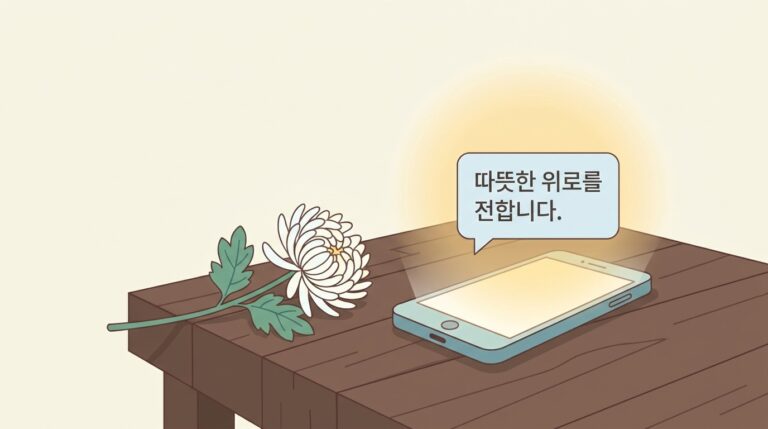
Handling Sad News: How to Reply to a Korean Obituary Text (부고 문자) with Care and Respect
안녕하세요! It’s your friendly Daily Hangul editor and Korean culture navigator. 💖
Have you ever received a text message in Korean that made your heart sink? You recognize the word for “funeral” or “passing away,” but you freeze. What do you say? How do you express your deepest condolences in a language that isn’t your first, without sounding awkward or insensitive?
In Korea, receiving an obituary text (부고 문자 – bugo munja) is a sensitive moment. Even native Koreans pause to choose their words carefully. Today, I’ll guide you through the exact, respectful phrases to use, the “Nunchi” (social intuition) behind them, and how to respond with the warmth of a true friend. Let’s learn how to navigate this delicate situation together.
Phase 2: Three Essential Condolence Phrases
1. 삼가 고인의 명복을 빕니다 (sam-ga go-in-ui myeong-bog-eul bim-ni-da)
- Pronunciation: Sahm-gah go-een-wee myeong-bohg-eul beem-nee-dah (Think of “sahm-gah” like “psalm-gah”).
- Meaning: “I pray for the soul of the deceased to rest in peace.”
- K-Culture Moment: This is the absolute standard phrase. You will see this written on black-and-white ribbons in Korean dramas when characters visit a funeral hall (장례식장 – jang-rye-sik-jang).
- Editor’s Insight: This is a highly formal, traditional phrase rooted in Buddhist/Confucian heritage, but used universally today regardless of religion. Keep in mind: never use emoji faces or exclamation marks with this sentence.
- Situation Spectrum: Casual: 🚫 | Semi-formal: ⚠️ | Formal: ✅
- 🤔 Think About It: In your culture, is it common to use a fixed religious or traditional phrase when someone passes away, or do you prefer more personalized messages?
2. 마음이 얼마나 아프실지 감히 상상조차 못 하겠습니다 (ma-eum-i eol-ma-na a-peu-sil-ji gam-hi sang-sang-jo-cha mot ha-get-seum-ni-da)
- Pronunciation: Mah-eum-ee eol-mah-nah ah-peush-eel-jee gahm-hee sahng-sahng-joh-chah moht hah-get-seum-nee-dah.
- Meaning: “I cannot even begin to imagine how much your heart must ache.”
- K-Culture Moment: Used by close friends or colleagues when they want to show deep emotional empathy rather than just repeating a formal idiom.
- Editor’s Insight: This shows a very high level of empathy. By saying “I dare not even imagine” (감히 상상조차 못 하다), you respect the uniqueness of their grief.
- Situation Spectrum: Casual: ⚠️ | Semi-formal: ✅ | Formal: ✅
- 🤔 Think About It: Why is acknowledging that you “cannot imagine” someone’s pain comforting? How does this compare to saying “I know how you feel”?
3. 큰 슬픔에 깊은 위로를 전합니다 (keun seul-peum-e gip-eun wi-ro-reul jeon-ham-ni-da)
- Pronunciation: Keun seulp-eum-eh geep-eun wee-roh-reul jeon-hahm-nee-dah.
- Meaning: “I send my deepest condolences for your great loss/sadness.”
- K-Culture Moment: Frequently used in professional settings, such as sending a message to a business partner or co-worker.
- Editor’s Insight: Clean, respectful, and safe. If you aren’t extremely close but want to show sincere respect, this is your go-to phrase.
- Situation Spectrum: Casual: 🚫 | Semi-formal: ✅ | Formal: ✅
- 🤔 Think About It: How do professional boundaries shape the way we express grief in your home country?
Phase 3: Textbook Korean vs. Real-Life Korean
When replying to an obituary text, using textbook phrases can sometimes sound either too cold or mismatched. Let’s look at how to adapt.
Case 1: Texting a Close Friend
- 📖 Textbook: 삼가 고인의 명복을 빕니다. (Too formal for a best friend)
- 🗣️ Real-Life: 갑작스러운 소식에 너무 놀랐어. 내가 어떤 말로도 위로가 안 되겠지만… 힘내자. 무슨 일 있으면 꼭 연락해. (“I was so shocked by the sudden news. I know no words can comfort you right now… Stay strong. Please call me if you need anything.”)
- 💡 Why is it different? While “삼가 고인의 명복을 빕니다” is respectful, sending only that to a very close friend can feel distant and detached. Speaking from the heart with “힘내자” (stay strong) shows genuine connection.
Case 2: Texting a Colleague / Senior
- 📖 Textbook: 위로를 드립니다. (A bit too brief/casual)
- 🗣️ Real-Life: 어떠한 말로도 위로가 되지 않겠지만 깊은 애도를 표합니다. (“Although no words can comfort you, I express my deepest condolences.”)
- 💡 Why is it different? Adding “어떠한 말로도 위로가 되지 않겠지만” acknowledges the limits of words, making your message sound much more thoughtful and respectful of their space.
Phase 4: K-Culture Deep Dive & Non-verbal Manners
4-1. Nunchi (눈치) & Texting Etiquette
- Timing is key: When you receive an obituary text, reply within 1-2 hours. You don’t need to call immediately, as the bereaved family is extremely busy organizing the funeral (장례). A quiet, respectful text message is highly appreciated.
- What to avoid: Never ask “How did they die?” (어떻게 돌아가셨어요?). In Korean culture, asking for details immediately is considered highly intrusive and rude. Keep the focus entirely on comforting them.
4-2. Cultural Codes in K-Dramas
Have you noticed in K-Dramas like My Mister (나의 아저씨) or Hospital Playlist (슬기로운 의사생활) that friends gather and stay through the night at the funeral hall? This is called 문상 (munsang) or 조문 (jomun). If you are invited or informed, replying politely to the text is the very first step of this important ritual.
Phase 5: Real-life Roleplay Scenario
The Situation: You receive a group obituary text from your Korean coworker, Min-su (민수), whose father has sadly passed away. You need to reply to him respectfully.
- Min-su (Coworker): [부고] 저의 부친께서 별세하셨기에 삼가 알려드립니다. (Obituary: I respectfully inform you that my father has passed away.)
- You: (🎭 Replying with a heavy but respectful heart) 민수 씨, 갑작스러운 비보에 마음이 너무 아픕니다. (Min-su, my heart aches so much at this sudden sad news.)
- Min-su: 위로해 주셔서 감사합니다. (Thank you for comforting me.)
- You: (🎭 Expressing respect for his father) 삼가 고인의 명복을 빕니다. (I pray for the deceased to rest in peace.)
- Min-su: 장례식은 서울병원 장례식장에서 치러집니다. (The funeral is being held at the Seoul Hospital Funeral Hall.)
- You: (🎭 Letting him know you’ll be thinking of him even if you cannot go) 직접 찾아뵙고 위로해 드려야 하는데, 그러지 못해 정말 죄송합니다. 멀리서나마 깊은 애도를 표합니다. (I should visit and comfort you in person, but I am so sorry I cannot. I send my deepest condolences from afar.)
- Min-su: 신경 써 주신 것만으로도 큰 힘이 됩니다. 정말 고맙습니다. (Just your thoughts are a huge comfort to me. Thank you so much.)
- You: (🎭 Wishing him strength to close the chat respectfully) 네, 몸 건강히 장례 잘 치르시길 바랍니다. 힘내세요. (Yes, I hope you take care of your health while handling the funeral. Please stay strong.)
🔀 Interactive Choice Point
How would you respond if Min-su asks you if you can make it to the funeral?
* A) “일이 바빠서 못 가요. 미안해요.” (I’m busy with work so I can’t go. Sorry.)
* B) “부득이한 사정으로 참석하지 못해 죄송합니다. 마음으로나마 함께하겠습니다.” (I am sorry I cannot attend due to unavoidable circumstances. I will be with you in spirit.)
* C) “언제 끝나요? 갈 수 있으면 갈게요.” (When does it end? I’ll go if I can.)
Feedback:
- Choice A (Bad): Too direct and informal. It can sound selfish during a sensitive time.
- Choice B (Best): Perfect. Highly polite, acknowledges your absence with regret, and expresses heartfelt support.
- Choice C (Risk): Too casual and puts pressure on the bereaved to check schedules.
Phase 6: 10-Second Emotional Shadowing Drill
When speaking these phrases, a low, gentle, and slow tone is essential. Practice pausing at the / marks.
[🥺 Sincerely and quietly]
삼가 / 고인의 / 명복을 / 빕니다.
(sam-ga / go-in-ui / myeong-bog-eul / bim-ni-da)-
[😔 With deep empathy]
갑작스러운 / 소식에 / 너무 / 놀랐어. / 힘내자.
(gap-jak-seu-reo-un / so-sik-e / neo-mu / nol-las-seo. / him-nae-ja)
Phase 7: K-Culture Mini Dictionary
- 부고 (Bugo): Obituary notice. Usually sent via SMS or KakaoTalk to friends, relatives, and colleagues.
- 조의금 (Joeuigeum): Condolence money. In Korea, guests bring cash in a white envelope to help the family cover funeral costs.
- 상주 (Sangju): The chief mourner (usually the eldest son or closest family member) who hosts the funeral.
- 국화 (Gukhwa): White chrysanthemum. The traditional flower used to pay respect at Korean funerals.
Phase 8: Survivor Kit for Travelers
Survival Phrases TOP 3
- 상주님께 깊은 위로를 전합니다. (I send my deepest condolences to the chief mourner.) – Use when meeting the family.
- 좋은 곳으로 가셨을 거예요. (They must have gone to a better place.) – Comforting phrase for friends.
- 도와줄 일이 있으면 언제든 말해줘. (If there’s anything I can do to help, let me know anytime.) – For close friends.
Editor’s Travel Note
If you ever need to attend a Korean funeral in person, you can locate the hospital’s funeral hall easily using Naver Map (네이버 지도). Always wear dark, conservative colors (black is best) and avoid wearing bright or flashy accessories. Note: Funeral customs can vary slightly depending on family traditions.
Phase 9: “A Step Deeper” (Cultural Reflection)
In Korean society, sharing grief (슬픔을 나누다) is considered the ultimate test of a relationship. Koreans often say, “It is more important to show up at a funeral than a wedding.” While a wedding is a happy celebration, a funeral is a time of vulnerability, and being there—or sending a heartfelt message—creates a bond of trust that lasts a lifetime.
💬 Your Turn: How does your culture view the balance between celebrating happy moments vs. comforting sad ones? Let us know in the comments below!
Phase 10: FAQ & Avoiding Misunderstandings
Q: Can I send emojis like 😭 or 🙏 in an obituary reply?
A: It is highly recommended not to use emojis in formal replies. Emojis can sometimes lighten the tone or appear too casual. Stick to respectful text.
Q: Is it okay to call instead of texting?
A: If you are a very close friend, a call is fine. But for colleagues, acquaintances, or business contacts, a text message is much better because they are busy answering hundreds of visitors and organizing arrangements.
Q: What color should I wear if I go to pay respects?
A: Black or very dark navy/grey. Avoid red, yellow, or any bright colors. Men wear suits, and women wear neat, long pants or a skirt with dark socks/stockings (bare feet are considered disrespectful).
🚨 Common Mistakes Alert!
- Mistake: Sending “축하드립니다” (Congratulations) by copying the wrong saved template.
- Correct Action: Double-check every letter. Ensure you are sending “깊은 애도를 표합니다” (deep condolences).
Phase 11: Action Mission
- Bronze: Write down “삼가 고인의 명복을 빕니다” on a piece of paper to practice your spelling.
- Silver: Bookmark this page so you can instantly access these polite templates when you receive sudden news in Korea.
- Gold 🎮 K-Culture Mission: Watch a funeral scene in a K-drama (like Goblin or My Mister) and listen to how characters greet the bereaved family.
Phase 12: Interactive Quiz Challenge
Test your understanding of Korean funeral text etiquette!
Q1. Which phrase is the most appropriate to send to a coworker who lost their family member?
- 생일 축하해요!
- 삼가 고인의 명복을 빕니다.
- 대박! 힘내요.
Click for Answer & Explanation
Correct Answer: 2
Explanation: “삼가 고인의 명복을 빕니다” is the standard, most respectful way to express condolences. 1 means “Happy Birthday” and 3 is way too casual (“Awesome! Stay strong”).
Q2. True or False: You should ask for details about how the person passed away to show you care.
- True
- False
Click for Answer & Explanation
Correct Answer: False
Explanation: In Korea, asking “Why?” or “How?” immediately upon hearing the news is considered rude and can cause more pain to the family. Keep your messages strictly supportive.






