

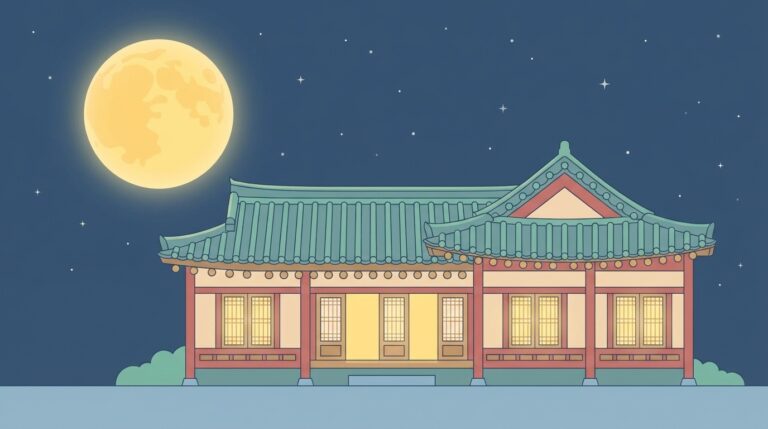
Master Counting “15 Days” in Korean: The Magic Word “Boreum” (보름)
안녕하세요! (An-nyeong-ha-se-yo!) Hello, my lovely Hangul friends! I’m your senior editor and neighborhood culture navigator from Daily Hangul.
Have you ever planned a trip to Korea, or perhaps looked at your favorite K-pop star’s schedule, and wondered how Koreans count a fortnight? Counting days in Korean can feel like a maze. Just when you think you have “일, 이, 삼” (il, i, sam – 1, 2, 3) or “하나, 둘, 셋” (ha-na, dul, set – 1, 2, 3) down, a native speaker drops a word like 보름 (bo-reum).
Imagine you are booking a hanok stay in Bukchon Hanok Village. You want to stay for exactly two weeks and a day (15 days). Instead of calculating “십오 일” (sip-o il), a friendly local host smiles and says: “보름 동안 계시는군요!” (So you are staying for a boreum!)
Today, we will conquer this beautiful, traditional word together. It’s super easy, and by the end of this post, you’ll sound like a true Seoul local!
Phase 2: Top 3 Essential Expressions
1. 보름 (bo-reum)
- Pronunciation: “Bo-rum” (Rhymes with “drum” but starts with a soft ‘b’ sound like in “boy”).
- Meaning: Exactly 15 days (a fortnight) or a full moon.
- K-Culture Moment: In historical K-dramas (사극 – Sa-geuk), lovers often promise to meet again “when the 보름달 (bo-reum-dal – full moon) rises,” which literally meant in 15 days!
- Editor’s Insight: While “십오 일” (sip-o il) is mathematically correct, “보름” carries a warm, poetic, and cozy feeling of completion.
- Situation Spectrum: Casual (✅) | Semi-formal (✅) | Formal (✅)
- 🤔 Think About It: In English, we use “fortnight” (14 nights). Why do you think Korean culture measures time by 15 days (the half-cycle of the moon)?
2. 보름 동안 (bo-reum dong-an)
- Pronunciation: “Bo-rum dong-ahn”
- Meaning: For 15 days / For a fortnight.
- K-Culture Moment: When a character in a drama goes on a secret training retreat or takes a brief hiatus, they say they’ll be gone “보름 동안.”
- Editor’s Insight: “동안” means “during” or “for.” Just attach it after “보름” to show duration!
- Situation Spectrum: Casual (✅) | Semi-formal (✅) | Formal (✅)
3. 보름 남았어요 (bo-reum nam-as-seo-yo)
- Pronunciation: “Bo-rum nah-maht-suh-yo”
- Meaning: There are 15 days left.
- K-Culture Moment: Counting down to a big concert or the release of a highly anticipated comeback album.
- Editor’s Insight: “남았어요” means “remains/left.” Use this to show your excitement for upcoming events!
- Situation Spectrum: Casual (✅) | Semi-formal (✅) | Formal (⚠️ – use “남았습니다” for very formal settings)
Phase 3: Textbook Korean vs. Real-Life Korean
Situation 1: Booking a Stay
- 📖 Textbook: “십오 일 동안 여행해요.” (Sip-o il dong-an yeo-haeng-hae-yo.) – I am traveling for 15 days.
- 🗣️ Real Life: “보름 동안 여행해요.” (Bo-reum dong-an yeo-haeng-hae-yo.)
- 💡 Why the difference? While “십오 일” is perfectly understandable, using “보름” sounds incredibly natural, warm, and shows you understand Korean culture.
Situation 2: Waiting for a Friend’s Return
- 📖 Textbook: “십오 일 후에 만나요.” (Sip-o il hu-e man-na-yo.) – Let’s meet in 15 days.
- 🗣️ Real Life: “보름 뒤에 봐요!” (Bo-reum dwi-e bwa-yo!) – See you in a fortnight!
- 💡 Why the difference? “뒤에” (dwi-e) means “after/later” and flows much better in casual daily conversations than “후에” (hu-e).
Phase 4: K-Culture Deep Dive & Non-verbal Manners
4-1. Gestures and “Nunchi” (눈치)
When talking about a “보름” (15 days), Koreans often make a small circular gesture with their hand to represent the “full moon” (보름달), which is where the word originates. If you are negotiating a stay or a rental, saying “보름” with a warm smile and a polite head nod shows great “Nunchi” (tact/social grace) and respect for traditional phrasing.
4-2. The Moon Cycle Culture
In Korea, the lunar calendar historically dictated daily life. The 15th day of the lunar month is always the full moon. This is why “보름” is not just a dry number; it’s a cozy concept associated with abundance, family reunions, and making wishes!
Phase 5: Real-Life Roleplay Scenario
Setting: A cozy hanok guesthouse lobby in Jeonju. You are speaking with Min-ji (민지), the warm and helpful guesthouse owner.
- Min-ji: 안녕하세요! 한국 여행은 얼마 동안 하세요?
(An-nyeong-ha-se-yo! Han-guk yeo-haeng-eun eol-ma dong-an ha-se-yo?)
🎭 [Smiling warmly while wiping the counter]
“Hello! How long are you traveling in Korea?” - You: 안녕하세요! 보름 동안 여행해요.
(An-nyeong-ha-se-yo! Bo-reum dong-an yeo-haeng-hae-yo.)
🎭 [Politely nodding and smiling]
“Hello! I am traveling for 15 days.” - Min-ji: 우와, 보름이나요? 정말 좋겠어요!
(U-wa, bo-reum-i-na-yo? Jeong-mal jok-get-seo-yo!)
🎭 [Clapping hands in delight]
“Wow, for a whole fortnight? That must be so nice!” - You: 네! 전주에서는 3일 있어요.
(Ne! Jeon-ju-e-seo-neun sam-il is-seo-yo.)
🎭 [Showing three fingers]
“Yes! I am staying in Jeonju for 3 days.” - Min-ji: 전주 비빔밥은 드셔보셨어요?
(Jeon-ju bi-bim-bap-eun deu-shyeo-bo-shyeot-eo-yo?)
🎭 [Making an eating gesture]
“Have you tried Jeonju Bibimbap?” - You: 아직이요. 추천해 주세요!
(A-jik-i-yo. Chu-cheon-hae ju-se-yo!)
🎭 [Curious and eager eyes]
“Not yet. Please recommend a place!” - Min-ji: 숙소 바로 옆에 진짜 맛집이 있어요!
(Suk-so ba-ro yeop-e jin-jja mat-jib-i is-seo-yo!)
🎭 [Pointing next door with a thumb]
“There is a really famous restaurant right next to the guesthouse!” - You: 감사합니다! 오늘 꼭 갈게요.
(Gam-sa-ham-ni-da! O-neul kkok gal-ge-yo.)
🎭 [Bowing head slightly in appreciation]
“Thank you! I will definitely go today.”
🔀 Interactive Choice!
How would you ask Min-ji if you could extend your stay by another 15 days?
* Option A: “15일 더 있을 수 있어요?” (Sip-o il deo is-seul su is-seo-yo?)
* Option B: “보름 더 있을 수 있어요?” (Bo-reum deo is-seul su is-seo-yo?)
* Option C: “보름달 주세요.” (Bo-reum-dal ju-se-yo.)
Feedback:
- Option A (Good but basic): Fully correct, but misses the warm native touch.
- Option B (Best!): Perfect! Min-ji will be amazed by your natural Korean.
- Option C (Oh No!): This means “Please give me the full moon.” You might get a laugh, but not a room extension!
Phase 6: 10-Second Emotion Shadowing Drill
Let’s practice speaking with real Korean emotion! Use the slash (/) as a tiny pause marker.
- [😊 Excitedly counting down to your K-pop idol’s comeback]:
- “컴백이 / 보름 / 남았어요!”
(Keom-baek-i / bo-reum / nam-as-seo-yo!)
-> “Only 15 days left / until the comeback!”
- “컴백이 / 보름 / 남았어요!”
- [🥺 Sadly telling your friend you have to leave soon]:
- “보름 뒤에 / 가야 해요…”
(Bo-reum dwi-e / ga-ya hae-yo…)
-> “I have to leave / in 15 days…”
- “보름 뒤에 / 가야 해요…”
Phase 7: K-Culture Mini Dictionary
- 보름달 (Bo-reum-dal) | Full Moon | Celebrated during Chuseok (Korean Thanksgiving) where people make wishes under it.
- 정월대보름 (Jeong-wol-dae-bo-reum) | First Full Moon of the Lunar Year | A traditional holiday where Koreans eat nuts to ward off bad luck.
- 동안 (Dong-an) | For / During | Used after time nouns (e.g., 하루 동안 – for one day, 보름 동안 – for fifteen days).
- 맛집 (Mat-jib) | Foodie Hotspot | A highly recommended, delicious restaurant loved by locals.
Phase 8: Survivor Kit for Travelers
Top 3 Survival Phrases
- 보름 예약해 주세요. (Bo-reum ye-yak-hae ju-se-yo.)
- Pro Tip: “Please make a booking for 15 days.”
- 보름 뒤에 올게요. (Bo-reum dwi-e ol-ge-yo.)
- Pro Tip: “I will come back in 15 days.”
- 보름 동안 쉬어요. (Bo-reum dong-an swi-eo-yo.)
- Pro Tip: Use this if you are taking a 2-week vacation: “I am resting for 15 days.”
Editor’s Travel Note
When planning a long-term trip in Korea, search for “한 달 살기” (Living for a month) or “보름 살기” (Living for 15 days) on local accommodation platforms. You can download the Naver Map App to find beautiful local guest houses that offer special discounts for “보름” stays! (Disclaimer: Discount rates vary by host and season).
Phase 9: “One Step Deeper” (Cultural Essay)
In many Western cultures, time is divided into neat blocks of weeks (7 days, 14 days). However, traditional Korean time-tracking is deeply tied to the natural rhythms of agriculture and the moon. Measuring time as “보름” (the growing phase of the moon) reminds us of a time when people lived in harmony with nature’s clock rather than strict digital calendars. This is why native speakers still hold this word so close to their hearts.
💬 Your Turn: How do you say “15 days” or “a fortnight” in your native language? Do you have any cultural festivals related to the moon? Tell us in the comments below!
Phase 10: FAQ & Avoiding Mistakes
Q: Can I use “보름” (bo-reum) for exactly 14 days?
A: Technically, “보름” represents 15 days. However, in casual conversation, Koreans often use it interchangeably to mean “about two weeks.” If you want to be precise, 14 days is “십사 일” (sip-sa il).
Q: Is “보름” used in business settings?
A: Yes! While formal reports will use “15일” (십오 일), managers and clients frequently say “보름 정도 걸립니다” (It will take about 15 days) in spoken meetings to sound polite and approachable.
Q: Is there a word for half of a “보름”?
A: Yes! “그믐” (geu-meum) refers to the end of the lunar month, and “초하루” (cho-ha-ru) is the first day. But don’t worry about those just yet—mastering “보름” is your primary goal as an A1 learner!
🚨 Common Mistakes Alert!
- Saying “보름 일” (bo-reum il): Do not add “일” (day) after “보름”. “보름” already includes the concept of days. Just say “보름”!
- Confusing “보름” with “볼룸” (bol-lum): “볼룸” is the English loanword “ballroom.” Make sure to keep that ‘r’ sound soft and native!
Phase 11: Action Missions
- 🥉 Bronze Medal: Say “보름” out loud 5 times in front of the mirror with a big smile.
- 🥈 Silver Medal: Write “보름 동안” on your calendar or favorite notebook next to your next vacation goal.
- 🥇 Gold Medal: Post a picture of a moon on Instagram, tag @DailyHangul, and use the hashtag
#보름!
Phase 12: Interactive Quiz Challenge
1. What does the word “보름” mean?
- A) 10 Days
- B) 15 Days
- C) 30 Days
Show Answer
Correct Answer: B) 15 Days
Explanation: “보름” refers to 15 days or a fortnight, inspired by the half-cycle of the moon!
2. True or False: You should say “보름 일” to mean 15 days.
Show Answer
Correct Answer: False
Explanation: “보름” already means 15 days. Adding “일” (il – day) is repetitive and grammatically incorrect. Just say “보름”!







