

Trend-Leading Korean: Deconstructing the Mid-Century Modern Craze in Korea (C2 Level)
Phase 1: Empathy (스토리 몰입형 오프닝)
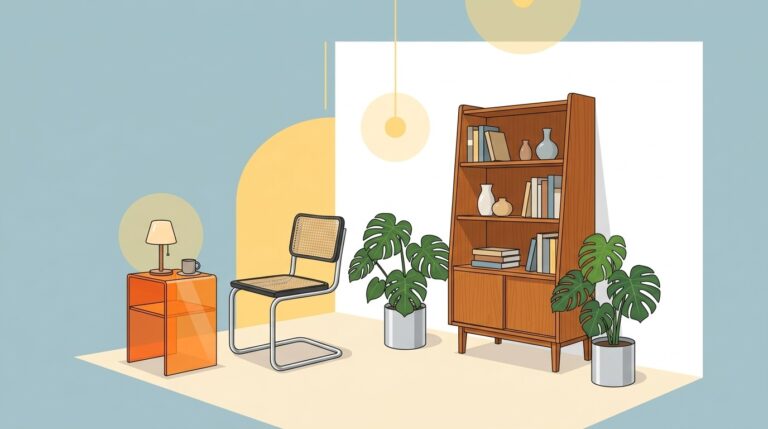
안녕하세요! It’s your Korean bestie and Daily Hangul’s Senior Editor here! 👋 Have you ever scrolled through a popular Korean lifestyle app like ‘오늘의집’ (Onhouse) or watched a cozy K-Drama and noticed a peculiar trend? Sleek chrome chairs, bold orange acrylic side tables, and warm teak wood furniture contrasted against stark white walls. Yes, we are talking about Mid-Century Modern (미드 센추리 모던).
Historically, Korean interior design was dominated by clean, minimalist scandinavian aesthetics (known as ‘북유럽 감성’) or cozy wooden tones. But suddenly, the nation fell head over heels for a style born in 1950s Western Europe and America.
Our advanced C2 learners often tell me, “I can talk about interior styles in Korean, but I lack the sophisticated, industry-level vocabulary to discuss why trends shift or how cultural fatigue drives consumer behavior.” Today, we are going beyond “이 의자 예뻐요” (This chair is pretty). We will equip you with high-level socio-cultural terms to dissect design trends like a true Seoulite visual director.
Phase 2: Key Expressions (핵심 표현 3선 심층 분석)
1. 세기말 감성 (Segimal Gamseong)
- Pronunciation: [Se-gi-mal Gam-seong] (Rhymes with “say-gee-mahl gahm-seong”)
- Meaning: Turn-of-the-century vibe / Retro-futuristic nostalgia.
- K-Culture Moment: Think of NewJeans’ music videos or retro K-Dramas where 90s technology meets sleek modern aesthetics.
- Editor’s Insight: While “미드 센추리” is literally mid-century, Koreans often bundle this aesthetic under “세기말 감성” to describe the gritty, metal-and-plastic heavy, nostalgic yet futuristic vibe of the late 90s and early 2000s that pairs perfectly with modern minimalism.
- Situation Spectrum: Casual ✅ | Semi-formal ✅ | Formal ⚠️
- 🤔 Think About It: Why does technological saturation make us crave analog textures? How does this manifest in your native culture’s design trends?
2. 미니멀리즘에 대한 피로감 (Minimolleojeome daehan pirogam)
- Pronunciation: [Mi-ni-meol-ri-jeum-e dae-han pi-ro-gam] (Say “me-nee-mull-ee-zum-eh dae-hahn pee-ro-gahm”)
- Meaning: Fatigue towards minimalism.
- K-Culture Moment: This is the ultimate industry term used in Korean design magazines like Space (공간) or Monthly Design (월간 디자인) to explain the shift from sterile all-white homes to colorful, personality-packed spaces.
- Editor’s Insight: “피로감” (fatigue) is a highly sophisticated term to describe market oversaturation and consumer boredom. It elevates your Korean from conversational to analytical.
- Situation Spectrum: Casual ⚠️ | Semi-formal ✅ | Formal ✅
- 🤔 Think About It: In Korean society, where conformity is strong, how does “fatigue towards uniformity” lead to highly expressive interior design?
3. 미적 갈증을 해소하다 (Mijeok galjeungeul haesohada)
- Pronunciation: [Mi-jeok gal-jeung-eul hae-so-ha-da] (Say “me-jeok gahl-jeung-eul hae-so-hah-dah”)
- Meaning: To quench one’s aesthetic thirst.
- K-Culture Moment: Used by art curators, interior designers, and lifestyle influencers on YouTube when explaining how bold accent colors (포인트 컬러) break the monotony of standard Korean apartment structures.
- Editor’s Insight: “갈증” is literally “thirst,” and “해소하다” is “to resolve/relieve.” Combining them with “미적” (aesthetic) creates a poetic, high-end metaphor for intellectual and visual satisfaction.
- Situation Spectrum: Casual 🚫 | Semi-formal ✅ | Formal ✅
- 🤔 Think About It: Is interior design in your country seen as a luxury, or is it, as in modern Korea, an essential tool to quench your daily aesthetic thirst?
Phase 3: Textbook vs. Real Korean (교과서 한국어 vs 진짜 한국어)
Situation 1: Explaining why you bought a colorful vintage lamp.
- 📖 Textbook Korean: “흰색 방이 지루해서 유색 램프를 샀습니다.” (I bought a colored lamp because the white room was boring.)
- 🗣️ 진짜 한국어: “올 화이트 인테리어에 피로감을 느끼던 차에, 포인트 컬러로 미적 갈증을 해소하고 싶어서 유기적인 곡선이 돋보이는 미드 센추리 조명을 들였어요.” (Just as I was feeling fatigued by the all-white interior, I brought in a mid-century lamp with organic curves to quench my aesthetic thirst with a point color.)
- 💡 Why the difference? The real Korean version utilizes Hanja-derived vocabulary (유기적 – organic, 피로감 – fatigue) and trendy design terms (들이다 – to bring/adopt furniture into a home) which sound immensely sophisticated and natural.
Situation 2: Discussing the trend of chrome/steel furniture.
- 📖 Textbook Korean: “철로 만든 가구가 요즘 유행합니다.” (Furniture made of iron is trendy lately.)
- 🗣️ 진짜 한국어: “차가운 스틸 재질과 따뜻한 원목의 조화가 주는 특유의 세기말 감성이 요즘 트렌드를 관통하고 있죠.” (The unique turn-of-the-century vibe created by the harmony of cold steel materials and warm solid wood is penetrating today’s trends.)
- 💡 Why the difference? “트렌드를 관통하다” (to penetrate/define a trend) is a professional journalistic expression that sounds much more competent than simply saying “유행하다” (to be popular).
Phase 4: K-Culture Deep Dive & Non-verbal Manners
4-1. The Aesthetics of “Chuga-Chuga” (추가추가) and Space Curation
In Korean design discussions, when presenting your space, showing humility while asserting taste is key. Use a light, flowing hand gesture—gently sweeping your hand across the room—when describing “조화” (harmony). Avoid pointing aggressively at expensive designer items (like a real Knoll or Herman Miller chair); instead, glaze over them with a modest smile, saying “그냥 제 취향을 조금 녹여냈을 뿐이에요” (I just dissolved a bit of my taste into it).
4-2. The Pandemic, “Zip-Kock” (집콕), and the Rise of Onhouse (오늘의집)
Why did Mid-Century Modern explode in Korea? During the pandemic, the phrase “집콕” (staying at home) became a survival method. As Koreans spent 24/7 in standard, cookie-cutter apartments, they faced severe visual boredom. They turned to the app 오늘의집 (Onhouse) to purchase accessible replica chrome chairs and colorful acrylic shelves. This transformed interior decoration from a rich man’s hobby into a democratic form of self-expression for the younger generation.
Phase 5: Interactive Roleplay Scenario
Setting: A trendy interior design studio in Hannam-dong, Seoul. You (the client) are consulting with Director Min (민 실장), a famous Korean interior space curator known for her sharp aesthetic eye.
Characters:
- Director Min (민 실장): A sophisticated, soft-spoken but incredibly professional designer in her late 30s.
- You (C2 Speaker): An expat looking to completely remodel your Seoul studio apartment with a unique twist.
Dialogue:
- 민 실장: “어서 오세요! 안 그래도 보내주신 공간 포트폴리오 미리 잘 봤습니다. 전체적으로 모노톤의 깔끔한 구성이더군요.”
(Welcome! I took a close look at the space portfolio you sent earlier. Overall, it’s a very clean, monotone setup.) -
You: “네, 맞아요. 처음에는 깔끔해서 좋았는데, 갈수록 올 화이트 인테리어에 대한 피로감이 몰려오더라고요.”
(Yes, exactly. At first, I liked the cleanliness, but as time went on, a wave of fatigue towards the all-white interior started hitting me.) -
민 실장: “🎭 (미소를 지으며 고개를 끄덕인다) 역시 그렇군요. 많은 분들이 대세를 따르다가 결국 획일화된 디자인에 갈증을 느끼시죠. 어떤 변화를 원하시나요?”
(🎭 [Nodding with a smile] Indeed. Many people follow the crowd but eventually feel thirsty due to the standardized design. What kind of change do you want?) -
You: “차가운 스틸과 따뜻한 원목이 공존하는 미드 센추리 모던 스타일로 공간의 미적 갈증을 해소하고 싶어요.”
(I want to quench my aesthetic thirst in this space with a Mid-Century Modern style where cold steel and warm solid wood coexist.) -
민 실장: “아! 요즘 유행하는 세기말 감성의 믹스앤매치를 정확히 짚어내셨네요. 혹시 염두에 두신 포인트 컬러가 있으신가요?”
(Ah! You pointed out exactly the mix-and-match of the turn-of-the-century vibe that is trending these days. Do you happen to have a point color in mind?) -
You: “쨍한 오렌지나 바우하우스 블루 컬러로 포인트를 주어 공간에 생기를 불어넣고 싶습니다.”
(I’d like to breathe life into the space by giving points with vivid orange or Bauhaus blue colors.) -
민 실장: “🎭 (태블릿을 켜며 감탄하는 표정을 짓는다) 훌륭한 안목이십니다. 획일화된 아파트 구조에 아주 유기적이고 입체적인 재미를 주겠네요. 바로 시안 보여드릴게요.”
(🎭 [Turning on her tablet with an admiring expression] You have excellent taste. That will add organic and three-dimensional fun to the standardized apartment structure. Let me show you the drafts right away.) -
You: “실장님만 믿고 진행하겠습니다. 멋진 제안 기대할게요!”
(I’ll leave it in your hands, Director. I look forward to your wonderful proposal!)
🔀 Interactive Branching Points (인터랙티브 선택지)
Director Min asks: “Where should we put the focus of our budget?”
- Choice A: “가장 넓은 면적인 벽지와 바닥재를 바꾸는 데 예산을 다 쓰고 싶어요.”
- Feedback (Bad): High budget consumption, but misses the core of Mid-Century Modern, which relies heavily on furniture and iconic lighting as accents rather than structural remodeling.
- Choice B: “빈티지 오리지널 가구와 바우하우스 조명 같은 포인트 오브제에 집중 투자하고 싶습니다.”
- Feedback (Best): Spot on! Mid-Century Modern is all about iconic furniture pieces (오브제) contrasted against simple backdrops. Highly professional approach!
- Choice C: “그냥 실장님이 알아서 다 채워주세요.”
- Feedback (Risk): Relinquishing your taste makes you look passive. In Korea’s design world, showing a clear subjective taste (주관적인 취향) earns you respect from the curators.
Phase 6: 10-Second Emotional Shadowing Drill
Speak like a stylish visual director! Pay close attention to the breath pauses (/) and the emotional cues in the brackets.
[😊 Confidently and gracefully]
“올 화이트 인테리어의 / 피로감에서 벗어나 / 나만의 세기말 감성을 / 한 방울 / 톡 떨어뜨리고 싶어요.”
(I want to break away from the fatigue of all-white interiors and drop a single drop of my own turn-of-the-century vibe into it.)-
[😎 Deeply passionate, like an expert]
“차가운 스틸과 / 따뜻한 원목의 / 이질적인 조화가 / 제 공간의 / 미적 갈증을 / 완벽하게 해소해 줍니다.”
(The heterogeneous harmony of cold steel and warm wood perfectly quenches my space’s aesthetic thirst.)
Phase 7: K-Culture Mini-Dictionary (미니 사전)
- 획일화 (Hoegil-hwa) | Standardization / Uniformity
- Usage: Often used to critique the uniform design of massive Korean apartment complexes (아파트 단지).
- 믹스앤매치 (Mix-and-Match) | Blending different eras/materials
- Usage: Essential slang when combining classic Korean wooden elements with steel/glass mid-century pieces.
- 오브제 (Obje) | Objet / Art object
- Usage: Pronounced like French objet. In Korea, this refers to any decorative item (like a vase, unique lamp, or bookstand) that acts as art.
- 식집사 (Sik-jipsa) | Plant butler (Plant parent)
- Usage: A blend of 식물 (plant) and 집사 (butler). Mid-century modern in Korea is almost always paired with unique leafy plants like Monsteras, cared for by stylish ‘식집사’.
Phase 8: Survival Kit for Travelers
Survival Expressions TOP 3
- “이 가구 빈티지 오리지널인가요?” [I gagu bin-ti-ji o-ri-ji-neol-in-ga-yo?]
- Pro Tip: Useful in expensive vintage shops in Euljiro or Hannam-dong to check if a piece is a licensed original or a reproduction.
- “포인트 컬러로 쓰기 좋은 오브제 추천해 주세요.” [Po-in-teu-keol-reo-ro sseu-gi jo-eun o-beu-je chu-cheon-hae ju-se-yo.]
- Pro Tip: Use this to ask store staff for decorative items to accent your room.
- “인테리어 소품숍 투어 중이에요.” [In-te-ri-eo so-pum-syop tu-eo jung-i-e-yo.]
- Pro Tip: A great conversational ice-breaker when visiting aesthetic showrooms in Seongsu-dong.
Editor’s Travel Note ✈️
If you want to experience the peak of Seoul’s interior trend, don’t just go to cafes. Download the 오늘의집 (Onhouse) App to study real Korean homes, and visit Euljiro 3-ga (을지로 3가) where mid-century industrial raw steel aesthetics meet hipster coffee culture. Note: Store operating hours in Euljiro can be highly irregular, so always check their Instagram pages before visiting.
Phase 9: “A Step Deeper” (생각 질문)
In Korea, apartments are the dominant form of housing. Because almost everyone lives in identical rectangular concrete structures, the interior space becomes the only canvas where one can assert individuality. Therefore, the Mid-Century Modern trend in Korea is not just a passing design fad; it is a silent, artistic rebellion against architectural uniformity.
💬 Your Turn: Does your living space reflect your inner identity, or do you tend to conform to the standard styles of your country? Share your thoughts in the comments below! (In Korean, if you dare! 😉)
Phase 10: FAQ & Common Mistakes
Q: Is ‘미드 센추리 모던’ understood by average Koreans?
A: Yes! Thanks to hit TV shows like I Live Alone (나 혼자 산다) where celebrities show off their designer metal furniture, it has become a household name.
Q: Can I use ‘세기말 감성’ to describe modern tech?
A: Not quite. It specifically refers to the nostalgia of the late 90s (Y2K) with its metallic hues, transparent plastic, and chunky hardware. It’s retro-futuristic, not purely high-tech.
Q: What is the difference between ‘원목’ and ‘나무’?
A: ‘나무’ is the general word for tree/wood. ‘원목’ (Won-mok) specifically means solid/natural wood used in high-end furniture manufacturing.
🚨 Common Mistakes (흔한 실수 경고판)
- Mistake: Saying “내 방은 미니멀리즘 피곤해요.” (My room is tired of minimalism.)
- Correct Action: ‘피곤하다’ is physical tiredness of a person. For trend fatigue, you must use the noun ‘피로감‘ (e.g., “미니멀리즘에 피로감을 느껴요”).
Phase 11: Action Mission & Participation
- 🥉 Bronze Mission: Open Instagram and search for the hashtag
#오늘의집or#미드센추리모던. Find one room you like and write down three materials you see (e.g., 유리, 철제, 원목). - 🥈 Silver Mission: Leave a comment below using the expression “~에 피로감을 느끼다” to describe a trend you are tired of in your own country.
- 🥇 Gold Mission: Walk into a local lifestyle shop or cafe, snap a picture of a mid-century interior element, and post it on your social media tagging
@DailyHangulwith the caption: “이곳에서 세기말 감성의 끝을 보았다!” (I saw the peak of turn-of-the-century vibe here!)
Phase 12: Interactive Quiz Challenge
1. Contextual Judgment
Which expression is most natural when you want to explain why you bought a bright red chair for your plain grey living room?
* A) 획일화를 위해서 (For uniformity)
* B) 미적 갈증을 해소하기 위해 (To quench aesthetic thirst)
* C) 식집사가 되기 위해 (To become a plant butler)
👀 Show Answer & Explanation
Correct Answer: B
Explanation: Adding a bold accent piece to a plain room is a classic way of satisfying your visual and artistic desires, which translates perfectly to “미적 갈증을 해소하다.”
2. Fill in the Blank
“요즘 유행하는 오렌지색 아크릴 테이블은 90년대 Y2K 분위기, 즉 ( )을 자극한다.”
* Hint: Turn-of-the-century vibe / retro-futurism.
👀 Show Answer & Explanation
Correct Answer: 세기말 감성 (Segimal Gamseong)







