

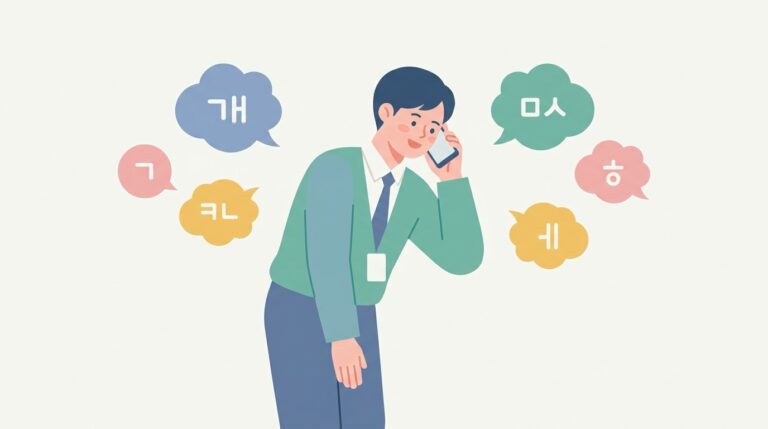
Mastering Korean Phone Etiquette: Say Goodbye to Phone Anxiety
Phase 1: Empathy (Your Korean Phone Call Survival Guide)
안녕하세요! I’m your Daily Hangul editor, your trusted native guide to the colorful world of Korean language and culture.
Picture this: You are watching your favorite K-Drama. The lead actor’s sleek smartphone rings with a generic ringtone. He swipes the screen, presses it to his ear, and utters that iconic, slightly drawn-out word: “Yeoboseyo?” (여보세요?)
It sounds so effortless when they do it. But for many Korean learners, actually answering a phone call from an unknown Korean number—or making a call to a clinic, a trendy restaurant, or a language partner—is a major source of anxiety. When the voice on the other end asks, “누구 찾으세요?” (Who are you looking for?), your mind goes completely blank.
Don’t worry! This is a classic B1-level hurdle. You already know basic vocabulary, but navigating the invisible rules of Korean telephone respect, tone, and cultural cues is where the real magic happens. This guide is built based on real feedback from learners who successfully conquered their “Korean phone phobia.” By the end of this post, you’ll be answering calls with the smooth confidence of a true Seoulite!
Phase 2: Deep Dive into 3 Key Expressions
Let’s break down the essential DNA of any Korean phone conversation.
1. 여보세요? (Yeoboseyo?)
- Pronunciation: Yuh-boh-seh-yo (Imagine saying “yo-bo” but keep the “yuh” soft, like the ‘u’ in ‘up’).
- Meaning: Hello? (Used exclusively on the phone).
- K-Culture Moment: You will hear this in literally every single K-Drama episode. It is the universal opener, but the tone changes everything. A quick, sharp “여보세요?” can sound annoyed, while a soft, rising “여보세요~?” is warm and inviting.
- Editor’s Insight: This word actually originates from “여기 보세요” (Yeogi boseyo), which literally means “Look here.” Over time, it condensed into “여보세요” to grab someone’s attention when you can’t physically see them.
- Situation Spectrum: Casual ✅ / Semi-formal ✅ / Formal ⚠️ (In highly corporate calls, they prefer starting with their company/department name instead of Yeoboseyo).
- 🤔 Think About It: In English, we just say “Hello?” for both face-to-face and phone greetings. Why do you think Korean has a completely separate word dedicated solely to phone calls?
2. 실례지만, 누구 찾으세요? (Sillyejiman, nugu chaseuseyo?)
- Pronunciation: Sheel-lyeh-jee-man, noo-goo chah-jeu-seh-yo?
- Meaning: Excuse me, but who are you looking for?
- K-Culture Moment: Usually spoken by an assistant or a family member who answers a landline or a shared office phone.
- Editor’s Insight: 실례지만 (Excuse me/I’m sorry for the interruption) is your ultimate shield of politeness. Combining it with 누구 찾으세요? turns a potentially blunt question into a soft, highly professional inquiry.
- Situation Spectrum: Casual ⚠️ / Semi-formal ✅ / Formal ✅
- 🤔 Think About It: How does this soften the conversation compared to just asking “Who is this?” in your native language?
3. ~님 계신가요? / ~님 자리에 계십니까? (~nim gyesingayo? / ~nim jarie gyesimnikka?)
- Pronunciation: …nim gyeh-sheen-gah-yo? / …nim jah-ree-eh gyeh-sheem-nee-kkah?
- Meaning: Is [Name] there? / Is [Name] at their desk?
- K-Culture Moment: Essential when calling an office or a department. For example, calling to speak with Manager Min: “민 부장님 계신가요?”
- Editor’s Insight: Notice the honorific 계시다 (to exist/be, honorific) instead of the basic 있다. Always use 계시다 when asking about someone of equal or higher status. Adding ~자리에 (at their desk/seat) shows that you understand they might be physically away from their workstation.
- Situation Spectrum: Casual 🚫 / Semi-formal ✅ / Formal ✅
- 🤔 Think About It: Notice how Korean telephone language deeply respects physical space and social hierarchy. How does this reflect the collectivist nature of Korean society?
Phase 3: Textbook Korean vs. Real Korean
Let’s compare the rigid sentences found in old-school textbooks with what Koreans actually say on the phone today.
Situation 1: Asking if a colleague/friend is available
- 📖 Textbook Korean: “김철수 씨 있습니까?” (Gim Cheol-su ssi isseumnikka? – Is Kim Chul-soo there?)
- 🗣️ 진짜 한국어: “혹시 철수 씨 지금 통화 가능하세요?” (Hoksi Cheol-su ssi jigeum tonghwa ganeunghaseyo? – By any chance, is Chul-soo available to talk on the phone right now?)
- 💡 Why the difference? Directly asking “있습니까?” (Is he there?) sounds like an interrogation. Real Koreans use 혹시 (by any chance) to soften the approach, and ask about their availability (통화 가능하세요?) out of respect for their time.
Situation 2: Ending the phone call politely
- 📖 Textbook Korean: “안녕히 계십시오.” (Annyeonghi gyesipsio. – Goodbye.)
- 🗣️ 진짜 한국어: “네, 들어가세요~” (Ne, deureogaseyo~ – Yes, please go in / please hang up.)
- 💡 Why the difference? “안녕히 계십시오” is almost never used to end a standard phone call; it is far too stiff. Instead, Koreans use 들어가세요 (literally “go inside”), which carries the warm nuance of “return safely to whatever you were doing before my call interrupted you.”
Phase 4: K-Culture Deep Dive & Non-verbal Manners
4-1. The Ghost Bow (Nunchi on the Phone)
If you walk into a Korean office, you will witness a fascinating phenomenon: employees bowing deeply to their desk phones while talking to a client or a boss. Even though the person on the other end cannot see them, the physical act of bowing (인사) shapes the vocal cords and naturally infuses the voice with a tone of respect and warmth.
* Pro-tip: When practicing Korean on the phone, actually nod or bow slightly! It will naturally correct your intonation and make you sound more like a native speaker.
4-2. The “Busy Tone” Dance (바쁘다 바빠)
K-Dramas often show characters hanging up without a formal goodbye when they are in a rush. In reality, modern Koreans value efficiency but dread being rude. If someone is busy, they will rapidly say “어, 내가 나중에 다시 전화할게!” (Yeah, I’ll call you back later!) and hang up with a gentle, repetitive “응~ 어~” sound. Understanding this rhythm is key to reading the room (눈치, Nunchi) during a call.
Phase 5: Real-world Roleplay Scenario
Characters & Setup
- Marcus (You): An intermediate Korean learner calling a local design agency to speak with the lead designer, Han Min-ji (한민지 님).
- Yujin (NPC): The polite and efficient receptionist at the agency.
1. Yujin: 여보세요, 디자인 마루입니다. 무엇을 도와드릴까요?
   (Yeoboseyo, Dijain Maru-imnida. Mueoseul dowadeurilkkayo?)
   [🎭 Professional, bright office voice]
   "Hello, this is Design Maru. How may I help you?"

2. Marcus: 안녕하세요! 혹시 한민지 디자이너님 자리에 계신가요?
   (Annyeonghaseyo! Hoksi Han Min-ji dijaineonim jarie gyesingayo?)
   [🎭 Polite, slightly nervous but clear]
   "Hello! By any chance, is Designer Han Min-ji at her desk?"

3. Yujin: 아, 실례지만 누구 찾으시는지 여쭤봐도 될까요?
   (A, sillyejiman nugu chajeusineunji yeojjwobado doelkkayo?)
   [🎭 Soft, curious, asking for verification]
   "Ah, excuse me, but may I ask who is looking for her?"

4. Marcus: 아, 저는 마커스라고 합니다. 지난번에 이메일로 연락드렸었어요.
   (A, jeoneun Makeoseurago hamnida. Jinanbeone imeillo yeonrakdeuryeosseosseoyo.)
   [🎭 Confident, offering context]
   "Ah, I am Marcus. I contacted her via email last time."

5. Yujin: 아, 마커스 씨요! 잠시만요, 연결해 드리겠습니다.
   (A, Makeoseu ssiyo! Jamsimanyo, yeongyeolhae deurige some-nida.)
   [🎭 Recognizing the name, helpful tone]
   "Ah, Mr. Marcus! One moment, please. I will connect you."

(A short dial tone rings... then Yujin speaks again)

6. Yujin: 죄송합니다, 마커스 씨. 한민지 님께서 지금 다른 전화를 받고 계셔서요. 메시지를 남겨 드릴까요?
   (Joesonghamnida, Makeoseu ssi. Han Min-ji nimkkeseo jigeum dareun jeonhwareul batgo gyesyeoseoyo. Mesijireul namgyeo deurilkkayo?)
   [🎭 Apologetic, speaking slightly slower]
   "I am sorry, Mr. Marcus. Ms. Han Min-ji is currently on another call. Would you like me to leave a message?"

7. Marcus: 아, 그렇군요. 그럼 제가 나중에 다시 전화드리겠다고 전해주세요.
   (A, geureokunyo. Geureom jega najunge dasi jeonhwadeurigeottago jeonhaejuseyo.)
   [🎭 Understanding and polite]
   "Ah, I see. Then please let her know that I will call back later."

8. Yujin: 네, 잘 전달하겠습니다. 좋은 하루 보내세요.
   (Ne, jal jeondalhagessu-nida. Joeun haru bonaeseyo.)
   [🎭 Warm ending]
   "Yes, I will deliver the message. Have a nice day!"

9. Marcus: 네, 감사합니다. 들어가세요!
   (Ne, gamsahamnida. Deureogaseyo!)
   [🎭 Hanging up gracefully]
   "Yes, thank you. Goodbye!"
🔀 Choose Your Path!
If Yujin had said, “한민지 님은 지금 외근 중이십니다” (Ms. Han Min-ji is out of the office on business), how should you respond?
* Option A: “아, 그래요? 알았어요.” (Oh, really? Okay.)
* 🚫 Feedback (Bad): Too blunt and informal. It sounds like you are annoyed by her absence.
* Option B: “아, 외근 중이시군요. 혹시 몇 시쯤 들어오시는지 알 수 있을까요?”
* 🏆 Feedback (Best): Extremely polite and professional! You acknowledge her status and ask for her estimated return time naturally.
* Option C: “그럼 휴대폰 번호 좀 알려주세요.”
* ⚠️ Feedback (Risk): Asking directly for someone’s personal mobile number on a business call is a major privacy breach in Korea unless you are already close.
Phase 6: 10-Second Emotion Shadowing Drill
Let’s train your emotional intonation. Read these aloud, mimicking the emotion cues and pausing at the / marks.
- [😊 Bright & Friendly]
“여보세요? / 혹시 / 민수 씨 / 핸드폰인가요?”
(Yeoboseyo? / Hoksi / Minsu ssi / haendeupon-ingayo?)
“Hello? / By any chance, / is this Minsu’s / cell phone?” -
[🥺 Softly Regretful & Apologetic]
“아, / 지금 / 회의 중이시군요. / 제가 / 나중에 / 다시 걸게요!”
(A, / jigeum / hoeui jung-isingunyo. / Jega / najunge / dasi geolgeyo!)
“Ah, / you are in a meeting right now. / I’ll / call back / later!”
Phase 7: K-Culture Mini Dictionary
| Word (Hangul / Romanization) | English Meaning | Real-Life Usage Note |
|---|---|---|
| 부재중 전화 (Bu-jae-jung jeon-hwa) | Missed Call | You’ll see this notification on your phone when you miss a Korean friend’s call. |
| 통화 중 (Tong-hwa-jung) | On another call / Line busy | If you call someone and it goes straight to a busy tone, they are 통화 중. |
| 문자 남기다 (Mun-ja nam-gi-da) | To leave a text message | Perfect when someone doesn’t pick up: “문자 남겨 놓을게요” (I’ll leave a text). |
| 전화 끊다 (Jeon-hwa kkeun-ta) | To hang up | “먼저 끊으세요” (You hang up first—a classic cute phrase between couples!). |
Phase 8: Traveler’s Survival Kit
Top 3 Survival Phrases for Travelers
- “네, 말씀하세요.” (Ne, malsseumhaseyo.)
- Pro Tip: Use this when a delivery driver or a hotel clerk calls you and you want to say, “Yes, go ahead, I’m listening.”
- “죄송한데, 제가 한국어를 잘 못해서요.” (Joesonghande, jega Hangugeoreul jal mothaeseoyo.)
- Pro Tip: The ultimate lifesaver. It politely explains: “I’m sorry, but I can’t speak Korean very well.”
- “문자로 보내주시겠어요?” (Munjaro bonaejusigesseoyo?)
- Pro Tip: If the speaker is talking too fast, ask them: “Could you send it to me via text message?” Reading Korean is always easier than listening on the spot!
Editor’s Travel Note
When traveling in Korea, you might need to make reservations. Instead of calling directly, try using the NAVER Map App to message business owners or use their built-in online booking system. It saves you from phone anxiety entirely! Note: Keep in mind that some older local shops still prefer phone calls, so having these phrases ready is always a great backup.
Phase 9: “One Step Deeper” (Cultural Insight Essay)
In English, we say “Goodbye” or “See you later” on the phone. But in Korean, ending a call with “들어가세요” (Go inside) or “수고하세요” (Keep up the hard work) reveals a deep-seated cultural focus on the communal group.
When a Korean says 들어가세요, they are verbally wrapping you in a blanket of comfort, wishing you a safe return to your personal space. It recognizes that phone calls are temporary interruptions to your day. By using these phrases, you aren’t just speaking Korean—you are showing that you understand the emotional warmth (정, Jeong) that binds Korean social interactions together.
💬 Your Turn: Have you ever had a scary or funny experience answering a call in Korean? Let’s chat in the comments below!
Phase 10: FAQ & Common Mistakes
Q: Can I use “안녕” (Annyeong) when answering the phone with close friends?
A: Actually, even with close friends, Koreans almost always start with “여보세요?” or a bright “어, 왜?” (Yeah, what’s up?) or “어, oo야~” (Yeah, [Name]~). “안녕” is rarely the first word spoken upon swiping the screen.
Q: What should I say if I dial the wrong number?
A: Don’t just hang up! That can feel jarring. Say: “죄송합니다. 전화를 잘못 걸었습니다.” (Joesonghamnida. Jeonhwareul jalmot georeosseum-nida – I’m sorry. I dialed the wrong number) and then hang up.
Q: Can I use “누구세요?” (Who is it?) when answering the phone?
A: “누구세요?” is fine when someone knocks on your door, but on the phone with an unknown number, it can sound slightly defensive or rude. Instead, use “실례지만, 누구 찾으세요?” (Excuse me, who are you looking for?) or “전화 거신 분 성함이 어떻게 되시나요?” (May I ask your name, please?).
🚨 Common Mistakes Warning Board
- Mistake 1: Saying “안녕히 계세요” to the person who called you.
- Correct Action: Use “들어가세요” or “네, 끊을게요~”.
- Mistake 2: Addressing an older caller or office contact by their name + “씨” (e.g., Minji-ssi).
- Correct Action: Use their professional title + “님” (e.g., 한민지 디자이너님).
- Mistake 3: Speaking too fast when you get nervous.
- Correct Action: Pause, take a breath, and say: “천천히 말씀해 주세요” (Please speak slowly).
Phase 11: Action Mission & Engagement
Are you ready to level up? Complete these 3 challenges!
* 🥉 Bronze Mission: Record yourself saying “여보세요?” with three different emotions (Warm, Confused, Business-like).
* 🥈 Silver Mission: Share this post on your social media with the hashtag #DailyHangul and tell us your favorite phone phrase.
* 🥇 Gold Mission: The next time a spam or unknown Korean number calls you, don’t ignore it immediately! Pick up and confidently say, “여보세요?”
🎮 K-Culture Mission: Watch any K-Drama episode today and count how many times a character ends a call with “어, 끊어” (Yeah, hanging up) versus “들어가세요”. You’ll be surprised by how often you spot it!
Phase 12: Interactive Quiz Challenge
Test your knowledge below! Click each question to reveal the correct answer.
Q1. Which expression is the most polite way to ask if Manager Kim is at his desk?
Answer: 김 부장님 자리에 계신가요?
Explanation: Using the honorific verb “계시다” (to be/exist) and adding “자리에” (at their desk/seat) shows excellent business etiquette.
Q2. True or False: “안녕히 계십시오” is the standard, natural way to hang up a daily phone call.
Answer: False.
Explanation: It is far too stiff! Native speakers prefer “들어가세요” (deureogaseyo) or “끊을게요” (kkeuneolgeyo).
Q3. What is the literal origin of “여보세요”?
Answer: “여기 보세요” (Look here).
Explanation: It was shortened over time to grab someone’s attention on the telephone where visual contact isn’t possible.







