

The Fine Line Between Love and Meddling: Navigating Korea’s Jeong (情) vs. Ojireap (오지랖)
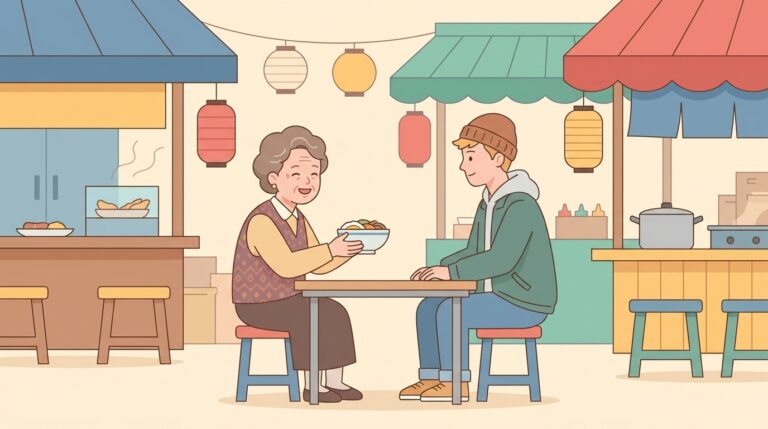
안녕하세요! Hello, fellow Korean culture lovers! I’m the lead editor at Daily Hangul, your trusty cultural guide. Have you ever been eating at a local Korean restaurant when the older owner (이모님 – Imonim) suddenly walks over, scolds you for not wearing a warmer jacket, and plops an extra side dish onto your table?
You might wonder: “Are they being incredibly warm, or are they overstepping my personal boundaries?”
In Korea, this is the classic clash between Jeong (정)—our unique brand of deep, collective affection—and Ojireap (오지랖)—which translates to meddling or being nosey. Understanding this fine line is your ultimate ticket to mastering Korean social dynamics at a B2 intermediate level. Let’s dive deep into this heartwarming (and sometimes eyebrow-raising) cultural phenomenon!
Phase 2: Deep Analysis of 3 Key Expressions
1. 오지랖이 넓다 (Ojiraebi neolpda)
- Pronunciation: Oh-ji-rap-i neolp-da (Rhymes with “hope-da”)
- Meaning: Lit. “To have a wide front hem”; Fig. To be nosey or meddle in others’ business.
- K-Culture Moment: In K-Dramas, you’ll often see neighborhood ‘Ajumas’ asking why a single character isn’t married yet. That’s pure ojireap!
- Editor’s Insight: ‘Ojireap’ is the front hem of traditional Hanbok. If the hem is too wide, it unnecessarily overlaps with someone else’s clothing. Use this to describe someone who cares a bit too much about things that don’t concern them.
- Situation Spectrum: Casual (✅) / Semi-formal (⚠️) / Formal (🚫)
- 🤔 Think About It: Does your native culture view uninvited life advice as rude, or as a sign of community care?
2. 정이 넘치다 (Jeongi neomchida)
- Pronunciation: Jung-i num-chee-dah
- Meaning: Lit. “Affection overflows”; Fig. To be incredibly warm-hearted, generous, and caring.
- K-Culture Moment: When a guesthouse owner packs you a bag of fruits and snacks for your day trip without you asking.
- Editor’s Insight: Jeong isn’t just love; it’s a sticky, shared emotional bond. When it ‘overflows’ (넘치다), it comes from a place of genuine communal connection, wanting you to feel safe and fed.
- Situation Spectrum: Casual (✅) / Semi-formal (✅) / Formal (⚠️)
- 🤔 Think About It: How does your culture show ‘unsolicited’ hospitality?
3. 신경 써 주다 (Singyeong sseo juda)
- Pronunciation: Seen-gyung ssuh joo-dah
- Meaning: Lit. “To write down one’s nerves/attention for someone”; Fig. To look after, pay attention to, or care for someone.
- K-Culture Moment: A coworker noticing you coughing and placing a warm tea bottle on your desk.
- Editor’s Insight: This is the most polite and natural way to acknowledge someone’s care. Even if their attention felt slightly like ojireap, saying they ‘paid attention/cared for you’ shows high emotional intelligence (Nunchi).
- Situation Spectrum: Casual (✅) / Semi-formal (✅) / Formal (✅)
- 🤔 Think About It: Why is noticing subtle, non-verbal needs of others considered a supreme virtue in Korea?
Phase 3: Textbook Korean vs. Real Korean
Situation 1: Declining a coworker’s overly personal question about your weekend plans.
- 📖 Textbook Korean: “제 사생활에 간섭하지 마세요.” (Please do not interfere in my private life.)
- 🗣️ Real Korean: “신경 써 주셔서 감사해요. 주말엔 그냥 쉬려고요!” (Thank you for caring. I’m just planning to rest this weekend!)
- 💡 Why the difference? The textbook expression sounds aggressively cold and hostile. In Korean society, even if someone is meddling (오지랖), you protect their face (체면) by acknowledging their ‘care’ (신경) first, then gently establishing your boundary.
Situation 2: Teasing a close friend who is worrying too much about a celebrity’s scandal.
- 📖 Textbook Korean: “당신은 왜 다른 사람의 일에 참견합니까?” (Why do you meddle in other people’s affairs?)
- 🗣️ Real Korean: “야, 너 진짜 참견 대장이다!” (Hey, you’re a real meddling boss/champion!)
- 💡 Why the difference? The textbook version sounds like a police interrogation. Among friends, using playful titles like “참견 대장” (Meddling Boss) keeps the tone light and humorous while delivering the point.
Phase 4: K-Culture Deep Dive & Non-verbal Manners
4-1. Nunchi (눈치) & Gentle Gestures
When someone crosses your personal boundary under the guise of ‘Jeong,’ physical actions speak louder than words. To decline politely without hurting feelings:
* The Soft Wave: Bring your hand near your chest and wave it side-to-side gently (not violently).
* The Head Tilt: Tilt your head slightly to the side with a soft smile. This signals “I appreciate it, but no thank you” without a blunt “No.”
4-2. K-Drama Culture Code
Have you watched Reply 1988 (응답하라 1988)? The neighborhood moms’ constant food-swapping and gossiping perfectly illustrate this thin line. Sharing food is Jeong, but questioning why the neighbor’s son hasn’t got a job yet borders on Ojireap. For Koreans, these two are twin sides of the same coin: you cannot have deep, supportive community bonds without occasionally tolerating a bit of noseyness.
Phase 5: Real-life Roleplay Scenario
Setting: Minji (your friendly but slightly nosey Korean colleague) notices you skipping lunch at the office pantry.
- 민지: 한스 씨, 왜 점심 안 먹어요? 다이어트해요? (Hans, why aren’t you eating lunch? Are you on a diet?)
- 한스: 🎭 (Embarrassed smile) 아, 아니요. 그냥 입맛이 좀 없어서요. (Oh, no. I just don’t have much of an appetite.)
- 민지: 에이, 그래도 끼니를 거르면 안 되죠! 제가 삼각김밥이라도 사다 줄까요? (Hey, still you shouldn’t skip meals! Shall I go buy you at least a triangle kimbap?)
- 한스: 🎭 (Gratefully waving hand) 괜찮아요, 민지 씨. 정말 괜찮습니다. (It’s okay, Minji. I’m really fine.)
- 민지: 아프면 서러워요! 무슨 일 있는 거 아니죠? 걱정되네. (It’s sad to be sick! Nothing’s wrong, right? I’m worried.)
- 한스: 🎭 (Calmly smiling) 네, 아무 일 없어요. 신경 써 주셔서 정말 감사해요. (Yes, nothing’s wrong. Thank you so much for caring.)
- 민지: 그래요? 그럼 다행이고요. 무슨 일 있으면 꼭 말해요! (Really? That’s a relief then. If anything’s up, make sure to tell me!)
- 한스: 네, 그럴게요. 민지 씨도 점심 맛있게 드세요! (Yes, I will. Have a delicious lunch too, Minji!)
🔀 Choose Your Next Move!
- Option A: “상관하지 마세요.” (Mind your own business.)
- 🔴 Feedback (Bad): Extremely rude. This will instantly freeze the office atmosphere and damage your relationship with Minji permanently.
- Option B: “아, 네…” (Avoids eye contact and walks away)
- 🟡 Feedback (Risk): Makes you look socially awkward or angry. Minji might think she upset you or that you are hiding something serious.
- Option C: “걱정해 주셔서 감사해요. 이따가 간식 먹을게요!” (Thank you for worrying. I’ll eat a snack later!)
- 🟢 Feedback (Best): Perfect! You gracefully acknowledge her Jeong (worrying) while smoothly declining her offer with a realistic alternative.
Phase 6: 10-Second Emotion Shadowing Drill
Practice saying these out loud to master the natural emotional flow of a native speaker:
- “걱정해 주셔서 / 진짜 감사해요!”
- [🥺 Softly and sincerely with a slight, polite bow]
- “아유, / 우리 부장님 / 오지랖도 넓으셔라~”
- [😆 Whispering to a close coworker, playfully rolling your eyes]
- “원래 / 정이 / 넘치는 분이에요.”
- [😊 Warmly explaining a local restaurant owner’s behavior to another foreign friend]
Phase 7: K-Culture Mini-Dictionary
- 참견 (Cham-gyeon): Meddling or interfering. Unlike ‘신경 씀’ (caring), this has a strictly negative nuance of stepping into someone’s territory.
- 츤데레 (Tsundere): A loan word widely used in Korea to describe someone who acts cold/aloof on the outside but secretly shows deep Jeong on the inside.
- 정(情) (Jeong): The invisible emotional glue of Korean society. It encompasses affection, sympathy, attachment, and mutual obligation.
- 덤 (Deom): Free extra items given by merchants as a physical manifestation of Jeong. Think of it as “extra with love!”
Phase 8: Survival Kit for Travelers
Survival Expressions TOP 3
- “괜찮습니다~” (Gwen-chan-seum-ni-da / It’s fine~) -> Deliver this with a gentle hand wave to politely decline excessive hospitality.
- “정말 정이 많으시네요!” (Jeong-mal jeong-i man-eu-si-ne-yo! / You are so full of affection!) -> Use this to compliment an older host or restaurant owner who is looking after you.
- “덕분에 마음이 따뜻해졌어요.” (Deok-bun-e ma-eum-i tta-tteut-hae-jyeot-seo-yo. / Thanks to you, my heart warmed up.) -> A poetic B2-level way to express gratitude for someone’s kind gesture.
Editor’s Travel Note
When traveling to traditional markets like Mangwon Market in Seoul, always keep your Naver Map app handy to navigate local restaurants where you might experience this. Knowing how to navigate physically is great, but knowing how to navigate the social ‘Jeong’ of market sellers will get you lots of Deom (free food extras)! Note: Always check official local apps for real-time operating hours.
Phase 9: “One Step Deeper” (Thinking Question)
In Western cultures, respecting individual boundaries is often the ultimate form of politeness. However, in Korea’s historically collectivist society, ‘not stepping in’ can sometimes be viewed as coldness or indifference (무관심). To Koreans, interfering slightly in your life (오지랖) is a paradoxical proof that they view you as part of their community, not as a stranger.
💬 Your Turn: How does your home culture draw the line between caring for someone and meddling in their business? Share your stories in the comments below!
Phase 10: FAQ & Avoiding Misunderstandings
Q: Is ‘오지랖이 넓다’ always an insult?
A: Not necessarily, but it is informal and holds a negative nuance. You shouldn’t say it directly to someone senior to you. However, you can use it self-deprecatingly: “제가 오지랖이 넓어서 죄송해요” (I’m sorry for being too nosey).
Q: How do I know if an elder’s comment is ‘Jeong’ or just rude?
A: Look at the intent. If an older person comments on your health, food, or weather-appropriate clothing, it’s almost always Jeong (affectionate worry). If they comment on your weight or marital status, it’s Ojireap, but usually stemming from outdated societal norms rather than malicious intent.
Q: Can I use ‘정’ in professional business settings?
A: Yes, but cautiously. While Korean businesses run on professional terms, long-term partnerships in Korea are heavily built on ‘Jeong’ (relationship building over meals and drinks). Showing genuine concern for a client’s well-being can seal a deal faster than a cold contract.
🚨 Common Mistakes Board
- Mistake 1: Bluntly saying “상관하지 마세요” (Mind your own business) to an elder.
- Correct Action: Soften it by saying “신경 써 주셔서 감사합니다” (Thank you for caring) first.
- Mistake 2: Assuming someone is angry at you because they ask personal questions.
- Correct Action: Relax! They are likely just trying to build a ‘Jeong’ bond with you.
- Mistake 3: Refusing ‘서비스’ (free extra side dishes) too strictly.
- Correct Action: Accept it with a happy “우와, 감사합니다!” even if you can’t eat it all.
Phase 11: Action Mission & Engagement
- 🥉 Bronze Mission: Next time a Korean acquaintance asks if you have eaten, don’t just say “Yes.” Say “네, 신경 써 주셔서 감사해요!”
- 🥈 Silver Mission: Share a post on your social media about a time you experienced warm Korean ‘Jeong’ and tag us at #DailyHangulJeong.
- 🥇 Gold Mission: Use the phrase “참견 대장” playfully with a close Korean friend when they try to choose your outfit or menu.
🎮 K-Culture Mission
Watch an episode of your favorite K-Drama today and count how many times an older character asks a younger character about their personal life. Is it Jeong or Ojireap? Write your verdict!
Phase 12: Interactive Quiz Challenge
Test your B2 level understanding of Jeong vs. Ojireap!
1. Which of the following is the most polite way to decline an elder’s unsolicited advice?
* A) 상관마세요. (Sang-gwan-ma-se-yo)
* B) 걱정해 주셔서 감사해요. 잘 해결해 볼게요! (Geok-jeong-hae ju-syeo-seo gam-sa-hae-yo. Jal hae-gyeol-hae bol-ge-yo!)
* C) 참견 대장이시네요. (Cham-gyeon dae-jang-i-si-ne-yo)
2. True or False: ‘Deom’ (덤) refers to the negative meddling of nosy neighbors.
* (True / False)
Click here to reveal the answers!
Answers & Explanations:
1. Correct Answer: B. Option B shows high emotional intelligence by thanking them for their worry before asserting your plan. Option A is rude, and Option C is an informal teasing phrase inappropriate for elders.
2. Correct Answer: False. ‘Deom’ refers to free extra goods given by merchants as a physical sign of ‘Jeong’!







