

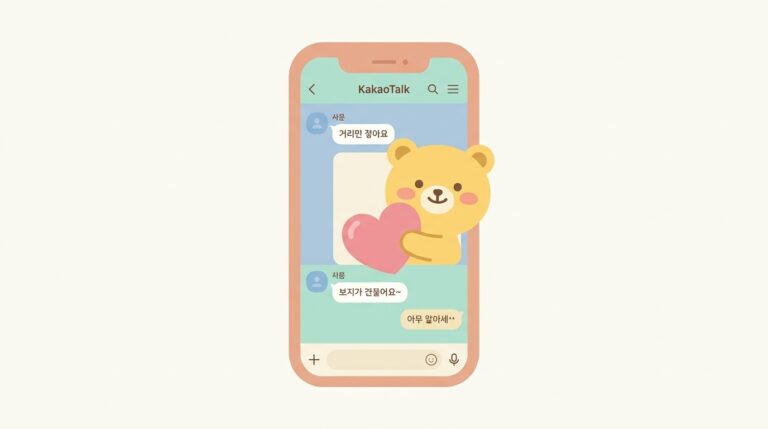
Gifting KakaoTalk Emoticons: The Ultimate Gen-Z Korean Love Language
Phase 1: Empathy (스토리 몰입형 오프닝)
안녕하세요! (An-nyeong-ha-se-yo!) I’m your Korean best friend and Senior Editor at Daily Hangul.
Imagine this: You are chatting with your close Korean friend on KakaoTalk. They’ve had a long, exhausting day at work, and you want to send them a little cheer-up message. A simple text like “힘내세요” (Cheer up!) feels a bit too dry, and sending a expensive Starbucks coupon feels a bit too formal. That is when you see it—an incredibly adorable, squishy white cat emoticon (임티 – Im-ti) that looks exactly like your friend’s grumpy morning face.
You want to gift it to them right now, but you hesitate. What do I say when I gift it? How do I sound natural without sounding like a textbook robot? Gifting emoticons (이모티콘 선물하기) is a massive part of modern Korean social bonding, especially for the Gen-Z and millennial crowd. Based on real feedback from hundreds of our B1-level learners who struggled with texting etiquette, we created this guide to help you master the exact phrases and cultural nuances of KakaoTalk gifting!
Phase 2: Core Expressions (핵심 표현 3선 심층 분석)
1. 이거 너랑 완전 찰떡이다! (i-geo neo-rang wan-jeon chal-tteok-i-da!)
- Pronunciation: “Ee-guh nuh-rahng wahn-juhn chahl-tteok-ee-dah” (Rhymes with the squishy, chewy sound of Korean rice cakes!)
- Meaning: This is a perfect match for you! (Literally: “This is total sticky rice cake with you!”)
- K-Culture Moment: Often used in K-Dramas when friends point out things that perfectly suit each other’s personality or looks.
- Editor’s Insight: “찰떡” (chal-tteok) means sticky rice cake. Because sticky rice cakes stick tightly to surfaces, Koreans use this to describe two things (or people!) that fit together perfectly. When you gift an emoticon that looks just like your friend, this is your go-to phrase!
- Situation Spectrum: Casual (✅) / Semi-formal (⚠️) / Formal (🚫)
- 🤔 Think About It: Why does Korean culture compare compatibility to a sticky food like rice cake? How does your native language express a “perfect match”?
2. 취향 저격할 것 같아서 골랐어 (chwi-hyang jeo-gyeok-hal geot gat-ah-seo gol-as-seo)
- Pronunciation: “Chwee-hyahng juh-gyuk-hahl guht gah-tah-suh gohl-aht-suh” (Flow smoothly over “chwi-hyang” and emphasize the crisp “jeo-gyeok”)
- Meaning: I chose this because I thought it would totally hit your taste. (Taste sniper!)
- K-Culture Moment: Frequently used in K-Pop variety shows when members buy gifts for each other and try to guess who picked what based on their personal styles.
- Editor’s Insight: “취향” (chwi-hyang) means personal taste/preference, and “저격” (jeo-gyeok) means sniping or targeting. Together, “취향 저격” means hitting someone’s exact taste perfectly. Saying this shows you’ve put deep thought into what they like.
- Situation Spectrum: Casual (✅) / Semi-formal (✅) / Formal (⚠️)
- 🤔 Think About It: How does the metaphor of “sniping someone’s taste” make gifting feel more personal and thoughtful than just saying “I hope you like this”?
3. 선물 보냈으니까 단톡방에서 맨날 써! (seon-mul bo-naet-eu-ni-kka dan-tok-bang-e-seo maen-nal sseo!)
- Pronunciation: “Suhn-mool boh-naet-eu-nee-kkah dahn-tohk-bahng-eh-suh maen-nahl ssuh!” (Short, bouncy rhythm on “maen-nal sseo”)
- Meaning: I sent you a gift, so you have to use it in our group chat every single day!
- K-Culture Moment: Standard teasing banter between Korean university classmates or close friends after exchanging cheap, funny digital items.
- Editor’s Insight: By playfully demanding that they use it “every day” (맨날) in the “group chat” (단톡방), you are lessening the burden of the gift. It shows you want to see them use it and keep the fun conversation going.
- Situation Spectrum: Casual (✅) / Semi-formal (⚠️) / Formal (🚫)
- 🤔 Think About It: In your culture, is it polite to tell someone how or when to use a gift? Why does this playful pressure feel friendly in Korean?
Phase 3: Textbook vs Real Korean (교과서 한국어 vs 진짜 한국어)
Scenario 1: Letting your friend know you sent a gift
- 📖 Textbook Style: “이모티콘을 선물합니다. 받아주세요.” (I gift you an emoticon. Please receive it. – Too robotic and distant!)
- 🗣️ Real Native Style: “임티 보냈어! 잘 써~!” (Sent you an im-ti! Use it well~!)
- 💡 Why it differs: Koreans rarely use the full word “이모티콘” in daily texting; they shorten it to the super cute “임티” (im-ti). Adding the friendly wave (~) softens the command “잘 써” (use it well) into a warm gesture.
Scenario 2: Asking if they like the design
- 📖 Textbook Style: “이모티콘 디자인이 마음에 드십니까?” (Does the emoticon design satisfy your heart? – Sounds like a business customer survey!)
- 🗣️ Real Native Style: “완전 귀엽지? 네 스타일일 것 같았어.” (Super cute, right? I figured it would be your style.)
- 💡 Why it differs: Native speakers use conversational checkpoints like “완전 귀엽지?” to build excitement and consensus, focusing on shared feelings rather than formal satisfaction.
Phase 4: K-Culture Deep Dive & Non-verbal manners (K-Culture 딥다이브 & 비언어적 매너)
4-1. Digital Nunchi (눈치) & Texting Gestures
In Korea, gifting is closely tied to the concept of Nunchi (눈치)—the art of reading the room. Sending a physical gift can sometimes put financial or social pressure on the receiver to return something of equal value. This is why emoticon gifting has become the ultimate low-pressure social lubricant!
When you gift an emoticon, use cute text-based gestures to show your excitement. Instead of a plain period, end your sentences with wavy lines (~), cute exclamation points (!!), or laughing consonants (ㅋㅋ or ㅎㅎ). It mimics the bouncy, cheerful body language you would use in real life!
4-2. The Culture of ‘K-Gifting’ on KakaoTalk
In K-Dramas, you might see characters resolving a petty fight or apologizing by sending a cute emoticon. This is because emoticons act as a proxy for your feelings. In KakaoTalk culture, sending a 2,500 KRW (approx. $2 USD) emoticon is not about the money—it is a modern manifestation of Jeong (정), the deep Korean feeling of attachment and affection. It says: “I saw this, thought of you, and wanted to make you smile.”
Phase 5: Real-world Roleplay (실전 롤플레이 시나리오)
Background: Sarah (a foreign exchange student in Seoul) wants to surprise her Korean university friend, Jiwon, who just passed a difficult midterm exam. She decides to gift him a hilarious, dancing bear emoticon.
- 지원 (Jiwon): 아… 중간고사 드디어 끝났다! 진짜 피곤해. (Ah… midterms are finally over! I’m so tired.)
- 사라 (Sarah): 🎭 [신나게 휴대폰을 두드리며] 지원아, 시험 보느라 진짜 고생 많았어! (Jiwon, you really worked so hard taking the exams!)
- 지원 (Jiwon): 고마워 ㅠㅠ 한 12시간 동안 잠만 자고 싶다. (Thanks ㅠㅠ I want to just sleep for like 12 hours.)
- 사라 (Sarah): 🎭 [이모티콘 선물 버튼을 누른 후] 피로 회복제 대신 이거 보낸다! 선물함 확인해 봐! (Sending this instead of fatigue recovery drinks! Check your gift box!)
- 지원 (Jiwon): 어? 이게 뭐야? 대박 귀여워 ㅋㅋㅋ (Huh? What is this? Seriously cute lol)
- 사라 (Sarah): 🎭 [웃으면서 타자를 치며] 이거 완전 너랑 찰떡이지? (This is totally a perfect match for you, right?)
- 지원 (Jiwon): 헐, 이 곰 캐릭터 나 졸려할 때 표정이랑 똑같네! 고마워, 잘 쓸게! (Heol, this bear character looks exactly like my face when I’m sleepy! Thanks, I’ll use it well!)
- 사라 (Sarah): 🎭 [기쁜 목소리로] 응! 단톡방에서 맨날 써야 해! (Yep! You have to use it in our group chat every day!)
🔀 Choose Your Next Reply!
What should Sarah say next to keep the friendly vibe going?
- Option A: “당연히 그래야죠. 내일부터 쓰세요.” (Of course you should. Please use it starting tomorrow.)
- Option B: “마음에 쏙 든다니 다행이다! 단톡방 도배 고고!” (I’m so glad it hit the spot! Group chat spamming go-go!)
- Option C: “이모티콘 가격은 이천오백 원입니다.” (The price of the emoticon is 2,500 won.)
💡 Feedback on Your Choice:
- Option A (Risk): Too formal! Switching back to formal “-요” speech after being casual makes you sound suddenly distant or slightly upset.
- Option B (Best): Excellent! “마음에 쏙 들다” (to fit perfectly in one’s heart) is highly native, and “단톡방 도배 고고” (let’s spam the group chat) uses fun, casual texting slang that will make your friend laugh.
- Option C (Bad): Yikes! Never mention the price of a gift in Korea. It ruins the warm vibe of “Jeong”!
Phase 6: 10-second Emotion Shadowing Drill (10초 감정 섀도잉 드릴)
Practice saying these lines with the exact emotional intonations. The slash / marks where you should pause briefly to sound incredibly natural.
- [😊 Expressing absolute delight and tease]
- “이거 / 완전 / 너랑 / 찰떡이야!”
- Pronunciation Guide: Ee-guh / wahn-juhn / nuh-rahng / chahl-tteok-ee-yah!
- [🥺 Playful puppy eyes / Expectant warning]
- “선물 보냈으니까 / 단톡방에서 / 맨날 써야 돼!”
- Pronunciation Guide: Suhn-mool boh-naet-eu-nee-kkah / dahn-tohk-bahng-eh-suh / maen-nahl ssuh-yah dwae!
Phase 7: K-Culture Mini Dictionary (K-Culture 미니 사전)
- 임티 (Im-ti) | Short for 이모티콘 (Emoticon). The absolute standard slang used by anyone under 40 when texting on KakaoTalk.
- 단톡방 (Dan-tok-bang) | Group Chatroom. Shortened from 단체 카카오톡방 (Group KakaoTalk Room). Where all the fun banter and plan-making happens.
- 갠톡 (Gaen-tok) | Private Chat. Short for 개인 카카오톡 (Individual KakaoTalk). Used when you want to take a conversation out of the group chat into a private 1-on-1 space.
- 선물함 (Seon-mul-ham) | Gift Box. The specific menu tab in KakaoTalk where you receive and download incoming gifts, vouchers, and emoticons.
Phase 8: Survival Kit for Travelers (여행자를 위한 생존 키트)
Survival Expressions TOP 3
- “임티 추천 좀 해주라!” (Im-ti chu-cheon jom hae-ju-ra!)
- Pro Tip: Use this when you want your Korean friends to recommend cute trending emoticons.
- “선물함에 왜 안 뜨지?” (Seon-mul-ham-e wae an tteu-ji?)
- Pro Tip: Use this if a gifted emoticon isn’t showing up in your gift box.
- “기한 연장 가능해?” (Gi-han yeon-jang ga-neung-hae?)
- Pro Tip: Good for checking if you can extend the expiration date of a gifted voucher.
Editor’s Travel Note
If you are planning to travel or live in Korea, downloading KakaoTalk is your absolute step zero! Make sure to head over to the App Store or Google Play Store to download the official KakaoTalk App. Once installed, you can link a local Korean phone card or use an international number. To use the gifting feature, you can hook up your KakaoPay account or use a registered domestic card for quick, seamless digital gifting!
Phase 9: “One Step Deeper” (한 발 더 깊이)
In Western texting culture, emojis are usually treated as decorative accents to text. However, in Korea, emoticons function as complete independent sentences. Sometimes, a whole 30-minute conversation can happen solely through exchanging emoticons without writing a single letter! This reflects the high-context, emotion-centric nature of Korean communication. Rather than spelling out “I am feeling sad and sorry,” a single animated character bowing deeply says it all with warmer, more cooperative social nuance.
💬 Your Turn: Have you ever used an emoticon to express something you couldn’t say in words? Leave a comment below with your favorite texting character!
Phase 10: FAQ & Common Mistakes (FAQ & 오해 방지)
Q: Can I gift KakaoTalk emoticons to friends who live outside of South Korea?
A: Yes, you can! However, both users must be using the same KakaoTalk app, and depending on the country settings of their app store, some specific domestic-only emoticons might not be downloadable. It is always safest to check if they can access the standard Kakao Emoticon Shop.
Q: Do gifted emoticons expire?
A: Standard purchased or gifted emoticons do not expire and can be used indefinitely! However, promotional emoticons (often given out during brand events) usually have a 30-day or 90-day usage limit.
Q: Is it okay to send emoticons to my Korean boss or university professor?
A: Tread carefully! In a highly hierarchical society like Korea, sending playful emoticons (especially ones with funny text or goofy animations) to a superior can be seen as highly unprofessional. Stick to formal text, or at most, use very standard, non-animated polite emoticons only if the boss sends one first.
🚨 Common Mistakes Warning Board
- Mistake: Sending an emoticon without saying anything afterward to your elder.
- Correct Action: If you send a gift to an older colleague, always follow up with a polite, formal sentence like “작은 성의이지만 받아주세요” (It is a small token of my appreciation, please accept it).
- Mistake: Assuming the friend got the gift immediately.
- Correct Action: Sometimes Kakao notifications get buried. Always send a text like “선물 보냈으니 확인해 봐!” (I sent a gift, so check it out!)
- Mistake: Using casual words like “임티” in a business group chat.
- Correct Action: Keep it professional. Use the full word “이모티콘” if you must mention it in a formal setting.
Phase 11: Action Mission (액션 미션 & 참여 유도)
- 🥉 Bronze Level: Open your KakaoTalk, find your favorite emoticon, and write down its name in Korean.
- 🥈 Silver Level: Take a screenshot of your favorite emoticon, post it on your Instagram story, and tag us at
@DailyHangulwith the caption: “이거 나랑 완전 찰떡이지?”. - 🥇 Gold Level: Actually gift a cheap, cute emoticon to a Korean friend or classmate, using the phrase: “취향 저격할 것 같아서 골랐어!”
- 🎮 K-Culture Mission: Watch a current trending K-Drama and pay close attention to how the characters chat on their phones. Can you spot any of them using or gifting emoticons to say sorry or express love?
Phase 12: Interactive Quiz Challenge (인터랙티브 퀴즈 챌린지)
1. Situation Quiz
Your Korean friend has been studying all night for an exam. You want to send them a cute emoticon to encourage them. Which phrase is the most natural to text along with the gift?
* A) 이모티콘 결제를 완료했습니다.
* B) 피곤할 텐데 이거 쓰고 힘내! 완전 너랑 찰떡이야.
* C) 제가 드리는 선물을 거절하지 마십시오.
🔍 Click here to see the answer!
Correct Answer: B
Explanation: Option B is extremely warm, friendly, and uses the natural phrase “너랑 찰떡이야” (perfect match for you) along with an encouraging tone. Option A is a transaction notification, and Option C sounds like an aggressive medieval demand!
2. Fill in the Blank
“와, 이 이모티콘 디자인 진짜 내 ( ) 저격이다! 고마워!”
(Hint: Think of the word for ‘taste/preference’ combined with ‘sniper’.)
🔍 Click here to see the answer!
Correct Answer: 취향 (chwi-hyang)
Explanation: The complete slang phrase is “취향 저격” (taste sniper), meaning something perfectly suits your exact taste.
3. True/False Culture Quiz
True or False: In Korea, it is considered highly polite to send cute, silly dancing emoticons to your company CEO to show that you are a friendly employee.
🔍 Click here to see the answer!
Correct Answer: False
Explanation: Hierarchy and professional manners (눈치) are highly respected in Korea. Sending silly, informal emoticons to superiors can be seen as disrespectful or lacking workplace etiquette.
“,







