

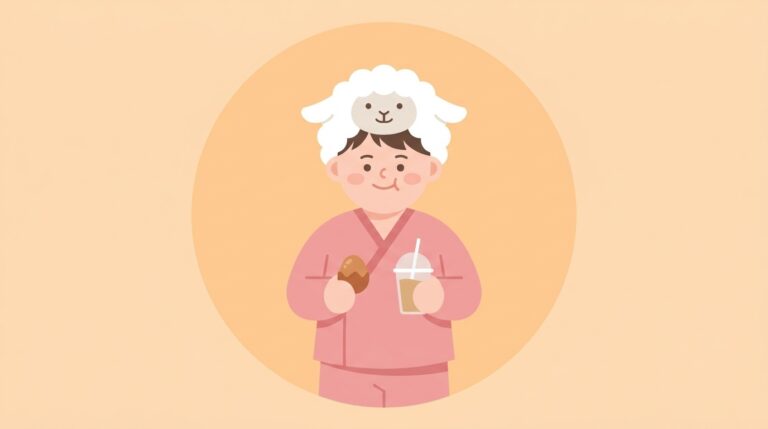
Master the K-Sauna Vibe: How to Make a ‘Sheep Head’ Towel (양 머리) Like a K-Drama Pro!
Phase 1: Empathy (스토리 몰입형 오프닝)
안녕하세요! (Annyeonghaseyo!) It’s your friendly neighborhood Korean editor and cultural navigator from Daily Hangul (매일한글)!
Picture this: You’ve finally stepped into a warm, glowing, salt-brick-lined Jjimjilbang (찜질방 – Korean bathhouse/sauna) after a long day of sightseeing in Seoul. You hear the gentle hum of people chatting, catch the rich aroma of roasted eggs, and notice everyone walking around looking incredibly cozy. But wait—there is a major trend here. Almost everyone is wearing a cute towel on their head that looks exactly like sheep ears!
You try to roll one yourself, but it keeps unravelling, sliding off your wet hair, and honestly, you feel a bit self-conscious. Don’t worry! Every Korean learner has faced this ‘how-to-wear-the-towel’ panic.
Today, we are going to unlock the mystery behind the Yang Meori (양 머리 – Sheep Head) towel and learn the essential Jjimjilbang phrases that will help you blend in like a true local. Grab your banana milk, and let’s roll!
Phase 2: Deep Dive into 3 Key Expressions (핵심 표현 3선 심층 분석)
1. 양 머리 해 주세요 (Yang meori hae juseyo)
- Pronunciation: Yahng muh-ree hae joo-seh-yo (Sounds like “yahng” as in ‘yawn’ with a ‘g’, and “meori” like ‘mer-ry’)
- Meaning: “Please make the sheep head towel for me.”
- K-Culture Moment: This is the ultimate bonding phrase! In classic K-Dramas, friends or couples sitting on the heated floor of a Jjimjilbang will look at each other, playfully fold towels, and say this while gently placing it on each other’s heads.
- Editor’s Insight: While ‘해 주세요’ (hae juseyo) literally means “please do it,” here it functions as a friendly request for help. Use it with a friend or a helpful local if your towel folds keep slipping.
- Situation Spectrum: Casual (✅) / Semi-formal (⚠️) / Formal (🚫)
- 🤔 Think About It: In many Western cultures, asking a stranger or acquaintance to fix your hair or hat might feel a bit too personal. In Korea, sharing a Jjimjilbang space creates a unique “we-ness” (우리 – uri) where sharing tips, food, and even folding towels for each other is a sign of warm hospitality. How does this compare to public spaces in your country?
2. 수건 좀 빌려주세요 (Sugeon jom billyeojuseyo)
- Pronunciation: Soo-guhn johm beel-yuh-joo-seh-yo (Sounds like “soo-gun” with a short ‘u’, “jom” as in ‘home’ but shorter)
- Meaning: “Could you please lend me some towels?” / “Can I have an extra towel?”
- K-Culture Moment: Usually, towels are provided at the front desk when you check in (and pay). However, if you drop yours on the wet floor of the changing room or need an extra one to craft the perfect sheep ears, you’ll head to the counter and say this.
- Editor’s Insight: The word ‘좀’ (jom) literally means “a little,” but when inserted into requests, it acts as a magical softener. It transforms a direct command into a highly polite, natural plea.
- Situation Spectrum: Casual (✅) / Semi-formal (✅) / Formal (⚠️)
- 🤔 Think About It: Why does adding “a little” (좀) make Korean requests sound so much softer? Think about how English speakers say “Could I just get some towels?” to avoid sounding demanding.
3. 식혜랑 구운 계란 주세요 (Sikhye-rang guun gyeran juseyo)
- Pronunciation: Sheek-hyeh-rahng goo-oon gyeh-rahn joo-seh-yo
- Meaning: “Sweet rice punch and roasted eggs, please.”
- K-Culture Moment: This is the holy grail snack combo of the K-Sauna world. You cannot wear a sheep towel without cracking a brown, slow-roasted egg (구운 계란) on your friend’s forehead (yes, that’s the tradition!) and washing it down with ice-cold Sikhye (식혜).
- Editor’s Insight: The particle ‘-랑’ (-rang) is the casual, everyday way to say “and” when linking nouns. It sounds much more natural in speech than the textbook ‘-과/와’ (-gwa/wa).
- Situation Spectrum: Casual (✅) / Semi-formal (✅) / Formal (🚫)
- 🤔 Think About It: Food is an essential part of the Korean wellness experience. Bathing is not just about hygiene; it is a full-day social activity. What is your country’s equivalent of “bathhouse food”?
Phase 3: Textbook Korean vs. Real Korean (교과서 한국어 vs. 진짜 한국어)
Situation 1: Asking someone to help you fold the towel
- 📖 Textbook Korean: 수건으로 양 머리를 만드는 방법을 가르쳐 주십시오.
(Sugeon-euro yang meorireul mandeuneun bangbeobeul gareuchyeo jusipsio.)
“Please teach me the method of making a sheep head with a towel.” (Too formal, sounds like a manual instructions manual!) - 🗣️ Real Korean: 이거 양 머리 어떻게 접어요?
(Igeo yang meori eotteohge jeobeoyo?)
“How do I fold this sheep head?” (Natural, friendly, and active!) - 💡 Why the Difference? Real Koreans prefer short, conversational verbs like ‘접다’ (jeopda – to fold) over heavy noun phrases like ‘만드는 방법’ (making method) when speaking casually.
Situation 2: Ordering the snack combo
- 📖 Textbook Korean: 저는 식혜 한 잔과 계란 세 개를 구입하고 싶습니다.
(Jeoneun sikhye han jan-gwa gyeran se gaereul guiphago sipseumnida.)
“I would like to purchase one cup of sikhye and three eggs.” (Extremely robotic and stiff.) - 🗣️ Real Korean: 식혜 하나랑 계란 세 개 주세요!
(Sikhye hana-rang gyeran se gae juseyo!)
“One sikhye and three eggs, please!” - 💡 Why the Difference? In real life, simple counters like ‘하나’ (hana – one) and ‘세 개’ (se gae – three things) combined with ‘-랑’ are all you need to sound fluent and relaxed.
Phase 4: K-Culture Deep Dive & Non-Verbal Manners
4-1. Nunchi (눈치) & Gestures
- The Forehead Egg Crack: If you want to eat a roasted egg with a friend, the classic “K-Drama” way is to tap the egg against your friend’s head to crack the shell. Warning: Do not do this to strangers or elders! It is strictly for close friends. Also, check your partner’s reaction (Nunchi) first—tap gently!
- Towel Wrapping Hygiene: Always fold and put on your Yang Meori using a clean, dry towel provided by the front desk, not the small washcloth you used inside the hot tubs.
4-2. Culture Code: The Magic of Jjimjilbang
In Korea, Jjimjilbang is a sanctuary of communal comfort. People of all ages sleep side-by-side on heated floors, watch TV together, and share snacks. Wearing the Yang Meori isn’t just for a cute Instagram photo; historically, it keeps your wet hair clean off the common floor area and protects your ears and temples from the intense dry heat of the high-temperature sauna rooms.
Phase 5: Real-Life Roleplay Scenario (실전 롤플레이 시나리오)
Setting: The main common hall (홀) of a traditional Jjimjilbang in Seoul.
Characters:
* You (A curious traveler wearing the standard sauna uniform)
* Min-ho (민호) (An friendly local regular holding a tray of drinks)
Min-ho: 안녕하세요! 처음 오셨나 봐요? 옷이 완전 새 거네요!
        (Annyeonghaseyo! Cheoum osyeonna bwayo? Osi wanjeon sae geoneyo!)
        🎭 [Smiling warmly, pointing to your neat uniform]
        "Hello! Is this your first time? Your clothes look brand new!"

You: 네, 맞아요. 찜질방 정말 신기해요! 근데 다들 머리에 쓴 거 뭐예요?
     (Ne, majayo. Jjimjilbang jeongmal sin-gihaeyo! Geunde dadeul meorie sseun geo mwoyeyo?)
     🎭 [Gesturing toward your own head with curious eyes]
     "Yes, that's right. The Jjimjilbang is so cool! But what is that thing everyone is wearing on their heads?"

Min-ho: 아, 이거요? 이거 '양 머리'라고 해요. 엄청 귀엽죠?
        (Ah, igeoyo? Igeo 'yang meori'-rago haeyo. Eomcheong gwiyeopjyo?)
        🎭 [Gently patting his own folded towel ears]
        "Ah, this? This is called a 'sheep head'. Pretty cute, right?"

You: 와! 너무 귀여워요. 저도 하고 싶어요. 이거 양 머리 어떻게 접어요?
     (Wa! Neomu gwiyeowoyo. Jeodo hago sipeoyo. Igeo yang meori eotteohge jeobeoyo?)
     🎭 [Holding up your clean towel with an eager grin]
     "Wow! It's so cute. I want to do it too. How do I fold this sheep head?"

Min-ho: 생각보다 아주 쉬워요! 제가 도와드릴까요?
        (Saenggakboda aju swiwoyo! Jega dowadeurilkkayo?)
        🎭 [Reaching out his hand to show you step-by-step]
        "It's much easier than you think! Shall I help you?"

You: 네! 양 머리 해 주세요. 감사합니다!
     (Ne! Yang meori hae juseyo. Gamsahamnida!)
     🎭 [Handing over the towel politely with both hands]
     "Yes! Please make the sheep head for me. Thank you!"

Min-ho: 짜잔! 완성됐어요. 머리에 한번 써 보세요! 잘 어울려요.
        (Jjajan! Wanseongdwaesseoyo. Meorie hanbeon sseo boseyo! Jal eoullyeyo.)
        🎭 [Placing the completed towel hat onto your head, thumbs up]
        "Ta-da! It's complete. Try putting it on your head! It suits you well."

You: 진짜요? 감사합니다! 이제 식혜랑 구운 계란 먹으러 가야겠어요.
     (Jinjayo? Gamsahamnida! Ije sikhye-rang guun gyeran meogeureo gayagesseoyo.)
     🎭 [Touching the towel ears with a big laugh]
     "Really? Thank you! Now I should go eat sweet rice punch and roasted eggs."
🔀 Interactive Choice Points
Now it’s your turn! How would you respond if Min-ho asks: “식혜랑 계란은 사 오셨어요? (Did you buy the sikhye and eggs yet?)”
- Option A: “아니요, 아직 안 샀어요. 같이 매점 갈래요?” (No, not yet. Want to go to the snack bar together?)
- 👉 Best! Perfect way to make a local friend. It’s polite, casual, and natural.
- Option B: “저는 배가 안 고파요.” (I am not hungry.)
- 👉 Bad. While grammatically correct, it kills the warm mood and shuts down the conversation.
- Option C: “식혜 주세요.” (Give me sikhye.)
- 👉 Risk. Min-ho is a friendly customer, not the worker! Saying this to him might make you look a bit rude or confused.
Phase 6: 10-Second Emotion Shadowing Drill (10초 감정 섀도잉 드릴)
Practice speaking with the authentic emotions of a relaxed sauna goer! Use the / marks to pause briefly.
- [😊 Filled with excitement & curiosity]
- “이거 / 양 머리 / 어떻게 접어요?”
- Igeo / yang meori / eotteohge jeobeoyo?
- [🥺 Playfully pleading, cute tone]
- “양 머리 / 해 주세요! / 네?”
- Yang meori / hae juseyo! / ne?
- [😋 Drooling, hungry after a hot sauna]
- “식혜랑 / 구운 계란 / 빨리 먹고 싶어요!”
- Sikhye-rang / guun gyeran / ppalli meoggo sipeoyo!
Phase 7: K-Culture Mini-Dictionary (K-Culture 미니 사전)
- 찜질방 (Jjimjilbang) | Korean Bathhouse | A 24-hour public bathhouse featuring hot tubs, dry saunas, and massive relaxation areas.
- 식혜 (Sikhye) | Sweet Rice Punch | A traditional sweet beverage made of malt barley and cooked rice, served ice-cold to hydrate you after sweating.
- 구운 계란 (Guun Gyeran) | Baked/Roasted Eggs | Eggs slow-baked at high temperatures inside sauna rooms until the shells turn brown and the whites get super chewy.
- 매점 (Maejeom) | Snack Counter / Kiosk | The food stall inside public places like saunas, train stations, or schools where you buy snacks and drinks.
Phase 8: Traveler’s Survival Kit (여행자를 위한 생존 키트)
Survival Phrases TOP 3
- 열쇠 어디에 찍어요? (Yeolsoe eodie jjigeoyo?)
- “Where do I tap my locker key?” (Used to pay for snacks inside—most Jjimjilbangs use electronic wristband keys instead of cash!)
- 여성 전용인가요? (Yeoseong jeonyong-ingayo?)
- “Is this female-only?” (Crucial when navigating separate bathing zones or resting rooms.)
- 담요 하나 더 주실 수 있나요? (Damyo hana deo jusil su innayo?)
- “Could I get one more blanket?” (If you plan to sleep in the quiet zone overnight.)
Editor’s Travel Note:
To find the best traditional saunas in Korea, download the Naver Map App (never use Google Maps in Korea, as it’s not fully updated!). Search for “찜질방” (Jjimjilbang) near your location. Don’t worry about cash—your wristband locker key tracks all your snack bar purchases, and you pay at the front desk when checking out!
Phase 9:
Frequently Asked Questions (FAQ)
Q: What does "양 머리 해 주세요 (Yang meori hae juseyo)" mean in Korean and how do you pronounce it?
A: In Korean, "양 머리 해 주세요 (Yang meori hae juseyo)" is pronounced [Yahng muh-ree hae joo-seh-yo (Sounds like "yahng" as in 'yawn' with a 'g', and "meori" like 'mer-ry'] and means: "Please make the sheep head towel for me."
Q: What does "수건 좀 빌려주세요 (Sugeon jom billyeojuseyo)" mean in Korean and how do you pronounce it?
A: In Korean, "수건 좀 빌려주세요 (Sugeon jom billyeojuseyo)" is pronounced [Soo-guhn johm beel-yuh-joo-seh-yo (Sounds like "soo-gun" with a short 'u', "jom" as in 'home' but shorter] and means: "Could you please lend me some towels?" / "Can I have an extra towel?"
Q: What does "식혜랑 구운 계란 주세요 (Sikhye-rang guun gyeran juseyo)" mean in Korean and how do you pronounce it?
A: In Korean, "식혜랑 구운 계란 주세요 (Sikhye-rang guun gyeran juseyo)" is pronounced [Sheek-hyeh-rahng goo-oon gyeh-rahn joo-seh-yo] and means: "Sweet rice punch and roasted eggs, please."







