

안녕하세요! Welcome back to Daily Hangul!
I’m your Daily Hangul Editor and local culture navigator! Today, we are stepping into a place that has recently become a massive trend in Korea: the 헬스장 (hel-seu-jang – Gym)!
Have you noticed how many K-Drama actors and K-Pop idols boast incredibly toned physiques? In Korea, going to the gym and doing 근력 운동 (geun-nyeok un-dong – Strength/Weight Training) is no longer just a hobby; it’s a lifestyle called ‘O-Un-Wan’ (오늘 운동 완료 – Today’s Workout Complete).
But stepping into a Korean gym for the first time can feel a bit intimidating. You see someone using the bench press you want, or you need to ask a trainer how to adjust a machine. Don’t worry! Today, we’re going to master the exact, simple phrases you need to conquer the weight room with absolute confidence. Let’s pump some iron in Korean! 🏋️♂️💪
Phase 2: Top 3 Essential Expressions for the Weight Room
1. 몇 세트 남으셨어요? (myeot se-teu nam-eu-syeo-seo-yo?)
- Pronunciation: myeot se-teu nam-eu-syeo-seo-yo? (Sounds like: “myut seh-teu nahm-eu-syuh-suh-yo?”)
- Meaning: How many sets do you have left?
- K-Culture Moment: In a busy Seoul gym (like in Gangnam or Hongdae), weight machines are high-demand real estate. Instead of awkwardly standing nearby staring at your phone, Koreans politely ask this question to coordinate their workout flow.
- Editor’s Insight: This is the ultimate gym etiquette phrase. It shows you respect their workout flow while politely claiming your turn next.
- Situation Spectrum: Casual ⚠️ | Semi-formal ✅ | Formal ✅
- 🤔 Think About It: In Korean culture, directly asking “When will you be done?” can sound a bit pushy. Asking “How many sets are left?” focuses on the shared structure of the workout, making it sound polite and cooperative.
2. 같이 써도 될까요? (gat-i sseo-do doel-kka-yo?)
- Pronunciation: gat-i sseo-do doel-kka-yo? (Sounds like: “gah-chee ssuh-doh dwel-kah-yo?”)
- Meaning: Can we use it together? / Can I work in?
- K-Culture Moment: You see someone taking long rests between sets on the squat rack. You want to slide in and do your sets during their rest times.
- Editor’s Insight: This is super common in friendly local Korean gyms. It’s highly efficient and usually met with a warm “Yes, of course!” (네, 쓰세요!).
- Situation Spectrum: Casual ⚠️ | Semi-formal ✅ | Formal ✅
- 🤔 Think About It: Why do you think sharing equipment is so widely accepted in Korea? It reflects the communal “Uri” (우리 – We/Our) culture where sharing space and resources is natural.
3. 무게 어떻게 조절해요? (mu-ge eo-tteo-ke jo-jeol-hae-yo?)
- Pronunciation: mu-ge eo-tteo-ke jo-jeol-hae-yo? (Sounds like: “moo-geh uh-ttuh-keh joh-juhl-heh-yo?”)
- Meaning: How do I adjust the weight?
- K-Culture Moment: You want to try a new state-of-the-art chest press machine, but the pin-select or plate-loaded system looks different from back home. You ask a nearby trainer.
- Editor’s Insight: Don’t struggle alone and risk getting hurt! Korean gym trainers (트레이너) are famously helpful and will gladly show you how.
- Situation Spectrum: Casual 🚫 | Semi-formal ✅ | Formal ✅
- 🤔 Think About It: Asking for help in a Korean gym is highly encouraged. It prevents injury and is seen as a sign of respect for the gym environment.
Phase 3: Textbook Korean vs. Real-Life Gym Slang
Let’s compare what textbooks teach you versus what you actually hear on the gym floor!
Situation 1: Working out hard
- 📖 Textbook: “열심히 운동하고 있어요.” (yeol-sim-hi un-dong-ha-go is-seo-yo.) – I am exercising hard.
- 🗣️ Real Life: “득근하고 있어요!” (deuk-geun-ha-go is-seo-yo!)
- 💡 Why the difference?: 득근 (Deuk-geun) is a popular slang portmanteau of 득 (gain) + 근 (muscle). It literally means “Gaining muscle!” or “May the muscle gains be with you!”
Situation 2: Finishing your workout
- 📖 Textbook: “오늘 운동을 끝냈습니다.” (o-neul un-dong-eul kkeut-naet-seup-ni-da.) – I finished today’s exercise.
- 🗣️ Real Life: “오늘 오운완 했어요!” (o-neul o-un-wan haet-seo-yo!)
- 💡 Why the difference?: 오운완 (O-Un-Wan) is the most famous fitness hashtag in Korea (오늘 운동 완료 – Today’s Workout Complete). It’s a badge of honor on Instagram!
Phase 4: K-Gym Etiquette & Culture Deep Dive
4-1. Nunchi (눈치) & Non-verbal Manners
- The Eye Contact Rule: If someone is performing a heavy lift (like a deadlift or squat) in front of the mirror, do not walk directly between them and the mirror. Mirrors are crucial for form and safety in Korea. Use your Nunchi (social sensing) to wait until their set is done before crossing!
- Towel Etiquette: Most Korean gyms provide small clean towels. Always wipe down your sweat from the bench before you walk away.
4-2. The “O-Un-Wan” Culture
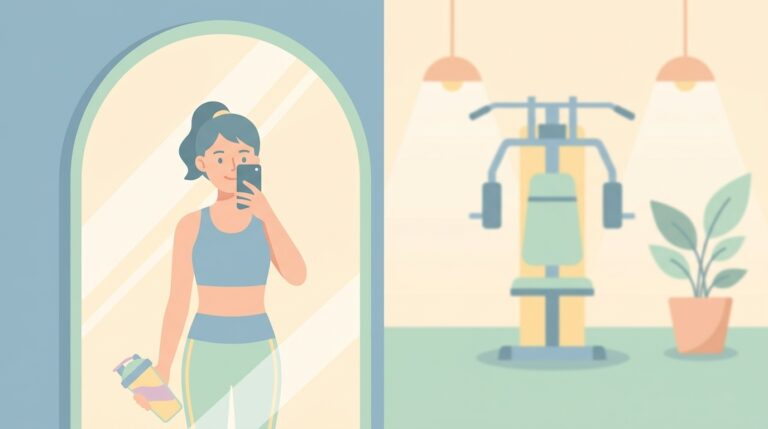
K-Pop stars frequently post mirror selfies in gym wear with the caption #오운완. It represents the self-care trend among young Koreans. Gyms in Korea are highly aesthetic, often featuring “photogenic zones” with great lighting specifically for your post-workout selfie!
Phase 5: Interactive Gym Roleplay
Let’s put this into practice! You are at a trendy gym in Seoul. You want to use the shoulder press machine, but a friendly regular named Min-jun is currently using it.
Characters:
- You (민우 / Min-u): An eager fitness enthusiast.
- Min-jun (민준): A friendly gym regular who looks like he lifts heavy.
Dialogue:
- You: 저기요, 실례합니다. 혹시 몇 세트 남으셨어요?
(jeo-gi-yo, sil-rye-hap-ni-da. hok-si myeot se-teu nam-eu-syeo-seo-yo?)
(🎭 Polite tone, making slight eye contact)
“Excuse me. By any chance, how many sets do you have left?” -
Min-jun: 아, 이제 두 세트 남았어요!
(a, i-je du se-teu nam-at-seo-yo!)
(🎭 Smiling, pointing to the barbell)
“Ah, I have two sets left!” -
You: 아, 그렇군요. 혹시 같이 써도 될까요?
(a, geu-reot-gun-yo. hok-si gat-i sseo-do doel-kka-yo?)
(🎭 Hopeful face, gesturing to the machine)
“Ah, I see. Could we perhaps work in together?” -
Min-jun: 네, 물론이죠! 제가 쉴 때 하세요. 무게는 괜찮으세요?
(ne, mul-ron-i-jyo! je-ga swil ttae ha-se-yo. mu-ge-neun gwaen-chan-eu-se-yo?)
(🎭 Enthusiastic tone, stepping back)
“Yes, of course! You do it when I rest. Is the weight okay for you?” -
You: 저는 조금 더 낮춰야 해요. 이 머신 무게 어떻게 조절해요?
(jeo-neun jo-geum deo nat-chwo-ya hae-yo. i meo-sin mu-ge eo-tteo-ke jo-jeol-hae-yo?)
(🎭 Pointing to the weight stack, looking slightly puzzled)
“I need to lower it a bit. How do I adjust the weight on this machine?” -
Min-jun: 아, 이 노란색 핀을 뽑아서 여기 원하는 무게에 꽂으시면 돼요.
(a, i no-ran-saek pin-eul ppob-as-seo yeo-gi won-ha-neun mu-ge-e kkot-eu-si-myeon dway-yo.)
(🎭 Demonstrating by pulling the pin and putting it back in)
“Ah, you just pull this yellow pin out and plug it into your desired weight here.” -
You: 우와, 정말 감사합니다! 덕분에 쉽게 하겠어요.
(u-wa, jeong-mal gam-sa-hap-ni-da! deok-bun-e sip-ge ha-get-seo-yo.)
(🎭 Grateful smile, bowing slightly)
“Wow, thank you so much! Thanks to you, I can do it easily.” -
Min-jun: 아니에요, 우리 같이 득근해요! 화이팅!
(an-i-e-yo, u-ri gat-i deuk-geun-hae-yo! hwa-i-ting!)
(🎭 Clenching fist in motivation)
“No problem, let’s gain muscles together! Fighting!”
🔀 Choose Your Next Move!
What do you say after Min-jun offers to work in with you?
* A) “아, 귀찮은데 그냥 다음에 할게요.” (Ah, it’s a hassle, I’ll just do it next time.)
* B) “감사합니다! 제가 먼저 할게요!” (Thank you! I’ll go first!)
* C) “감사합니다! 준비되시면 말씀해 주세요.” (Thank you! Please let me know when you are ready.)
Feedback:
- Choice A (Bad): Oops! This sounds very dismissive and slightly rude after he kindly agreed to share.
- Choice B (Risk): While enthusiastic, cutting in front of him immediately without letting him finish his current set rhythm might be slightly discourteous.
- Choice C (Best): Perfect! It shows high respect and allows him to finish his resting/active interval comfortably.
Phase 6: 10-Second Emotion Shadowing Drill
Let’s practice speaking with real emotions! Pay attention to the pauses (/) and the emotional cues.
- [😊 Politer & Friendly]
혹시 / 몇 세트 / 남으셨어요?
(hok-si / myeot se-teu / nam-eu-syeo-seo-yo?) -
[🙌 Enthusiastic & Motivated]
오늘도 / 같이 / 득근해요!
(o-neul-do / gat-i / deuk-geun-hae-yo!) -
[🥺 Softly asking for help]
이 머신 / 무게 어떻게 / 조절해요?
(i meo-sin / mu-ge eo-tteo-ke / jo-jeol-hae-yo?)
Phase 7: K-Gym Mini Dictionary
- 헬창 (Hel-chang) | Gym Rat
- A popular internet slang for someone obsessed with working out and muscle gains.
- PT (Pee-Tee) | Personal Training
- In Korea, personal training sessions are simply called “PT.” You will often hear trainers asking if you want to sign up for PT.
- 단백질 (Dan-baek-jil) | Protein
- Essential word! Look for this on convenience store drinks after your workout (단백질 음료).
- 스트레칭 (Seu-teu-rae-ching) | Stretching
- Every gym has a designated stretching zone where you roll out tight muscles using foam rollers.
Phase 8: Traveler’s Survival Kit
Survival Phrases TOP 3
- 일일권 있어요? (il-il-gwon is-seo-yo?) – Do you have a 1-day pass?
- Pro Tip: If you are traveling, ask this at the front desk. A 1-day pass is usually around 10,000 to 20,000 KRW.
- 운동복 제공되나요? (un-dong-bok je-gong-doe-na-yo?) – Are workout clothes provided?
- Pro Tip: Many Korean gyms rent out clean t-shirts and shorts for free or a small fee!
- 수건 어디에 있어요? (su-geon eo-di-e is-seo-yo?) – Where are the towels?
📝 Editor’s Travel Note
Most Korean gyms require you to wear 실내 운동화 (indoor sneakers) that you haven’t worn outside. Make sure to pack a clean pair of shoes in your bag! To find nearby gyms with day-passes, search “헬스장” on Naver Map (네이버 지도 App).
Phase 9: “A Step Deeper” (Cultural Reflection)
In Korea, gym culture is heavily influenced by the concept of 자기관리 (ja-gi-gwan-ri – Self-Management). Taking care of your body isn’t just about looking good; it is viewed as a sign of diligence and respect for oneself and others. When you go to a Korean gym, you’ll see people of all ages—from students to grandmothers—running on treadmills and lifting weights. It’s a beautiful, shared pursuit of health.
💬 Your Turn: Do people in your country actively share equipment at the gym like in Korea? Let us know in the comments below!
Phase 10: FAQ & Common Mistakes
Q: Can I use outdoor running shoes inside a Korean gym?
A: Generally, no. Almost all Korean gyms strictly prohibit wearing outdoor shoes inside to keep the floors clean and safe. Always carry a clean pair of indoor-only sneakers in your gym bag.
Q: Is it okay to scream or grunt loudly when lifting?
A: While some noise is natural, excessive grunting (called “쇠질 소리” or iron-clanking noise) is frowned upon in public Korean gyms. Keeping it quiet and respectful is the local standard.
Q: Do I need to bring my own lock for the locker?
A: Most premium gyms use digital keypad locks where you set your own 4-digit password on the spot, so you don’t need to carry a heavy padlock!
🚨 Common Mistakes Alert!
- Saying “머신 어떻게 사용해요?” to other gym-goers too often.
- Correct Action: It’s fine to ask once, but if you need a full tutorial, ask the staff or trainer on duty to avoid interrupting other people’s workouts.
- Leaving weight plates on the bar.
- Correct Action: Put away your plates (원판 정리) when finished. It’s a universal rule, but very strictly observed in Korea!
- Taking photos where other people’s faces are clearly visible.
- Correct Action: Korea has strict privacy customs. If you take a #오운완 selfie, ensure other members are blurred or not in the frame.
Phase 11: Action Missions
- 🥉 Bronze Mission: Practice saying “몇 세트 남으셨어요?” out loud 3 times in front of the mirror.
- 🥈 Silver Mission: Write “오늘도 오운완!” in the comments section below to commit to your next workout!
- 🥇 Gold Mission: Next time you go to the gym (or a Korean gym!), politely ask someone to share or work in using: “같이 써도 될까요?”
Phase 12: Interactive Quiz Challenge
1. Situation Quiz
You want to ask someone how many sets they have left on the lat pulldown machine. What do you say?
* A) 무게 조절해요? (mu-ge jo-jeol-hae-yo?)
* B) 몇 세트 남으셨어요? (myeot se-teu nam-eu-syeo-seo-yo?)
* C) 일일권 있어요? (il-il-gwon is-seo-yo?)
Reveal Answer & Explanation
Correct Answer: B
Explanation: ‘몇 세트 남으셨어요?’ means ‘How many sets do you have left?’ which is the perfect phrase for this situation! A is for adjusting weight, and C is for asking about a day pass.
2. Fill in the Blank
Complete the popular Korean gym slang for “Today’s Workout Complete”:
“오늘 운동 ” (오.운.)
Reveal Answer & Explanation
Correct Answer: 완료 (wan-ryo – Complete)
Explanation: The full phrase is ‘오늘 운동 완료’ (Today’s Workout Complete), abbreviated as 오운완.
3. True or False
In Korea, it is perfectly fine to wear the sneakers you wore outside on the gym’s treadmills.
Reveal Answer & Explanation
Correct Answer: False
Explanation: To maintain hygiene and protect the machines, you must bring a separate pair of clean indoor sneakers to change into at the gym.







