

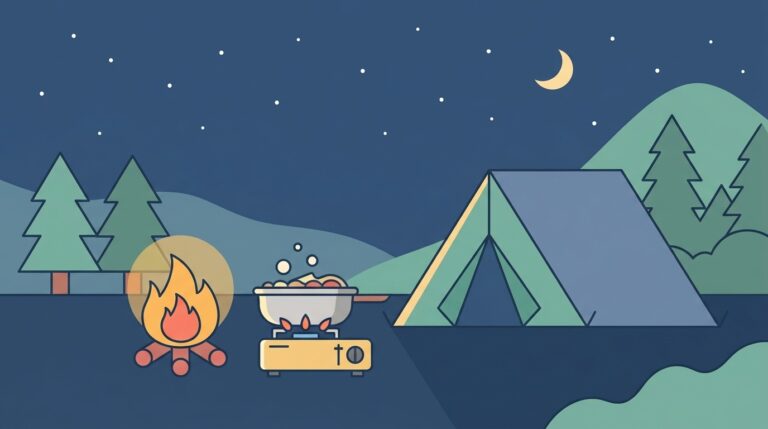
Camping in Korea: Master the Art of the 캠핑 밀키트 (Camping Meal Kit) like a Pro!
안녕하세요! (An-nyeong-ha-se-yo!) I’m your Daily Hangul editor and local culture navigator. If you’ve ever watched a K-Drama or a Korean variety show like I Live Alone or Three Meals a Day, you’ve probably noticed that Koreans take camping—and especially camping food—very seriously.
We don’t just roast marshmallows; we prepare full-course feasts! But here is the secret: nobody actually chops garlic or marinates meat at the campsite anymore. The secret weapon of modern Korean camping is the 밀키트 (Mil-ki-teu – Meal Kit).
Our intermediate (B2) learners often tell us: “I want to join my Korean friends for camping, but I don’t know the right vocabulary to coordinate the meal prep, and I get confused by the instructions on the package!” Don’t worry. Today, you’ll learn the essential expressions to talk about, prep, and enjoy camping meal kits like a true local.
Phase 2: Deep Dive into 3 Key Expressions
1. 밀키트로 때우자 (Mil-ki-teu-ro ttae-u-ja)
- Pronunciation: Mil-ki-teu-ro ttae-u-ja (Sounds like “meal-key-too-ro ttae-ooh-jah”)
- Meaning: Let’s just get by/make do with a meal kit.
- K-Culture Moment: You will hear this in variety shows when cast members arrive at a campsite late at night, tired from pitching the tent, and want a quick but delicious meal without a fuss.
- Editor’s Insight: The verb 때우다 (ttae-u-da) originally means to patch a hole or substitute something. In the context of food, it means to quickly finish a meal with something simple instead of cooking a formal, labor-intensive dish. It has a casual, cozy vibe.
- Situation Spectrum: Casual: ✅ | Semi-formal: ⚠️ | Formal: 🚫
- 🤔 Think About It: In your culture, is using pre-made kits seen as “cheating” or as a smart shortcut? In Korea, it’s considered highly efficient and trendy!
2. 국물이 끝내줘요 (Guk-mul-i kkeut-nae-jwo-yo)
- Pronunciation: Guk-mool-ee kkeut-nae-jwo-yo (Sounds like “gook-mool-ee kkeut-nae-jwo-yo”)
- Meaning: The broth/soup is amazing/mind-blowing!
- K-Culture Moment: This is an iconic 90s noodle commercial catchphrase that has become a permanent part of the Korean lexicon. Perfect when sipping hot Budae-jjigae (army stew) in the cool mountain air.
- Editor’s Insight: Korean camping food is heavily centered around hot pot dishes (jeongol or jjigae). Saying “끝내줘요” (from 끝내다, meaning to finish/end) implies the taste is so good it “ends” all competition.
- Situation Spectrum: Casual: ✅ | Semi-formal: ✅ | Formal: ⚠️
- 🤔 Think About It: Why do you think hot broth is so central to Korean outdoor culture compared to dry barbecues in Western countries?
3. 사리 추가할까? (Sa-ri chu-ga-hal-kka?)
- Pronunciation: Sa-ri choo-ga-hal-kka? (Sounds like “sah-ree choo-gah-hal-kkah?”)
- Meaning: Shall we add extra toppings/noodles?
- K-Culture Moment: Essential when eating any Korean stew or tteokbokki camping kit. You ask this when the stew is bubbling, and you want to throw in ramen noodles, tteok (rice cakes), or cheese.
- Editor’s Insight: 사리 (sari) refers to portions of noodles (ramen, glass noodles, udon) added to stews. Adding sari is a crucial stage of the meal that transitions it from a light stew to a hearty feast.
- Situation Spectrum: Casual: ✅ | Semi-formal: ✅ | Formal: 🚫
- 🤔 Think About It: “Sari” is a unique culinary loanword from traditional food culture. How does your language describe adding carb-heavy extras to a stew?
Phase 3: Textbook Korean vs. Real-Life Korean
Situation 1: Suggesting a simple meal
- 📖 Textbook Korean: “캠핑용 간편식을 먹읍시다.” (Kaem-ping-yong gan-pyeon-sig-eul meog-eup-si-da. – Let us eat convenient food for camping.)
- 🗣️ Real Korean: “우리 그냥 편하게 밀키트 먹자!” (U-ri geu-nyang pyeon-ha-ge mil-ki-teu meog-ja! – Let’s just comfortably eat a meal kit!)
- 💡 Why the difference? Textbook phrases use formal, Sino-Korean words like gan-pyeon-sik (convenience food). Locals prefer the conversational English-derived mil-ki-teu and express comfort using pyeon-ha-ge (comfortably/easily).
Situation 2: Expressing fullness after adding extras
- 📖 Textbook Korean: “라면을 넣어서 배가 부릅니다.” (Ra-myeon-eul neo-eoseo bae-ga bu-reup-ni-da. – I am full because I put in ramen.)
- 🗣️ Real Korean: “사리 추가했더니 배 터질 것 같아!” (Sa-ri chu-ga-haet-deo-ni bae teo-jil geot gat-a! – I added noodles, now I feel like my stomach is going to burst!)
- 💡 Why the difference? Real Korean uses the vivid, hyperbolic idiom 배 터지다 (bae teo-ji-da – stomach bursts) to express extreme satisfaction and fullness after a delicious meal.
Phase 4: K-Culture Deep Dive & Non-Verbal Manners
4-1. 눈치 (Nunchi) & Camping Etiquette
When preparing a mil-ki-teu at a campsite, nunchi (tact/situational awareness) is key. Don’t let your friends do all the work while you wait for the food.
* The Helper’s Gesture: If someone is opening the kit, immediately offer to fetch water or light the portable gas stove (beo-neo). Grab the trash bag and place it nearby to clean up plastic waste instantly—Korean campsites have very strict recycling rules (bun-ryu-su-geo).
4-2. The “K-Campfire” Culture
Korean camping centers around 불멍 (bul-meong)—staring blankly at a campfire to zone out and relax. Cooking a hot stew on the campfire grill while sipping beer is the peak camping aesthetic. Preparing a high-quality mil-ki-teu like gopchang-jeongol (tripe hot pot) or milfeulle-nabe shows that you have sophisticated tastes.
Phase 5: Real-Life Roleplay Scenario
Setting: A beautiful campsite in Gapyeong. You (Ji-won) and your Korean friend (Min-woo) have just finished setting up your tent. The sun is setting, and you are both starving.
Characters:
* 민우 (Min-woo): The camping veteran who brought a massive cooler bag.
* 지원 (Ji-won – You): The enthusiastic helper ready to show off intermediate Korean skills.
Dialogue
- 민우: 🎭 (Stretches his arms) 아, 텐트 치느라 고생했다! 지원아, 배고프지 않냐?
(Ah, ten-teu chi-neu-ra go-saeng-haet-da! Ji-won-a, bae-go-peu-ji an-nya?)
“Ah, great job setting up the tent! Ji-won, aren’t you hungry?” - 지원: 🎭 (Patting stomach) 응, 배에서 아주 난리가 났어. 우리 오늘 저녁 뭐 먹어?
(Eung, bae-e-seo a-ju nan-ri-ga nas-seo. U-ri o-neul jeo-nyeok mwo meog-eo?)
“Yeah, my stomach is throwing a tantrum. What are we eating for dinner tonight?” - 민우: 🎭 (Grinning, opens cooler) 요리하기 귀찮을까 봐 밀키트 챙겨왔지! 곱창전골 어때?
(Yo-ri-ha-gi gwi-chan-eul-kka bwa mil-ki-teu chaeng-gyeo-wat-ji! Gop-chang-jeon-gol eo-ttae?)
“I brought meal kits in case cooking was too tedious! How about some tripe hot pot?” - 지원: 🎭 (Clapping hands) 대박! 진짜 맛있겠다. 내가 물 올릴까?
(Dae-bak! Jin-ja mas-it-get-da. Nae-ga mul ol-ril-kka?)
“Awesome! That sounds delicious. Shall I boil the water?” - 민우: 🎭 (Handing over the pack) 응, 여기 설명서 보고 물 좀 맞춰줘. 야채는 내가 씻을게.
(Eung, yeo-gi seol-myeong-seo bo-go mul jom mat-chweo-jweo. Ya-chae-neun nae-ga ssi-seul-ge.)
“Yeah, check the instructions here and measure the water. I’ll wash the vegetables.” - 지원: 🎭 (Reading package) 오케이! 소스랑 다 같이 넣고 끓이기만 하면 되네. 대박 편하다!
(O-kei! So-seu-rang da ga-chi neo-ko kkeul-i-gi-man ha-myeon doe-ne. Dae-bak pyeon-ha-da!)
“Okay! We just need to put the sauce and everything in and boil it. So convenient!” - 민우: 🎭 (Looking at boiling pot) 와, 냄새 끝내준다. 여기에 사리 추가할까?
(Wa, naem-sae kkeut-nae-jun-da. Yeo-gi-e sa-ri chu-ga-hal-kka?)
“Wow, the smell is amazing. Shall we add some extra noodles?” - 지원: 🎭 (Holding a pack of ramen) 당연하지! 라면 사리 들어간다!
(Dang-yeon-ha-ji! Ra-myeon sa-ri deul-eo-gan-da!)
“Of course! In goes the ramen noodle!”
🔀 Interactive Choice Points
At Step 7, Min-woo asks about adding extras. What is your response?
* A: “귀찮은데 그냥 먹자.” (It’s tedious, let’s just eat.)
* 👉 Feedback (Bad): While honest, it kills the exciting camping vibe. Half the fun of a Korean meal kit is customizing it!
* B: “당연하지! 라면 사리랑 치즈도 넣자!” (Of course! Let’s put in ramen noodles and cheese too!)
* 👉 Feedback (Best!): Perfect! This shows you understand the true essence of Korean Jeongol culture. Min-woo will be highly impressed by your food synergy.
* C: “저는 밥만 먹고 싶어요.” (I only want to eat rice.)
* 👉 Feedback (Risk): A bit too formal and polite. Camping is about sharing communal pots. Try to go with the flow of the shared stew.
Phase 6: 10-Second Emotion Shadowing Drill
Practice speaking like an expressive native with these emotion markers and pauses (/).
- [😊 Excited and hungry]
- 배에서 / 아주 난리가 났어!
- Bae-e-seo / a-ju nan-ri-ga nas-seo! (My stomach is throwing a tantrum!)
- [🤩 Amazed by the smell]
- 와, / 국물이 / 진짜 끝내준다!
- Wa, / guk-mul-i / jin-ja kkeut-nae-jun-da! (Wow, the broth is seriously amazing!)
- [😋 Craving extra carbs]
- 여기에 / 우동 사리 / 추가하면 / 맛있겠다!
- Yeo-gi-e / u-dong sa-ri / chu-ga-ha-myeon / mas-it-get-da! (It’d be delicious if we added udon noodles to this!)
Phase 7: K-Culture Mini Dictionary
- 불멍 (Bul-meong) | Campfire spacing-out | The therapeutic act of staring into a campfire without thinking about anything.
- 밀키트 (Mil-ki-teu) | Meal Kit | Pre-portioned ingredients packaged for quick, high-quality cooking.
- 버너 (Beo-neo) | Portable gas stove | An absolute necessity for Korean camping, usually powered by butane canisters.
- 볶음밥 (Bok-keum-bap) | Fried Rice | The mandatory final stage of eating any Korean stew/stir-fry, using the leftover sauce.
Phase 8: Traveler’s Survival Kit
Survival Expressions TOP 3
- 이거 어떻게 조리해요? (I-geo eo-tteo-ke jo-ri-hae-yo?) – How do I cook this?
- 물 얼마나 넣어야 돼요? (Mul eol-ma-na neo-eoya dwae-yo?) – How much water should I put in?
- 부탄가스 어디서 사요? (Bu-tan-ga-seu eo-di-seo sa-yo?) – Where can I buy butane gas canisters?
Editor’s Travel Note
Before heading out, make sure to download the Naver Map App to locate the nearest large discount stores (like E-Mart or Lotte Mart), which have massive, dedicated “Camping Meal Kit” zones with dishes you can’t find anywhere else. Note: Store hours and availability may change based on local policies.
Phase 9:
Frequently Asked Questions (FAQ)
Q: What does "밀키트로 때우자 (Mil-ki-teu-ro ttae-u-ja)" mean in Korean and how do you pronounce it?
A: In Korean, "밀키트로 때우자 (Mil-ki-teu-ro ttae-u-ja)" is pronounced [Mil-ki-teu-ro ttae-u-ja (Sounds like "meal-key-too-ro ttae-ooh-jah"] and means: Let's just get by/make do with a meal kit.
Q: What does "국물이 끝내줘요 (Guk-mul-i kkeut-nae-jwo-yo)" mean in Korean and how do you pronounce it?
A: In Korean, "국물이 끝내줘요 (Guk-mul-i kkeut-nae-jwo-yo)" is pronounced [Guk-mool-ee kkeut-nae-jwo-yo (Sounds like "gook-mool-ee kkeut-nae-jwo-yo"] and means: The broth/soup is amazing/mind-blowing!
Q: What does "사리 추가할까? (Sa-ri chu-ga-hal-kka?)" mean in Korean and how do you pronounce it?
A: In Korean, "사리 추가할까? (Sa-ri chu-ga-hal-kka?)" is pronounced [Sa-ri choo-ga-hal-kka? (Sounds like "sah-ree choo-gah-hal-kkah?"] and means: Shall we add extra toppings/noodles?







