

Master the Market: How to Use Onnuri Gift Certificates Like a Born-and-Bred Korean
Phase 1: Empathy (Your Local Companion’s Warm Welcome)
안녕하세요! (An-nyeong-ha-se-yo!) Welcome back to your favorite corner of the internet, brought to you by the Daily Hangul editorial team. I’m your resident culture navigator, and today, we are heading straight into the aromatic, bustling heart of Korean daily life: the traditional market (전통시장 – Jeon-tong-si-jang).
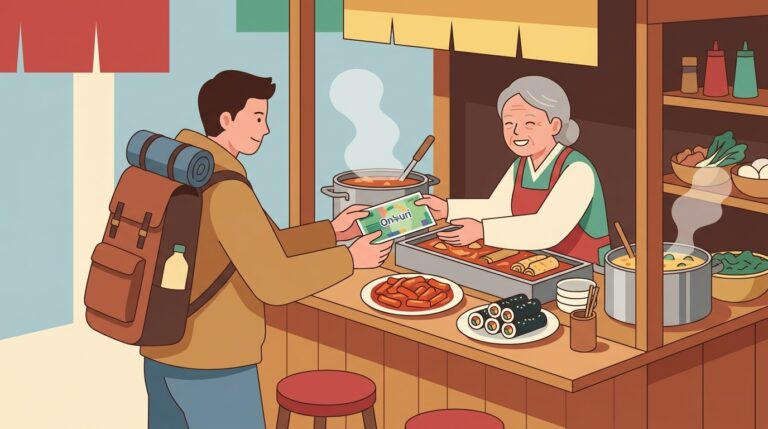
Imagine this: You are walking through the vibrant alleys of Mangwon Market (망원시장) or Gwangjang Market (광장시장). Your senses are overwhelmed by the sizzling sound of nokdu-jeon (mung bean pancakes) and the sweet aroma of bubbling tteokbokki. You want to buy some fresh fruits and side dishes. You proudly pull out an Onnuri Gift Certificate (온누리상품권)—a government-backed voucher designed to support local vendors—that you got at a discount.
But suddenly, a wave of hesitation hits you:
* “Can I use this at this specific stall?”
* “Do I get change back if I don’t spend the whole amount?”
* “What if they only accept the mobile version?”
If your heart did a little nervous flutter just reading that, don’t worry! You are not alone. Many of our B2-level intermediate learners tell us they feel confident ordering in cafes but completely freeze up when dealing with traditional market voucher rules. Today, we are going to dismantle those fears. By the end of this guide, you will be handling Onnuri vouchers with the effortless grace of a local ajumma (middle-aged lady) hunting for the best deals!
Phase 2: Deep Dive into the Top 3 Expressions
To navigate the traditional market confidently, you need these three powerhouse B2-level phrases. Let’s break down their grammar, nuance, and social context.
1. 이거 온누리상품권 쓸 수 있어요? (I-geo on-nu-ri-sang-pum-gwon sseul su isseo-yo?)
- Pronunciation Analogy: “Ee-gaw ohn-noo-ree-sahng-poom-gwon sseul soo ees-suh-yo?”
- Meaning: “Can I use this Onnuri Gift Certificate here?”
- K-Culture Moment: You will hear this phrase echoed throughout the market aisles, especially near popular street food stalls where tourists and locals alike queue up.
- Editor’s Insight: The pattern -ㄹ/을 수 있다 (to be able to) is elementary, but pairing it with the specific noun “온누리상품권” instantly signals to the vendor that you understand the local economic culture. It is polite, direct, and universally understood.
- Situation Spectrum:
- Casual: ⚠️ 이거 온누리 돼? (I-geo on-nu-ri dwae? – Use only with close friends)
- Semi-formal: ✅ 이거 온누리상품권 쓸 수 있어요? (Perfect for market stalls)
- Formal: ✅ 온누리상품권 가맹점인가요? (On-nu-ri-sang-pum-gwon ga-maeng-jeom-in-ga-yo? – “Is this an Onnuri-affiliated store?”)
- 🤔 Think About It: Korea introduced Onnuri vouchers in 2009 to protect small businesses from mega-corporations. Does your home country have local currencies or vouchers specifically designed to support small neighborhood businesses?
2. 혹시 잔돈은 현금으로 주시나요? (Hok-si jan-don-eun hyeon-geum-euro ju-si-na-yo?)
- Pronunciation Analogy: “Hoke-shee jahn-done-eun hyun-geum-eu-ro joo-shee-nah-yo?”
- Meaning: “By any chance, do you give the change back in cash?”
- K-Culture Moment: This is the ultimate insider phrase used when buying something worth 6,000 KRW with a 10,000 KRW voucher.
- Editor’s Insight: The magic word here is 혹시 (by any chance). It softens the question. Under Onnuri rules, if you spend 60% or more of the voucher’s face value, you are legally entitled to receive the remaining change in cash. Asking this politely ensures a smooth transaction.
- Situation Spectrum:
- Casual: ⚠️ 잔돈 현금으로 줘? (Jan-don hyeon-geum-euro jwo? – Too blunt!)
- Semi-formal: ✅ 혹시 잔돈은 현금으로 주시나요? (Polite, soft, and highly effective)
- Formal: ✅ 잔돈 반환은 현금으로 가능합니까? (Jan-don ban-hwan-eun hyeon-geum-euro ga-neung-hap-ni-ka? – Too cold/stiff for a market)
- 🤔 Think About It: Traditional markets rely heavily on cash flow. How does “정” (Jeong – cultural warmth/affection) play into financial transactions in Korea compared to the transactional coldness of modern shopping malls?
3. 모바일(카드형) 온누리도 결제돼요? (Mo-ba-il [ka-deu-hyeong] on-nu-ri-do gyeol-je-dwae-yo?)
- Pronunciation Analogy: “Moh-bah-eel [kah-deu-hyung] ohn-noo-ree-doh gyul-jeh-dway-yo?”
- Meaning: “Do you also accept mobile (card-type) Onnuri payments?”
- K-Culture Moment: Popularized by younger foodies on Instagram, this phrase is crucial now that Onnuri has gone digital via QR codes and linked credit cards.
- Editor’s Insight: The verb 결제되다 (to be paid/processed) is the passive form of 결제하다 (to pay). Using this passive form makes your Korean sound incredibly natural and business-savvy.
- Situation Spectrum:
- Casual: ⚠️ 모바일 온누리도 돼? (Mo-ba-il on-nu-ri-do dwae?)
- Semi-formal: ✅ 모바일(카드형) 온누리도 결제돼요? (Highly recommended)
- Formal: ✅ 모바일 상품권 결제가 가능합니까? (Mo-ba-il sang-pum-gwon gyeol-je-ga ga-neung-hap-ni-ka?)
- 🤔 Think About It: Traditional spaces are rapidly modernizing. Do you prefer preserving old-school paper methods, or do you appreciate the transition to digital systems like Korea’s Mobile Onnuri?
Phase 3: Textbook Korean vs. Real-Life Korean
To reach a true B2 level, you must abandon the rigid sentences found in old grammar books. Let’s look at how textbooks differ from real life.
Situation 1: Confirming voucher acceptance
- 📖 Textbook Korean: “이 온누리상품권을 취급하십니까?” (I on-nu-ri-sang-pum-gwon-eul chwi-geup-ha-sip-ni-ka? – “Do you trade in this Onnuri Gift Certificate?”)
- 🗣️ Real-Life Korean: “사장님, 온누리 돼요?” (Sa-jang-nim, on-nu-ri dwae-yo? – “Boss, does Onnuri work?”)
- 💡 Why the difference? Market vendors are busy. They appreciate brief, friendly language. Calling the vendor 사장님 (Sa-jang-nim – literally ‘CEO/Boss’) instantly establishes warmth, while shortening the long noun to just “온누리” is how 99% of locals talk.
Situation 2: Asking for your change
- 📖 Textbook Korean: “액면가의 육십 퍼센트 이상 사용 시 잔돈을 환불받을 수 있습니까?” (Aek-myeon-ga-ui yuk-sip peo-sen-teu i-sang sa-yong si jan-don-eul hwan-bul-bad-eul su is-seup-ni-ka? – “Can I get a refund of the change if I use more than 60 percent of the face value?”)
- 🗣️ Real-Life Korean: “남은 건 현금으로 주시는 거죠?” (Nam-eun geon hyeon-geum-euro ju-si-neun geo-jyo? – “You give the remaining back in cash, right?”)
- 💡 Why the difference? Nobody quotes financial bylaws to a sweet market merchant! Using -는 거죠? (-neun geo-jyo? – “…, right?”) assumes the standard market rule politely without sounding confrontational or overly formal.
Phase 4: K-Culture Deep Dive & Non-Verbal Etiquette
4-1. Nunchi (눈치) & Hand Gestures
Traditional markets are the ultimate arena for Nunchi (intuitive situational awareness).
* Two-Hand Rule: When handing over a paper Onnuri voucher or your phone for a mobile scan, always use two hands (or support your right elbow with your left hand). This shows deep respect.
* The Eye-Contact Smile: Traditional market vendors (often older aunts and uncles) respond beautifully to warm eye contact and a cheerful greeting. A stiff, silent transaction is seen as cold.
4-2. The “Newtro” Market Craze
Traditional markets are no longer just for older generations. In Korea, there is a massive trend called Newtro (New + Retro). K-Dramas like Our Blues and variety shows like Amazing Saturday (놀라운 토요일) showcase young celebrities feasting on traditional market snacks. Using Onnuri vouchers is seen as a smart, eco-friendly, and culturally conscious way to enjoy these trendy foodie havens.
Phase 5: Live Action Roleplay
Setting: A highly popular side-dish (Banchan) stall in the historic Tongin Market (통인시장), Seoul. The stall is crowded, and the owner (Imonim) is energetically packaging seasoned spinach and braised tofu.
- Characters:
- You (민지 – Min-ji): A curious expat wanting to buy delicious banchan using an Onnuri voucher.
- 이모님 (I-mo-nim): The warm but incredibly busy stall owner.
이모님: (Wiping her brow, smiling) 어서 오세요! 뭐 드릴까? 반찬 맛있어!
        (Eo-seo o-se-yo! Mwo deu-ril-ka? Ban-chan mas-is-seo!)
        "Welcome! What can I get you? The side dishes are delicious!"

민지: (Pointing at the braised tofu) 이모님, 이거 두부조림 한 팩 주세요. 얼마예요?
      (I-mo-nim, i-geo du-bu-jo-rim han paek ju-se-yo. Eol-ma-yeo?)
      "Auntie, please give me one pack of this braised tofu. How much is it?"

이모님: (Packaging it swiftly) 이거 육천 원! 완전 밥도둑이야.
        (I-geo yuk-cheon-won! Wan-jeon bap-do-duk-i-ya.)
        "This is 6,000 won! It's a total rice thief (delicious side dish)."

민지: (Pulling out a 10,000 won paper Onnuri voucher) 혹시 이거 온누리상품권 쓸 수 있어요?
      (Hok-si i-geo on-nu-ri-sang-pum-gwon sseul su is-seo-yo?)
      "By any chance, can I use this Onnuri Gift Certificate?"

이모님: (Nodding happily) 아이고, 당연히 되지! 온누리 아주 환영해.
        (Ai-go, dang-yeon-hi doe-ji! On-nu-ri a-ju hwan-yeong-hae.)
        "Oh, of course! Onnuri is highly welcome."

민지: (Handing the voucher with two hands) 여기요. 육천 원이니까, 잔돈 사천 원은 현금으로 주시나요?
      (Yeo-gi-yo. Yuk-cheon-won-i-ni-ka, jan-don sa-cheon-won-eun hyeon-geum-euro ju-si-na-yo?)
      "Here it is. Since it's 6,000 won, do you give the 4,000 won change in cash?"

이모님: (Handing over two crisp 2,000 won bills) 그렇지! 육십 퍼센트 넘게 썼으니까 현금으로 거슬러 줘야지. 여기 사천 원!
        (Geu-reo-chi! Yuk-sip peo-sen-teu neom-ge sseos-seu-ni-ka hyeon-geum-euro geo-seul-leo jwo-ya-ji. Yeo-gi sa-cheon-won!)
        "That's right! Since you spent over 60 percent, I must give you change in cash. Here is 4,000 won!"

민지: (Bowing slightly, receiving cash with two hands) 감사합니다, 이모님! 많이 파세요!
      (Gam-sa-hap-ni-da, i-mo-nim! Ma-ni pa-se-yo!)
      "Thank you, Auntie! I hope you sell a lot today!"
🔀 Interactive Choice Points
Imagine the vendor hesitated and said, “미안한데, 만 원짜리라 잔돈 남겨주기 좀 애매하네…” (I’m sorry, but since it’s a 10,000 won bill, giving change is a bit awkward…)
- Choice A: “법적으로 육십 퍼센트 이상 쓰면 현금으로 주셔야 해요.” (Legally, you have to give cash if I spend over 60 percent.)
- Choice B: “아, 그래요? 그럼 이천 원짜리 콩나물무침 하나 더 추가할게요!” (Oh, really? Then I’ll add one more pack of seasoned bean sprouts for 2,000 won!)
- Choice C: “그럼 그냥 카드로 낼게요. 온누리는 다음에 쓸게요.” (Then I’ll just pay by card. I’ll use Onnuri next time.)
💡 Feedback on Your Choice:
- Best Choice: B! This shows incredible Nunchi. By adding a small 2,000 won side dish, you bring the total to 8,000 won, making it much easier for the owner to give change while showing that you support her business. This is the definition of Jeong (정).
- Bad Choice: A! While legally correct, citing consumer laws to a busy market auntie ruins the friendly atmosphere. It lacks empathy and cultural tact.
- Risk Choice: C! This is safe and polite, but you miss out on the fun of using your voucher and getting a taste of authentic market transactions.
Phase 6: 10-Second Emotion Shadowing Drill
To speak like a native, you need rhythm, pauses (/), and emotional delivery. Practice these three drills out loud!
- [😊 Brightly & Greetingly]
“사장님, / 이거 / 온누리상품권 / 쓸 수 있어요?”
(Sa-jang-nim, / i-geo / on-nu-ri-sang-pum-gwon / sseul su is-seo-yo?) -
[😉 Tactful & Soft]
“혹시… / 잔돈 사천 원은 / 현금으로 / 주시는 거죠?”
(Hok-si… / jan-don sa-cheon-won-eun / hyeon-geum-euro / ju-si-neun geo-jyo?) -
[🥺 Super Grateful & Warm]
“우와! / 정말 감사합니다, 이모님! / 많이 파세요!”
(U-wa! / Jeong-mal gam-sa-hap-ni-da, i-mo-nim! / Ma-ni pa-se-yo!)
Phase 7: K-Culture Mini-Dictionary
| Word (Hangul / Romanization) | English Meaning | Real-Life Usage Insight |
|---|---|---|
| 온누리상품권 (On-nu-ri-sang-pum-gwon) | Onnuri Gift Certificate | Government vouchers usable only at registered traditional markets and commercial districts. |
| 가맹점 (Ga-maeng-jeom) | Affiliated Store | Look for the colorful “온누리상품권” sticker on the shop window or cart to confirm they accept it. |
| 잔돈 (Jan-don) | Small change / Balance | Used when referring to physical coins and low-denomination bills returned after a purchase. |
| 지하상가 (Ji-ha-sang-ga) | Underground Shopping Mall | Often affiliated with traditional markets, where you can also frequently use Onnuri vouchers. |
Phase 8: Traveler’s Survival Kit
Survival Phrases TOP 3
- “이거 온누리 가맹점 맞아요?” (I-geo on-nu-ri ga-maeng-jeom ma-ja-yo?)
- -> “Is this an Onnuri affiliate shop?” (Use this if you don’t see the sticker clearly).
- “영수증은 안 주셔도 돼요.” (Yeong-su-jeung-eun an ju-syeo-do dwae-yo.)
- -> “You don’t need to give me a receipt.” (A polite gesture to save paper for busy vendors).
- “모바일 앱 결제 QR코드 어디 있어요?” (Mo-ba-il aep gyeol-je QR-ko-deu eo-di is-seo-yo?)
- -> “Where is the mobile app payment QR code?”
Editor’s Travel Note:
Before you head out, download the official Naver Map App (네이버 지도 앱 다운로드). You can search for “온누리상품권 가맹점” directly in the search bar to see a live map of every single market stall that accepts these vouchers! Additionally, keep in mind that local policy changes can occur, so it’s always wise to have some backup cash or a physical credit card just in case.
Phase 9: One Step Deeper (Reflective Prompt)
In Western societies, transactions are highly standardized. You tap your card, the machine beeps, and you leave. In Korean traditional markets, however, transactions are highly interactive.
Negotiating change, asking for Service (서비스 – free extra food), and checking voucher eligibility are forms of small talk that build community. The Onnuri system is a deliberate cultural effort to keep this human-to-human connection alive in an increasingly digitized world.
💬 Your Turn:
Have you ever experienced a traditional market in Korea or your own country? What is one thing you find charming (or intimidating) about buying things face-to-face? Share your thoughts in the comments below!
Phase 10: FAQ & Common Mistakes (FAQ Schema)
Q: Can foreigners buy and use Onnuri Gift Certificates?
A: Yes, absolutely! Foreigners with an Alien Registration Card (ARC) can buy them at major banks with up to a 10% discount. Tourists without an ARC can easily purchase paper versions at banks using their passports, or simply use cash/cards at the market if they don’t have vouchers.
Q: What happens if I spend less than 60% of the voucher value?
A: If you spend less than 60% (e.g., spending 3,000 KRW with a 10,000 KRW voucher), the vendor is not obligated to give you cash back. They will likely ask you to pick up another item, or they might politely ask for a card instead.
Q: Can I use Onnuri vouchers at modern supermarkets like E-Mart or Homeplus?
A: No, you cannot. Onnuri vouchers are strictly prohibited at large conglomerates, department stores, and non-affiliated franchise shops to protect small local businesses.
🚨 Common Mistakes Board (TOP 3)
- Paying with crumbled paper vouchers with one hand: Avoid this! Always flatten the voucher and present it respectfully with two hands.
- Demanding cash change for a tiny purchase: Don’t try to buy a 1,000 won snack with a 10,000 won voucher just to get cash. It goes against market etiquette.
- Confusing Onnuri with local district currencies (e.g., Seoul Pay): Onnuri is national and market-specific; local currencies are district-wide. Look for the specific “온누리” branding.
Phase 11: Action Mission
- Bronze Level 🥉: Look up a YouTube vlog of Mangwon Market and spot at least three shops displaying the Onnuri (온누리) logo.
- Silver Level 🥈: Write a short, fictional dialogue in the comments using the phrase “혹시 잔돈은 현금으로 주시나요?”
- Gold Level 🥇: On your next trip to Korea, visit a traditional market, buy delicious food using an Onnuri voucher, and successfully get your cash change back!
Phase 12: Interactive Quiz Challenge
Test your knowledge before you hit the streets of Seoul!
1. Situation Quiz
You are buying 7,000 KRW worth of Hotteok (sweet pancakes) with a 10,000 KRW paper Onnuri voucher. Which of the following is the most natural and polite way to ask for change?
* A) 돈 내놔요. (Don nae-nwa-yo.)
* B) 잔돈 사천 원은 현금으로 거슬러 주시겠어요? (Jan-don sa-cheon-won-eun hyeon-geum-euro geo-seul-leo ju-si-ges-seo-yo?)
* C) 잔돈 삼천 원은 현금으로 주시나요? (Jan-don sam-cheon-won-eun hyeon-geum-euro ju-si-na-yo?)
🔍 Reveal Answer & Explanation
- Correct Answer: C!
- Explanation: 10,000 – 7,000 = 3,000 KRW. Choice B calculates the change wrong (4,000 won instead of 3,000 won). Choice A is extremely rude (“Give me money”). Choice C is polite, mathematically correct, and culturally perfect!
2. Fill-in-the-Blank
Complete the following sentence to ask if they accept mobile payments:
* “혹시 ________ 온누리도 결제돼요?”
🔍 Reveal Answer & Explanation
- Correct Answer: 모바일 (or 카드형)
- Explanation: “혹시 모바일 온누리도 결제돼요?” (Do you also accept mobile Onnuri payments?)
3. True or False
“You can get cash change back even if you only spent 30% of the Onnuri voucher value.” (True / False)
🔍 Reveal Answer & Explanation
- Correct Answer: False!
- Explanation: You must spend at least 60% of the voucher’s face value to receive the remaining balance in cash. If you spend less, you should buy more items to reach the 60% threshold!
Now you are fully armed with the linguistic tools and cultural intelligence to navigate any traditional market in Korea! Keep practicing, stay curious, and as always, 매일한글과 함께 매일 더 재미있게! (Have more fun every day with Daily Hangul!)







