

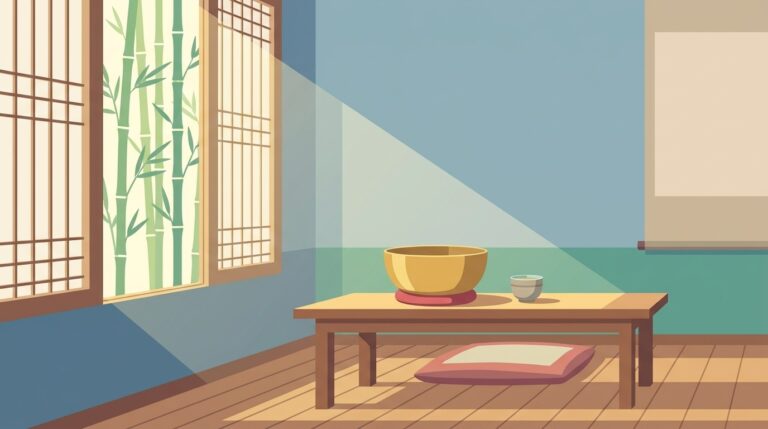
Finding Your Inner Calm: A Deep Dive into Korean Singing Bowl Meditation and Healing
Phase 1: Empathy (An Invitation to Inner Peace)
안녕하세요! (Annyeonghaseyo!) Your trusted Korean culture navigator and Daily Hangul editor is back.
Have you ever felt completely overwhelmed by the relentless, fast-paced rhythm of modern life? Imagine walking through the bustling, neon-lit streets of Gangnam, your mind buzzing with endless notifications. Now, imagine stepping into a quiet, wooden Hanok temple hall tucked away in the mountains. The scent of mugwort tea fills the air, and as you close your eyes, the deep, resonant ring of a Singing Bowl (싱잉볼) washes over you.
Many of our advanced learners, like Sarah—a yoga instructor who recently visited Korea—tell us they struggle to describe these profoundly spiritual and physical sensations in Korean. They know basic words like ‘좋아요’ (It’s good) or ‘조용해요’ (It’s quiet), but they lack the poetic, highly sensory vocabulary needed to truly share their meditative experiences.
Today, we’re leveling up your Korean to the C1 level by exploring the delicate linguistic nuances of Singing Bowl Meditation (싱잉볼 명상) and healing. By the end of this guide, you won’t just speak Korean; you’ll be able to express the quiet movements of your soul.
Phase 2: Three Core Expressions for Deep Mindfulness
Let’s explore three essential, advanced Korean expressions that native speakers use to describe the therapeutic effects of sound meditation.
1. 울림이 깊다 (Ullimi gipda)
- Pronunciation: [Ullimi gipda] (Think of the ‘Ull’ sounding like “wool” and ‘im’ like “im” in “impossible” — wool-lim-i gip-da)
- Meaning: “The resonance is deep” / “The vibration carries deep spiritual weight.”
- K-Culture Moment: Often heard in healing variety shows or healing dramas when a character strikes an ancient bell at a temple or plays a heavy brass singing bowl.
- Editor’s Insight: 울림 (resonance/vibration) comes from the verb 울리다 (to ring/echo). In Korean, a deep resonance isn’t just physical sound; it touches your emotional core. When you say the resonance is deep, you mean the vibration physically shook your tense muscles and calmed your mind.
- Situation Spectrum: Casual ✅ | Semi-formal ✅ | Formal ✅
- 🤔 Think About It: In your culture, do you describe sounds as having “depth” (깊이), or do you focus more on their volume and pitch? How does this reflect our relationship with silence?
2. 잡념이 비워지다 (Jamnyeomi biwojida)
- Pronunciation: [Jam-nyeom-i bee-wo-jee-da] (Pronounce ‘Jam’ like “jam” on toast, and ‘nyeom’ like “yawn” with an ‘n’ in front)
- Meaning: “Distracting thoughts are emptied out” / “To clear one’s mind of trivial worries.”
- K-Culture Moment: Used by artists, athletes, or actors in interviews when discussing how they overcome burnout or performance anxiety.
- Editor’s Insight: 잡념 (雜念) literally translates to “miscellaneous, scattered thoughts.” Unlike the English “clearing your mind,” the Korean phrase uses 비워지다 (to be emptied), evoking the image of pouring out muddy water to leave an empty, clean vessel.
- Situation Spectrum: Casual ✅ | Semi-formal ✅ | Formal ✅
- 🤔 Think About It: Why do you think Korean culture places such high value on “emptying” (비움) rather than “filling” (채움) when it comes to mental health?
3. 마음에 온기가 돌다 (Ma-eume ongiga dolda)
- Pronunciation: [Ma-eum-e on-gi-ga dol-da] (‘On’ as in “on” the table, ‘gi’ like “key” but with a softer ‘g’)
- Meaning: “Warmth circulates back into one’s heart/mind.”
- K-Culture Moment: Frequently used in comforting K-Drama dialogues to describe the feeling of receiving deep empathy or experiencing a restorative, quiet moment.
- Editor’s Insight: 온기 (溫氣) means “warm warmth.” When you meditate with a singing bowl, the soothing sound vibrations make you feel safe, restoring warmth to a heart that had grown cold and rigid from stress.
- Situation Spectrum: Casual ✅ | Semi-formal ✅ | Formal ✅
- 🤔 Think About It: How does your native language describe the physical sensation of mental relief? Is it warm, light, or perhaps cool?
Phase 3: Textbook Korean vs. Real Native Korean
Let’s compare the sterile expressions found in standard textbooks with the vibrant, natural phrases native Koreans use during a healing session.
Situation 1: Describing the immediate effect of the singing bowl
- 📖 Textbook Korean: 소리를 들으니 스트레스가 풀려요. (Soleelyul deuleuni seuteuleseuga pullyeoyo.)
- “I listen to the sound, so my stress is relieved.”
- 🗣️ 진짜 Korean: 소리의 파동 덕분에 머리가 맑아져요. (Soleeyi padong deogbune meoliga malg-ajeoyo.)
- “Thanks to the sound waves, my head is becoming crystal clear.”
- 💡 Why the difference? C1 speakers use precise terms like 파동 (wave vibration/resonance) instead of just 소리 (sound) to capture the therapeutic, physical aspect of singing bowl meditation.
Situation 2: Expressing how relaxed you feel after the session
- 📖 Textbook Korean: 기분이 아주 좋습니다. (Gibuni aju johseubnida.)
- “My mood is very good.”
- 🗣️ 진짜 Korean: 온몸의 긴장이 풀리면서 제대로 힐링했어요. (Onmomi ginjang-i pullimyeonseo jedaelo hilling-haess-eoyo.)
- “As the tension in my entire body melted away, I experienced genuine healing.”
- 💡 Why the difference? 제대로 힐링하다 (to experience genuine, proper healing) is a highly popular modern Korean phrase combining the adverb 제대로 (properly) with the loanword 힐링 (healing) to express deep satisfaction.
Phase 4: K-Culture Deep Dive & Non-verbal Manners
4-1. “Nunchi” & Etiquette in Korean Meditation Spaces
When attending a meditation session or a temple stay in Korea, practicing Nunchi (눈치)—the art of reading the room—is essential.
* Silence is respect: Before the singing bowl begins, sit in Hapjang (합장), a gesture where you press your palms together at chest level and bow slightly.
* Eye Contact: Keep your eyes gently closed or cast downward at a 45-degree angle. Staring around the room breaks the collective flow of energy.
* Footwear Etiquette: Always wear clean, neat socks. Bare feet are considered disrespectful in spiritual or communal wooden floors in Korea.
4-2. The Rise of “Meong-ttailigi” (멍때리기) Culture
Have you heard of 멍때리기 (Meong-ttailigi)? It literally means “spacing out” or letting your brain go completely blank. In highly competitive, workaholic Korea, “spacing out” has evolved from a lazy habit into a highly respected wellness trend! Koreans practice 불멍 (spacing out looking at fire), 물멍 (looking at water), and now, 소리멍 (spacing out to healing sounds like singing bowls). This cultural wave is prominent in popular cozy reality shows where celebrities unplug and just listen to singing bowls under the stars.
Phase 5: Real-Life Roleplay Scenario
Setting: A serene tea and meditation studio in Bukchon Hanok Village.
Characters:
* 지우 (Ji-woo): The calm, soft-spoken meditation instructor (NPC).
* Sophia: An advanced foreign learner seeking peace after a stressful week.
- 지우: 🎭 (차를 가볍게 따르며) Sophia 씨, 요즘 많이 바쁘셨죠? 얼굴에 피로가 조금 보이네요.
- (Ji-woo: [Gently pouring tea] Sophia, you’ve been busy lately, right? I can see a bit of fatigue on your face.)
- Sophia: 🎭 (한숨을 낮게 쉬며) 네, 맞아요. 머릿속이 복잡해서 잠도 잘 못 잤어요.
- (Sophia: [Sighing softly] Yes, that’s right. My head has been so cluttered that I haven’t been able to sleep well.)
- 지우: 🎭 (싱잉볼을 매만지며) 잘 오셨어요. 이제 눈을 감고, 이 싱잉볼의 소리에 온전히 집중해 보세요.
- (Ji-woo: [Gently touching the singing bowl] You’ve come to the right place. Now close your eyes, and focus entirely on the sound of this singing bowl.)
- 지우: 🎭 (싱잉볼을 부드럽게 두드린다. 웅장한 진동이 방 안을 채운다)
- (Ji-woo: [Gently strikes the singing bowl. A majestic vibration fills the room])
- Sophia: 🎭 (깊게 숨을 내쉬며) 와… 소리의 울림이 정말 깊네요. 가슴까지 전해져요.
- (Sophia: [Breathing out deeply] Wow… the resonance of the sound is truly deep. I can feel it in my chest.)
- 지우: 🎭 (미소를 지으며) 소리의 진동이 몸의 긴장을 풀어줄 거예요. 어떤 기분이 드시나요?
- (Ji-woo: [Smiling] The vibration of the sound will melt away the tension in your body. How do you feel?)
- Sophia: 🎭 (어깨를 내리며) 신기하게도 복잡했던 잡념이 싹 비워지는 기분이에요.
- (Sophia: [Lowering her shoulders] Magically, it feels like all those cluttered, distracting thoughts are completely emptied out.)
- 지우: 🎭 (따뜻한 눈빛으로) 다행이네요. 이제 차를 마시며 천천히 몸의 감각을 깨워 보세요.
- (Ji-woo: [With warm eyes] I’m glad. Now, let’s drink some tea and slowly awaken your body’s senses.)
- Sophia: 🎭 (찻잔을 잡으며) 손끝부터 온몸에 따뜻한 온기가 도는 것 같아요. 정말 치유되네요.
- (Sophia: [Holding the teacup] It feels like a warm warmth is circulating from my fingertips through my whole body. This is truly healing.)
🔀 Choose Your Path! How would you reply next to Ji-woo?
- [A] “이 싱잉볼 어디서 살 수 있어요? 너무 갖고 싶어요!”
- [B] “덕분에 마음이 아주 편안해졌어요. 깊은 평화를 느꼈습니다.”
- [C] “소리가 너무 커서 머리가 좀 아프네요. 그만해 주세요.”
💡 Feedback on Your Choice:
- Selection A (Risk): While expressing desire to buy a singing bowl is natural, asking to purchase one immediately after a profound spiritual moment might break the peaceful, meditative ambiance.
- Selection B (Best!): Perfect! This showcases advanced emotional vocabulary and shows deep appreciation for the practice, matching the quiet, reflective atmosphere.
- Selection C (Bad): While honesty is important, saying “The sound is too loud, my head hurts, please stop” in a blunt manner lacks Nunchi. It’s better to say: “진동이 저에게는 조금 강한 것 같아요” (The vibration feels a bit strong for me).
Phase 6: 10-Second Emotion Shadowing Drill
To master the delicate, emotional rhythm of Korean meditation speech, practice whispering this sentence with pauses and deep emotion.
“싱잉볼 소리를 / 가만히 들으면 / 복잡했던 잡념이 / 마법처럼 / 비워져요.”
- Pronunciation Guide: [Sing-ing-bol so-li-leul / ga-man-hi deu-leu-myeon / bop-jap-haet-deon jam-nyeom-i / ma-beop-cheo-reom / bi-wo-jyeo-yo]
- Emotion Map:
[🥺 차분하고 고요한 목소리로, 세상의 모든 짐을 내려놓듯](In a calm, tranquil whisper, as if letting go of all the world’s burdens.)
Phase 7: K-Culture Mini Dictionary
- 명상 (Myeongsang | 冥想): Meditation. In Korean, it implies a deep contemplation to find one’s true self.
- 치유 (Chiyu | 治癒): Healing / Curing. While “치료” refers to clinical medical treatment, “치유” refers to holistic, spiritual, and emotional recovery.
- 힐링 (Healing | 힐링): Self-care / Trendy healing. Used widely by young Koreans to describe trendy cafes, solo travel, or relaxing activities that bring instant emotional relief.
- 마음 챙김 (Ma-eum Chaeng-gim): Mindfulness. Literally translates to “taking care of/looking after one’s heart.”
Phase 8: The Mindful Traveler’s Survival Kit
Top 3 Survival Phrases for a Korean Temple Stay / Meditation Class
- 요가 매트나 방석을 주실 수 있나요?
- [Yoga mae-teu-na bang-seog-eul ju-sil su in-na-yo?]
- Pro Tip: “Could I have a yoga mat or a sitting cushion?” Crucial if your knees hurt from sitting cross-legged on the wooden floor.
- 조금 더 약하게 두드려 주실 수 있을까요?
- [Jo-geum deo yak-ha-ge du-deu-ryeo ju-sil su is-seul-kka-yo?]
- Pro Tip: “Could you strike it a bit softer?” If the acoustic vibrations of the singing bowl feel too overwhelming for your head.
- 몸과 마음이 정말 가벼워졌습니다.
- [Mom-gwa ma-eumi jeong-mal ga-byeo-wo-jyeot-seub-ni-da.]
- Pro Tip: “My body and mind have become truly light.” The perfect, polite way to thank your instructor after a session.
Editor’s Travel Note:
To find authentic temple stay programs or private singing bowl classes in Seoul, we highly recommend downloading the 네이버 지도 (Naver Map App) or visiting the official 템플스테이 예약 사이트 (Official Temple Stay Booking Website).
Disclaimer: Prices and class availabilities vary by season; always double-check in advance.
Phase 9: “Go Deeper” — Cultural Reflection
In Western cultures, meditation is often viewed as an individualistic mental workout or productivity tool to sharpen focus. However, in Korea, meditation is deeply tied to the collective culture of Jeong (정) and Wi-ro (위로 – comfort).
When Koreans practice singing bowl meditation, they often do so in small groups, sharing their emotional burdens afterward over hot tea. It is not just about clearing one’s own brain; it is about sharing a silent space of healing with others. In Korea, true healing is completed when your warmth (온기) connects with the warmth of the community around you.
💬 Your Turn: Have you ever experienced a collective healing session? How did it feel compared to meditating alone? Let us know in the comments below!
Phase 10: FAQ & Avoiding Common Mistakes
Q: Can I use “힐링” in formal situations, or should I stick to “치유”?
A: “힐링” is incredibly common and perfect for casual conversations, social media, and semi-formal blogs. However, in highly formal speeches, academic writing, or medical therapy contexts, “치유” is preferred as it sounds more elegant, authentic, and grounded.
Q: Does “잡념” mean the same thing as “생각” (thoughts)?
A: No. “생각” is a neutral word for any thoughts. “잡념” specifically refers to the noisy, useless, and distracting thoughts that prevent you from focusing—like worrying about your taxes while trying to relax.
Q: What is the polite way to decline tea if I am too full?
A: Simply say: “차 향기만 맡아도 기분이 좋아지네요. 감사합니다.” (Just smelling the scent of the tea makes me feel happy. Thank you.) This shows high level Nunchi and appreciation without being rude.
🚨 Common Mistakes Alert!
| ❌ Wrong Expression | 👿 The Misunderstanding | Correct Action |
|---|---|---|
| “머리를 비웠어요” (Meolileul biwot-seoyo) | Literally means “I emptied my brain (physically/stupidly).” | Use “잡념을 비웠어요” or “머리가 맑아졌어요” instead. |
| “진동이 시끄러워요” (Jindongi sikkeuleowoyo) | Sounds like you are complaining about loud construction noise. | Use “울림이 조금 강해요” (The resonance is a bit strong) to be polite. |
| “힐링을 만들었어요” (Hillingeul mandeul-eoyo) | Grammatically awkward “I created healing.” | Use “힐링이 되었어요” (It became healing / It was healing) or “힐링했어요”. |
Phase 11: Action Mission & K-Culture Challenge
Ready to put your C1 skills into practice? Take on our Daily Hangul Action Challenge!
- 🥉 Bronze Level: Read our Shadowing Drill out loud three times. Pay close attention to the soft, emotional pauses.
- 🥈 Silver Level: Go to YouTube, search for “싱잉볼 명상” (Singing bowl meditation), find a video, and write a simple Korean comment using “울림이 정말 깊네요” or “머리가 맑아져요”.
- 🥇 Gold Level: Next time you feel stressed, tell a friend or write in your journal: “오늘은 잡념이 너무 많아서 힐링이 필요해.” (I have too many distracting thoughts today; I need some healing.)
Phase 12: Interactive Quiz Challenge
Test your knowledge of advanced Korean meditation language and culture below!
🔍 Q1: Which word best describes the noisy, distracting thoughts you want to empty during meditation?
- Answer: 잡념 (Jamnyeom)
- Explanation: While ‘생각’ means thoughts in general, ‘잡념’ refers specifically to the stressful, cluttered thoughts you wish to clear away.
🔍 Q2: Fill in the blank: “싱잉볼 소리의 깊은 ( ) 덕분에 마음이 평온해졌습니다.”
- Answer: 울림 (Ullim)
- Explanation: ‘울림’ (resonance/vibration) is the perfect noun to describe the deep, therapeutic sound waves of a singing bowl.
🔍 Q3: True or False: It is perfectly fine to walk bare-foot into a traditional Korean temple or meditation studio.
- Answer: False
- Explanation: Traditional etiquette (Nunchi) dictates that you should always wear clean socks when walking on communal wooden floors in Korean spiritual spaces.






