

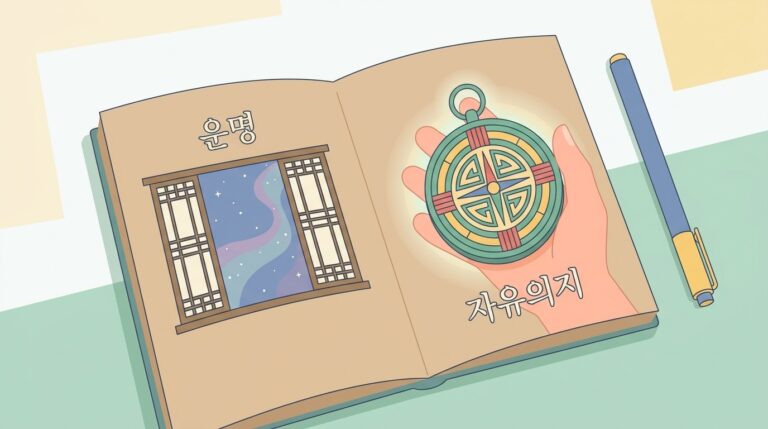
Fate vs. Free Will: How to Debate Destiny in Sophisticated, C2-Level Korean
Phase 1: Empathy (스토리 몰입형 오프닝)
안녕하세요! 매일한글(Daily Hangul)의 수석 에디터이자 여러분의 단짝 친구입니다.
Have you ever stayed up until 3 AM debating with a friend about whether our lives are pre-written like a K-drama script, or if we are the sole authors of our destiny? In Korea, this isn’t just a late-night dorm room debate—it is deeply woven into the fabric of our culture. Think of the legendary fantasy drama Goblin (쓸쓸하고 찬란하神 – 도깨비), where the deity poses a profound question to the protagonist: “The answer is not given by me. It is you who must find the answer.” This tension between absolute fate (숙명) and autonomous human choice (자유 의지) is a fascinating sweet spot for advanced Korean learners.
At the C2 level, you shouldn’t just translate philosophical terms from English. You need to speak with the cultural weight, emotional nuances, and the precise rhetorical tools that native intellectuals use. In this guide, based on dozens of debates I’ve hosted with advanced global learners, we will dive into the deepest corners of Korean fatalism, causal chains, and agency. Let’s master the art of sophisticated Korean philosophy!
Phase 2: 핵심 표현 3선 심층 분석 (Deep-Dive Core Expressions)
1. 팔자려니 하다 (pal-ja-ryeo-ni ha-da)
- Pronunciation: Pal-ja-ryeo-ni ha-da (Think of “pal-ja” as ‘destiny’ and “ryeoni” as a soft resignation: “Ah, it must be my lot in life.”)
- Meaning: To resign oneself to one’s predetermined fate; to accept a situation as ‘just my luck’ or destiny.
- K-Culture Moment: You will hear this in family melodramas when a protagonist faces a sudden hardship and says with a sigh, “이것도 다 내 팔자려니 해야지.” (I guess I have to accept this as my fate.)
- Editor’s Insight: “팔자” (Palja) refers to the Eight Characters of Saju (Korean astrology). Saying “팔자려니 하다” is a uniquely Korean psychological coping mechanism. It is not pure passivity; rather, it is a way of reclaiming emotional peace by choosing not to fight the unchangeable past.
- Situation Spectrum: Casual ⚠️ / Semi-formal ✅ / Formal ✅
- 🤔 Think About It: Does your native language have a phrase that allows you to emotionally surrender to a bad situation without feeling like a complete loser? How does it differ from accepting your “팔자”?
2. 인과율의 사슬을 끊다 (in-gwa-yul-ui sa-seul-eul kkeun-ta)
- Pronunciation: In-gwa-yul-ui sa-seul-eul kkeun-ta (Think of “in-gwa-yul” as cause-and-effect and “sa-seul” as chains.)
- Meaning: To break the chains of causality; to defy determinism through sheer willpower.
- K-Culture Moment: Highly utilized in sci-fi or thriller K-dramas like Signal (시그널) or Reborn Rich (재벌집 막내아들), where characters travel through time to change historical outcomes.
- Editor’s Insight: This is a highly academic and poetic expression. Use this during intellectual debates to show that you believe human agency can alter the seemingly pre-determined physical or historical path.
- Situation Spectrum: Casual 🚫 / Semi-formal ⚠️ / Formal ✅
- 🤔 Think About It: Can a person truly break the chains of their socio-economic background, or is that itself another illusion of causality?
3. 주체적인 결단력 (ju-che-jeok-in gyeol-dan-ryeok)
- Pronunciation: Ju-che-jeok-in gyeol-dan-ryeok (Emphasize the sharp ‘k’ sounds to project authority.)
- Meaning: Autonomous/subjective decision-making power; proactive resolve.
- K-Culture Moment: Frequently used in modern editorial columns and philosophical podcasts discussing youth psychology and existentialist living in contemporary Seoul.
- Editor’s Insight: While “의지” (will) is general, “주체적인 결단력” emphasizes that you are the owner of your life, independent of societal expectations or predetermined structures.
- Situation Spectrum: Casual ⚠️ / Semi-formal ✅ / Formal ✅
- 🤔 Think About It: In highly communal societies like Korea, how difficult is it to maintain truly 주체적인 결단력 without clashing with the group?
Phase 3: 교과서 한국어 vs 진짜 한국어 (Textbook vs. Real-Life Nuance)
Situation 1: Discussing Career & Destiny
- 📖 Textbook Korean: “우리는 스스로의 선택으로 운명을 바꿀 수 있습니다.” (We can change our destiny through our own choices.)
- 🗣️ 진짜 한국어: “결국 제 팔자 탓하기보다 제가 직접 부딪쳐서 개척하는 수밖에 없죠.” (In the end, rather than blaming my fate, I have no choice but to face it head-on and carve out my own path.)
- 💡 Why the Difference?: While the textbook sentence is grammatically flawless, real Koreans use visceral words like “부딪쳐서 개척하다” (carve out by physically bumping into obstacles) to express the gritty struggle of free will against destiny.
Situation 2: Debating Determinism
- 📖 Textbook Korean: “모든 행동은 이전 원인에 의해 결정됩니다.” (All actions are determined by prior causes.)
- 🗣️ 진짜 한국어: “다 정해져 있다면 굳이 발버둥 칠 필요가 있을까요?” (If everything’s already pre-determined, is there even a point in struggling so hard?)
- 💡 Why the Difference?: Academic terms like “이전 원인” sound cold. The word “발버둥 치다” (to struggle/squirm desperately) brings a highly emotional, existential depth to the determinism debate.
Phase 4: K-Culture 딥다이브 & 비언어적 매너 (Deep Dive & Non-Verbal Manners)
4-1. The Art of Philosophical Respect: Eye Contact & Softening
When discussing heavy philosophical topics like free will and determinism in Korea, maintaining harmony (화합) is key.
* The Tilt and Nod: When your opponent makes a deterministic point, tilt your head slightly (about 5 degrees) and slowly nod while saying “그렇죠…” (True…) or “일리가 있는 말씀입니다” (You have a point). This signals that you respect their intellect before you present your counter-argument.
* Soften with Sighs: Using a subtle sigh (“하아… 참 어려운 문제네요”) shows you are deeply pondering the depth of the topic, rather than just trying to win a cold, logical argument.
4-2. Cultural Code: The Paradox of Saju (사주) and Free Will
Koreans love visiting Saju cafes (사주 카페) or consulting fortunetellers before big life events (weddings, business launches, or exams). This seems like extreme determinism. However, the cultural paradox is that Koreans do not use Saju to give up. They use it as a strategic guide. If a fortuneteller says, “You have water energy, so avoid fire,” the Korean response is to use their free will to actively avoid fire. In this way, determinism serves as the terrain, but free will remains the vehicle!
Phase 5: 실전 롤플레이 시나리오 (Interactive Debate Roleplay)
The Setting
A cozy hanok cafe in Bukchon, Seoul. Two graduate students, 민혁 (Minhyuk – a deterministic realist) and 소연 (Soyeon – an existentialist believer in agency), are discussing life choices over hot ginger tea.
- 민혁: 소연 씨, 솔직히 우리가 내리는 모든 선택이 유전자와 환경의 조합일 뿐이라고 생각하진 않으세요? 🎭 [진지한 눈빛으로 찻잔을 만지며]
- 소연: 음, 일리가 있어요. 하지만 저는 매 순간 우리가 행하는 ‘결단’에는 분명한 자유 의지가 있다고 봐요. 🎭 [찻잔을 내려놓으며 단호하게]
- 민혁: 하지만 그 ‘결단’마저도 뇌의 전기 신호와 과거의 경험들이 빚어낸 필연적인 결과물 아닐까요? 🎭 [안경을 고쳐 쓰며 미소 지음]
- 소연: 그렇다면 우리는 그냥 정해진 시나리오대로 움직이는 로봇에 불과하다는 말씀인가요? 🎭 [고개를 약간 가로저으며]
- 민혁: 로봇이라기보다는… 거대한 우주의 흐름 속 한 조각인 거죠. 때로는 팔자려니 하고 받아들이는 게 편할 때도 있고요. 🎭 [조용히 창밖을 바라보며]
- 소연: 저는 동의하기 힘들어요. 인과율의 사슬을 끊고 주체적으로 행동하는 인간이야말로 존엄하니까요. 🎭 [민혁의 눈을 똑바로 응시하며]
- 민혁: 그 존엄성이라는 개념조차 인류가 살아남기 위해 만들어낸 결정론적 환상일지 모릅니다. 🎭 [낮고 차분한 목소리로]
- 소연: 와, 오늘 토론 정말 흥미롭네요. 그럼 제 다음 선택도 다 정해져 있었던 건가요? 🎭 [장난기 섞인 미소를 지으며]
🔀 Your Turn: How will you respond to Minhyuk’s last question?
- Choice A: “당연하죠. 민혁 씨가 그렇게 질문할 것도 이미 수십억 년 전에 결정되어 있었던 거예요!” (Agree completely with extreme determinism)
- Choice B: “글쎄요, 하지만 제가 지금 이 찻잔을 깰지 말지는 온전히 저의 자유 의지 아닐까요?” (Challenge with a physical act of defiance)
- Choice C: “결정론이든 자유의지든, 지금 이 순간 우리가 나누는 교감이 가장 중요한 우연 아닐까요?” (Synthesize both views with emotional intelligence)
💡 Feedback on Your Choices:
- Best Choice – Choice C: Highly sophisticated! It pivots the cold academic debate into a warm human connection, which is deeply appreciated in Korean conversational culture.
- Risk Choice – Choice B: A classic philosophical counter-argument, but be careful not to actually break the expensive hanok cafe’s cup! Keep it playful.
- Bad Choice – Choice A: A bit too rigid and dry. It might end the conversation prematurely by leaving no room for dialectic play.
Phase 6: 10초 감정 섀도잉 드릴 (10-Second Emotional Shadowing)
Practice these high-level sentences by paying attention to the pauses (/) and the emotional cues. Mimic the dramatic cadence of an intellectual K-drama character!
[고뇌에 차서 / Deeply contemplative]- “결국 우리 인생은 / 이미 정해진 책의 / 한 페이지를 / 넘기는 것에 불과한 걸까요?”
- Gyeol-guk u-ri in-saeng-eun / i-mi jeong-hae-jin chaek-ui / han pe-i-ji-reul / neom-gi-neun geos-e bul-gwa-han geol-kka-yo?
- (In the end, is our life merely turning a single page of an already written book?)
[단호하고 주체적으로 / Resolute and agentic]- “환경이 아무리 나를 옥죄어도 / 나는 내 주체적인 의지로 / 내 운명을 / 개척할 것입니다.”
- Hwan-gyeong-i a-mu-ri na-reul ok-jwoe-eo-do / na-neun nae ju-che-jeok-in ui-ji-ro / nae un-myeong-eul / gae-cheok-hal geos-im-ni-da.
- (No matter how much the environment constrains me, I will carve out my destiny with my autonomous will.)
Phase 7: K-Culture 미니 사전 (Philosophical Keywords)
- 인연 (In-yeon / Retributive Affinity):
- The beautiful destiny of people meeting. It implies that every human connection is predestined over thousands of past lifetimes.
- 업보 (Eop-bo / Karma):
- The accumulated consequences of your actions. Koreans often use this casually: “이것도 다 내 업보다” (This is my karma/I brought this on myself).
- 필연 (Pil-yeon / Inevitability):
- Absolute necessity or logical inevitability. Opposite of 우연 (accident/coincidence).
- 사주팔자 (Saju-pal-ja / Four Pillars and Eight Characters):
- Traditional Korean fortune-telling based on the cosmic alignment at your birth hour, believed to outline your deterministic boundaries.
Phase 8: 여행자를 위한 생존 키트 (Traveler’s Survival Kit)
Even if you’re not debating Kant in Seoul, you might encounter these concepts when visiting traditional spots!
Survival Expressions
- “여기 사주 잘 보는 곳이 어디예요?”
- Yeo-gi sa-ju jal bo-neun gos-i eo-di-yeo-yo?
- (Where is a good place around here for a Saju reading?)
- “제 사주에 물의 기운이 많나요?”
- Je sa-ju-e mul-ui gi-un-i man-na-yo?
- (Does my Saju have a lot of water element?)
- “다 좋은 인연이라고 생각해요.”
- Da jo-eun in-yeon-i-ra-go saeng-gak-hae-yo.
- (I believe everything is a good connection/destined relationship.)
Editor’s Travel Note
If you want to experience the fascinating crossroads of fate and free will in Seoul, look up “Saju cafes” in Hongdae or Insadong. You can download the Naver Map App to search for local “사주 타로” (Saju Tarot) shops. Most master readers use highly philosophical Korean terms, so bringing this guide along will make you look like a seasoned local philosopher!
(Note: Saju cafe fees generally range from 20,000 to 50,000 KRW; prices may vary.)
Phase 9: 한 발 더 깊이 (Think Deeper: Cultural Essay)
In Western philosophy, the debate between free will and determinism often feels like a strict binary battle—you are either a compatibilist, a hard determinist, or a libertarian. However, the Korean mind approaches this through a holographic lens.
We acknowledge that the universe is governed by massive, predetermined tides—family background, societal structures, historical eras (운명). Yet, we believe the human heart possesses a mystical space called 정 (Jeong) and 인연 (In-yeon) that can bend these tides. In Korea, destiny is not a prison; it is a collaborative dance between the cosmos and your daily choices.
💬 Your Turn: Do you think your decision to study Korean was written in the stars, or was it a purely autonomous choice? Tell me your story in the comments below!
Phase 10: FAQ & 오해 방지 (FAQ Schema & Common Mistakes)
Q: Is “팔자” (Palja) used in academic or formal writing?
A: While “팔자” has traditional roots, it is considered slightly colloquial or poetic. In academic or strictly formal philosophical texts, you should use terms like 결정론 (Determinism) or 운명론 (Fatalism) instead.
Q: Can I use “인과율의 사슬” when talking about simple daily situations?
A: It sounds extremely dramatic and theatrical! If you use it to describe why you overslept (“인과율의 사슬을 끊지 못해 늦었습니다”), people will laugh at your witty, grandiose humor.
Q: How do I politely express that I disagree with someone’s fatalistic outlook?
A: Start with: “그 말씀도 일리가 있지만, 한편으로는…” (That makes sense too, but on the other hand…) to soften the blow of your disagreement.
🚨 흔한 실수 (Common Mistakes) 경고판
- Confusing ‘팔자’ (Fate) with ‘발자국’ (Footprint):
- Incorrect: “제 발자가 나빠요.” (My footprints are bad.)
- Correct: “제 팔자가 사나워요.” (My fate is harsh.)
- Overusing ‘결정주의’ instead of ‘결정론’:
- Incorrect: “저는 결정주의를 믿습니다.”
- Correct: “저는 결정론을 지지합니다.” (Determinism as a philosophical stance is ‘결정론’.)
- Using basic verb endings for advanced topics:
- Incorrect: “자유 의지는 중요해요.”
- Correct: “자유 의지의 존재 유무는 인간 존엄성의 근간을 이룹니다.” (The existence of free will forms the very foundation of human dignity.)
Phase 11: 액션 미션 & 참여 유도 (Action Missions)
- Bronze Mission 🥉: Write down one thing you believe was destined in your life using the phrase: “이것은 나의 운명이다” (This is my destiny).
- Silver Mission 🥈: Share a post on social media explaining your stance on Free Will using: “나는 주체적인 결단력을 믿는다” (I believe in autonomous decision-making power).
- Gold Mission 🥇 / 🎮 K-Culture Mission: Find a scene in your favorite K-drama where characters talk about fate (운명) or causality (인과관계). Write down the quote, and explain how they tried to break that fate! Tag #DailyHangulPhilosophy so I can personally review your insights.
Phase 12: 인터랙티브 퀴즈 챌린지 (Quiz Challenge)
1. Which term is most appropriate when you want to resign yourself to an unchangeable situation with deep emotional acceptance?
- A) 인과율의 사슬
- B) 팔자려니 하다
- C) 주체적인 결단력
2. Fill in the blank:
“모든 일에는 원인이 있고 결과가 있다는 이론을 ( )이라고 합니다.”
* Hint: Determinism
3. True or False:
Koreans only visit Saju cafes because they completely reject the concept of free will and believe everything is 100% unchangeable.
🔑 정답 및 해설 (Reveal Answers)
- 정답: B) 팔자려니 하다
- Explanation: This phrase is specifically used to resign oneself to fate in a natural, comforting way.
- 정답: 결정론 (Gyeol-jeong-ron)
- Explanation: ‘결정론’ is the official Korean translation for philosophical Determinism.
- 정답: False
- Explanation: Koreans visit Saju cafes strategically—to understand the ‘forecast’ of fate so they can use their free will to navigate life better!
- Explanation: Koreans visit Saju cafes strategically—to understand the ‘forecast’ of fate so they can use their free will to navigate life better!






