

Master the Art of Pitching Workations: A C2 Guide to Attracting Digital Nomads
Phase 1: Empathy (스토리 몰입형 오프닝)
안녕하세요! Welcome back to another masterclass by Daily Hangul. I’m your chief editor and local cultural navigator.
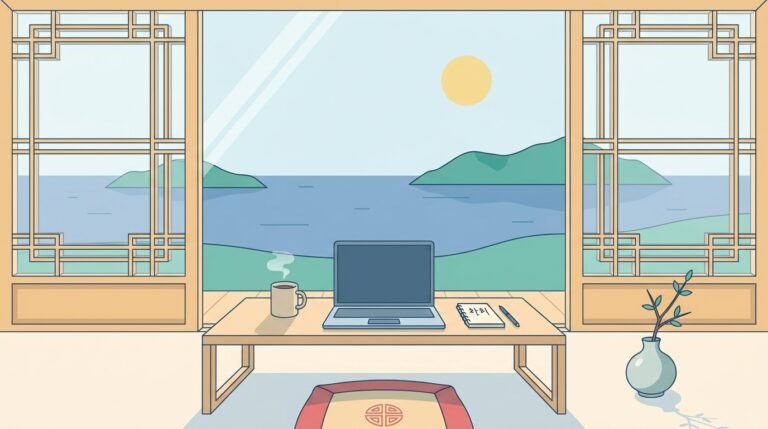
Imagine this: You are sitting in a sleek, restored Hanok (traditional Korean house) in Jeju Island, sipping a cold hallabong ade. Your laptop is open, connected to lightning-fast 5G Wi-Fi, and right outside your window is a tranquil stone wall overlooking the ocean. This isn’t just a vacation—it’s a Workation (워케이션), the hottest frontier in the Global MICE (Meetings, Incentives, Conferences, Exhibitions) and tourism industry.
As a C2-level learner, you aren’t just ordering food anymore; you are negotiating deals, pitching products, and shaping policy. Designing and pitching a workation product to highly demanding global digital nomads requires more than just translating words. It requires understanding the subtle push-and-pull of local Korean municipal governments (지자체), community-driven business dynamics, and the precise corporate idioms that make Korean stakeholders say, “이거 되겠다!” (This will definitely work!).
This guide is built from real-world consulting cases of MICE planners who struggled to bridge the gap between traditional tourism and the agile digital nomad lifestyle. By the end of this lesson, you will possess the precise linguistic keys to pitch, structure, and execute a premium Korean workation program.
Phase 2: Core Expressions (핵심 표현 3선 심층 분석)
To pitch to Korean decision-makers, you need high-impact, sophisticated vocabulary. Here are three game-changing expressions for your pitch deck.
1. 발 벗고 나서다 (Bal beotgo naseoda)
- Pronunciation: Bal beot-go nah-seo-dah (Imagine saying “ball” with a soft “b”, followed by “but-go” and “nah-suh-dah”. It literally translates to “to step out barefoot.”)
- Meaning: To actively take initiative; to throw oneself into a task with enthusiasm.
- K-Culture Moment: You will often see this in Korean news articles or business dramas like Start-Up when local mayors or corporate executives enthusiastically champion a new public-private partnership.
- Editor’s Insight: In Korean culture, taking off your shoes and socks (발을 벗다) historically meant you were putting aside all formalities to work in the muddy fields. Using this in a proposal shows you appreciate their active, hands-on commitment.
- Situation Spectrum: Casual (⚠️) | Semi-formal (✅) | Formal (✅)
- 🤔 Think About It: How does this contrast with the English “rolling up one’s sleeves”? What does the imagery of “bare feet” tell us about Korean historical values of labor and sincerity?
2. 체류형 관광 (Chaeryuhyeong gwan-gwang)
- Pronunciation: Ch’ae-ryu-hyeong gwan-gwang (Sounds like “chay-ryu-hyung gwan-gwang”).
- Meaning: Long-stay / residential tourism (as opposed to hit-and-run, single-day sightseeing).
- K-Culture Moment: This is the current holy grail for Korean provincial tourism boards in K-Dramas like Welcome to Samdal-ri, where preserving local ecosystems while hosting long-term guests is the main conflict.
- Editor’s Insight: This is a crucial professional MICE term. If you pitch “여행” (travel), you sound like an amateur. Pitch “체류형 관광 상품” (long-stay tourism product) to instantly sound like a seasoned industry expert.
- Situation Spectrum: Casual (🚫) | Semi-formal (⚠️) | Formal (✅)
- 🤔 Think About It: Why is the shift from transactional sightseeing to experiential, long-stay tourism so vital for local economies in Korea right now?
3. 인프라를 구축하다 (Inpeurareul guchukhada)
- Pronunciation: In-p’eu-ra-reul gu-ch’uk-ha-da (Sounds like “in-pra-reul goo-chook-ha-dah”).
- Meaning: To build/establish infrastructure.
- K-Culture Moment: You’ll hear this constantly in economic briefings or urban planning dramas. It refers not just to physical roads, but to high-speed internet networks, coworking spaces, and residential convenience.
- Editor’s Insight: Standard Korean uses “만들다” (to make), but in a business context, “구축하다” (to construct/structure) adds a layer of professional authority.
- Situation Spectrum: Casual (🚫) | Semi-formal (⚠️) | Formal (✅)
- 🤔 Think About It: How does utilizing Sino-Korean verbs like 구축 (構築) elevate your professional authority in Korean corporate environments?
Phase 3: Textbook vs. Real Korean (교과서 한국어 vs 진짜 한국어)
Let’s bridge the gap between academic Korean and the high-level, natural phrasing used by modern marketing directors.
Situation 1: Explaining internet reliability to stakeholders
- 📖 Textbook Korean: “디지털 노마드를 위해 우수한 인터넷 환경을 제공합니다.”
(We provide an excellent internet environment for digital nomads.) - 🗣️ 진짜 한국어: “디지털 노마드들에게는 빵빵한 와이파이는 기본이고, 몰입할 수 있는 원격 워크스페이스가 필수적입니다.”
(For digital nomads, seamless, ultra-fast Wi-Fi is a given, and an immersive remote workspace is an absolute must.) - 💡 Why the difference? C2 professionals use colloquial yet precise industry slang like “빵빵하다” (to be fully loaded/ultra-fast) combined with modern loanwords like “워크스페이스” to show they understand both local realities and global nomad demands.
Situation 2: Discussing community integration with local councils
- 📖 Textbook Korean: “지역 주민과 관광객의 화합을 돕겠습니다.”
(We will help the harmony of local residents and tourists.) - 🗣️ 진짜 한국어: “단순한 관광객 유치를 넘어, 로컬 크리에이터들과의 상생 생태계를 구축하는 데 초점을 맞췄습니다.”
(Moving beyond merely attracting tourists, we focused on building a win-win, co-existing ecosystem with local creators.) - 💡 Why the difference? Modern MICE policy in Korea centers on “상생” (win-win/mutual growth) and “생태계” (ecosystem). Using these terms shows you are aligned with ESG (Environmental, Social, Governance) values.
Phase 4: K-Culture Deep Dive & Non-verbal Manners
4-1. Executive Nunchi (눈치) & Pitch Etiquette
When presenting a workation proposal to conservative Korean government officials or corporate sponsors, your non-verbal cues must scream respect and strategic preparation:
* The Business Card Exchange (명함 교환): Never slide your card across the table. Present it with both hands, text facing the recipient, with a slight bow. Take a moment to read their title. If they are a “과장님” (Manager) or “국장님” (Director), address them as such throughout the pitch.
* Nunchi (눈치) during Pitches: Pay attention to silence. In Korean business culture, a long pause after your slide on budget doesn’t necessarily mean “no.” It means they are contemplating how to present a counteroffer without losing face. Do not immediately fill the silence with nervous chatter; acknowledge their deliberation with a polite nod.
4-2. The Cultural Backdrop of
Frequently Asked Questions (FAQ)
Q: What does "발 벗고 나서다 (Bal beotgo naseoda)" mean in Korean and how do you pronounce it?
A: In Korean, "발 벗고 나서다 (Bal beotgo naseoda)" is pronounced [Bal beot-go nah-seo-dah (Imagine saying "ball" with a soft "b", followed by "but-go" and "nah-suh-dah". It literally translates to "to step out barefoot."] and means: To actively take initiative; to throw oneself into a task with enthusiasm.
Q: What does "체류형 관광 (Chaeryuhyeong gwan-gwang)" mean in Korean and how do you pronounce it?
A: In Korean, "체류형 관광 (Chaeryuhyeong gwan-gwang)" is pronounced [Ch'ae-ryu-hyeong gwan-gwang (Sounds like "chay-ryu-hyung gwan-gwang"] and means: Long-stay / residential tourism (as opposed to hit-and-run, single-day sightseeing).
Q: What does "인프라를 구축하다 (Inpeurareul guchukhada)" mean in Korean and how do you pronounce it?
A: In Korean, "인프라를 구축하다 (Inpeurareul guchukhada)" is pronounced [In-p'eu-ra-reul gu-ch'uk-ha-da (Sounds like "in-pra-reul goo-chook-ha-dah"] and means: To build/establish infrastructure.







