

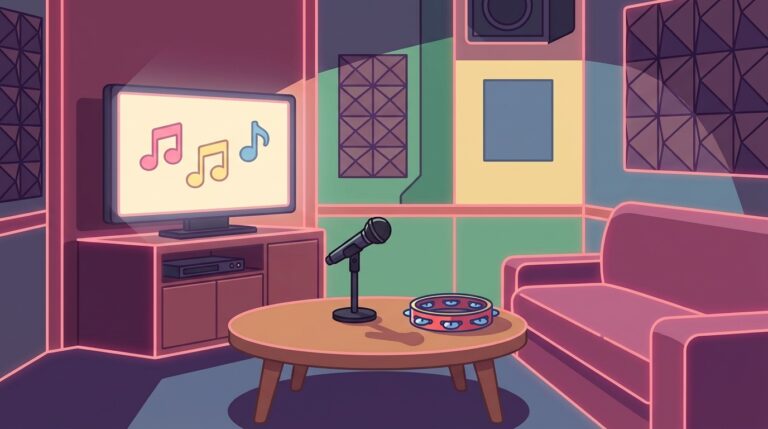
Phase 1: Empathy (Your Korean Bestie is Here!)
안녕하세요! (Annyeonghaseyo!) I am your senior editor and your trusted personal Korean culture navigator at Daily Hangul.
Imagine this: You are walking down the vibrant, neon-lit streets of Hongdae with your Korean friends on a Friday night. The air is cool, the food was delicious, and everyone is laughing. Suddenly, your friend turns to you with glowing eyes and says: “노래방 가자!” (Let’s go to Noraebang!)
Your heart skips a beat. “Wait, do I have to sing in Korean? What if I ruin the mood? How do I even survive a Korean karaoke night?”
Don’t worry at all! Our global learners frequently tell us that going to a Noraebang (노래방) was one of the most exciting yet nerve-wracking experiences of their time in Korea. Today, we are going to break down the walls of anxiety. By the end of this guide, you will not only know exactly what to say, but you’ll also possess the cultural “cheat codes” to be the life of the party!
Phase 2: Deep Dive into 3 Key Expressions
Let’s master the three magical phrases that will make you look like a seasoned Seoulite.
1. 노래방 가자! (Noraebang gaja!)
- Pronunciation: Noh-rae-bang gah-jah! (Think of: “No-ray” like a musical scale + “bang” like a room + “gah-jah” which means “let’s go”).
- Meaning: Let’s go to the karaoke room! (Literal: Song room + let’s go!)
- K-Culture Moment: This is the ultimate battle cry of Korean nightlife. You will hear this in almost every slice-of-life K-Drama right after a team dinner or a gathering with friends.
- Editor’s Insight: The word “방” (bang) means room. Korea has a massive “room culture” (PC bang, VR bang, Board game bang) because young people love private spaces to hang out. 가자 (gaja) is very casual, so use this only with close friends or people younger than you!
- Situation Spectrum: Casual ✅ / Semi-formal ⚠️ / Formal 🚫
- 🤔 Think About It: In many Western countries, karaoke is done on an open stage in front of strangers. Why do you think Koreans prefer private rooms (“방”) with just their friends?
2. 서비스 주세요! (Seobiseu juseyo!)
- Pronunciation: Suh-bee-seu joo-seh-yo! (Sounds exactly like the English word “service” with a Korean accent + “joo-seh-yo” meaning “please give”).
- Meaning: Please give us some free extra time! (Literal: Please give us service!)
- K-Culture Moment: When your room timer is down to 1 minute, you run to the counter or catch the owner’s eye, flash a sweet smile, and say this phrase. Suddenly, magic happens: your screen adds 20 or 30 free minutes!
- Editor’s Insight: In Korea, “서비스” (service) means “on the house” or “free of charge.” Asking for “service” in a Noraebang is a fun, lighthearted negotiation that owners actually expect and enjoy!
- Situation Spectrum: Casual ✅ / Semi-formal ✅ / Formal ⚠️
- 🤔 Think About It: Is there a concept of “freebies” or “on the house” items in your culture when visiting local businesses?
3. 한 곡만 더! (Han gong-man deo!)
- Pronunciation: Hahn gong-mahn duh! (Think of: “Hahn” meaning one + “gong” which sounds like song/track + “mahn” meaning only + “duh” meaning more).
- Meaning: Just one more song!
- K-Culture Moment: The lights are spinning, the tambourine is shaking, and nobody wants the night to end. You raise your hand and yell this to keep the energy alive!
- Editor’s Insight: Even if you say “just one more,” this usually turns into three or four more songs. It’s the ultimate phrase to show you are having the time of your life.
- Situation Spectrum: Casual ✅ / Semi-formal ⚠️ / Formal 🚫
- 🤔 Think About It: What is your ultimate “one last song” that you always sing to end a great party?
Phase 3: Textbook Korean vs. Real Korean
Let’s compare the stiff expressions found in dusty grammar books with how trendy young Koreans actually speak.
Situation 1: Suggesting a trip to Noraebang
- 📖 Textbook Korean: “노래방에 가고 싶습니다.” (Noraebange gago sipseumnida. / I want to go to the karaoke room.)
- 🗣️ 진짜 (Real) Korean: “노래방 고?” (Noraebang go? / Noraebang, let’s go?)
- 💡 Why the difference? Young Koreans love mixing Korean nouns with English action verbs. “Noun + 고? (Go?)” is the fastest, coolest way to invite someone to do something. It sounds fresh and effortlessly friendly!
Situation 2: Asking for the remote control
- 📖 Textbook Korean: “리모컨을 전달해 주십시오.” (Rimokeoneul jeondalhae jusipsio. / Please hand over the remote controller.)
- 🗣️ 진짜 (Real) Korean: “리모컨 좀 줘!” (Rimokeon jom jwo! / Pass the remote!)
- 💡 Why the difference? Inside a Noraebang, speed is key! The word “좀” (jom) is a magical Korean word that softens commands, making a casual request sound polite without using stiff formal grammar.
Phase 4: K-Culture Deep Dive & Non-verbal Manners
To truly fit in, you need to understand the invisible rules of Noraebang etiquette.
4-1. Nunchi (눈치) & Gestures
- The Tambourine Duty (흥 – Heung): Korean karaoke is a team sport! Even when it is not your turn to sing, you should shake the tambourine to cheer on your friends. This shows high energy (흥) and consideration (눈치 – social sensing).
- Microphone Hygiene: Always put the small sanitary microphone cover on before you sing. This is a crucial sign of respect for the next singer!
4-2. Culture Code: What is “흥” (Heung)?
- “Heung” is a unique Korean cultural concept that translates to a deep, joyful excitement, rhythm, and passion. Noraebang is not a talent show; it is a safe space to let go of daily stress, laugh together, and express “Heung.” Don’t worry about singing perfectly—worry about having fun!
Phase 5: Real-Life Roleplay Scenario
Let’s practice! Meet Minjun, your energetic Korean friend who is taking you out for “Fire Friday” (불금 – Bul-geum).
- Setting: A lively street in Hongdae. Neon signs are reflecting in the puddles.
- Characters: You (excited but slightly nervous) and Minjun (ready to dance).
1. Minjun: 🎭 (Smiling widely, nudging your shoulder) 오늘 불금인데, 우리 2차 어디 가?
(O-neul bul-geum-in-de, u-ri i-cha eo-di ga? / It’s Fire Friday, where are we going for round 2?)
2. You: 🎭 (Pumping your fist in the air) 노래방 가자!
(Noraebang gaja! / Let’s go to Noraebang!)
3. Minjun: 🎭 (Clapping his hands) 오, 좋아! 진짜 신나게 놀자!
(Oh, jo-a! Jin-ja sin-na-ge nol-ja! / Oh, awesome! Let’s have real fun!)
4. You: 🎭 (Entering the neon-lit room, pointing to the screen) 리모컨 좀 줘!
(Rimokeon jom jwo! / Pass the remote!)
5. Minjun: 🎭 (Handing over the remote while grabbing a tambourine) 여기! 첫 곡은 너 먼저 불러!
(Yeo-gi! Cheot gog-eun neo meon-jeo bul-reo! / Here! You sing the first song!)
6. You: 🎭 (Waving hands nervously, blushing slightly) 나 부끄러워. 같이 부르자!
(Na bu-kkeu-reo-wo. Gat-i bu-reu-ja! / I’m shy. Let’s sing together!)
7. Minjun: 🎭 (Shaking the tambourine energetically) 오예! 가보자고!
(O-ye! Ga-bo-ja-go! / Oh yeah! Let’s go!)
(One hour passes… the timer on the TV screen flashes ‘1 Min remaining’)
8. You: 🎭 (Running to the counter with your best pleading eyes) 사장님, 서비스 주세요!
(Sa-jang-nim, seobiseu juseyo! / Boss, please give us some free extra time!)
🔀 Interactive Choice: What will you do next?
- Option A: You sing a high-energy K-Pop song together with Minjun.
- Option B: You sit quietly and look at your phone because you are too shy to sing.
- Option C: You grab the microphone and sing three slow ballads in a row without sharing.
💡 Feedback:
- If you chose A (Best!): Perfect! You matched the group’s “Heung” (energy). You are officially a Noraebang master!
- If you chose B (Risk): Oh no! Minjun might think you are having a bad time. Even a simple clap or shaking a tambourine helps you join the fun!
- If you chose C (Bad): Uh-oh! Solo-hogging the mic and singing only sad ballads might kill the party vibe. Remember to rotate songs!
Phase 6: 10-Second Emotion Shadowing Drill
Let’s practice the rhythm of spoken Korean. Read these out loud, pausing at the / marks!
[😊 Shouting excitedly to your friends]- 노래방 / 가자! (No-rae-bang / ga-ja!)
[🥺 Cute, sweet, and pleading to the owner]- 사장님, / 서비스 / 주세요~ (Sa-jang-nim, / seo-bi-seu / ju-se-yo~)
[🎤 Passionate and high-energy]- 한 곡만 / 더! (Han gong-man / deo!)
Phase 7: K-Culture Mini Dictionary
Here are four essential words to boost your vocabulary:
- 불금 (Bul-geum): Literally “Fire Friday” (TGIF). It describes the high energy of Friday nights in Korea.
- 2차 (I-cha): “Round 2.” Koreans love multi-stage nights: dinner (1차), Noraebang/bar (2차), and sometimes dessert or drinks (3차).
- 탬버린 (Taem-beo-rin): Tambourine. The essential instrument of Noraebang joy!
- 취소 (Chwi-so): Cancel. The most important red button on the remote used to skip a song if it’s too difficult.
Phase 8: Survival Kit for Travelers
Survival Phrases for the Street:
- 코인 노래방 어디 있어요? (Koin noraebang eodi isseoyo?)
- Meaning: Where is the coin karaoke? (Pro Tip: Coin Noraebangs are cheaper, perfect for 1 or 2 people!).
- 마이크 커버 주세요. (Ma-i-keu keo-beo ju-se-yo.)
- Meaning: Please give me a microphone cover.
- 번호가 뭐예요? (Beon-ho-ga mwo-yeo-yo?)
- Meaning: What is the song number?
Editor’s Travel Note:
When looking for the best Noraebangs in Seoul, Google Maps might not give you the best local results. Be sure to download the Naver Map App before your trip! Type in “코인노래방” (Coin Noraebang) to find clean, modern, and cheap self-service singing spots near you.
Phase 9: “One Step Deeper” (Reflective Thought)
In Korea, hierarchy is very important. In the office, there are strict rules about how to address your boss. However, inside the Noraebang, those boundaries melt away. It is a unique social “release valve” where the intern and the CEO can sing duets and shake tambourines together.
This shows the beautiful, collectivist side of Korean culture: we work hard together, and we play hard together.
💬 Your Turn: Is there a place or activity in your country where social boundaries disappear and everyone becomes equals? Let us know in the comments below!
Phase 10: FAQ & Avoiding Misunderstandings
Q: Can I go to a Noraebang completely alone?
A: Yes! “Coin Noraebangs” (코인노래방) are designed precisely for this. You can pay per song (usually 500 KRW to 1,000 KRW for 2-3 songs) and sing in a cozy private booth all by yourself.
Q: Is it rude to skip a song halfway through?
A: Not at all! If the song is too high or you don’t know the lyrics, simply press the red “취소” (Cancel) button. Your friends will actually thank you for saving the vibe!
Q: Can we bring our own drinks inside?
A: Most standard Noraebangs sell water, soda, and snacks. Bringing outside food is usually prohibited, but some Coin Noraebangs have drinks vending machines inside.
🚨 Common Mistakes Board:
- Mistake 1: Singing over someone else’s song.
- Correct Action: Let them have their spotlight! Join in only if they ask you to sing along.
- Mistake 2: Reserving 5 of your songs in a row.
- Correct Action: Keep a fair rotation so everyone gets a turn to select a song.
- Mistake 3: Speaking rudely to the owner.
- Correct Action: Always call the owner politely: “사장님” (Sa-jang-nim / Boss).
Phase 11: Action Mission & Participation
Are you ready to practice? Try these three levels of missions!
- 🥉 Bronze Mission: Practice saying “노래방 가자!” three times out loud with high energy!
- 🥈 Silver Mission: Share this post on your social media and tag your favorite friend with: “Hey, 노래방 가자!”
- 🥇 Gold Mission: Next time you talk to your Korean language exchange partner, casually say: “우리 다음에 노래방 고?” (Shall we go to Noraebang next time?)
-
🎮 K-Culture Mission: Watch any K-Drama party scene tonight. Write down in our comments section if you spot a character shaking a tambourine or asking for “서비스”!
Phase 12: Interactive Quiz Challenge
Test your knowledge before you hit the streets of Seoul!
1. What does the word “서비스” (Service) mean in a Korean Noraebang?
- A) The waiters will bring you food.
- B) Free extra singing time.
- C) Helping you set up the microphone.
👉 Click to reveal the answer!
Correct Answer: B
“서비스” (Service) in Korea refers to anything given for free by a business owner as a gesture of goodwill! Enjoy your free minutes!
2. True or False: You should only go to a Noraebang if you are a great singer.
- A) True
- B) False
👉 Click to reveal the answer!
Correct Answer: B (False!)
Noraebang is not about talent; it is about “흥” (excitement) and stress relief. The worse you sing, the more fun and laughs you share!







