

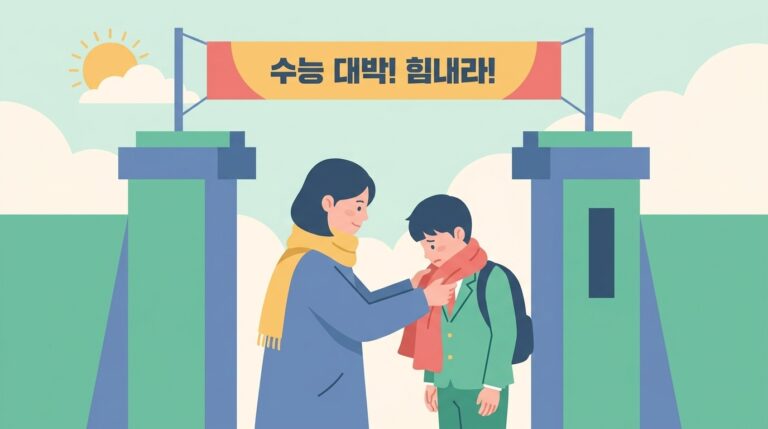
The Day a Whole Nation Holds Its Breath: Navigating Korea’s Intense Suneung Day Atmosphere
안녕하세요! I am your lead editor and native companion at Daily Hangul. If you have ever watched a K-Drama where a student desperately runs toward a closing school gate escorted by a police motorcycle, you have witnessed a snapshot of Suneung (수능)—Korea’s College Scholastic Ability Test. For C1 learners, understanding Suneung is not just about memorizing vocabulary; it is about grasping a national phenomenon that blends Confucian academic zeal, collective empathy, and intense social dynamics. Today, we will dissect the linguistic and cultural nuances of this fateful day.
Phase 1: Empathy (The Day Korea Stands Still)
Imagine a chilly Thursday morning in mid-November. The streets of Seoul, usually bustling with traffic, are eerily quiet. Business opening hours are pushed back to 10:00 AM to keep the roads clear. Even airplanes are grounded for 35 minutes during the English listening exam. Suneung day is a collective national ritual. Many advanced learners feel overwhelmed by the sheer scale of the vocabulary and the heavy social weight behind terms like ‘입시’ (college entrance exams). Through this guide, you will master the highly specific, emotionally charged vocabulary Koreans use to navigate this high-stakes day.
Phase 2: Core Expressions Deep Dive
1. 재수를 결심하다 (jaesureul gyeolsimhada)
- Pronunciation: Jae-su-reul gyeol-sim-ha-da (Sounds like ‘Jay-sue’ combined with the English verb ‘resolve’)
- Meaning: To decide to retake the college entrance exam (literally, ‘to resolve to study a second time’).
- K-Culture Moment: Often heard in family dramas when a devastated student tells their parents they did not get the score required for their dream university, initiating another grueling year at a ‘재수학원’ (exam prep academy for retakers).
- Editor’s Insight: Beyond the prefix ‘재-‘ (re-), Koreans also use ‘삼수’ (three attempts) or ‘N수’ (multiple attempts). It is a highly sensitive topic, as it represents a year of social isolation and intense pressure.
- Situation Spectrum: Casual ✅ | Semi-formal ✅ | Formal ✅
- 🤔 Think About It: How does your society view gap years or retaking exams? In Korea, ‘재수’ is seen as a rigorous, respectable, yet painful battle of endurance.
2. 수능 한파 (suneung hanpa)
- Pronunciation: Su-neung han-pa (Sounds like ‘Sue-nung’ + ‘Han-pah’ as in cold wave)
- Meaning: Suneung cold wave.
- K-Culture Moment: Weather anchors on Korean news invariably discuss the ‘수능 한파’ every November, warning test-takers to dress in layers.
- Editor’s Insight: This is a fascinating cultural myth that often proves true. Even if the preceding weeks are warm, Suneung day almost always brings a sudden drop in temperature. Psychologically, the cold weather mirrors the freezing nervousness of the students.
- Situation Spectrum: Casual ✅ | Semi-formal ✅ | Formal ✅
- 🤔 Think About It: Is there a seasonal weather phenomenon in your country that is psychologically tied to a major national event?
3. 딱 붙다 (ttak butda)
- Pronunciation: Ttak but-da (Stress the double consonant: ‘T-tahk’ + ‘Boot-dah’)
- Meaning: To stick tightly (idiomatically: to pass an exam perfectly).
- K-Culture Moment: Well-wishers gift traditional sticky treats like ‘엿’ (yeot – traditional taffy) and ‘찹쌀떡’ (chapssaltteok – glutinous rice cakes) so that the student’s score ‘sticks’ to the university of their choice.
- Editor’s Insight: ‘붙다’ means to stick. It is the antonym of ‘미끄러지다’ (to slip/fail). Be careful: never give a test-taker seaweed soup (미역국) because it is slippery, and their grades might ‘slip’ away!
- Situation Spectrum: Casual ✅ | Semi-formal ✅ | Formal ⚠️ (Use ‘합격하다’ in formal settings)
- 🤔 Think About It: How do non-verbal superstitions influence success in your culture compared to the Korean focus on stickiness?
Phase 3: Textbook Korean vs. Real Native Korean
- Situation 1: Wishing someone good luck before the exam
- 📖 Textbook: “시험을 잘 보세요.” (Please take the exam well.)
- 🗣️ Real Native: “평소 실력대로만 해! 대박 나자!” (Just do as well as your usual standard! Let’s hit the jackpot!)
- 💡 Why the difference? C1 speakers avoid overly formal, robotic phrases. “평소 실력대로만 해” relieves pressure by telling the student they are already good enough, while “대박 나자” injects vibrant, supportive energy.
- Situation 2: Warning someone not to fail
- 📖 Textbook: “시험에 떨어지지 마세요.” (Do not fail the exam.)
- 🗣️ Real Native: “절대 미끄러지면 안 돼!” (You must absolutely not slip!)
- 💡 Why the difference? The verb ‘미끄러지다’ (to slip) is the native metaphorical equivalent for failing an exam. Using the textbook ‘떨어지다’ sounds too clinical and harsh.
Phase 4: K-Culture Deep Dive & Non-verbal Manners
4-1. Cheering Etiquette & Non-verbal Gestures
On the morning of Suneung, juniors (후배) gather outside school gates at the break of dawn. They beat drums, chant school cheers, and perform deep bows (절) to their seniors entering the gates. If you are ever near an exam site, the unspoken rule is absolute silence after 8:10 AM. Honking car horns or speaking loudly near test sites is considered incredibly rude.
4-2. The Dramatic Lens of K-Dramas
Dramas like Sky Castle or Crash Course in Romance depict the extreme stress surrounding Suneung. The mothers’ fierce ‘치맛바람’ (chimatbaram – excessive maternal zeal) and the students’ psychological isolation are real-world phenomena taken to dramatic extremes. Suneung is not just a test; it is the culmination of twelve years of public education, making it a goldmine for intense narrative conflict in Korean media.
Phase 5: Live Roleplay Scenario
Setting: Outside the high school gate on a freezing Suneung morning. Zia (지아, supportive older sister) is sending off her younger brother Hyunwoo (현우, a nervous test-taker).
- 지아: 🎭 [현우의 목도리를 여며주며] 현우야, 드디어 당일이네. 날씨가 생각보다 엄청 쌀쌀하지?
(Hyunwoo, the day is finally here. It is way colder than I thought, right?) - 현우: 🎭 [손을 바르르 떨며] 네, 누나. 수능 한파는 진짜 과학인가 봐요. 온몸이 덜덜 떨려요.
(Yeah, Noona. The Suneung cold wave must be real science. My whole body is shivering.) - 지아: 🎭 [현우의 어깨를 따뜻하게 다독이며] 긴장해서 그래. 자, 따뜻한 꿀물 보온병에 담았으니까 매 교시 끝날 때마다 마셔.
(It’s because you are nervous. Here, I put warm honey water in a thermos, so drink some after every exam period.) - 현우: 🎭 [억지로 미소를 지으며] 고마워요. 근데 저 진짜 실수해서 재수하게 될까 봐 너무 걱정돼요.
(Thanks. But I’m so worried I’ll mess up and end up having to retake the exam.) - 지아: 🎭 [단호하지만 다정한 눈빛으로] 재수는 무슨! 그런 부정적인 생각은 저리 치워. 넌 무조건 딱 붙을 거야.
(Retaking? No way! Toss those negative thoughts away. You are absolutely going to stick.) - 현우: 🎭 [크게 심호흡을 하며] 후우… 알겠어요. 정문 앞에서 후배들이 응원해 주는 소리를 들으니까 정신이 좀 드네요.
(Phew… Okay. Hearing the juniors cheering at the gate helps me snap out of it.) - 지아: 🎭 [주먹을 불끈 쥐며] 그래, 그 좋은 기운 그대로 안고 들어가는 거야. 넌 이미 완벽하게 준비된 수험생이니까.
(Exactly, take that positive energy in with you. Because you are already a perfectly prepared candidate.) - 현우: 🎭 [게이트 안으로 걸어가며] 최선을 다하고 올게요. 누나, 시험 끝나면 나 진짜 맛있는 거 사줘야 해!
(I will do my best. Noona, you have to buy me something really delicious after the exam!)
🔀 Choose Your Response
How would you encourage Hyunwoo here to show your advanced Korean and cultural empathy?
* Choice A: “시험 못 보면 재수하면 되니까 너무 걱정 마!” (If you fail, you can just retake it, so don’t worry!)
* Choice B: “그동안 고생 많았어. 네 노력이 결실을 맺을 거야. 딱 붙자!” (You have worked so hard. Your efforts will bear fruit. Let’s stick!)
* Choice C: “미역국 먹고 갈래? 힘내야지.” (Do you want to eat seaweed soup before you go? You need strength.)
💡 Feedback Matrix
- Choice A (Risk): While meant to relieve pressure, mentioning ‘재수’ (retaking the exam) right before he enters the exam room is highly taboo and can damage his confidence.
- Choice B (Best): Perfect! It acknowledges his long-term effort, uses natural C1 metaphors (결실을 맺다), and includes the highly supportive ‘딱 붙자!’
- Choice C (Bad): A cultural disaster! ‘미역국’ (seaweed soup) is slippery, and eating it before an exam is a superstitious omen for failing (slipping).
Phase 6: 10-Second Shadowing Drill
To speak like a native, you must capture the emotional rhythm. Pay attention to the pauses (/) and emotional tone indicators.
- Sentence: “수능 한파라더니 / 진짜 춥네, / 평소 실력대로만 / 차분하게 보고 와! / 파이팅!”
- Pronunciation: Suneung hanparadeoni / jinjja chumpne, / pyeongso sillyeokdaeroman / chabunhage bogo wa! / Paiting!
- Emotional Guide:
[🥺 Warm and comforting, then 😊 transitioning to bright encouragement]
Phase 7: K-Culture Mini Dictionary
- 수험생 (Suheomsaeng) | Exam Candidate
- Used exclusively for students preparing for major national exams. During autumn, the entire nation treats ‘수험생’ with utmost care and respect.
- 응원전 (Eungwonjeon) | Cheering Battle
- The organized pep rallies held by junior students outside the test centers, creating an electric atmosphere.
- 치맛바람 (Chimatbaram) | Maternal Academic Zeal
- Literally ‘the swish of a skirt.’ It describes the intense, sometimes overbearing involvement of mothers in their children’s education.
- 수시 vs. 정시 (Susi vs. Jeongsi) | Rolling Admission vs. Regular Admission
- ‘수시’ relies on high school transcripts and portfolios, while ‘정시’ depends almost entirely on the single-day Suneung score.
Phase 8: Traveler’s Survival Kit
If you are traveling in Korea in mid-November, keep these three survival phrases in mind:
- “오늘 수능 날이라 차가 많이 막히나요?” (Is traffic very heavy today because of Suneung?)
- “시험장 주변은 조용히 지나가야 해요.” (We must pass quietly around the exam venue.)
- “수험표 할인 되나요?” (Is there a discount for test-takers? Pro Tip: Many restaurants, cinemas, and theme parks offer massive discounts to anyone who shows their Suneung registration card!)
🗺️ Editor’s Travel Note
On Suneung day, avoid traveling by taxi or bus between 7:00 AM and 8:30 AM. Subways are highly recommended as they run more frequently during this rush hour. To navigate real-time traffic updates, make sure to use Naver Map App Download instead of international map apps, as local data is updated instantaneously.
Phase 9: Deep Think (한 발 더 깊이)
Suneung is more than a test of intellect; it is a cultural mirror. Korea’s rapid economic development was fueled by an obsession with education. Because academic pedigree historically decided one’s social standing, Suneung became a sacred, collective ritual. When the entire nation quietens its streets for high school seniors, it showcases a deep-seated communal empathy and shared national priority. It shows that in Korea, your child’s success is, in a way, the community’s success.
💬 Your Turn: Does your country have a national exam that halts the entire society, or is the process more individualized? Let’s discuss in the comments below!
Phase 10: FAQ & Common Mistakes (FAQ Schema)
Q: Can I wish someone good luck by saying “시험 축하해요”?
A: No! “축하해요” means ‘congratulations’ and is used after a successful event. Saying it before the exam sounds premature and confusing. Use “시험 잘 봐!” or “대박 나길 바래!” instead.
Q: Why do people gift forks (포크) and toilet paper (휴지) to test-takers?
A: These are visual puns! A fork is used to ‘ 찍다’ (to stab/poke, which also means to guess a multiple-choice answer correctly). Toilet paper unrolls smoothly, symbolizing that the exam will ‘풀리다’ (unroll/solve) easily.
Q: What is the most respectful way to support an older colleague’s child taking the Suneung?
A: You can send a mobile gift voucher for a rice cake set with the message: “자녀분의 수능 대박을 기원합니다. 그동안 고생 많으셨습니다.” (I pray for your child’s Suneung jackpot. Thank you for your hard work as a parent.)
🚨 Common Mistakes Alert!
- Mistake 1: Gifting seaweed soup (미역국) or eggs (계란—which can roll away or represent zero ‘빵점’).
- Mistake 2: Using ‘떨어지다’ (to fail) casually in conversation. Avoid the syllable ‘떨’ entirely around a suheomsaeng.
- Mistake 3: Confusing ‘재수’ (retaking exam) with ‘재수 없다’ (to be extremely unlucky/a jerk). Saying “너 재수 있기를 바래” to mean “I hope you retake” or accidentally sounding offensive is a critical error. Stick to “합격을 기원해”!
Phase 11: Action Missions
- 🥉 Bronze Mission: Write a supportive comment below using the native phrase: “평소 실력대로만 해!”
- 🥈 Silver Mission: Share this post on your socials with a photo of your favorite Korean snack and explain why it would (or wouldn’t) make a good Suneung gift.
- 🥇 Gold Mission: Use the phrase “수능 한파” with a language exchange partner to comment on chilly November weather.
Phase 12: Interactive Quiz
1. Which of the following is the WORST gift for a Suneung candidate?
- A) 찹쌀떡 (Glutinous rice cake)
- B) 미역국 (Seaweed soup)
- C) 포크 (Fork)
Reveal Answer & Explanation
Correct Answer: B
Explanation: Seaweed soup is slippery, symbolizing slipping and failing the exam. Glutinous rice cake (A) helps you ‘stick’ (pass), and a fork (C) helps you ‘stab’ (correctly guess) the answers!
2. Fill in the blank: “이번 시험 꼭 _____ 붙어라!”
- A) 슥 (seuk)
- B) 딱 (ttak)
- C) 푹 (puk)
Reveal Answer & Explanation
Correct Answer: B
Explanation: ‘딱’ is the native mimetic word meaning ‘tightly’ or ‘perfectly’. “딱 붙어라!” means “Stick to it tightly!”
3. True or False: Airplane departures are temporarily halted in Korea during Suneung day.
Reveal Answer & Explanation
Correct Answer: True
Explanation: During the 35-minute English listening assessment, airplanes are restricted from landing or taking off to prevent any noise disruption for the students. It shows the incredible societal scale of the exam!
“, 100, 150,







