

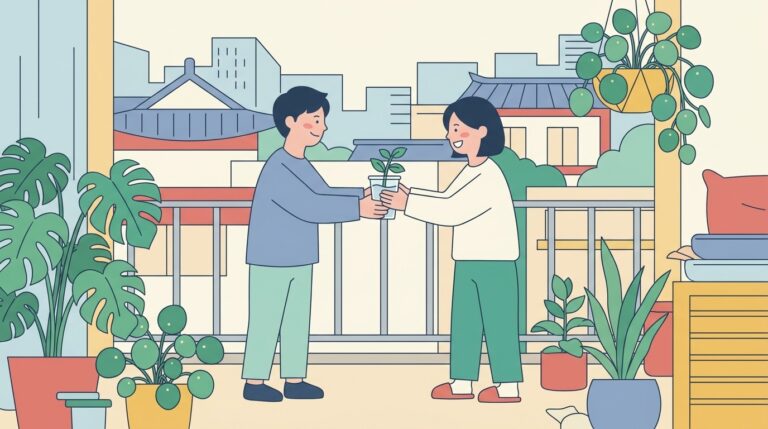
Master the Art of Korean ‘Plant Sharing’ Etiquette: Advanced Sik-jipsa Secrets
Phase 1: Empathy (An Invitation into the Green World of Korean ‘Sik-jipsa’)
안녕하세요! Welcome back to Daily Hangul, your trusted local cultural navigator. If you have been living in Korea or closely following Korean lifestyle trends, you might have noticed a fascinating shift. The traditional concrete jungles of Seoul are turning lush green. Koreans are no longer just growing houseplants; they have become 식집사 (Sik-jipsa)—a portmanteau of 식물 (plant) and 집사 (butler/deacon), meaning “plant butler.”
Imagine this: You are scrolling through a neighborhood app like Danggeun Market (당근마켓) or a Naver Cafe, and you spot someone offering a rare Monstera Albo cutting for a free 나눔 (nanum – free sharing). You want to reply, but you hesitate. At a C2 level, you know that simply saying “Please give it to me” sounds horribly blunt. How do you convey your deep respect for their gardening efforts, prove you are a responsible “butler” capable of keeping the cutting alive, and navigate the delicate unspoken rules of Korean plant communities?
Today, we are diving deep into the sophisticated linguistic nuances of Korean plant-sharing culture. This guide is built on real case studies of foreign expats who successfully integrated into local plant cafes, turning simple transactions into lifelong green friendships. Let’s elevate your Korean from textbook-flat to organic, natural, and culturally resonant.
Phase 2: Deep Dive into 3 Essential Plant Butler Expressions
1. 순둥순둥하게 잘 자라다 (Soon-doong-soon-doong-ha-ge jal ja-ra-da)
- Pronunciation: Sun-dung-sun-dung-ha-ge jal ja-ra-da (Sounds like “soon-doong,” mimicking a gentle, mild-tempered baby or pet)
- Meaning: To grow gently and easily without being fussy (low-maintenance).
- K-Culture Moment: In K-Dramas featuring cozy neighborhood settings, you’ll often see characters exchanging small pots saying, “얘 진짜 순둥순둥하게 잘 자라요” (This little guy grows so easily without throwing tantrums).
- Editor’s Insight: In Korean, repeating a sound like “순둥 (soon-doong)” softens the tone immensely. It originates from 순하다 (mild/gentle). Applying this to a plant anthropomorphizes it, showing the speaker’s affectionate bond.
- Situation Spectrum: Casual ✅ | Semi-formal ✅ | Formal ⚠️
- 🤔 Think About It: How does your native language anthropomorphize plants? In English, we say “hardy” or “forgiving,” but the Korean “순둥순둥” treats the plant like a sweet-natured infant. What does this reveal about the emotional connection Korean plant owners seek?
2. 순치(를) 거치다 (Soon-chi-reul geo-chi-da)
- Pronunciation: Sun-chi-reul geo-chi-da (Sounds like “soon-chee,” similar to “soon” + the “chee” in cheese)
- Meaning: To undergo acclimatization / hardening off (especially for delicate cuttings moving from high-humidity propagating chambers to normal room environments).
- K-Culture Moment: Serious plant collectors on YouTube (식튜버) use this term constantly when introducing imported foliage that has survived the strict quarantine and adaptation process.
- Editor’s Insight: This is a highly technical, high-register term derived from Hanja (馴致). Using this in a casual chat instantly signals that you are an expert who understands plant physiology, gaining you immediate respect in collector circles.
- Situation Spectrum: Casual ⚠️ | Semi-formal ✅ | Formal ✅
- 🤔 Think About It: Using precise technical jargon like ‘순치’ in a neighborly chat elevates your status from a casual hobbyist to a serious enthusiast. How does language acts as a passport to subculture communities in your culture?
3. 식구를 늘리다 (Sik-gu-reul neol-ri-da)
- Pronunciation: Sik-gu-reul neol-ri-da (Sounds like “sick-gu”)
- Meaning: To expand one’s family (used metaphorically for propagating plants and making new pots).
- K-Culture Moment: When old friends visit a plant lover’s home in a slice-of-life drama, they might look at the balcony and tease, “그새 또 식구를 늘렸네!” (You expanded your family again in the meantime!).
- Editor’s Insight: 식구 (食口) literally means “mouths to feed together” (family members). By referring to plants as ‘식구’, Koreans express that caring for plants is equivalent to raising family members who share domestic space.
- Situation Spectrum: Casual ✅ | Semi-formal ✅ | Formal 🚫
- 🤔 Think About It: Why does Korean culture emphasize “eating together” even when naming household plants? It highlights the collective warmth and domestic responsibility embedded in the language.
Phase 3: Textbook Korean vs. Real-Life Native Korean
Situation 1: Offering a plant cutting for free online
- 📖 Textbook Korean: “식물을 무료로 나누어 드립니다. 관심 있으신 분은 연락 주세요.”
(I am sharing plants for free. If you are interested, please contact me.) - 🗣️ Real-Life Native Korean: “애지중지 키운 대품에서 나온 삽수 나눔해요! 좋은 이웃분께 분양 보냈으면 좋겠습니다.”
(I’m sharing a cutting taken from a mature plant that I cherished with all my heart! I hope to adopt it out to a wonderful neighbor.) - 💡 Why is it different? The native version uses “애지중지” (cherishing passionately) and “분양” (adopting out, a term usually reserved for pets or apartments), showcasing a deep emotional attachment. It frames the free transaction not as getting rid of waste, but as a warm community adoption.
Situation 2: Asking for care tips after receiving a plant
- 📖 Textbook Korean: “이 식물은 물을 얼마나 자주 주어야 합니까?”
(How often should I water this plant?) - 🗣️ Real-Life Native Korean: “혹시 요 아이, 물주기는 겉흙이 마를 때 듬뿍 주면 될까요? 과습에 예민한지 궁금해요.”
(By any chance, for this little baby, should I give it a thorough soak when the topsoil dries out? I wonder if it’s sensitive to overwatering.) - 💡 Why is it different? Native plant lovers refer to plants as “요 아이” (this kid/this baby) and use watering jargon like “겉흙이 마를 때 듬뿍” (thoroughly when topsoil dries) and “과습” (overwatering). It shows nuanced, professional care awareness.
Phase 4: K-Culture Deep Dive & Non-verbal Etiquette
4-1. The Nunchi (눈치) of Plant Sharing: Packaging and “Jeong” (정)
When you meet a neighbor to receive a free plant cutting (나눔), the non-verbal manners are crucial.
1. The Takeout Cup Hack: It is a golden rule in Korea to recycle plastic take-out coffee cups as temporary green holders. When giving a cutting, put damp kitchen towel around the node, wrap it in plastic warp, and place it safely inside a clean plastic cup. It shows extreme consideration.
2. The Small Gesture of Gratitude: Even if the plant is free (나눔), arriving empty-handed is a minor cultural faux pas. Bringing a tiny treat—like a warm can of coffee, a small pouch of juice, or a sweet snack—is called 성의 (seong-ui – sincerity). When handing it over, bow slightly, use both hands, and say:
“약소하지만 오다가 시원한 음료수 하나 샀어요. 예쁘게 잘 키울게요!”
(It’s not much, but I grabbed a cool drink on my way here. I will raise it beautifully!)
4-2. The Cultural Code: “Sik-jipsa” in Modern K-Life
In dense urban spaces like Seoul, where single-person households are skyrocketing, plants serve as silent, non-demanding companions. The modern Korean “Sik-jipsa” culture represents a therapeutic movement. Rather than merely decorating a space, it’s about slow living, emotional grounding, and building quiet, trusting local micro-communities through apps like Danggeun (당근).
Phase 5: Real-Life Roleplay Scenario
Setting: A quiet afternoon outside a subway exit in Seoul. Sarah (a C2-level plant enthusiast) is meeting Min-woo, a legendary local “plant master” from a Naver plant forum, to receive a rare variegated cutting.
Characters:
- 민우 (Min-woo): A warm, experienced plant collector in his late 30s who treats his plants like masterpieces.
- Sarah: An advanced expat plant collector who wants to show respect and local expertise.
민우: (holding a carefully insulated paper bag, smiling) 안녕하세요! 당근에서 연락 주신 '초록초록' 님이시죠?

Sarah: (bowing politely with both hands on her bag) 네, 안녕하세요! 만나 뵙게 되어서 정말 영광이에요. 날씨도 더운데 멀리까지 나와 주셔서 감사합니다.

민우: 앗, 아니에요! 마침 이 근처에 볼일이 있었거든요. 여기, 약속했던 '몬스테라 알보' 삽수예요. 공중뿌리가 아주 튼튼해서 바로 흙에 심으셔도 될 겁니다.

Sarah: (carefully taking the bag with both hands, eyes widening) 와... 세상에, 무늬가 정말 예술이네요! 애지중지 키우신 티가 팍팍 나요. 이거 혹시 순치 과정을 따로 거쳐야 할까요?

민우: (pleasantly surprised by her vocabulary) 오, '순치'라는 단어도 아시네요! 네, 안 그래도 저희 집 온습도에 완전히 적응을 마친 상태라, 일주일 정도만 반양지에 두셨다가 분갈이해 주시면 돼요. 아주 순둥순둥해서 초보자도 키우기 쉬울 거예요.

Sarah: 다행이네요. 가습기를 따로 세팅해 줘야 하나 걱정했거든요. 과습만 조심하면서 정성껏 키워 볼게요. 식구를 늘리는 기쁨을 선물해 주셔서 정말 감사해요.

민우: 하하, 말씀하시는 게 완전히 베테랑 식집사이신데요? 혹시 키우시다가 잎이 타들어 가거나 이상이 생기면 언제든 편하게 당근 챗 주세요.

Sarah: (reaching into her bag) 아! 그리고 이건 제 작은 성의예요. 오다가 시원한 아이스 바닐라 라떼 한 잔 샀는데, 가시면서 드세요!
🔀 Interactive Decision Point: What should Sarah do next to solidify this community bond?
- Option A: Politely refuse any further contact to avoid bothering him, saying “I’ll handle the rest!”
- Option B: Keep in touch by sending a photo update of the plant’s first new leaf after two weeks.
- Option C: Ask him if he has any more expensive plants he is willing to sell cheap since they are now “friends.”
💡 Feedback on Your Choice:
- Best Choice – Option B: This is the peak of Korean plant community etiquette! Sending a photo update (인증샷) after a couple of weeks to show the plant is thriving under your care is deeply appreciated. It proves you respected their hard work.
- Risk Choice – Option A: While polite, it closes the door to building a local network. Plant collectors love sharing tips and trading plants long-term.
- Bad Choice – Option C: Highly inappropriate. It ruins the pure, community-driven spirit of “나눔” by turning it into a transactional, pushy business relationship.
Phase 6: 10-Second Emotional Shadowing Drill
Practice the natural rhythm and soft cadence of Korean plant-talk. Pause at the / marks and match the emotional tags.
- [🥺 Filled with deep gratitude and caution]
“애지중지 키우신 아이를 / 제가 받아도 될지 모르겠어요. / 정말 / 예쁘게 잘 키울게요!”
Ae-ji-jung-ji ki-u-shin a-i-reul / je-ga ba-da-do doel-ji mo-reu-get-seo-yo. / Jeong-mal / ye-bbu-ge jal ki-ul-ge-yo! - [😊 Reassuring and warm-hearted]
“이 아이는 / 정말 순둥순둥해서 / 물만 제때 주시면 / 알아서 잘 자랄 거예요.”
I a-i-neun / jeong-mal sun-dung-sun-dung-hae-seo / mul-man je-ttae ju-shi-myeon / al-a-seo jal ja-ral geo-ye-yo.
Phase 7: K-Culture Mini Dictionary
- 식집사 (Sik-jipsa) | Plant Butler
- Usage: Used to describe someone whose life revolves around watering, repotting, and organizing their indoor garden. Often used in hashtags: #식집사일상 (Daily life of a plant butler).
- 삽수 (Sapsu) | Cutting / Propagule
- Usage: A node or stem cut from a parent plant for propagation. This is the primary currency of plant trade in Korea.
- 흙손 / 똥손 (Heulg-son / Ddong-son) | Green Thumb / Brown Thumb
- Usage: Literally “dirt hand” (talented at growing things) vs. “poop hand” (someone who accidentally kills every plant they touch).
- 풀멍 (Pul-meong) | Plant-gazing
- Usage: The act of zoning out while staring silently at green leaves to relieve stress. Similar to 불멍 (fire-gazing) and 물멍 (aquarium-gazing).
Phase 8: The Traveler’s Survival Green Kit
Survival Expressions for Visiting Flower Markets:
- “이 식물, 실내 그늘에서도 잘 버티나요?”
- I sik-mul, sil-nae geu-neul-e-seo-do jal beo-ti-na-yo?
- Pro Tip: Ask this to find out if the plant can survive in a darker studio apartment.
- “초보자가 키우기에 가장 수월한 애로 추천해 주세요.”
- Cho-bo-ja-ga ki-u-gi-e ga-jang su-wol-han ae-ro chu-cheon-hae ju-se-yo.
- Pro Tip: Perfect when you want to avoid expensive, high-maintenance divas.
- “분갈이용 흙이랑 배수망도 같이 살 수 있을까요?”
- Bun-ga-ri-yong heulg-i-rang bae-su-mang-do ga-chi sal su is-seul-kka-yo?
- Pro Tip: Use this to grab repotting soil and plastic drainage mesh together.
🗺️ Editor’s Travel Note:
If you want to experience the absolute pinnacle of Korean plant heaven, search for “양재꽃시장” (Yangjae Flower Market) on the Naver Map App. It is the largest flower market in South Korea. Bring cash as you can often negotiate small discounts, and wear comfortable shoes because you will be walking through humid greenhouse tunnels for hours!
Phase 9:
Frequently Asked Questions (FAQ)
Q: What does "순둥순둥하게 잘 자라다 (Soon-doong-soon-doong-ha-ge jal ja-ra-da)" mean in Korean and how do you pronounce it?
A: In Korean, "순둥순둥하게 잘 자라다 (Soon-doong-soon-doong-ha-ge jal ja-ra-da)" is pronounced [Sun-dung-sun-dung-ha-ge jal ja-ra-da (Sounds like "soon-doong," mimicking a gentle, mild-tempered baby or pet] and means: To grow gently and easily without being fussy (low-maintenance).
Q: What does "순치(를) 거치다 (Soon-chi-reul geo-chi-da)" mean in Korean and how do you pronounce it?
A: In Korean, "순치(를) 거치다 (Soon-chi-reul geo-chi-da)" is pronounced [Sun-chi-reul geo-chi-da (Sounds like "soon-chee," similar to "soon" + the "chee" in cheese] and means: To undergo acclimatization / hardening off (especially for delicate cuttings moving from high-humidity propagating chambers to normal room environments).
Q: What does "식구를 늘리다 (Sik-gu-reul neol-ri-da)" mean in Korean and how do you pronounce it?
A: In Korean, "식구를 늘리다 (Sik-gu-reul neol-ri-da)" is pronounced [Sik-gu-reul neol-ri-da (Sounds like "sick-gu"] and means: To expand one's family (used metaphorically for propagating plants and making new pots).







