

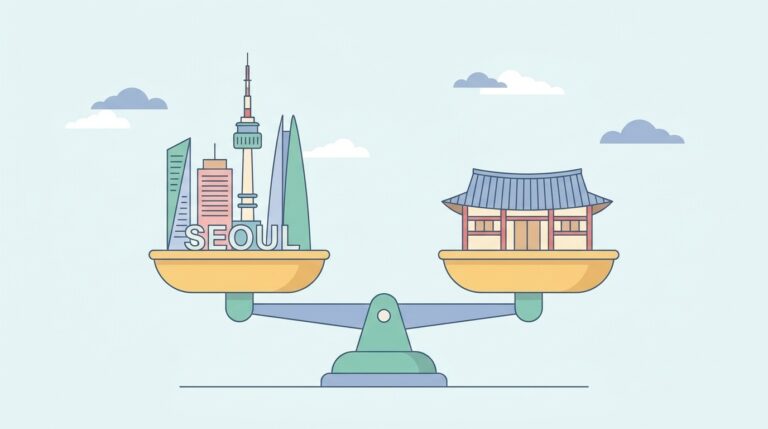
Master C1 Korean: Discussing Income Polarization and Social Welfare Like a Native
Phase 1: Empathy (공감) — The Modern Korean Divide
안녕하세요! Your premium Korean culture navigator and editor from Daily Hangul is here.
Have you ever watched the legendary film Parasite (기생충) or the hit drama Squid Game (오징어 게임) and wished you could discuss the deep social themes behind them in fluent Korean? Discussing complex issues like income polarization (소득 양극화) and social welfare (사회 복지) is the ultimate gateway to achieving native-level C1 proficiency.
Many advanced learners tell me, “Editor, when I talk about social issues, I sound like an academic textbook, or worse, I use overly simplistic words like ‘rich and poor’ (부자와 가난한 사람).” Don’t worry! Today, we will transition from basic descriptions to highly sophisticated, culturally aware arguments that will make any Korean interlocutor nod in deep respect. This guide is built upon real-world feedback from our C1 learners who successfully navigated university debates and professional policy discussions in Korea.
Phase 2: Key Expressions Analysis (핵심 표현 3선 심층 분석)
1. 양극화가 심화되다 (yang-geuk-hwa-ga sim-hwa-doe-da)
- Pronunciation: [yang-geuk-hwa-ga sim-hwa-doe-da] (Think of yang-geuk as two poles, like North and South, and sim-hwa as “deepening”).
- Meaning: The polarization (gap) is intensifying/deepening.
- K-Culture Moment: This term is frequently blasted across South Korean nightly news broadcasts when discussing the soaring real estate prices in Seoul versus the provinces.
- Editor’s Insight: “심화되다” is a premium C1-level passive verb used exclusively for abstract, systemic problems (e.g., 갈등이 심화되다 – conflict deepens). Avoid using simple words like “심해지다” in formal debates.
- Situation Spectrum: Casual (🚫) | Semi-formal (⚠️) | Formal (✅)
- 🤔 Think About It: Why does Korean society refer to the wealth gap as “polarization” (양극화) rather than just a “gap” (격차)? It reflects a deeply felt societal anxiety that the middle class is completely disappearing.
2. 개천에서 용 나기 어렵다 (gae-cheon-e-seo yong na-gi eo-ryeop-da)
- Pronunciation: [gae-cheon-e-seo yong na-gi eo-ryeop-da] (Literal: “It is hard for a dragon to rise from a small ditch”).
- Meaning: Upward social mobility is becoming impossible; the death of the self-made success story.
- K-Culture Moment: You will hear this proverb in K-Dramas like Sky Castle (스카이 캐슬) or The Golden Spoon (금수저) where characters lament that birth status dictates their entire future.
- Editor’s Insight: This classic idiom is a favorite among Koreans when discussing structural inequality. It encapsulates the frustration of the “dirt spoon” (흙수저) generation who feel that hard work alone no longer guarantees success.
- Situation Spectrum: Casual (✅) | Semi-formal (✅) | Formal (⚠️)
- 🤔 Think About It: How does the concept of “a dragon rising from a ditch” compare to the “American Dream” or the concept of meritocracy in your home country?
3. 복지 사각지대 (bok-ji sa-gak-ji-dae)
- Pronunciation: [bok-ji sa-gak-ji-dae] (sa-gak-ji-dae sounds like the blind spot of a car mirror).
- Meaning: Welfare blind spots (individuals or families left out of government assistance due to administrative loopholes).
- K-Culture Moment: Often featured in social welfare documentaries or humanistic dramas like My Mister (나의 아저씨) when characters fall through the cracks of the state safety net.
- Editor’s Insight: “사각지대” (blind spot) is a highly versatile term. By combining it with “복지” (welfare), you show a sophisticated understanding of policy failures.
- Situation Spectrum: Casual (⚠️) | Semi-formal (✅) | Formal (✅)
- 🤔 Think About It: Do you think welfare blind spots in your country are caused more by administrative bureaucracy or systemic funding shortages?
Phase 3: Textbook Korean vs. Real Native Korean
Scenario 1: Discussing the widening wealth gap
- 📖 Textbook Korean: “가난한 사람과 부유한 사람의 차이가 더 커지고 있습니다.” (The difference between poor and rich people is getting bigger.)
- 🗣️ Real Native Korean: “빈부격차가 날이 갈수록 벌어지고 있습니다.” (The wealth gap is widening day by day.)
- 💡 Why it matters: C1 speakers replace “가난한 사람과 부유한 사람의 차이” with the elegant compound noun 빈부격차 (the gap between rich and poor) and use the verb 벌어지다 (to widen/separate) to create a striking visual impact.
Scenario 2: Suggesting solutions for vulnerable groups
- 📖 Textbook Korean: “정부는 가난한 사람들에게 돈을 더 많이 줘야 합니다.” (The government should give more money to poor people.)
- 🗣️ Real Native Korean: “취약계층을 보호하기 위한 실질적인 사회안전망을 구축해야 합니다.” (We must construct a practical social safety net to protect vulnerable social groups.)
- 💡 Why it matters: “가난한 사람” can sometimes sound condescending or overly simplistic in policy debates. “취약계층” (vulnerable groups) and “사회안전망 구축” (building a social safety net) are standard, highly respectful terms used in South Korean media and administrative circles.
Phase 4: K-Culture Deep Dive & Non-verbal Manners
4-1. Eye Contact, Tone, and “Nunchi” (눈치)
When discussing sensitive topics like wealth, poverty, and inequality in Korea, your body language must reflect empathy and seriousness.
* The Clasp (공수 자세): When speaking formally in a group or seminar, place one hand over the other gently near your lower stomach. It projects composure and deep respect.
* System over Individual: When complaining about inequality, avoid blaming individuals (e.g., “They are poor because they are lazy” is a massive cultural taboo). Frame your arguments around structural issues to sound constructive, thoughtful, and highly cultured.
4-2. The “Spoon Class Theory” (수저계급론)
To truly understand Korean inequality debates, you must grasp the Spoon Class Theory. Born in the mid-2010s, this theory classifies individuals based on their parents’ assets:
* 금수저 (Gold Spoon): Born into extreme wealth.
* 흙수저 (Dirt Spoon): Born with no financial backing.
This isn’t just internet slang anymore; it is a major sociological lens through which modern Koreans analyze real estate bubbles and the educational divide.
Phase 5: Real-Life Roleplay Scenario
Setting: A university discussion group in Seoul. Min-ho (a passionate sociology major) and Sophia (an advanced international student) are analyzing the causes of income polarization.
- 민호: 소피아 씨, 요즘 한국의 가장 큰 사회적 화두가 뭐라고 생각해요?
(Sophia, what do you think is the biggest social topic in Korea these days?) - 소피아: 🎭 (진지한 표정으로 고개를 끄덕이며) 저는 단연 소득 양극화 문제라고 봐요. 부익부 빈익빈 현상이 너무 심해지는 것 같거든요.
(I definitely think it’s the income polarization issue. It feels like the rich-get-richer, poor-get-poorer phenomenon is worsening.) - 민호: 맞아요. 특히 청년층 사이에서 흙수저라는 자조적인 표현이 유행하는 걸 보면 마음이 아파요.
(You’re right. It hurts my heart to see self-deprecating expressions like ‘Dirt Spoon’ trending among the youth.) - 소피아: 🎭 (차분한 어조로 분석하며) 교육 기회의 불평등이 결국 소득 양극화로 이어지는 것 같아요. 이제는 정말 개천에서 용 나기 어려운 시대가 되었잖아요.
(Inequality in educational opportunities seems to lead to income polarization in the end. It really has become an era where it’s hard for a dragon to rise from a small stream.) - 민호: 동감합니다. 그럼 이 문제를 해결하려면 정부가 어떤 대책을 세워야 할까요?
(I agree. Then, what measures should the government take to solve this issue?) - 소피아: 우선 복지 사각지대에 놓인 가구들을 찾아내서 실질적으로 지원해 줘야 해요.
(First, we must find households in welfare blind spots and provide practical support.) - 민호: 좋은 생각이에요. 단순한 현금 지원보다는 일자리 창출을 통한 자립 지원이 병행되어야겠죠?
(Great point. Rather than simple cash handouts, support for self-reliance through job creation should go hand in hand, right?) - 소피아: 🎭 (미소를 지으며 확신에 찬 목소리로) 바로 그거예요! 튼튼한 사회안전망이야말로 양극화 극복의 첫걸음입니다.
(Exactly! A strong social safety net is indeed the first step to overcoming polarization.)
🔀 Interactive Choice Points
How would you reply to Min-ho’s question about government measures?
* Choice A: “정부가 부자들한테 세금을 엄청 많이 걷어서 가난한 사람들한테 다 줘야 해요.” (The government should collect huge taxes from the rich and give it all to the poor.)
* Choice B: “취약계층의 자립을 돕는 생산적 복지와 사회안전망 강화가 균형을 이루어야 합니다.” (Productive welfare that helps vulnerable groups become self-reliant and the strengthening of the social safety net must be balanced.)
* Choice C: “저는 경제에 관심이 없어서 복지 정책은 잘 모르겠어요.” (I don’t care about economics, so I don’t know much about welfare policy.)
💬 Feedback Corner
- Best Choice (Choice B): Perfect! You used “취약계층” (vulnerable group), “생산적 복지” (productive welfare), and “사회안전망” (social safety net) seamlessly. You sound like a professional policy researcher!
- Risk Choice (Choice A): While passionate, the tone is overly simplified (“엄청 많이”) and politically aggressive, which might derail a polite academic debate.
- Bad Choice (Choice C): This shuts down the conversation entirely. Even if you don’t know much, attempting to use basic C1 vocabulary shows great effort!
Phase 6: 10-Second Emotion Shadowing Drill
To master the natural cadence of a native speaker during intense debates, practice these sentences with emotional pauses (/ marks pauses; use the emotional cue inside brackets):
[🥺 Deeply concerned and serious]
“개천에서 / 용 나는 시대는 / 이제 끝났다는 말이 / 피부로 와닿아요.”
(The saying that the era of a dragon rising from a ditch is over… really hits home.)-
[💪 Resolute and hopeful]
“더 늦기 전에 / 복지 사각지대를 해소하고 / 사회안전망을 / 재구축해야 합니다.”
(Before it’s too late, we must eliminate welfare blind spots and rebuild the social safety net.)
Phase 7: K-Culture Mini Dictionary
- 상대적 박탈감 (sang-dae-jeok bak-tal-gam) | Relative Deprivation
- Feeling poor compared to others around you. Crucial when discussing why SNS (like Instagram) makes modern Koreans feel unhappy.
- 부익부 빈익빈 (bu-ik-bu bin-ik-bin) | The rich get richer, the poor get poorer
- A classic four-character idiom (사자성어) used to describe structural economic inequality.
- 기본소득 (gi-bon-so-deuk) | Universal Basic Income (UBI)
- A highly debated topic in current Korean politics as a solution to structural job loss.
- 일자리 창출 (il-ja-ri chang-chul) | Job Creation
- Always cited as the number-one sustainable solution to polarization by Korean policymakers.
Phase 8: Traveler’s Survival Kit (For Policy Debates & Reading the News)
Survival Phrases for the Intellectually Curious
- “이 문제에 대해서 어떻게 생각하세요?” [i mun-jae-e dae-hae-seo eo-tteoh-ge saeng-gak-ha-se-yo?]
- Pro Tip: Excellent for shifting the spotlight to your Korean partner during a heavy discussion.
- “시급한 대책이 필요해 보입니다.” [si-geup-han dae-chaek-i pil-yo-hae bo-im-ni-da]
- Pro Tip: Use this to conclude a discussion about a serious social issue with professional authority.
- “빈부격차 문제를 간과해서는 안 됩니다.” [bin-bu-gyeok-cha mun-jae-reul gan-gwa-hae-seo-neun an doem-ni-da]
- Pro Tip: “간과하다” means “to overlook.” This phrase warns that we must not ignore the wealth gap.
🗺️ Editor’s Travel Note: To stay on top of daily social trends and debates in South Korea, download the Naver News App or read columns on the Seoul Shinmun Editorial Section. Observing how columnists frame these economic issues will boost your vocabulary tenfold. (Note: App availability and interface designs are subject to change by developers.)
Phase 9: “한 발 더 깊이” (Deepening Thought) — From Jeong to Fairness
Historically, South Korean society was bound by 정 (Jeong – deep mutual affection/communal bond), where communities looked after their poor neighbors naturally. However, rapid industrialization created a hyper-competitive society. Today, Korean youth care deeply about 공정 (Gong-jeong – Fairness/Equity). Because they feel the starting line of the race is already rigged by parental wealth (the “Spoon Class”), they demand absolute fairness in college admissions and job markets. Understanding this transition from “communal affection” to “brutal demand for fairness” is key to understanding modern Korean sociology.
💬 Your Turn: How do the youth in your country view structural fairness? Let me know in the comments below! Let’s get a global discussion going!
Phase 10: FAQ & Common Mistakes
Q: What is the difference between “복지” (Bok-ji) and “행복” (Haeng-bok)?
A: Many learners confuse these because they both sound warm! “복지” refers strictly to social welfare/public assistance system, while “행복” refers to personal happiness/well-being.
Q: Can I use the word “가난하다” in formal discussions?
A: It is not grammatically wrong, but “가난하다” can carry a slight social stigma. In professional debates, use “소득 분배가 불평등하다” (income distribution is unequal) or “경제적 취약계층” (economically vulnerable class) for a more objective, academic tone.
Q: Is “흙수저” (Dirt Spoon) polite enough to use with older professors?
A: It is fine to mention it as a societal phenomenon (e.g., “젊은이들 사이에서 흙수저라는 말이 유행합니다”), but never use it to describe yourself or someone else directly in front of elders, as they might perceive it as overly cynical or lacking perseverance.
🚨 Common Mistakes Alert!
- Saying “복지 사거리” instead of “복지 사각지대”
- Why: “사거리” means intersection/crossroad. “사각지대” means blind spot! Saying “복지 사거리” sounds like you are looking for a welfare office at a traffic light.
- Using “돈을 나눠주다” in academic presentations
- Why: This means “handing out cash.” Instead, use the formal policy term: “재난지원금을 지급하다” (to distribute emergency relief funds) or “소득을 보전하다” (to supplement income).
Phase 11: Action Mission & Engagement
- Bronze Mission (Self-Practice): Read aloud our shadowing drills in Phase 6 three times, focusing on the emotional pauses.
- Silver Mission (Social Sharing): Post a short summary of your thoughts on Parasite or Squid Game on your social media using the words 양극화 and 사회안전망.
- Gold Mission (Real Use): The next time you talk with a Korean friend, ask them: “요즘 한국에서 ‘개천에서 용 나기 어렵다’는 말을 많이 쓰나요?” and listen to their personal story!
🎮 K-Culture Mission: Watch an episode of a drama like My Mister or The Golden Spoon this weekend. Keep an ear out for any terms related to money, class, or administrative struggles! Write down at least one sentence you find.
Phase 12: Interactive Quiz Challenge
Test your knowledge of high-level social welfare Korean!
- Which word refers to the “blind spots” of government assistance programs?
- A) 사거리 (Sa-geo-ri)
- B) 사각지대 (Sa-gak-ji-dae)
- C) 삼각형 (Sam-gak-hyeong)
- Fill in the blank with the appropriate C1-level verb:
- “최근 물가 상승으로 인해 취약계층의 경제적 어려움이 더욱 ( )되고 있습니다.”
- A) 축소 (chuk-so)
- B) 심화 (sim-hwa)
- C) 해결 (hae-gyeol)
- True or False: “개천에서 용 난다” means that social mobility is very easy in modern Korea.
- A) True
- B) False
🔍 Click here to reveal the answers and detailed explanations!
- Answer: B (사각지대)
- Explanation: “사각지대” means blind spot. “사거리” is an intersection, and “삼각형” is a triangle.
- Answer: B (심화)
- Explanation: “심화되다” is the sophisticated verb for when an issue gets deeper or intensifies.
- Answer: B (False)
- Explanation: Historically, it meant a self-made success was possible, but in modern contexts, people say “개천에서 용 나기 어렵다” (it is hard to rise from a ditch) to express that social mobility has become extremely difficult.
- Explanation: Historically, it meant a self-made success was possible, but in modern contexts, people say “개천에서 용 나기 어렵다” (it is hard to rise from a ditch) to express that social mobility has become extremely difficult.







