

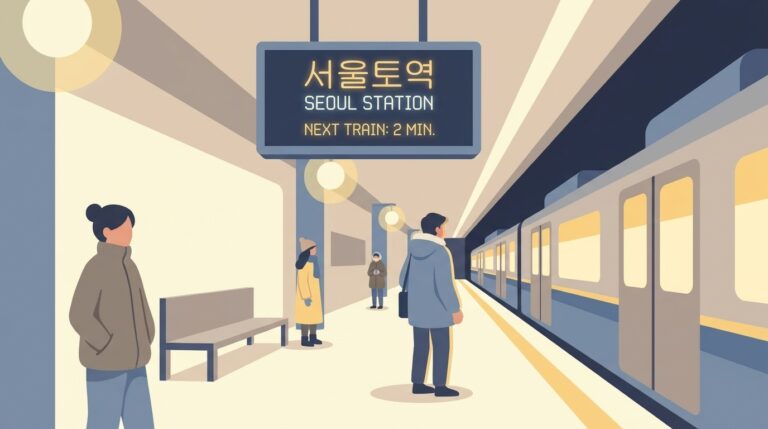
Don’t Get Stranded in Seoul! Ask for the Last Subway Train Like a Local
Phase 1: Empathy (Your Late-Night Seoul Savior)
안녕하세요! (An-nyeong-ha-se-yo!) Hello! I’m your lead editor at Daily Hangul, your trusty local guide to mastering real-life Korean.
Imagine this: You’ve had an incredible evening in Hongdae. You shared delicious Korean barbecue, laughed with new friends, and suddenly realize it’s past midnight. You rush down into the bustling Seoul subway station. The platforms are getting quieter, and you feel a wave of anxiety. Has the last train already left? How do I ask someone without sounding robotic?
We’ve all been there! Many of our global learners tell us that navigating the “Cinderella hour” of Seoul’s public transit is one of their biggest travel worries. Today, we’re going to turn that anxiety into absolute confidence. By the end of this quick guide, you’ll know exactly how to ask for the last train time just like a born-and-raised Seoulite!
Phase 2: Core Phrases Deep-Dive
Let’s look at the 3 golden phrases you need to survive midnight in the Seoul subway system.
1. 막차 언제예요? (Mak-cha eon-je-yeo-yo?)
- Pronunciation: “Mock-cha eon-je-yo?” (Sounds like: Mock as in mock trial + cha as in cha-cha + eon-je as in ‘on-jelly’ without ‘lly’ + yo)
- Meaning: When is the last train? (Literally: “Last car, when is it?”)
- K-Culture Moment: You’ll hear this phrase echoed in countless romantic K-dramas when the lead characters are trying to prolong their date but realize time is running out.
- Editor’s Insight: “막차” (Mak-cha) is a compound word: “막” (last/final) + “차” (car/vehicle). It’s the absolute go-to word for any last transit of the night.
- Situation Spectrum: Casual ✅ | Semi-formal ✅ | Formal ⚠️
- 🤔 Think About It: In your hometown, do you refer to the last transit with a special short slang word like “막차”?
2. 막차 몇 시에 있어요? (Mak-cha myeot si-e isseo-yo?)
- Pronunciation: “Mock-cha myeot shee-eh ees-suy-yo?”
- Meaning: What time is the last train? (Literally: “Last train, at what hour does it exist?”)
- K-Culture Moment: Often blurted out in a rush to station staff at the information desk near the ticket barriers.
- Editor’s Insight: Use this when you want a highly specific time (e.g., “11:54 PM”) rather than a general answer.
- Situation Spectrum: Casual ✅ | Semi-formal ✅ | Formal ✅
- 🤔 Think About It: Korean time markers are simple. “몇 시” (myeot si) means “what time”. Just add “에 있어요” to ask if something exists at that time!
3. 막차 갔어요? (Mak-cha gat-sseo-yo?)
- Pronunciation: “Mock-cha gat-suh-yo?”
- Meaning: Did the last train already leave? (Literally: “Did the last train go?”)
- K-Culture Moment: Said with a slight look of panic while looking at the digital train arrival screens.
- Editor’s Insight: The verb “가다” (to go) becomes “갔어요” (went/gone). It’s super short, direct, and incredibly natural.
- Situation Spectrum: Casual ✅ | Semi-formal ✅ | Formal 🚫
- 🤔 Think About It: Why does Korean use “go” instead of “leave” in this context? It shows how actions are viewed from the perspective of the station platform!
Phase 3: Textbook Korean vs. Real Korean
Let’s compare the stiff expressions found in standard academic books with what real people actually say on the platforms of Seoul.
Scenario A: Asking if the last train has departed
- 📖 Textbook Korean: 마지막 지하철이 이미 출발하였습니까? (Ma-ji-mak ji-ha-cheol-i i-mi chul-bal-ha-yeot-seub-ni-kka?) “Has the final underground train already departed?”
- 🗣️ Real Korean: 막차 갔어요? (Mak-cha gat-sseo-yo?) “Did the last train go?”
- 💡 Why the difference? Stiff textbook grammar is too heavy for a fast-paced environment. Real Koreans prioritize speed and ease when they are in a rush!
Scenario B: Asking for the time of the last transit
- 📖 Textbook Korean: 열차 운행이 몇 시에 종료됩니까? (Yeol-cha un-haeng-i myeot si-e jong-ryo-doeb-ni-kka?) “At what hour does the train service terminate?”
- 🗣️ Real Korean: 막차 몇 시예요? (Mak-cha myeot si-yeo-yo?) “When’s the last train?”
- 💡 Why the difference? Dropping unnecessary particles like “이/가” makes you sound like a natural local rather than a reading comprehension exercise.
Phase 4: K-Culture Deep-Dive & Non-Verbal Manners
4-1. Subway Nunchi & Polite Gestures
When asking a stranger or station staff near the turnstiles, use the “Polite Wave and Bow”. Avoid pointing your finger. Instead, point gently toward the train tracks with an open palm. Keep your body slightly angled—this shows “눈치” (Nunchi – situational awareness), signaling that you know they might be busy but you desperately need quick help!
4-2. The Midnight Dash Culture
In Korea, catching the “막차” is almost a national sport. Around 11:30 PM to midnight, you will see a sudden shift in pace. People in business suits and high heels alike will suddenly start walking briskly or even sprinting in unison down the escalators. Don’t be alarmed—they are just participating in the midnight “막차 rush”!
Phase 5: Real-Life Roleplay Scenario
Setting: Jack (an A1 learner) is standing confused near the ticket gates of Hongik University (Hongdae) Station at 11:50 PM. He spots Minji, a friendly-looking local waiting near the lockers.
- Jack: 저기요… 죄송한데요. (Jeo-gi-yo… joe-song-han-de-yo.) “Excuse me… I’m sorry to bother you.”
- Minji: 네? 무슨 일이세요? (Ne? Mu-seun il-i-se-yo?) “Yes? What’s the matter?”
- Jack: 🎭 [Pointing nervously toward the platform] 혹시… 막차 몇 시예요? (Hok-si… mak-cha myeot si-yeo-yo?) “By any chance… what time is the last train?”
- Minji: 아, 어디로 가세요? 신촌이요? (Ah, eo-di-ro ga-se-yo? Sin-chon-i-yo?) “Oh, where are you heading? Sinchon?”
- Jack: 네, 신촌역이요! (Ne, Sin-chon-yeok-i-yo!) “Yes, Sinchon Station!”
- Minji: 🎭 [Checking her phone app quickly] 신촌행 막차는 12시 5분에 있어요! (Sin-chon-haeng mak-cha-neun yeol-du-si o-bun-e isseo-yo!) “The last train for Sinchon is at 12:05!”
- Jack: 아! 아직 안 갔어요? (Ah! A-jik an gat-sseo-yo?) “Ah! It hasn’t gone yet?”
- Minji: 네, 아직 시간 있어요. 빨리 내려가세요! (Ne, a-jik si-gan isseo-yo. Ppal-li nae-ryeo-ga-se-yo!) “Yes, you still have time. Go down quickly!”
- Jack: 정말 감사합니다! (Jeong-mal gam-sa-hap-ni-da!) “Thank you so much!”
🔀 Your Turn: Interactive Choice!
What should Jack do if Minji tells him the train has already left? Choose your action:
* A) Say “막차 끊겼어요?” (Is the line cut off?) with a sad face.
* B) Ask “첫차 언제예요?” (When is the first train?) and get ready to stay up all night.
* C) Say “택시 어디서 타요?” (Where do I catch a taxi?) to head home safely.
- Editor’s Feedback:
- Choosing A (Best Option): Excellent! This shows high emotional connection and uses natural slang for a missed train.
- Choosing B (Risk Option): Brave! But the first train is usually around 5:30 AM. Make sure you have a warm café or a 24-hour Noraebang (karaoke) lined up!
- Choosing C (Practical Option): Very smart! Finding the right exit for a taxi queue is the best backup plan in Seoul.
Phase 6: 10-Second Emotional Shadowing Drill
Practice saying these with the exact pauses (/) and emotional tones to sound natural:
- [🥺 Anxious & Polite]
저기요… / 막차 / 언제예요?
(Jeo-gi-yo… / mak-cha / eon-je-yeo-yo?) -
[😊 Relieved & Excited]
아! / 아직 / 안 갔어요? / 다행이다!
(Ah! / a-jik / an gat-sseo-yo? / da-haeng-i-da!)
Phase 7: K-Culture Mini Dictionary
- 막차 (Mak-cha) | Last Transit / Train
- Used daily for subways, buses, and even metaphorically for “the last opportunity” in life or business.
- 첫차 (Cheot-cha) | First Transit / Train
- The opposite of 막차. Usually starts running around 5:30 AM in Seoul.
- 막차 전철 (Mak-cha jeon-cheol) | Last Subway Train
- A slightly more specific term than just “막차”, highlighting that you specifically mean the electric subway.
- 끊기다 (Kkeun-gi-da) | To run out / To be cut off
- Used when transit stops running. E.g., “버스 끊겼어요” (The buses have stopped running).
Phase 8: Traveler’s Survival Kit
Top 3 SOS Phrases
- 지하철 끝났어요? (Ji-ha-cheol kkeun-nat-seo-yo?) – “Is the subway finished?”
- 택시 정류장 어디예요? (Taek-si jeong-ryu-jang eo-di-yeo-yo?) – “Where is the taxi stand?”
- 카카오 택시 불러야 해요. (Ka-ka-o taek-si bul-leo-ya hae-yo.) – “I need to call a Kakao Taxi.”
💡 Editor’s Travel Note: Always download the Naver Map App before exploring Seoul. It provides real-time countdowns for the last trains on every subway line. Note: Transit schedules can change slightly during national holidays or strikes, so always check live local apps!
Phase 9: One Step Deeper (The Midnight Community of Seoul)
In many Western cities, taking the very last train can sometimes feel dark or lonely. However, in Seoul, the “막차” is surprisingly warm and lively. You will see students clutching notebooks, office workers holding hands after dinner, and street food vendors packing up. Rushing for the last train together creates a silent, shared bond of community among Seoulites. You are never alone in the Seoul night!
💬 Your Turn: Have you ever missed the last train in your own country? What did you do? Let us know in the comments below!
Phase 10: FAQ & Common Mistakes
Q: Can I use “마지막 기차” (ma-ji-mak gi-cha) instead of “막차”?
A: While it is grammatically correct, “기차” usually refers to intercity bullet trains (like KTX). For city subways, locals always prefer the short and snappy term 막차.
Q: Do subways run 24 hours in Seoul?
A: No, Seoul subways generally shut down between midnight and 1:00 AM, resuming around 5:30 AM.
Q: How do I ask if a train goes to my specific station?
A: You can simply say, “[Station Name] 가요? ” (Does this go to [Station]?). For example: “홍대 가요?” (Hong-dae ga-yo?).
🚨 Common Mistakes Alert!
- Mistake: Saying “마지막 차” (Ma-ji-mak cha) slowly.
- Correct Action: Merge it smoothly into 막차 (Mak-cha). It sounds much more natural and urgent!
- Mistake: Waiting on the platform silently when you’re unsure.
- Correct Action: Ask immediately using “막차 갔어요?”. Station doors can close fast!
Phase 11: Action Missions
- 🥉 Bronze Mission: Practice saying “막차 언제예요?” out loud in front of a mirror 5 times with a polite smile.
- 🥈 Silver Mission: Write down the phrase in your phone’s notepad so you can easily show it to a station master in an emergency.
- 🥇 Gold Mission: Next time you watch a modern K-drama, listen closely to see if you can spot the characters saying “막차” or “막차 끊기다”!
Phase 12: Interactive Quiz Challenge
Test your survival instincts! Click below to see the answers.
Q1. Which word means “the last train of the night”?
- A) 첫차 (Cheot-cha)
- B) 막차 (Mak-cha)
- C) 기차 (Gi-cha)
Reveal Answer
Correct Answer: B) 막차
Explanation: 막차 literally means the final vehicle or train of the night. 첫차 is the first train, and 기차 is a long-distance train.
Q2. True or False: Seoul subways run 24 hours a day.
Reveal Answer
Correct Answer: False
Explanation: They shut down around midnight to 1:00 AM, making the phrase “막차 몇 시예요?” highly essential for late travelers!
“,







