

Speak Like a Local: How to Order the Perfect Cup Size in Korean Cafes
Phase 1: Empathy & Connection
안녕하세요! (An-nyeong-ha-se-yo!) Hello! Your Daily Hangul editor is here to help you navigate your next Korean coffee adventure.
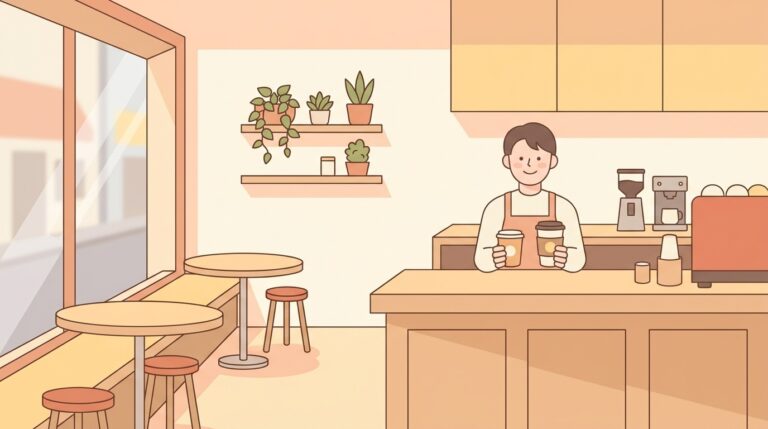
Picture this: You are standing in a gorgeous, sunlit cafe in the heart of Seongsu-dong, Seoul. The smell of freshly roasted coffee beans fills the air. You’ve practiced your order perfectly: “아이스 아메리카노 한 잔 주세요” (One iced Americano, please). But then, the smiling barista asks a rapid-fire question:
🗣️ “사이즈는 어떤 걸로 도와드릴까요?” (What size would you like?)
Suddenly, your mind goes blank. Do you say “Medium”? Do they use Starbuck-style words? Or is there a specific Korean word you should use?
Don’t worry at all! This is one of the most common “panic moments” for language learners. In this guide, we will teach you how to choose your cup size confidently so you can enjoy your delicious coffee without any awkward silences. Let’s master this together!
Phase 2: Deep Dive into 3 Core Expressions
Here are the three most powerful, natural phrases you can use at any Korean cafe counter.
1. 작은 걸로 주세요 (jageun geollo juseyo)
- Pronunciation: jah-geun geol-loh joo-seh-yo (Think of “jah-geun” as “ja” from “jacket” + “geun” like the first half of “good” with an ‘n’ sound. “Geollo” rhymes with “solo” but with a soft ‘g’).
- Meaning: “Please give me the small one.”
- K-Culture Moment: You will hear this in every slice-of-life K-Drama when a character drops by a local neighborhood cafe for a quick morning espresso or a light hot tea.
- Editor’s Insight: 작은 (jageun) means “small” and 걸로 (geollo) means “as this option.” It is incredibly natural and polite for everyday transactions.
- Situation Spectrum: Casual ✅ / Semi-formal ✅ / Formal ⚠️
- 🤔 Think About It: Why do you think Korean uses “as the small one” (~로) instead of just saying “Give me small”? It reflects the polite, indirect nature of Korean culture!
2. 제일 큰 사이즈가 뭐예요? (jeil keun saijeuga mwoyeyo?)
- Pronunciation: jeh-il keun sah-ee-jeu-gah mwoh-yeh-yo? (Think of “jeil” as “jay-il”. “Keun” is similar to the English “coo” but with a very flat tongue position).
- Meaning: “What is the biggest size?”
- K-Culture Moment: Think of K-Pop idols during long practice sessions drinking those giant 1-liter iced coffees to keep their energy up.
- Editor’s Insight: If you need maximum caffeine, use 제일 큰 (jeil keun – the biggest). This is a great question to ask when the menu doesn’t show the cup sizes visually.
- Situation Spectrum: Casual ✅ / Semi-formal ✅ / Formal ✅
- 🤔 Think About It: In your country, is the biggest coffee size usually called Large, Venti, or something else? How does that compare to the Korean cafe landscape?
3. 중간 사이즈로 해 주세요 (jung-gan saijeuro hae juseyo)
- Pronunciation: joong-gahn sah-ee-jeu-roh hae joo-seh-yo (“Jung-gan” sounds like “joong” as in “jungle” + “gahn” as in “gone”).
- Meaning: “Please make it a medium (middle) size.”
- K-Culture Moment: A safe, classic choice when meeting a friend or business partner for a casual chat over drinks.
- Editor’s Insight: 중간 (jung-gan) literally means “middle/medium.” You can also simply say “레귤러 주세요” (re-gyul-leo joo-se-yo – Regular, please), but using “중간 사이즈” sounds beautifully local.
- Situation Spectrum: Casual ✅ / Semi-formal ✅ / Formal ⚠️
- 🤔 Think About It: How does choosing the “middle” option make things socially comfortable in a group setting?
Phase 3: Textbook Korean vs. Real Korean
Sometimes, textbooks teach overly formal words that sound a bit robotic in real life. Let’s look at the differences:
Situation 1: Ordering a large size
- 📖 Textbook Korean: “대(大) 자 크기로 주십시오.” (Dae-ja keu-gi-ro ju-sip-si-o.)
- 🗣️ Real Korean: “제일 큰 거 주세요.” (Jeil keun geo juseyo.) or “라지 사이즈로 주세요.” (Raji saijeuro juseyo.)
- 💡 Why the difference? Traditional Hanja-based terms like ‘대’ (Large) are used on wholesale menus or traditional markets, but modern Korean cafes prefer natural adjectives or English loanwords.
Situation 2: Asking for a medium size
- 📖 Textbook Korean: “보통 크기로 원합니다.” (Bo-tong keu-gi-ro won-ham-ni-da.)
- 🗣️ Real Korean: “중간 사이즈 주세요.” (Jung-gan saijeu juseyo.) or “레귤러 주세요.” (Regyulleo juseyo.)
- 💡 Why the difference? “원합니다” (I want) sounds too dramatic for a simple coffee order. “~주세요” (Please give me) is the undisputed king of friendly cafe talk.
Phase 4: K-Culture Deep Dive & Non-Verbal Manners
4-1. Nunchi (눈치) & Gestures at the Counter
When ordering your size in Korea, non-verbal cues help a lot!
* The Cup Gesture: If you are unsure of the size names, baristas will often point to sample cups on the counter. You can point to your choice and nod slightly while saying “이걸로 주세요” (i-geol-lo juseyo – This one, please).
* The Polite Hand: When handing over your credit card or receiving your coffee, it is polite to use both hands or support your right elbow/wrist with your left hand. It shows great manners (예의)!
4-2. The “Eol-Juk-Ah” Phenomenon
Have you heard of 얼죽아 (Eol-Juk-Ah)? It stands for “얼어 죽어도 아이스” (Even if I freeze to death, I’ll drink iced coffee). Koreans love iced Americanos so much that they order them in the dead of winter! If you want to fit in, order a “Large Iced Americano” even when it snows!
Phase 5: Real-life Roleplay Scenario
Setting: A trendy, minimalist cafe in Hongdae, Seoul.
Characters:
* Min-ji (민지): The friendly barista wearing a neat green apron.
* Alex (알렉스): An eager A2-level Korean learner visiting Seoul.
Min-ji: 어서 오세요! 주문 도와드릴까요?
(Eo-seo o-se-yo! Ju-mun do-wa-deu-ril-kka-yo?)
Welcome! How can I help you?
Alex: [😊 Smiling politely] 안녕하세요, 아이스 라떼 한 잔 주세요.
(An-nyeong-ha-se-yo, a-i-seu ra-tte han jan ju-se-yo.)
Hello, one iced latte, please.
Min-ji: 네, 라떼 한 잔이요. 사이즈는 어떤 걸로 도와드릴까요?
(Ne, ra-tte han jan-i-yo. Sai-jeu-neun eo-tteon geol-lo do-wa-deu-ril-kka-yo?)
Sure, one latte. What size would you like?
Alex: [👉 Pointing to the medium display cup] 음… 중간 사이즈로 해 주세요.
(Eum… jung-gan sa-i-jeu-ro hae ju-se-yo.)
Hm… Please make it a medium size.
Min-ji: 네, 중간 사이즈요. 매장에서 드시고 가시나요?
(Ne, jung-gan sa-i-jeu-yo. Mae-jang-e-seo deu-si-go ga-si-na-yo?)
Okay, medium size. Are you having it here in the shop?
Alex: 아니요, 테이크아웃 해 주세요.
(A-ni-yo, te-i-keu-a-ut hae ju-se-yo.)
No, to-go, please.
Min-ji: 결제는 카드로 도와드릴까요?
(Gyeol-je-neun ka-deu-ro do-wa-deu-ril-kka-yo?)
Would you like to pay by card?
Alex: [💳 Handing card over with both hands] 네, 여기요. 감사합니다!
(Ne, yeo-gi-yo. Gam-sa-ham-ni-da!)
Yes, here you go. Thank you!
🔀 Interactive Choice Point
What if the barista tells you they only have “Tall” and “Grande” sizes? How do you respond?
- Option A: “그냥 큰 거 주세요.” (Geu-nyang keun geo juseyo.) – “Just give me the big one.”
- Option B: “그란데 사이즈로 주세요.” (Geu-ran-de sa-i-jeu-ro ju-se-yo.) – “Please give me the Grande size.”
- Option C: “아무거나 괜찮아요.” (A-mu-geo-na gwaen-cha-na-yo.) – “Anything is fine.”
💡 Feedback on Your Choice:
- Best Choice: Option B! It is clear, polite, and uses the exact cafe sizing language.
- Bad Choice: Option C! This might confuse the busy barista because they still have to select a size on the register to complete your payment.
- Risk Choice: Option A! While they will understand you, it can sound a bit blunt if spoken without a friendly smile.
Phase 6: 10-Second Emotion Shadowing Drill
Let’s practice speaking with real Korean emotion! Use the pauses / to sound incredibly natural.
- [😊 Polites & Warm]
아이스 / 아메리카노 / 작은 걸로 / 주세요.
(A-i-seu / a-me-ri-ka-no / jah-geun geol-loh / joo-seh-yo.) -
[🤔 Curious & Friendly]
혹시… / 제일 큰 사이즈가 / 뭐예요?
(Hok-si… / jeh-il keun sah-ee-jeu-gah / mwoh-yeh-yo?) -
[🙋♀️ Confident & Direct]
중간 사이즈 / 테이크아웃으로 / 할게요!
(Joong-gahn sah-ee-jeu / te-i-keu-a-ut-eu-roh / hal-geh-yo!)
Phase 7: K-Culture Mini Dictionary
- 얼죽아 (Eol-juk-ah) | Iced coffee lover | Slang for someone who drinks iced drinks even in freezing weather.
- 샷 추가 (Syat chu-ga) | Extra shot | Adding an extra espresso shot to boost your caffeine.
- 테이크아웃 (Te-i-keu-a-ut) | To-go / Takeout | Essential when you want to take your coffee to go.
- 매장 컵 (Mae-jang keop) | In-store cup | Glass or reusable cups used when you are drinking inside the cafe (it’s the law in Korea to reduce waste!).
Phase 8: Survival Kit for Travelers
Survival Expressions TOP 3
- 사이즈 업 해주세요! (Sai-jeu eop hae-ju-se-yo!) – Please size it up! (Perfect if you have a discount coupon or points).
- 이거 무슨 사이즈예요? (I-geo mu-seun sa-i-jeu-yeo?) – What size is this?
- 남은 거 테이크아웃 해주세요. (Nam-eun geo te-i-keu-a-ut hae-ju-se-yo.) – Please pack the leftover drink to-go.
🗺️ Editor’s Travel Note
When traveling in Korea, download the Naver Map App to find the trendiest hidden cafes in Seoul. Also, most cafes in Korea are card-only now, so keep your travel card or T-Money card ready at the counter!
Phase 9: “A Step Deeper” (Cultural Reflection)
In Korea, cafe culture is not just about drinking coffee; it’s a social ritual called “카공” (Ka-gong)—studying or working at a cafe. Because of this, ordering the right size is often linked to how long you plan to stay. Ordering a small size and occupying a table for four hours is considered slightly impolite. Choosing a medium or large size shows that you respect the cafe space and plan to enjoy your time there comfortably.
💬 Your Turn: Do you prefer studying in cafes, or do you just grab your drink to-go? Let us know in the comments below!
Phase 10: FAQ & Common Mistakes
Q: Can I just use standard English words like
Frequently Asked Questions (FAQ)
Q: What does "작은 걸로 주세요 (jageun geollo juseyo)" mean in Korean and how do you pronounce it?
A: In Korean, "작은 걸로 주세요 (jageun geollo juseyo)" is pronounced [jah-geun geol-loh joo-seh-yo (Think of "jah-geun" as "ja" from "jacket" + "geun" like the first half of "good" with an 'n' sound. "Geollo" rhymes with "solo" but with a soft 'g'] and means: "Please give me the small one."
Q: What does "제일 큰 사이즈가 뭐예요? (jeil keun saijeuga mwoyeyo?)" mean in Korean and how do you pronounce it?
A: In Korean, "제일 큰 사이즈가 뭐예요? (jeil keun saijeuga mwoyeyo?)" is pronounced [jeh-il keun sah-ee-jeu-gah mwoh-yeh-yo? (Think of "jeil" as "jay-il". "Keun" is similar to the English "coo" but with a very flat tongue position] and means: "What is the biggest size?"
Q: What does "중간 사이즈로 해 주세요 (jung-gan saijeuro hae juseyo)" mean in Korean and how do you pronounce it?
A: In Korean, "중간 사이즈로 해 주세요 (jung-gan saijeuro hae juseyo)" is pronounced [joong-gahn sah-ee-jeu-roh hae joo-seh-yo ("Jung-gan" sounds like "joong" as in "jungle" + "gahn" as in "gone"] and means: "Please make it a medium (middle) size."







