

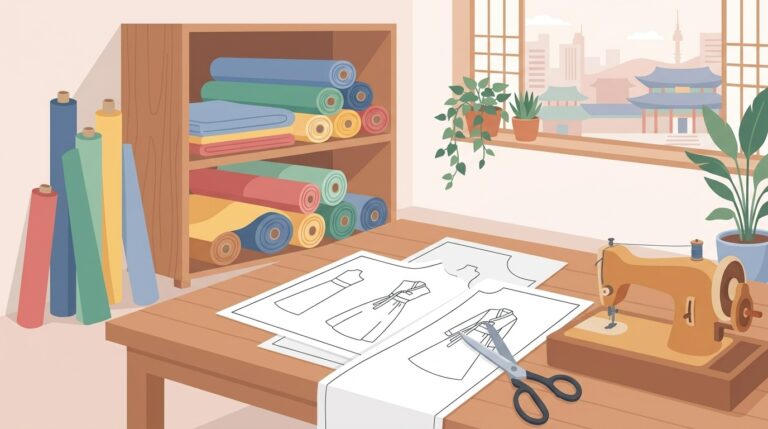
Master the Seoul Runway: Advanced Korean for Pattern Making and Sewing (C1)
Phase 1: Empathy (스토리 몰입형 오프닝)
안녕하세요! 매일한글 에디터입니다. (Hello! This is your Daily Hangul Editor.)
Imagine walking into a bustling, historic garment factory in Changsin-dong, Seoul—the heart of Korea’s legendary fast-fashion ecosystem. Steam irons hiss, sewing machines hum like high-speed trains, and shelves are stacked with vibrant fabrics destined for the trendy boutiques of Hongdae and Gangnam. You have your masterfully sketched fashion design in hand, but as you approach the seasoned master pattern maker (패턴 장인), your throat tightens.
How do you explain that the seam allowance needs to be exactly 1.5 cm, or that the silk fabric is puckering along the grainline?
If you rely on basic textbook Korean like “바느질이 이상해요” (The sewing is strange), you might get a puzzled look. To collaborate with Seoul’s legendary fashion masters, you need the precise, high-level vocabulary used in real-world ateliers. This guide is based on real feedback from international fashion students in Seoul who successfully transformed their design collaborations from frustrating miscommunications into seamless creative partnerships. Let’s dive into the artisan’s vocabulary!
Phase 2: Key Expressions (핵심 표현 3선 심층 분석)
1. 시접을 주다 (sijeobeul juda)
- Pronunciation: see-jeop-eul joo-da (Sounds like “see-jup” + “eul” + “joo-da”)
- Meaning: To add/leave a seam allowance (Literally: “To give seam allowance”)
- K-Culture Moment: You will hear this constantly in fashion survival K-dramas like Record of Youth (청춘기록) or Fashion King (패션왕), where young designers plead with master tailors to save a garment by adjusting the seam allowances during tight deadlines.
- Editor’s Insight: In standard Korean, “시접” refers to the extra fabric left beyond the seam line. Interestingly, Koreans use the verb “주다” (to give) instead of “남기다” (to leave) or “더하다” (to add). It highlights a spatial mindset where you “grant” extra space to the fabric so it can breathe and drape beautifully.
- Situation Spectrum: Casual (✅) / Semi-formal (✅) / Formal (✅)
- 🤔 Think About It: In English, we “add” or “allow” a seam. In Korean, we “give” (주다) it. How does treating space as a “gift” to the fabric change your physical relationship with fashion design?
2. 식서 방향을 맞추다 (sikseo banghyangeul matchuda)
- Pronunciation: seek-seo bang-hyang-eul mah-choo-da (Sounds like “seek-suh” + “bang-hyang-eul” + “mah-choo-da”)
- Meaning: To align with the grainline/selvage direction
- K-Culture Moment: In behind-the-scenes vlogs of K-pop stylists custom-making stage outfits for groups like BLACKPINK or BTS, you’ll see them meticulously laying out patterns on velvet or silk to ensure the light catches the fabric perfectly. They are obsessing over the 식서 방향.
- Editor’s Insight: “식서” (grainline/selvage) is a highly technical Sino-Korean term (食緖). “맞추다” means to align, match, or adjust. If you don’t align the grainline, the garment will warp after washing. Using this phrase instantly signals to any Korean tailor that you are a highly trained professional.
- Situation Spectrum: Casual (⚠️) / Semi-formal (✅) / Formal (✅)
- 🤔 Think About It: Precision in jargon establishes instant trust. Why do you think specialized subcultures (like fashion) preserve Sino-Korean terminology rather than modernizing it?
3. 우글거리다 (ugeulgeorida)
- Pronunciation: oo-geul-geo-ree-da (Sounds like “oo-gool” + “guh-ree-dah”)
- Meaning: To pucker, wrinkle unevenly, or ripple (fabric/seams)
- K-Culture Moment: An indie fashion designer inspecting a sample garment on a reality audition show, pointing at a poorly tensioned zipper seam and sighing because the fabric is warping.
- Editor’s Insight: This is a classic Korean mimetic word (의태어) that describes a wavy, uneven, or bubbling surface. While “구겨지다” means to be simply wrinkled, “우글거리다” specifically describes the frustrating puckering caused by improper machine tension, wrong needles, or mismatched fabrics.
- Situation Spectrum: Casual (✅) / Semi-formal (✅) / Formal (⚠️)
- 🤔 Think About It: Mimetic words bring tactile and visual sensations to life in Korean. Can you think of an English equivalent that so perfectly describes the specific, annoying rippling of a ruined seam?
Phase 3: Textbook vs. Real Korean (교과서 한국어 vs 진짜 한국어)
Situation A: Pointing out a puckered or warped stitch
- 📖 Textbook: “바느질이 올바르지 않고 비뚤어졌습니다.” (The sewing is incorrect and crooked.)
- 🗣️ 진짜 한국어: “이 부분 봉제가 좀 울었어요.” (I bubun bongje-ga jom ureoss-eoyo. – This part of the sewing puckered/shrunk a bit.)
- 💡 왜 다를까? In professional sewing, Koreans use the verb “울다” (to cry) to describe puckered fabric. When fabric “cries,” it bunches up in sorrow! It sounds incredibly natural and inside-industry compared to the stiff, robotic textbook version.
Situation B: Asking to trim or cut away excess fabric
- 📖 Textbook: “가위로 필요 없는 원단을 자르십시오.” (Cut the unnecessary fabric with scissors.)
- 🗣️ 진짜 한국어: “시접 좀 쳐 주세요.” (Sijeop jom chyeo ju-seyo. – Please trim/slash the seam allowance.)
- 💡 왜 다를까? The verb “치다” (to strike/hit) is used widely in Korean workshops to mean “swiftly cut off” or “trim down” excess pattern paper or fabric. It sounds proactive, fast-paced, and highly experienced.
Phase 4: K-Culture Deep-Dive & Non-Verbal Manners (비언어적 매너)
4-1. 눈치 (Nunchi) & Atelier Etiquette
In Korean fashion workshops, the master pattern makers (패턴사님) or factory owners (사장님) are often older artisans with decades of physical experience. Showing respect while advocating for your design requires high-level 눈치 (situational quick-wittedness):
* The Two-Handed Pattern Handover: When handing over your paper patterns or delicate fabrics, always use both hands. It shows you value their craft and the material.
* Physical Deference: When pointing out an issue, never point aggressively with a finger. Instead, gently tap the fabric with the back of a chalk or a pattern ruler while saying, “이쪽 요척이나 시접을 한 번만 봐 주실 수 있을까요?” (Could you take a quick look at the fabric consumption or seam allowance here?).
4-2. The Soul of Dongdaemun: “Sajangnim” Culture
Korea’s rapid fashion cycle (sometimes taking only 48 hours from sketch to store) relies on the tight-knit relationships in Dongdaemun. When you call an older female sewing master “이모님” (Auntie) or a male pattern master “사장님” (President), you aren’t just using titles; you are entering a pseudo-family network where mutual respect can get your sample made overnight instead of next week!
Phase 5: Interactive Roleplay Scenario (실전 롤플레이 시나리오)
Setting: A brightly lit pattern-making studio in Sindang-dong, Seoul. You (the designer) are reviewing a first-run sample garment with Master Lee (이 사장님), a master tailor with 30 years of experience.
- 이 사장님: “디자이너님, 이번 샘플 패턴대로 한번 짜 봤는데, 실크 원단이라 그런지 끝단이 좀 애매하네.”
(Designer, I tried sewing this sample according to your pattern, but since it’s silk, the hemline is looking a bit awkward.) - You: “아, 사장님! 신경 써 주셔서 감사합니다. 🎭 (Gently inspecting the hem of the dress) 확실히 실크라서 끝단 부분이 조금 우글거리네요.”
(Ah, Master Lee! Thank you for your care. Indeed, because it’s silk, the hem is puckering a bit.) - 이 사장님: “그렇지? 아무래도 이 부분 바느질을 다시 해야 할 것 같아. 시접을 더 넓게 잡아야 하려나?”
(Right? It seems we need to sew this part again. Should we make the seam allowance wider?) - You: “네, 사장님. 뒷부분은 시접을 1.5cm로 넉넉하게 주시고, 바이어스 방향 대신 식서 방향을 맞춰서 다시 재단해 주시면 울지 않을 것 같아요.”
(Yes, Master Lee. If you could give a generous 1.5cm seam allowance in the back and align it with the grainline instead of the bias, I don’t think it will pucker.) - 이 사장님: “오, 역시 디자이너라 그런지 정확히 짚어내네! 그럼 요척(fabric yield)은 괜찮겠어?”
(Oh, as expected of a designer, you pointed it out perfectly! Will the fabric yield be okay then?) - You: “네, 요척은 계산해 보니 충분해요. 번거로우시겠지만 한 번만 더 가봉(basting/fitting) 봐 주실 수 있을까요?”
(Yes, I calculated the yield and it’s sufficient. I know it’s a hassle, but could we do one more fitting/basting check?) - 이 사장님: “좋아! 그럼 요 패턴 수정해서 내일 아침까지 가봉 끝내 놓을게.”
(Great! I’ll modify this pattern and have the basting sample ready by tomorrow morning.) - You: “정말 감사합니다, 사장님! 역시 사장님 손길이 닿아야 옷이 사네요!”
(Thank you so much, Master Lee! Indeed, the clothes only come alive when your hands touch them!)
🔀 Choose Your Next Move!
What do you do when Master Lee suggests reducing the fabric yardage to save costs, but it alters your design drape?
- [Option A] “사장님, 그래도 제 디자인의 드레이프가 중요해서 요척은 그대로 유지해 주세요.”
👉 Feedback (Best): Polite, professional, and clear. You stood your ground while respecting his effort. He will respect your artistic vision. - [Option B] “그냥 대충 돈 아끼게 적게 써서 만들어 주세요.”
👉 Feedback (Bad): “Just use less to save money and make it roughly.” This sounds lazy and dismissive of the garment’s quality. Master Lee might lose enthusiasm. - [Option C] “아무렇게나 해 주세요. 사장님이 전문가시잖아요.”
👉 Feedback (Risk): Letting the master decide everything might seem respectful, but in Korea’s fashion industry, a designer who doesn’t take responsibility for their design is seen as unprofessional.
Phase 6: 10-Second Shadowing Drill (10초 감정 섀도잉 드릴)
Let’s practice speaking with the precise cadence, pauses, and emotional nuances of a confident professional designer. Read aloud emphasizing the slash points / for breath and rhythm!
- [🔥 Professional & Direct]
“사장님, / 이 부분은 / 식서 방향을 맞춰서 / 재단해 주셔야 / 안 울어요.”
(Sa-jang-nim, / i bu-bun-eun / seek-seo bang-hyang-eul mah-choo-sheo / jae-dan-hae joo-shyeo-ya / an oo-reo-yo.) -
[🥺 Polite, showing appreciation and requesting adjustments]
“바쁘시겠지만, / 시접을 / 조금만 더 / 쳐 주실 수 있을까요?”
(Ba-ppeu-shee-get-jee-man, / see-jeop-eul / jo-geum-man deo / chyeo joo-shil soo iss-eul-kka-yo?)
Phase 7: K-Culture Mini Dictionary (핵심 키워드 4개)
- 가봉 (Ga-bong) | Fitting/Basting
- Temporary sewing with loose stitches to check the fit on a model or mannequin before final stitching. Vital for custom clothes.
- 요척 (Yo-cheok) | Fabric Yield/Consumption
- The exact amount of fabric required to construct one garment. Calculating this accurately saves massive production costs.
- 마킹 (Ma-king) | Pattern Layout/Marking
- The process of drawing or arranging pattern pieces on fabric before cutting. Doing this poorly leads to massive fabric waste.
- 시야게 (Si-ya-ge) | Finishing/Ironing (Workshop Jargon)
- Derived from Japanese, this industry slang refers to the final pressing, thread-trimming, and quality check before a garment is packed.
Phase 8: Traveler’s Survival Kit (여행자를 위한 생존 키트)
Survival Expressions for Fashion Lovers
- Expression 1: “이 원단은 어떤 바늘을 써야 하나요?” (I won-dan-eun eo-tteon ba-neul-eul sseo-ya ha-na-yo?)
- 👉 Pro Tip: Use this at Dongdaemun retail shops when buying tricky fabrics like velvet, stretch, or silk.
- Expression 2: “샘플 제작비는 얼마예요?” (Saem-peul jae-jak-bee-neun eol-ma-yeo-yo?)
- 👉 Pro Tip: Ask this early to avoid “foreigner tax” in production houses.
- Expression 3: “시접 여유분 좀 더 남겨 주세요.” (See-jeop yeo-yu-bun jom deo nam-gyeo joo-seyo.)
- 👉 Pro Tip: Useful when ordering custom-tailored suits or dresses in Itaewon.
🗺️ Editor’s Travel Note: Conquering Dongdaemun Shopping Complex
If you are hunting for materials, download the 네이버 지도 앱 다운로드 (Naver Map App) to find Dongdaemun Shopping Complex (동대문종합시장).
* Pro-tip: The complex is huge, stretching from Buildings A to D. For high-end garment patterns and trims, head straight to the 2nd and 3rd floors. Note that many shop owners may not list prices, so keep your translation app open and show extreme respect (존댓말) to get the best wholesale deals!
Phase 9: One Step Deeper (생각 질문)
In the world of Korean fashion manufacturing, you will often hear a mixture of standard Korean, English loanwords, and older Japanese-influenced workshop jargon (like 시야게 for finishing, 아다라시 for new, or 오바록 for overlock). This linguistic mosaic reflects Korea’s rapid modernization. Older artisans who rebuilt the nation’s textile economy in the 1970s and 80s passed down these terms to a highly globalized younger generation of designers. Thus, speaking this professional dialect is not just about fashion; it is about honoring the history of Korean labor and modernization.
💬 Your Turn: How does the jargon of your country’s traditional industries reflect its historical transitions? Share your thoughts in the comments below!
Phase 10: FAQ & Common Mistakes (FAQ Schema)
Q: Why do Korean pattern makers prefer the term “가봉” over “피팅”?
A: While “피팅” (fitting) is widely understood, “가봉” (basting/temporary sewing) specifically implies the physical stage of adjusting temporary cotton or muslin mockups. Saying “가봉” sounds much more technically grounded and respectful of their specific labor.
Q: Can I use “울다” (to cry) for any fabric wrinkle?
A: No. “울다” is specifically for unintentional warping or puckering along sewn seams due to poor stitch tension or fabric misalignment. For general wrinkles from wear, use “구겨지다” (to get wrinkled).
Q: What is the best way to address an older craftsman in a Korean sewing factory?
A: Always address males as “사장님” (Sa-jang-nim – President) or “패턴사님” (Pae-teon-sa-nim – Pattern Maker), and females as “사장님” or “이모님” (I-mo-nim – Auntie) if you have built a warm relationship. Never call them by their first names.
🚨 Common Mistakes Alert!
| Mistake | Why it’s bad | Correct Action |
|---|---|---|
| Saying “바느질이 틀렸어요” (The sewing is incorrect) | Sounds accusing and offensive to an artisan’s decades of work. | Say “봉제가 조금 울었네요” (The sewing has puckered slightly). |
| Demanding “빨리 해 주세요” (Do it quickly) | Disrupts the delicate process of pattern balance and ruins relationships. | Say “일정이 조금 급한데, 최대한 맞춰 주실 수 있을까요?” |
| Pointing with feet or scissors | Highly disrespectful non-verbal behavior in Korean culture. | Use both hands to present patterns and point gently with a chalk tail. |
Phase 11: Action Mission & K-Culture Challenge
Action Mission 3-Steps
- Bronze: Write down “시접을 주다” and “식서 방향” in your sketchbook and practice saying them 3 times.
- Silver: Take a photo of a piece of clothing you own that has a puckered seam, post it on social media, and label the issue in Korean using “우글거리다” or “울다”. (Tag #DailyHangul!)
- Gold: Visit a local Korean sewing or alteration shop (수선집) and ask: “시접 여유가 얼마나 남아 있나요?” (How much seam allowance is left?).
🎮 K-Culture Mission
Watch a fashion-themed K-drama (like Now, We Are Breaking Up or Fashion King) and try to spot the moment when a character is frantically adjusting paper patterns or screaming about “가봉” (fitting) deadlines!
Phase 12: Interactive Quiz Challenge (인터랙티브 퀴즈)
Test your knowledge to see if you are ready for the Seoul Fashion Week backstage!
1. Situation Quiz
You noticed the side seam of a satin dress is rippling awkwardly after being sewn. What should you tell the tailor?
* A) 시접을 다 잘라 주세요.
* B) 옆선 봉제가 좀 울었어요.
* C) 식서 방향을 다 없애 주세요.
2. Fill-in-the-blank
“원단의 사선 방향 대신, 형태를 유지하기 위해 방향을 맞춰서 재단해 주세요.”
(Instead of the bias direction of the fabric, please align with the [blank] direction to maintain the shape.)
3. True or False
In Korean sewing jargon, “바느질이 울다” means the thread is literally crying tears because it is wet. (T/F)
🎉 Click to Reveal Answers & Explanations!
- Answer: B
- Explanation: “울다” (to cry/pucker) is the perfect industry term for wavy, rippling seams on delicate fabrics like satin.
- Answer: 식서 (Sik-seo / Grainline)
- Explanation: Aligning the grainline (식서 방향) prevents warp distortion.
- Answer: False
- Explanation: It’s a colorful metaphor describing fabric that gathers or puckers unevenly, looking like tear trails on a face!







