

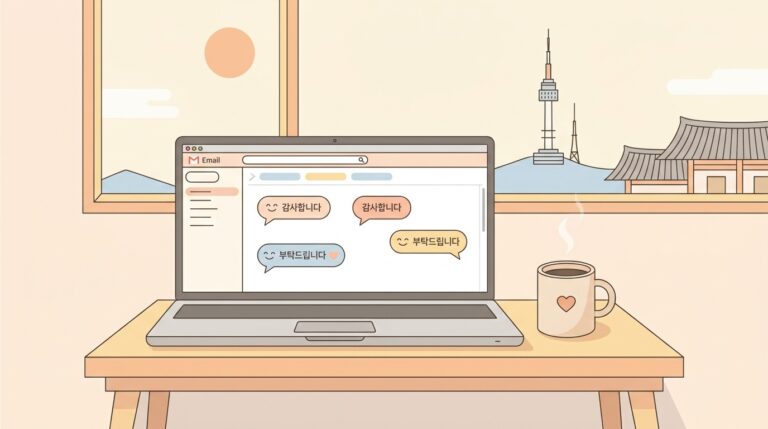
The Art of Saying ‘No’ in Korean Business: How to Reject Politely Without Burning Bridges
Phase 1: Empathy (공감 – Connection & Storytelling)
안녕하세요! Your friendly K-culture navigator and Daily Hangul senior editor is here!
Imagine this: You are working at a sleek, high-rise office in Teheran-ro, Seoul’s Silicon Valley. Your email inbox dings. It’s an eager proposal from an external partner company. They want to launch a joint project immediately. However, your team has reviewed the budget, and the answer is a clear “no.”
You open a new draft. You translate “We reject this proposal” directly using a translator tool, and it outputs: “이 제안을 거절합니다.”
Stop right there!
If you send that, you might hear a metaphorical glass shattering across the Han River. In Korean business culture, saying “No” directly can feel incredibly harsh, almost like a personal rejection. It breaks the harmony (화합 – Hwahap) and can permanently damage professional relationships.
But don’t worry! Today, we are going to unlock the secrets of “쿠션어” (Cushion Words)—the ultimate linguistic pillows that soften bad news. By the end of this guide, you will be writing polite rejection emails that actually strengthen your professional network, showing off your high-level “Nunchi” (눈치 – situational intuition). Let’s dive in!
Phase 2: Deep Dive into 3 Essential Expressions (핵심 표현 심층 분석)
1. ~기 어려울 것 같습니다 (It seems difficult to…)
- Pronunciation: [~gi eo-ryeo-ul geot gat-seum-ni-da] (Sounds like: gee uh-ryuh-ool gut gat-sum-nee-da)
- Meaning: Literally “It seems to be difficult to…”, but used in business as a polite “We cannot do this.”
- K-Culture Moment: Think of K-Dramas like Misaeng (Incomplete Life) or Start-Up. When a junior manager has to tell a supplier they can’t meet a deadline, they don’t say “We can’t.” They sigh politely and say, “이번에는 조율하기 어려울 것 같습니다” (It seems difficult to coordinate this time).
- Editor’s Insight: Koreans rarely say “안 됩니다” (No/Impossible) in business. Instead, they frame it as a “difficulty” (~기 어렵다) paired with the softening ending “~것 같습니다” (It seems like). This shifts the tone from a harsh refusal to an objective challenge.
- Situation Spectrum:
- Casual: 🚫 (Too formal for close friends)
- Semi-formal: ⚠️ (Can be used with senior colleagues face-to-face)
- Formal: ✅ (Perfect for emails and corporate negotiations)
- 🤔 Think About It: Why does saying “it seems difficult” feel more comfortable than saying “we cannot”? How does this reflect the Korean cultural value of maintaining mutual comfort (체면 – saving face)?
2. 아쉽게도 이번에는… (Regrettably, this time…)
- Pronunciation: [a-swip-ge-do i-beon-e-neun…] (Sounds like: ah-sheep-geh-doh ee-bun-eh-noon)
- Meaning: “Regrettably/Unfortunately, this time…”
- K-Culture Moment: Often heard in reality shows like Heart Signal or business talk shows. When a panelist has to choose between options and regretfully pass on one, they start with “아쉽게도…”.
- Editor’s Insight: This phrase does magic. By adding “이번에는” (this time), you are implying that while this opportunity didn’t work out, future collaborations are still highly possible. It keeps the door open and leaves a warm impression.
- Situation Spectrum:
- Casual: ✅ (Used when canceling plans with friends: “아쉽게도 이번 주말은 안 돼!”)
- Semi-formal: ✅
- Formal: ✅ (Excellent opening cushion for a rejection email)
- 🤔 Think About It: How does adding “this time” change the psychological impact of a refusal?
3. 너른 양해 부탁드립니다 (We ask for your broad understanding)
- Pronunciation: [neo-reun yang-hae bu-tak-deu-rim-ni-da] (Sounds like: nuh-roon yahng-hae boo-tahk-dum-nee-da)
- Meaning: “We request your generous understanding/forbearance.”
- K-Culture Moment: You’ll see this phrase printed on posters in Seoul Metro stations when a line is undergoing maintenance, or in official emails from major companies like Samsung or Naver when their service is temporarily down.
- Editor’s Insight: “양해” (Yang-hae) is a beautiful Korean concept meaning “to understand someone else’s difficult situation with a warm heart.” By asking for “너른” (broad/generous) understanding, you are treating the recipient as a magnanimous partner.
- Situation Spectrum:
- Casual: 🚫 (Way too formal for daily life)
- Semi-formal: ⚠️
- Formal: ✅ (Standard ending sentence for polite rejections)
- 🤔 Think About It: How does asking for “understanding” rather than “pardon” shift the dynamic between two business entities?
Phase 3: Textbook Korean vs. Real-World Korean (교과서 한국어 vs. 진짜 한국어)
Scenario A: Rejecting a partnership offer
- 📖 Textbook Style:
“저희는 당신의 제안을 거절합니다.”
[Jeo-hui-neun dang-sin-ui je-an-eul geo-jeol-ham-ni-da.]
(We reject your proposal. – Ouch! This sounds incredibly cold and aggressive.) - 🗣️ Real-World Style:
“내부 사정상 이번 제안은 진행하기 어려울 것 같습니다.”
[Nae-bu sa-jeong-sang i-beon je-an-eun jin-haeng-ha-gi eo-ryeo-ul geot gat-seum-ni-da.]
(Due to internal circumstances, it seems difficult to proceed with this proposal this time.) - 💡 Why the difference? Real-world Korean business relies on “내부 사정” (internal circumstances) as a neutral shield. It shifts the blame from “we don’t like your offer” to “our current situation doesn’t allow it,” protecting everyone’s feelings.
Scenario B: Declining an invitation to an event
- 📖 Textbook Style:
“시간이 없어서 못 갑니다.”
[Si-gan-i eop-seo-seo mot gam-ni-da.]
(I cannot go because I don’t have time. – Sounds dismissive and rude.) - 🗣️ Real-World Style:
“선약이 있어 아쉽게도 참석이 어려울 것 같습니다.”
[Seon-yak-i is-seo a-swip-ge-do cham-seok-i eo-ryeo-ul geot gat-seum-ni-da.]
(Regrettably, due to a prior engagement, it seems difficult for me to attend.) - 💡 Why the difference? Using “선약” (prior engagement) is the gold standard of polite excuses. Even if you just want to rest at home, it shows respect by implying you wanted to attend but are bound by duty elsewhere.
Phase 4: K-Culture Deep Dive & Written Etiquette
4-1. Written Nunchi (눈치) & Cushion Words
In western business culture, clarity and brevity are often prioritized. However, in Korean written business communication, “Nunchi” (situational awareness) reigns supreme. When writing a rejection email, you must use Cushion Words (쿠션어) to pad the impact.
* Common Cushion Words:
* 죄송하오나… (I am sorry, but…)
* 모처럼 제안해 주셨는데… (Though you made this valuable proposal…)
* 너그러이 양해해 주신다면… (If you would generously understand…)
4-2. The “Sandwich Technique” in K-Drama Corporate Life
If you watch Korean dramas set in corporate offices (like What’s Wrong with Secretary Kim or Agency), you’ll notice that bad news is always sandwiched between layers of compliment and future hope.
1. The Top Bun (Appreciation): Thank them warmly for their interest and effort.
2. The Meat (Softened Rejection): Use “어려울 것 같습니다” with a vague reason (internal scheduling, budget limits).
3. The Bottom Bun (Future Promise): Express hope for next time and wish them success.
Phase 5: Real-World Roleplay Scenario (실전 롤플레이 시나리오)
Setting: Min-jun (Project Manager at a trendy K-Beauty brand) receives an email from Sarah (International Marketing Agency) proposing a costly influencer campaign. Min-jun must decline due to budget cuts.
🎭 The Dialogue
- Min-jun:
“안녕하세요, 사라님. 보낸 주신 제안서 잘 검토했습니다.”
[An-nyeong-ha-se-yo, Sa-ra-nim. Bo-naen ju-sin je-an-seo jal geom-to-haet-seum-ni-da.]
(Hello, Sarah. We have carefully reviewed the proposal you sent.)
(🎭 Typing politely with a warm, respectful smile) -
Sarah:
“네, 감사합니다! 우리 제안이 마음에 드셨기를 바랍니다.”
[Ne, gam-sa-ham-ni-da! U-ri je-an-i ma-eum-e deu-syeot-gi-reul ba-ram-ni-da.]
(Thank you! I hope you liked our proposal.)
(🎭 Leaning forward with expectation) -
Min-jun:
“네, 제안 내용이 정말 혁신적이고 훌륭했습니다. 브랜드 이미지와도 아주 잘 맞고요.”
[Ne, je-an na-yong-i jeong-mal hyeok-sin-jeok-i-go hul-lyung-haet-seum-ni-da. Beu-raen-deu i-mi-ji-wa-do a-ju jal mat-go-yo.]
(Yes, the content was truly innovative and excellent. It fits our brand image very well.)
(🎭 Setting the positive tone first – the “Top Bun”) -
Sarah:
“아, 다행이네요! 그럼 이번 분기에 같이 진행할 수 있을까요?”
[Ah, da-haeng-i-ne-yo! Geu-reom i-beon bun-gi-e ga-chi jin-haeng-hal su is-seul-ka-yo?]
(Ah, thank you! Then can we proceed together this quarter?)
(🎭 Brimming with hope) -
Min-jun:
“아쉽게도 현재 저희 예산 상황상, 당장 진행하기는 조금 어려울 것 같습니다.”
[A-swip-ge-do hyeon-jae jeo-hui ye-san sang-hwang-sang, dang-jang jin-haeng-ha-gi-neun jo-geum eo-ryeo-ul geot gat-seum-ni-da.]
(Regrettably, due to our current budget situation, it seems a bit difficult to proceed immediately.)
(🎭 Softening the blow with an apologetic, calm voice) -
Sarah:
“아… 예산 조율이 전혀 불가능할까요?”
[Ah… ye-san jo-yul-i jeon-hyeo bul-ga-neung-hal-ka-yo?]
(Ah… is budget adjustment completely impossible?)
(🎭 Looking slightly disappointed but professional) -
Min-jun:
“죄송합니다. 이번 분기 예산이 확정되어 조율이 어렵습니다. 모처럼 좋은 제안을 주셨는데 아쉬운 마음이 큽니다.”
[Joe-song-ham-ni-da. I-beon bun-gi ye-san-i hwak-jeong-doe-eo jo-yul-i eo-ryeo-p-seum-ni-da. Mo-cheo-reom jo-eun je-an-eul ju-syeot-neun-de a-swi-un ma-eum-i keum-ni-da.]
(I apologize. Since this quarter’s budget is fixed, adjustment is difficult. We highly value your great proposal, so we feel very regretful as well.)
(🎭 Speaking with deep sincerity and bowing head slightly) -
Sarah:
“이해합니다. 아쉽지만 어쩔 수 없네요. 다음 기회에 꼭 함께해요!”
[I-hae-ham-ni-da. A-swip-ji-man eo-jjeol su eop-ne-yo. Da-eum gi-hoe-e kkok ham-kke-hae-yo!]
(I understand. It’s a pity, but it cannot be helped. Let’s definitely work together next time!)
(🎭 Smiling warmly, feeling respected)
🔀 Interactive Choice: What should Min-jun do next?
Scenario: Sarah replies asking if they can schedule a short call to discuss future possibilities for next quarter. How should Min-jun respond?
- Option A: “시간이 나면 연락드릴게요.” (I’ll contact you when I have time.)
- Option B: “네, 다음 분기 일정이 잡히는 대로 먼저 연락드리겠습니다. 남겨주신 자료는 잘 보관하겠습니다.” (Yes, as soon as next quarter’s schedule is set, I will contact you first. We will keep your materials safe.)
- Option C: “지금은 바빠서 전화가 곤란합니다.” (I’m busy now, so a call is difficult.)
[Feedback Hub]
- Option A (Risk): Too vague and sounds a bit like a brush-off. While common in casual settings, in business, it lacks professional warmth.
- Option B (Best – 100% Core Hit!): Perfect! It gives a concrete action (“next quarter’s schedule”), shows appreciation (“keep materials safe”), and maintains a strong bridge for future partnership.
- Option C (Bad): Extremely blunt. Saying “I’m busy now” directly in a business email sounds highly unprofessional and dismissive.
Phase 6: 10-Second Emotion Shadowing Drill (10초 감정 섀도잉 드릴)
Let’s practice reading these cushion phrases with the perfect pitch and pauses. Pay attention to the slash / marks, which indicate short pauses to let the emotion sink in!
- [🥺 Deeply Apologetic and Regretful Tone]
“아쉽게도 / 이번에는 / 함께하지 못하게 되었습니다.”
[A-swip-ge-do / i-beon-e-neun / ham-kke-ha-ji mot-ha-ge doe-eot-seum-ni-da.]
(Regrettably / this time / we are unable to work together.) -
[💼 Highly Professional but Soft Tone]
“너른 양해 / 부탁드립니다.”
[Neo-reun yang-hae / bu-tak-deu-rim-ni-da.]
(We ask for your / broad understanding.) -
[😊 Appreciative yet Firm Tone]
“모처럼 제안해 주셨는데 / 죄송합니다.”
[Mo-cheo-reom je-an-hae ju-syeot-neun-de / joe-song-ham-ni-da.]
(Though you made this valuable proposal / I am sorry.)
Phase 7: K-Culture Mini Dictionary (K-Culture 미니 사전)
- 반려 (Ban-ryeo) | Rejection / Return
- Usage: Used internally when a superior rejects a report or plan. “부장님께서 내 기획안을 반려하셨어” (The general manager rejected my proposal).
- 보류 (Bo-ryu) | Put on hold / Postpone
- Usage: A very safe word to use when you don’t want to say a flat “No.” “이 안건은 일단 보류하는 것으로 하겠습니다” (We will put this agenda on hold for now).
- 양해 (Yang-hae) | Understanding / Forbearance
- Usage: Asking the other party to understand your difficult situation. Often paired with “구하다” (to seek) or “부탁하다” (to request).
- 피드백 (Pi-deu-baek) | Feedback
- Usage: Highly used in Korean modern offices. Koreans expect quick feedback, even if it is a polite rejection. Leaving someone hanging is worse than saying no.
Phase 8: Traveler & Business Survival Kit (비즈니스 서바이벌 키트)
Survival Expressions TOP 3
- “메일로 다시 연락드리겠습니다.”
- Pronunciation: [Me-il-lo da-si yeon-rak-deu-ri-get-seum-ni-da.]
- Pro Tip: Use this at the end of a meeting when you need to make a tough decision or say ‘No’ in writing rather than face-to-face.
- “다음 기회에 꼭…”
- Pronunciation: [Da-eum gi-hoe-e kkok…]
- Pro Tip: The ultimate polite parting phrase. It means “Let’s definitely do this next time!”
- “검토해 주셔서 감사합니다.”
- Pronunciation: [Geom-to-hae ju-syeo-seo gam-sa-ham-ni-da.]
- Pro Tip: “Thank you for reviewing.” Use this when rejecting an applicant or a supplier politely.
Editor’s Travel Note: Business in Seoul 🚇
If you are visiting Seoul for a business trip, exchanging business cards (명함 – Myeong-ham) is your first step. Always hand and receive cards with both hands, read the card carefully, and place it on the table during the meeting—never shove it into your pocket immediately!
* Useful App Recommendation: To keep track of all your Korean contacts, use the 리멤버 (Remember) 명함 관리 앱 (Remember Business Card App). It is the absolute standard in Korea for digital business card storage.
* Note: App interface and features may change over time according to developer updates.
Phase 9: “One Step Deeper” (한 발 더 깊이)
Korean business communication is deeply rooted in high-context communication (고맥락 소통) and harmony (화합). In many Western cultures, being clear and direct is considered a virtue and a sign of respect for the other person’s time.
However, in Korea, directness can sometimes be perceived as a lack of effort or care. By spending extra lines in your email to explain why (indirectly) you cannot proceed, and expressing sincere regret, you are showing the other person that you respect their effort and value their dignity (체면). A good rejection email in Korea is not just about delivering a decision; it is about preserving the relationship for the next five years.
💬 Your Turn:
How do business rejections work in your home country? Would using indirect expressions like “~기 어려울 것 같습니다” (It seems difficult) be viewed positively or negatively in your professional environment? Let’s talk in the comments below!
Phase 10: FAQ & Common Mistakes (자주 묻는 질문 & 실수 방지)
FAQ
Q: Can I just write “죄송합니다만 거절하겠습니다” to make it simple?
A: We strongly recommend avoiding the word 거절하겠습니다 (I will reject). In Korean, the verb “거절하다” is extremely strong and personal. It sounds like you are turning down a beggar. Instead, use passive or soft terms like 진행이 어려울 것 같습니다 (It seems difficult to proceed) or 양해를 구합니다 (We ask for your understanding).
Q: What does “내부 사정” (internal circumstances) mean exactly? Do I need to explain the details?
A: No, you don’t! That’s the beauty of this phrase. “내부 사정” is a universally accepted corporate code word. It could mean budget cuts, sudden strategy shifts, or simply that the boss didn’t like the plan. By saying “내부 사정상…”, you politely signal that the details are confidential, and Koreans will instinctively respect that boundary.
Q: Is it okay to use emojis in Korean business emails?
A: For traditional corporate environments (conglomerates, finance), avoid emojis like ^^ or ㅠㅠ. Stick to polite honorifics. However, if you are working with casual IT startups or marketing agencies, using a simple, polite tilde (~) or a friendly smiley (~^^) is occasionally acceptable to soften the tone, but use them sparingly!
🚨 Common Mistakes Dashboard (주의해야 할 흔한 실수)
| Incorrect Expression (X) | Why it’s a mistake | Correct Action (O) |
|---|---|---|
| “못 합니다.” (I can’t do it) | Sounds rebellious or extremely lazy. | “일정상 조율이 어려울 것 같습니다.” (It seems difficult to coordinate due to the schedule) |
| “싫습니다.” (I don’t like it) | Unbelievably rude in a business context. | “저희 브랜드 방향성과 다소 차이가 있습니다.” (It has some differences with our brand direction) |
| “제안을 거절합니다.” (I reject the proposal) | Destroys the business relationship instantly. | “이번에는 아쉽게도 인연을 맺지 못하게 되었습니다.” (Regrettably, we are unable to form a partnership this time) |
Phase 11: Action Mission & K-Culture Challenge
Are you ready to practice your new professional Korean skills? Take on today’s mission!
- 🥉 Bronze Mission: Copy the sentence “아쉽게도 이번에는 어려울 것 같습니다” (Regrettably, it seems difficult this time) into your notes app and practice pronouncing it 3 times.
- 🥈 Silver Mission: Write a mockup 3-sentence rejection email in the comments section below using our “Sandwich Technique.” We will personally review and give you feedback!
- 🥇 Gold Mission: Next time you have to decline a request from a Korean colleague or partner, use the phrase “양해를 구합니다” (We ask for your understanding) in your email.
🎮 K-Culture Mission
Watch a single episode of any office-themed K-drama (like Misaeng, My Mister, or What’s Wrong with Secretary Kim). Try to find at least one scene where a character declines an offer or delivers bad news to their boss. Listen carefully to how they soften their voice and what cushion words they use!
Phase 12: Interactive Quiz Challenge (인터랙티브 퀴즈 챌린지)
Test your business Korean Nunchi! Click on the tabs below to reveal the answers.
1. Situation Judgment Quiz
You received a collaboration request from a firm. You must decline it because of budget issues. Which is the most appropriate sentence to write in your email?
* A) 돈이 없어서 거절합니다.
* B) 이번 제안은 예산 사정상 진행이 어려울 것 같습니다.
* C) 예산 조율은 귀사가 알아서 하세요.
👉 Click to see the Answer & Explanation
Correct Answer: B
- Explanation: A is too blunt and sounds unprofessional (“We reject because we have no money”). C is very aggressive (“You handle the budget adjustment yourself”). B uses “예산 사정상” (due to budget circumstances) and “어려울 것 같습니다” (it seems difficult), which is the perfect polite formula!
2. Fill-in-the-Blank
Complete the standard polite closing sentence:
“너른 _______ 부탁드립니다.” (We ask for your broad understanding.)
- A) 반려
- B) 양해
- C) 거절
👉 Click to see the Answer & Explanation
Correct Answer: B (양해 – Yang-hae)
- Explanation: “너른 양해 부탁드립니다” is the fixed collocated phrase used across all Korean business sectors to ask for understanding. “반려” means rejection, and “거절” means refusal, neither of which fit here!
3. True or False?
In Korean business, it is best to be as direct as possible when saying “No” so that the other party doesn’t waste their time. (True / False)
👉 Click to see the Answer & Explanation
Correct Answer: False
- Explanation: While saving time is important, preserving relationship harmony (화합) and saving face (체면) are highly prioritized in Korea. Direct refusals are considered rude. Softening the rejection with cushion words is the professional norm!
Stay tuned for our next episode of Daily Hangul, where we will unlock the secrets of networking at Korean team dinners (회식)! 다음에 또 만나요! 👋







