

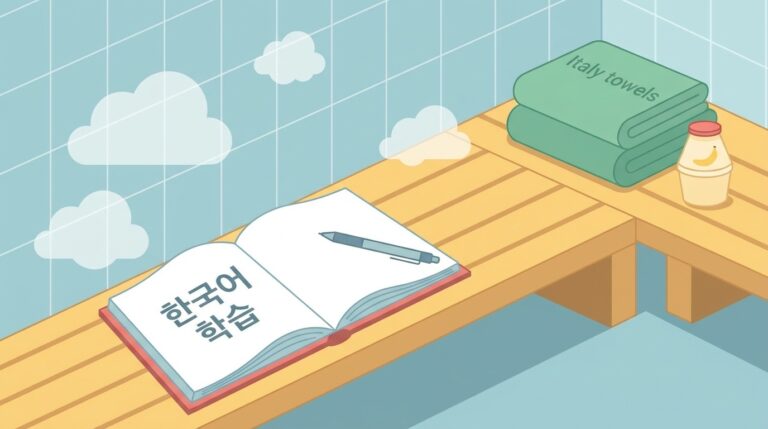
Surviving the Korean Bathhouse: How to Talk to a Scrub Master Like a Pro
Phase 1: Empathy (안녕하세요! Welcome to the Steamy World of K-Saunas!)
안녕하세요! (Annyeonghaseyo!) Hello, my lovely language learners! It’s your favorite local culture guide and Senior Editor from Daily Hangul.
Picture this: You are standing inside a beautiful, steamy Korean bathhouse (Mokgyoktang – 목욕탕). You’ve managed to navigate the locker room, and you’re enjoying the warm, soothing waters. But then, you see it: the legendary green vinyl table where the Ttemiri (때밀이 – Scrub Master) works their magic. You want to try the world-famous exfoliating scrub to get baby-soft skin, but you feel completely frozen. What if they scrub too hard? How do I ask them to go easy on me? What do I say when it’s time to flip over?
If your heart starts racing just thinking about this, don’t worry! You are definitely not alone. Many of our intermediate (B1) students tell us that talking to a Korean Scrub Master is one of the most intimidating real-world experiences in Korea. But here is the secret: once you learn just three simple phrases and understand the non-verbal body language of the sauna, you will transform this nerve-wracking moment into your absolute favorite self-care ritual. Let’s dive into the steam and learn together!
Phase 2: Deep-Dive Expressions (The Sauna Survival Trio)
1. 살살 해주세요 (Salsal hae-juseyo)
- Pronunciation: Sal-sal hae-ju-se-yo (Think of saying “sal-sa” like the dance, but softer, twice: sal-sal)
- Meaning: “Please do it gently/softly.”
- K-Culture Moment: You will often see this phrase in Korean variety shows (like Running Man) when members get a painful sports massage and beg the therapist to stop hurting them.
- Editor’s Insight: The word 살살 (salsal) is a beautiful Korean mimic word (mimetic word) that describes doing something with very light, gentle friction or pressure. If the scrub master’s iconic green “Italy towel” feels a bit too much like sandpaper on your skin, say this immediately with a warm smile. They will adjust their pressure instantly!
- Situation Spectrum: Casual (⚠️ 살살 해줘 – only for close friends) | Semi-formal (✅ 살살 해주세요 – Perfect for service workers) | Formal (🚫 살살 해주십시오 – Too stiff for a bathhouse!)
- 🤔 Think About It: Does your native language have a specific word that means “doing something with light, vibrating pressure” like salsal?
2. 시원해요 (Siwon-haeyo)
- Pronunciation: She-won-hae-yo
- Meaning: “It’s refreshing!” / “It feels amazing!”
- K-Culture Moment: In K-Dramas, you will often see older Korean men drinking a steaming bowl of spicy soup or sitting in a boiling hot bath while sighing deeply and saying, “Ah~ siwon-hada!“
- Editor’s Insight: This is one of the most culturally fascinating words in Korean. While the dictionary says 시원하다 (siwon-hada) means “to be cool/chilly,” Koreans use it to describe physical relief from heat, muscle tension, or even spicy food! Saying this to your scrub master is the ultimate compliment—it means their pressure is perfect and your muscle tension is melting away.
- Situation Spectrum: Casual (✅ 시원해) | Semi-formal (✅ 시원해요) | Formal (⚠️ 시원합니다)
- 🤔 Think About It: Why do you think Korean culture connects the physical sensation of heat/pressure with the concept of “coolness” and psychological relief?
3. 아파요 (Apayo)
- Pronunciation: Ah-pah-yo
- Meaning: “It hurts!”
- K-Culture Moment: The universal word for pain! You’ll hear it in almost every drama when a character stubs their toe, gets a papercut, or receives an injection at the clinic.
- Editor’s Insight: Do not suffer in silence! Scrub masters are absolute professionals, but everyone’s skin sensitivity is different. If you feel pain, say 아파요 clearly. It is not rude at all; it helps the specialist protect your skin barrier.
- Situation Spectrum: Casual (✅ 아파) | Semi-formal (✅ 아파요) | Formal (🚫 아픕니다)
- 🤔 Think About It: In your culture, is it considered polite or impolite to tell a massage therapist or service provider that they are hurting you?
Phase 3: Textbook Korean vs. Real-Life Korean
Let’s compare the stiff expressions you might find in an old textbook with the natural language used on the bathhouse floor.
Situation 1: Ordering the body scrub service
- 📖 Textbook style: “제 피부의 때를 밀어주십시오.” (Je pibu-ui tte-reul mireo-jutsipsio)
- Why it’s weird: This sounds like a scientific request or a robotic command from a sci-fi movie.
- 🗣️ Real-Life style: “때밀이 할게요.” (Ttemiri halgeyo) or “세신 받을게요.” (Sesin badeulgeyo)
- 💡 Why it’s better: 세신 (Sesin) is the formal, elegant word for “body wash/scrub” usually written on the bathhouse service menus, while 때밀이 (Ttemiri) is the friendly, everyday word everyone uses. Both sound natural and polite!
Situation 2: Expressing your satisfaction
- 📖 Textbook style: “마사지가 아주 만족스럽습니다.” (Masaji-ga aju manjokeureopsumnida)
- Why it’s weird: It sounds like you are writing a formal business review rather than relaxing.
- 🗣️ Real-Life style: “어우, 너무 시원해요!” (Eou, neomu siwon-haeyo!)
- 💡 Why it’s better: Adding the natural exclamation 어우 (Eou – Wow/Oh) makes you sound exactly like a local who is truly enjoying the relaxing experience.
Phase 4: K-Culture Deep-Dive & Non-Verbal Manners
4-1. The Art of “Nunchi” (눈치) & Bathhouse Body Language
In a Korean bathhouse, actions speak louder than words. Here are two critical non-verbal cues you must know:
1. The “Slap” Signal (찰싹! – Chal-ssak!): When you are lying on the scrub table, you do not need to ask when to turn over. The scrub master will gently slap the table or slap your thigh. This is not aggression! It is the universal, efficient sign to flip over like a pancake. Just roll over relaxed!
2. Be a Wet Noodle: Do not try to help the scrub master by lifting your own arms or legs. They are incredibly strong and have mastered the physics of leverage. Keep your body completely limp and relaxed.
4-2. The “Naked Friendship” (목욕탕 정 – Mokgyoktang Jeong)
In Korea, bathing together is a deep bonding experience. There is a special concept called 목욕탕 정 (Mokgyoktang Jeong)—the warm communal affection built through shared vulnerability. When you remove your clothes, you also remove your social status, expensive brands, and job titles. Everyone is equal in the bathhouse. This is why many Koreans go to the bathhouse with their parents, children, or closest friends to talk about life.
Phase 5: Real-Life Roleplay Scenario
Meet Yumi (유미), a brave traveler, and Auntie Kim (김 이모), a legendary Scrub Master with 20 years of experience at a local neighborhood bathhouse in Seoul.
[Setting: A steamy, green-tiled wet room. Yumi is waiting nervously near the vinyl table.]

김 이모: 손님, 여기 누우세요. 머리는 이쪽으로 하시면 돼요.
        (Sonnim, yeogi nu-useyo. Meori-neun iccheog-euro hasimyeon dwayo.)
        "Customer, please lie down here. Put your head on this side."

유미: 🎭 [Lies down flat on the table, trying to relax her tense shoulders]
      네, 이모님. 잘 부탁드립니다.
      (Ne, imonim. Jal butakdeurimnida.)
      "Yes, Auntie. I'm in your hands. (Please take good care of me.)"

김 이모: 🎭 [Splashes warm water over Yumi's body and puts on the green mitts]
        물 온도 괜찮아요? 자, 시작하겠습니다~
        (Mul ondo gwaenchannayo? Ja, sijakhagesseumnida~)
        "Is the water temperature okay? Alright, let's begin!"

유미: 🎭 [Fears the friction but finds it surprisingly warm]
      네, 온도 딱 좋아요!
      (Ne, ondo ttak joayo!)
      "Yes, the temperature is just perfect!"

김 이모: 🎭 [Starts scrubbing Yumi's arm with vigorous, rhythmic strokes]
        살성이 좋네! 안 아파요?
        (Salseong-i jonne! An apayo?)
        "You have great skin texture! Doesn't it hurt?"

유미: 🎭 [Feels the scrub getting slightly too intense near her collarbone]
      앗, 조금 아파요. 여기는 살살 해주세요.
      (At, jogeum apayo. Yeogi-neun salsal hae-juseyo.)
      "Ah, it hurts a little. Please do it gently here."

김 이모: 아이고, 미안해요! 내가 힘이 좀 세지? 이제 어때요?
        (Aigo, mianhaeyo! Naega him-i jom seji? Ije eotteyo?)
        "Oh dear, I'm sorry! I'm a bit strong, aren't I? How about now?"

유미: 🎭 [Sighs with deep physical relief]
      우와, 이제 진짜 시원해요! 감사합니다.
      (Uwa, ije jincca siwon-haeyo! Gamsahamnida.)
      "Wow, now it feels absolutely amazing! Thank you."
🔀 Choose Your Path! What would you do next?
- A) Keep your muscles tense and try to lift your arm to help the Auntie scrub.
- Feedback: Risk! Auntie Kim will tell you to relax your body. Tense muscles actually make the scrubbing feel more painful and make it harder for her to do her job.
- B) Relax like a wet noodle, and flip over immediately when you hear the gentle “찰싹” (slap) on the table.
- Feedback: Best! You have mastered the silent language of the Korean bathhouse. Auntie Kim will smile and praise your sauna manners!
- C) Suffer through the pain without saying anything because you don’t want to seem weak.
- Feedback: Bad. Your skin might turn red and get irritated. Remember, Korean scrub masters want you to communicate so they can give you the best experience!
Phase 6: 10-Second Shadowing Drill
Let’s practice speaking with real Korean emotion! Use the pause markers (/) and pay attention to the emotional guides.
- [🥺 Nervous but polite]
- 저… / 조금만 / 살살 해주세요.
- Jeo… / jogeum-man / salsal hae-juseyo.
- “Um… please / just a little / do it gently.”
- [😊 Deep, satisfying physical relief]
- 어우~ / 진짜 / 너무 시원해요!
- Eou~ / jincca / neomu siwon-haeyo!
- “Oh wow~ / truly / it feels so refreshing!”
Phase 7: K-Culture Mini Dictionary
- 때밀이 (Ttemiri) / 세신사 (Sesinsa): The professional scrub master. Ttemiri is colloquial, while Sesinsa is the professional job title.
- 이태리타월 (Italy Towel): The iconic, coarse viscose mitt. Fun fact: It was invented in Korea in the 1960s using imported viscose fabric from Italy, hence the name!
- 목욕탕 (Mokgyoktang): Traditional neighborhood public bathhouses focusing strictly on washing, soaking, and scrubbing.
- 바나나우유 (Banana Uyu): Sweet banana milk. Drinking a cold, sweet banana milk right after sweating and scrubbing is the ultimate, sacred Korean ritual.
Phase 8: Traveler’s Survival Kit
Survival Phrases TOP 3
- 뜨거운 물에 20분 불렸어요. (Tteugeoun mul-e isipbun bullyeosseoyo.)
- Pro Tip: Tell this to the scrub master. It means: “I soaked in the hot tub for 20 minutes.” (This tells them your dead skin is ready to roll off easily!)
- 얼굴은 빼고 해주세요. (Eolgul-eun ppaego hae-juseyo.)
- Pro Tip: “Please skip my face.” Use this if you have sensitive facial skin or want to avoid exfoliating your face.
- 감사합니다! 진짜 개운해요. (Gamsahamnida! Jincca gaeun-haeyo.)
- Pro Tip: “Thank you! I feel incredibly clean/refreshed.” This makes the scrub master’s day!
🗺️ Editor’s Travel Note
Before heading out, make sure to use Naver Map App to search for local bathhouses near your accommodation using the keywords 목욕탕 (Mokgyoktang) or 사우나 (Sauna).
Note: Operating hours and admission prices (usually between 8,000 KRW to 15,000 KRW) may change depending on the season and location.
Phase 9: “One Step Deeper” (A Slice of Korean Life)
In Western cultures, sharing naked spaces can sometimes feel vulnerable or awkward. However, in Korea, it is a form of deep emotional cleansing. By leaving your clothes behind, you also shed the armor of daily worries, ego, and social pressure. The scrub master is not looking at your body shape; they look at your skin with the eye of an artist looking at a canvas. It is a space of pure, non-judgmental care.
💬 Your Turn: Would you be brave enough to try a traditional Korean body scrub? Or have you already tried one? Let us know in the comments below!
Phase 10: FAQ & Common Mistakes
Q: Do I need to bring my own soap and towels to the bathhouse?
A: Most bathhouses provide communal soap and small towels (usually free for men, and a small rental fee for women). However, for the body scrub service, you do not need to bring anything; the scrub master will use their own professional tools.
Q: Is it okay to go if I have tattoos?
A: While some traditional bathhouses used to be hesitant, modern Korean bathhouses and Jjimjilbangs are generally very welcoming to foreigners with tattoos. Just behave politely, and you will have a wonderful experience.
Q: How much should I tip the scrub master?
A: Tipping is not a part of Korean culture! You pay for the service at the bathhouse counter (or directly to the scrub master at their desk inside), and no extra tip is expected. A warm “감사합니다!” (Thank you!) is the best tip you can give.
🚨 Common Mistakes Warning Board
- Mistake 1: Trying to get a scrub without soaking first.
- Correct Action: You must soak in the hot tub (온탕 – Ontang) for at least 15–20 minutes before your scrub. Otherwise, your skin is too dry, and scrubbing will hurt!
- Mistake 2: Standing up immediately when the scrub is done.
- Correct Action: Your blood pressure might be slightly low after lying down in a warm room. Sit up slowly, rest for a moment, and then stand up.
- Mistake 3: Shaving your body right before going to the sauna.
- Correct Action: Avoid shaving for 2-3 days before a scrub. The scrub master’s towel will irritate freshly shaved skin.
Phase 11: Action Missions
- 🥉 Bronze Mission (Solo Practice): Stand in front of your bathroom mirror and practice saying “살살 해주세요!” (Please do it gently!) out loud three times with different facial expressions.
- 🥈 Silver Mission (SNS Share): Take a photo of a banana milk bottle (or any refreshing drink you love after a hot bath) and share it on Instagram. Tag us
@DailyHangulwith the hashtag#Siwonhaeyo! - 🥇 Gold Mission (Real World): Visit a traditional Korean bathhouse during your next trip, successfully book a Sesin (세신) service, and use at least one phrase we learned today!
-
🎮 K-Culture Mission: Watch a clip of a Korean variety show featuring a Jjimjilbang scene and try to spot the green Italy towels! Can you hear anyone saying 시원하다?
Phase 12: Interactive Quiz Challenge
Test your new Korean sauna knowledge! Click the boxes below to reveal the answers.
1. What does “살살” (Salsal) mean in the phrase “살살 해주세요”?
👉 Click to reveal the answer
Answer: Gently / Softly. Use this when the scrub master is rubbing a bit too hard!
2. When the scrub master gently slaps the table or your leg, what should you do?
👉 Click to reveal the answer
Answer: It is the non-verbal signal to flip over! Keep your body relaxed like a wet noodle and roll over.
3. True or False: You should shave your skin right before getting a Korean scrub to make it easier for the scrub master.
👉 Click to reveal the answer
Answer: False! Shaving creates micro-cuts on your skin, which will sting and burn during the exfoliating scrub. Skip shaving for a few days before your sauna visit!
Keep practicing, stay warm, and see you in our next cultural adventure! 안녕! (Goodbye!)







