

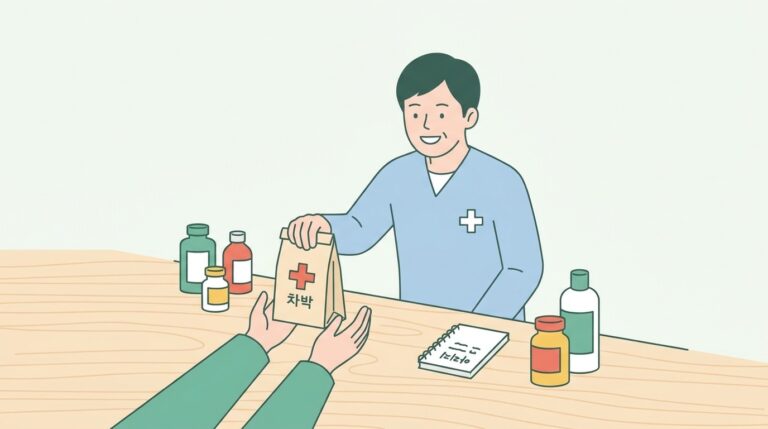
How to Navigate Korean Pharmacies Like a Local: OTC vs. Prescription Rules
Phase 1: Empathy (Your Late-Night Seoul Rescue Story)
안녕하세요! Welcome back to Daily Hangul! It’s your favorite local editor and cultural navigator here.
Imagine this: You’ve just finished an incredible, spicy late-night tteokbokki and fried chicken feast in Hongdae. But as you head back to your accommodation, your stomach starts churning. You walk into a brightly lit store with a big red ‘약‘ (Yak) sign. You want to quickly grab some powerful stomach medicine and perhaps a strong painkiller, just like you would from a supermarket shelf back home.
But wait! You look around and see no aisles stacked with medicine. Instead, there’s a pharmacist looking at you from behind a high counter, ready for a chat.
Navigating healthcare in a foreign country can be intimidating, especially when you are feeling under the weather. Many of our intermediate learners have shared that they felt quite nervous asking for medicine in Korean, fearing they might get the wrong dosage or sound impolite. Don’t worry! Today, we are going to master the difference between 일반 의약품 (OTC) and 전문 의약품 (Prescription Drugs) so you can confidently walk into any Korean pharmacy and get exactly what you need. Let’s dive in!
Phase 2: Deep Dive into 3 Key Expressions
1. 처방전 없이 살 수 있어요? (Can I buy this without a prescription?)
- Pronunciation: Cheo-bang-jeon eop-si sal su is-seo-yo? (Think of “chuh-bang-jun” rhyming with “June”, “up-she” for eopsi, and “sal su itt-uh-yo”)
- Meaning: Can I buy this without a prescription?
- K-Culture Moment: In K-dramas, you often see characters rushing to the pharmacy to buy medicine for a feverish friend or a love interest. They ask this exact question to check if they need to find an open clinic first.
- Editor’s Insight: In Korea, the division between OTC and prescription drugs is strictly monitored. If you ask this, the pharmacist will instantly know whether they can hand you the medication directly or if you need to go to a nearby clinic (병의원) first.
- Situation Spectrum:
- Casual (to close friends): 처방전 없이 살 수 있어? (⚠️)
- Semi-formal (to the pharmacist): 처방전 없이 살 수 있어요? (✅)
- Formal (business/official): 처방전 없이 구매가 가능합니까? (✅)
- 🤔 Think About It: Why do you think Korea strictly separates clinic visits from purchasing certain medicines compared to your home country?
2. 증상이 어떠세요? (What are your symptoms?)
- Pronunciation: Jeung-sang-i eo-tteo-se-yo? (Think of “jeung-sang-ee” followed by “uh-tteo-seh-yo”)
- Meaning: What are your symptoms?
- K-Culture Moment: The moment you step up to a Korean pharmacy counter, the pharmacist won’t just ask “What do you want?” They will kindly ask for your symptoms to recommend the best targeted OTC remedy.
- Editor’s Insight: Korean pharmacists act as highly accessible primary health consultants. Instead of just picking a random box of cold medicine, explaining your specific symptoms allows them to hand you a customized combination of medicines.
- Situation Spectrum:
- Casual: 증상이 어때? (⚠️)
- Semi-formal: 증상이 어떠세요? (✅)
- Formal: 구체적인 증상을 말씀해 주시겠습니까? (✅)
- 🤔 Think About It: How does having an active medical consultation with a pharmacist change your perspective on taking medication?
3. 처방전 약 조제해 주세요. (Please prepare this prescription medicine.)
- Pronunciation: Cheo-bang-jeon yak jo-je-hae ju-se-yo. (Pronounce “jo-je” as “jo-jay”)
- Meaning: Please fill this prescription.
- K-Culture Moment: Walking into a pharmacy right next to a busy hospital with a paper prescription slip in hand, placing it on the counter with both hands.
- Editor’s Insight: The verb 조제하다 (jojehada) means to compound or prepare medicine. When handing over your paper 처방전 (prescription) from a doctor, this phrase makes you sound incredibly natural and respectful.
- Situation Spectrum:
- Casual: 처방약 좀 지어줘 (⚠️)
- Semi-formal: 처방전 약 조제해 주세요. (✅)
- Formal: 처방전에 따라 조제 부탁드립니다. (✅)
- 🤔 Think About It: In Korea, prescription pills are often packed into customized, sealed daily plastic packets. How does this compare to getting a full plastic bottle of loose pills?
Phase 3: Textbook Korean vs. Real Korean
Let’s compare stiff, textbook-style Korean with the warm, natural phrases that locals actually use in pharmacies.
Situation 1: Asking for Painkillers
- 📖 Textbook Korean: “진통제를 원합니다.” (Jintongjereul wonhamnida. / I want painkillers.)
- 🗣️ Real Korean: “머리가 아파서 그러는데, 진통제 좀 주시겠어요?” (Meoriga apaseo geureoneunde, jintongje jom jusigesseoyo? / My head hurts, so could I get some painkillers?)
- 💡 Why the difference? Directly saying “I want X” can sound a bit demanding in Korean. Locals always state their symptom first using “~아/어서 그러는데” (Since it is X…) to soften the request and explain why they need it.
Situation 2: Dealing with Indigestion
- 📖 Textbook Korean: “소화 불량이 있습니다.” (Sohwa bullyangi isseumnida. / I have indigestion.)
- 🗣️ Real Korean: “체한 것 같아서 소화제 좀 사려고요.” (Chehan geot gataseo sohwaje jom saryeogoyo. / I think I have indigestion, so I’d like to buy some digestive medicine.)
- 💡 Why the difference? While 소화 불량 (indigestion) is a medical term, Koreans almost always use the native word 체하다 (to have food stuck/indigestion) in daily conversations. Saying “체한 것 같다” sounds much more natural!
Phase 4: K-Culture Deep Dive & Non-verbal Manners
4-1. Nunchi & Gestures
- Two-Handed Respect (두 손): Always hand over your prescription slip or cash/credit card with both hands, and receive your medicine with both hands as well. This shows deep respect for the pharmacist.
- Physical Gestures: If you struggle with Korean medical terms, don’t worry! Lightly touching the area that hurts (e.g., rubbing your temples for a headache, or patting your chest for heartburn) while using intermediate filler words like “속이…” (My stomach…) is highly intuitive and appreciated.
4-2. Culture Code: “Ppalri-Ppalri” (Fast-Fast) and Medicine
Korea’s healthcare system is famous for being incredibly fast. If you visit a local clinic, you can see a doctor, get diagnosed, walk next door to a pharmacy, hand over your 처방전, and walk out with your compounded medicine in under 15 minutes! Because of this fast-paced culture, pharmacists expect you to state your symptoms clearly and efficiently.
Additionally, due to Korea’s beloved late-night eating culture (야식문화), over-the-counter digestive drinks (like 활명수 – Hwalmyeongsu) are practically a national staple and are treated like magic potions for any heavy meal.
Phase 5: Interactive Roleplay Scenario
Setting: A local pharmacy called “건강약국” (Health Pharmacy) in Hongdae. You are talking to a friendly, experienced pharmacist named Min-su.
Min-su (Pharmacist): 🎭 (Smiling warmly) 어서 오세요. 어디가 불편하세요?
                     (Welcome! Where does it feel uncomfortable?)

You: 🎭 (Rubbing your stomach) 어제 저녁부터 속이 좀 안 좋고 소화가 안 돼요.
     (My stomach has been a bit upset and I've had indigestion since yesterday evening.)

Min-su: 🎭 (Nodding sympathetically) 아, 체하신 것 같네요. 열도 좀 나시나요?
         (Ah, it sounds like you have indigestion. Do you have a fever too?)

You: 🎭 (Shaking your head) 열은 안 나는데, 머리가 조금 지끈거려요.
     (No fever, but my head is throbbing a bit.)

Min-su: 🎭 (Reaching for the medicine shelf) 그럼 소화제랑 약한 진통제 같이 드릴게요. 혹시 다른 약 드시는 거 있으세요?
         (Then I'll give you digestive medicine and a mild painkiller together. By any chance, are you taking any other medicine?)

You: 🎭 (Answering clearly) 아니요, 먹는 약은 없어요. 이거 처방전 없이 살 수 있는 거죠?
     (No, I'm not taking anything else. I can buy this without a prescription, right?)

Min-su: 🎭 (Handing over a small bag with both hands) 네, 이건 일반 의약품이라 처방전 없이 구매 가능해요. 식사 후에 한 알씩 드세요.
         (Yes, these are over-the-counter medicines, so they are available without a prescription. Take one pill after meals.)

You: 🎭 (Receiving the bag with both hands) 감사합니다. 얼마예요?
     (Thank you. How much is it?)
🔀 Your Turn! What will you say next?
- Option A: “혹시 더 센 약은 없나요? 처방전 받아와야 해요?” (Is there stronger medicine? Do I need to get a prescription?)
- Feedback: Best! You are showing active interest in the system and checking if a clinic visit is required for stronger medication (전문 의약품).
- Option B: “그냥 타이레놀만 주세요.” (Just give me Tylenol.)
- Feedback: Risk. Tylenol is great for pain, but ignoring the pharmacist’s custom advice for your indigestion might prolong your stomach pain.
- Option C: “약국 말고 편의점 갈래요.” (I’ll go to the convenience store instead of the pharmacy.)
- Feedback: Bad. Convenience stores only carry basic, limited emergency medicines (안전상비의약품). For a targeted consultation, sticking with the pharmacist is highly recommended!
Phase 6: 10-Second Emotion Shadowing Drill
Let’s practice speaking with local emotional nuances! Pay attention to the pauses (/) and try to mimic the emotions in the brackets.
- “머리가 / 지끈거리는데 / 진통제 좀 / 주세요.” [🥺 Painful and tired tone]
- (My head is throbbing, so please give me some painkillers.)
- “이거 / 처방전 / 있어야 / 살 수 있나요?” [🤔 Curious and polite tone]
- (Do I need a prescription to buy this?)
Phase 7: K-Culture Mini Dictionary
- 일반 의약품 (Ilban uiyakpum): OTC Medicine. You can buy these directly from any pharmacy without a doctor’s visit.
- 전문 의약품 (Jeonmun uiyakpum): Prescription Medicine. High-strength or specialized medicines that legally require a doctor’s diagnosis.
- 처방전 (Cheobangjeon): Prescription Slip. The paper document given to you by a doctor to hand to your pharmacist.
- 안전상비의약품 (Anjeonsangbi-uiyakpum): Emergency Medicine. Basic drugs (like Tylenol or basic digestive pills) sold in 24-hour convenience stores when pharmacies are closed.
Phase 8: Traveler’s Survival Kit
Top 3 Survival Phrases
- 감기약 주세요. (Gamgiyak juseyo.) – Please give me cold medicine.
- 연고랑 대일밴드 주세요. (Yeongorang daeilbaendeu juseyo.) – Please give me ointment and band-aids.
- 물약으로 주세요. (Mulyageuro juseyo.) – Please give it to me in liquid form. (Great for fast absorption!)
🧭 Editor’s Travel Note
Before heading out, make sure to download the Naver Map app to search for the nearest 약 (Yak) sign. While most regular pharmacies close on Sundays, you can look up “휴일지킴이약국” (holiday guard pharmacies) online to find locations open 24/7 or on weekends. Note: Store operating hours may vary, so always double-check the app before walking.
Phase 9: One Step Deeper (Reflecting on Society)
In 2000, South Korea implemented the 의약분업 (separation of prescribing and dispensing drugs). This reform aimed to prevent the overuse of antibiotics and protect public health. This is why you cannot buy strong painkillers or antibiotics directly from a pharmacist anymore. This system shows how much Korean society values collective safety and structured healthcare, backed by highly subsidized national health insurance.
💬 Your Turn: Have you ever experienced getting sick in Korea? How did the pharmacy experience compare to your home country? Let me know in the comments below!
Phase 10: FAQ & Common Mistakes
Q: Can I buy antibiotics over the counter in Korea?
A: No, antibiotics are strictly classified as 전문 의약품 (prescription drugs). You must visit a clinic first to get a prescription.
Q: Where should I go for medicine late at night or on holidays?
A: You can buy basic painkillers, fever reducers, and digestive aids at any 24-hour convenience store under the 안전상비의약품 category.
Q: Do Korean pharmacies accept international credit cards?
A: Yes, almost all pharmacies in Korea accept major international credit cards like Visa and Mastercard.
🚨 Common Mistakes Checklist
- Mistake 1: Asking for strong sleeping pills or narcotics without a prescription. (Pharmacists cannot legally provide them!)
- Mistake 2: Expecting to find medicine on open supermarket shelves. (In Korea, you must talk directly to the pharmacist at the counter.)
- Mistake 3: Forgetting your ID/passport. (If you need to visit a clinic to get a prescription, you will need identification for registration.)
Phase 11: Action Mission
- Bronze Mission: Speak the sentence “처방전 없이 살 수 있어요?” aloud 5 times in front of a mirror.
- Silver Mission: Take a photo of your favorite home remedy or write down the word “약국” on your Instagram/Twitter and tag #DailyHangul!
- Gold Mission: The next time you visit Korea, walk into a pharmacy and ask for a cold medicine completely in Korean using “감기약 좀 주시겠어요?”
-
🎮 K-Culture Mission: Watch an episode of a medical K-drama (like Hospital Playlist or Dr. Romantic) and listen closely for the words “처방전” or “약국”.
Phase 12: Interactive Quiz Challenge
1. Which of the following can you buy WITHOUT a doctor’s prescription?
- A) 항생제 (Antibiotics)
- B) 일반 의약품 (OTC Medicine)
- C) 전문 의약품 (Prescription Medicine)
Reveal Answer & Explanation
Correct Answer: B) 일반 의약품
일반 의약품 refers to over-the-counter medicine that you can buy directly from a pharmacist without a prescription.
2. Fill in the blank:
“머리가 아파서 그러는데, ________ 좀 주시겠어요?” (My head hurts, so could I get some painkillers?)
Reveal Answer & Explanation
Correct Answer: 진통제 (Jintongje)
진통제 means painkiller. Excellent job!
3. True or False: You can buy any type of medicine at a Korean convenience store.
Reveal Answer & Explanation
Correct Answer: False
Convenience stores only sell limited emergency medicines (안전상비의약품) like basic Tylenol or simple digestive aids. For specialized medication, you must visit a pharmacy.







