

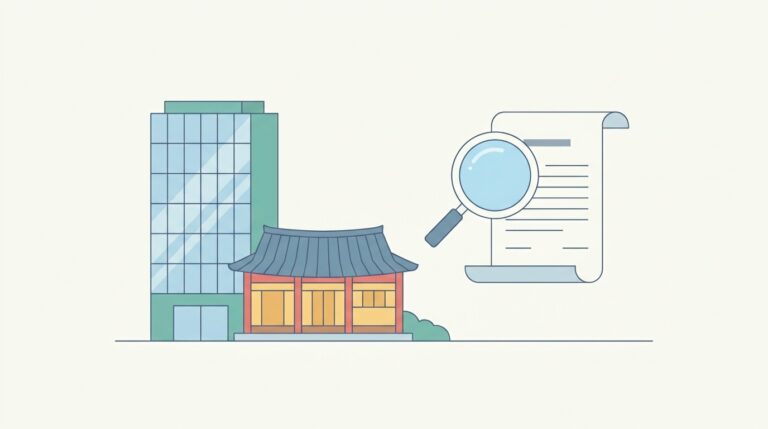
Decoding Korean Redevelopment: Navigate High-Stakes Real Estate Like a Native
Phase 1: Empathy (스토리 몰입형 오프닝)
안녕하세요! Your trusted K-culture and language navigator from Daily Hangul here!
Have you ever watched a K-drama like My Mister (나의 아저씨) or Itaewon Class (이태원 클라쓰) and felt a lump in your throat during those scenes where local business owners are forced to leave their beloved neighborhood because of a massive redevelopment project?
In Korea, real estate is not just about brick and mortar—it is a high-stakes, emotional, and legally complex arena. Whether you are looking to rent a trendy commercial space in Seoul or aiming to invest in a cozy officetel, coming face-to-face with 재개발 (redevelopment) or 재건축 (reconstruction) issues can be incredibly daunting. Many advanced learners feel completely lost when legal jargon starts flying around during contract negotiations.
Don’t worry! This guide is built on real case studies of expats who successfully negotiated their leases amidst urban planning changes. By the end of this post, you will be able to dissect redevelopment clauses like a seasoned investor and protect your hard-earned deposit.
Phase 2: Core Expressions Deep Dive (핵심 표현 3선 심층 분석)
1. 권리금을 회수하다 (gwon-ri-geum-eul hoe-su-hada)
- Pronunciation: gwon-ri-geum-eul hwe-soo-hada (Think of “gwon” like “kwon”-do, “ri” as “re”-read, and “geum” like “goom” with a short ‘oo’).
- Meaning: To recover commercial premium/key money (the intangible value of a commercial space’s location, facilities, and customer base).
- K-Culture Moment: In Itaewon Class, when Danbam is forced to move because of the villainous Jangga Group buying their building, Park Saeroyi had to navigate recovering his premium key money to set up shop elsewhere.
- Editor’s Insight: In Korean commercial leasing, Gwonrigeum (권리금) is often a huge sum. When a building undergoes redevelopment, tenants struggle to “recover” this money from the next tenant because the building is slated for demolition. Knowing how to legally protect and recover this is vital.
- Situation Spectrum: Casual 🚫 | Semi-formal ⚠️ | Formal ✅
- 🤔 Think About It: Does your home country have an equivalent concept to “key money” paid between tenants, or does the landlord control all financial transactions? How does this reflect the community-based commercial culture of Korea?
2. 입주권을 분양받다 (ip-ju-gwon-eul bun-yang-bat-da)
- Pronunciation: ip-joo-gwon-eul boon-yang-baht-da (Think “ip” like “sip” without the ‘s’, “ju” like “joo”-ice, and “gwon” as “kwon”).
- Meaning: To be allocated/granted an apartment occupancy right (the right to obtain a newly built apartment after redevelopment).
- K-Culture Moment: You will hear characters in family-centric K-dramas (like Reply 1988 or The Penthouse) whispering excitedly or arguing fiercely over getting an ip-ju-gwon because it is seen as a golden ticket to overnight wealth.
- Editor’s Insight: An ip-ju-gwon (입주권) is granted to original property owners within the redevelopment zone. It is highly valued because it is much cheaper than buying the apartment after it’s built and open to the public.
- Situation Spectrum: Casual ⚠️ | Semi-formal ✅ | Formal ✅
- 🤔 Think About It: Why do you think apartment ownership is tied so deeply to social status and wealth accumulation in modern Korea?
3. 현금청산 대상이 되다 (hyeon-geum-cheong-san dae-sang-i doe-da)
- Pronunciation: hyeon-goom-cheong-san dae-sang-ee dwe-da (Think “hyeon” like “hyun” Bin, and “cheong” like “chung”-key).
- Meaning: To become subject to cash liquidation/payout (receiving cash compensation instead of a new apartment occupancy right).
- K-Culture Moment: Often the source of dramatic conflict in legal thrillers, where property owners realize they won’t get a shiny new apartment but are instead being “cashed out” at a rate below market value.
- Editor’s Insight: If you do not meet the strict legal criteria to receive an occupancy right (ip-ju-gwon), you are forced into hyeon-geum-cheong-san. This can lead to heavy financial losses if property valuations are low.
- Situation Spectrum: Casual 🚫 | Semi-formal ⚠️ | Formal ✅
- 🤔 Think About It: Imagine your home being demolished and receiving cash instead of a replacement home. How would you calculate the “fair value” of your memories and neighborhood connection?
Phase 3: Textbook vs. Real Korean (교과서 한국어 vs 진짜 한국어)
Scenario 1: Inquiring if a property is in a redevelopment zone
- 📖 Textbook: “이 건물은 재개발 구역에 포함되어 있습니까?” (Is this building included in the redevelopment zone?)
- 🗣️ 진짜 한국어: “여기 혹시 재개발 들어간다는 소문이나 계획이 잡혀 있나요?” (Are there any rumors or solid plans of redevelopment going on around here?)
- 💡 Why the difference? The textbook phrasing sounds like an official audit. Locals and real estate agents (공인중개사) discuss redevelopment in terms of “rumors” (소문) or “plans being caught” (계획이 잡히다) because redevelopment projects can be stalled for decades.
Scenario 2: Expressing concern about losing a deposit due to rebuilding
- 📖 Textbook: “재건축 시 임대차 보증금 반환이 우려됩니다.” (I am concerned about the return of my lease deposit during reconstruction.)
- 🗣️ 진짜 한국어: “나중에 재건축 들어갈 때 보증금 제때 돌려받을 수 있는지 걱정돼서요.” (I\’m just worried about whether I can get my deposit back on time when reconstruction starts later.)
- 💡 Why the difference? The real Korean version uses “제때 돌려받다” (to get back on time) and “걱정돼서요” (because I’m worried), which softens the tone while making your objective crystal clear to the landlord or broker.
Phase 4: K-Culture Deep Dive & Non-verbal Manners (K-Culture 딥다이브)
4-1. Nunchi (눈치) & Body Language in Real Estate
When negotiating real estate in Korea, especially regarding redevelopment, never show too much excitement or desperation.
* The Nod & “Aha” (아~ 예~): When a broker tells you about future redevelopment value, do not nod enthusiastically. Instead, do a slow, contemplative nod while looking slightly downward. This indicates you are doing the math and aren’t easily swayed by hype.
* Eye Contact: Maintain steady, calm eye contact when discussing the 특약사항 (special contract clauses). It signals that you are legally literate and expect complete transparency.
4-2. The “Apartment Republic” (아파트 공화국)
Korea is often called the “Apartment Republic.” Redevelopment (재개발) and Reconstruction (재건축) are the twin engines of Korea\’s urban transformation. Old, cozy villa neighborhoods are constantly demolished to make way for high-rise apartment complexes (단지). Understanding this drive for modernization helps you empathize with landlords who want to reconstruct, but also arms you to protect your rights as a tenant.
Phase 5: Real-life Roleplay Scenario (실전 롤플레이 시나리오)
The Setting
You are at the Daehan Real Estate Office (대한 부동산) in Mapo, Seoul. You are discussing a lease contract with Mr. Kim, a veteran real estate agent (공인중개사) who has seen the neighborhood transform over 30 years.
Characters:
* Mr. Kim (공인중개사 김민수): Friendly, experienced, uses a slightly fast-paced Mapo dialect.
* You (손님): An advanced Korean learner looking to sign a commercial lease.
Dialogue:
- Mr. Kim: “어서 오세요! 아유, 요새 이 동네 마포 쪽 매물 찾기가 하늘의 별 따기예요.”
(Welcome! Oh, these days, finding a property here in Mapo is like plucking a star from the sky.) - You (🎭 걱정스러운 표정으로): “네, 사장님. 그런데 여기 혹시 나중에 재개발 구역으로 지정되거나 하진 않을까요?”
(Yes, sir. But is there any chance this place might get designated as a redevelopment zone later?) - Mr. Kim: “아이고, 아직 구체적인 계획은 없어요. 조합 설립 추진한다는 얘기만 돌고 있지, 시간 한참 걸려요.”
(Oh, there is no concrete plan yet. There are only rumors about pushing to establish an association, but that takes a long time.) - You (🎭 진지하게 눈을 맞추며): “그래도 계약서 쓸 때 특약사항에 관련 내용을 명시해 두고 싶어서요.”
(Even so, when we write the contract, I want to clearly specify the related terms in the special clauses section.) - Mr. Kim: “에이, 집주인이 그런 깐깐한 특약은 안 넣으려고 할 텐데… 어떤 내용 넣으시려고요?”
(Gee, the landlord might not want to put in such a strict special clause… What kind of terms are you looking to add?) - You (🎭 차분하고 단호한 어조로): “재개발 진행 시 퇴거 조건이랑 권리금 회수 기장 보장이나 보증금 반환 약정을 정확히 적어뒀으면 해요.”
(I’d like to precisely write down the eviction conditions, guaranteed period for recovering key money, and the deposit return agreement in case redevelopment proceeds.) - Mr. Kim (🎭 감탄하며 껄껄 웃는다): “와, 한국 법률 용어를 아주 꿰고 계시네! 알겠어요. 제가 주인분한테 연락해서 중간에서 조율 잘해 볼게요.”
(Wow, you really know your Korean legal terms inside out! Got it. I will contact the landlord and mediate it well for you.) - You (🎭 밝게 웃으며): “네, 사장님만 믿겠습니다. 조율 잘해 주시면 저도 기분 좋게 도장 찍을게요!”
(Yes, sir, I\’ll trust your expertise. If you mediate this well, I\’ll happily sign the contract!)
🔀 Interactive Choice Point
How do you respond if the landlord flatly refuses to add any special clauses regarding redevelopment?
- Option A: “그럼 이 계약은 진행하기 어렵겠네요. 다른 매물 알아봐 주세요.” (Then it will be difficult to proceed with this contract. Please find me another property.)
- Feedback (Best! 🌟): Assertive and professional. In Korea, showing you are willing to walk away keeps you from getting locked into a risky legal situation.
- Option B: “네, 그럼 어쩔 수 없죠. 그냥 집주인분 말씀대로 진행해 주세요.” (Okay, then it can’t be helped. Let’s just go with what the landlord wants.)
- Feedback (Bad! ❌): Very risky. Without a special clause, if redevelopment starts next year, you could lose your entire Gwonrigeum and face sudden eviction.
- Option C: “사장님이 중간에서 집주인분께 밥 한번 사시면서 잘 얘기해 주시면 안 돼요?” (Can\’t you buy the landlord a meal and convince them for me, broker?)
- Feedback (Risk! ⚠️): Highly informal and puts the broker in an awkward professional position. Stick to business-like negotiation.
Phase 6: 10-Second Emotion Shadowing Drill (10초 감정 섀도잉 드릴)
Practice saying this high-stakes sentence with the exact pauses (/) and emotional tone specified!
[🎭 Calm, Firm, and Professional – Imagine protecting your deposit]
“재개발 추진 시 / 임차인의 권리금 회수 기회를 / 방해하지 않는다는 조항을 / 특약사항에 / 꼭 넣어 주세요.”
Pronunciation: Jae-gae-bal choo-jin si / im-cha-in-ui gwon-ri-geum hoe-su gi-hoe-reul / bang-hae-ha-ji an-neun-da-neun jo-hang-eul / teuk-yak-sa-hang-e / kkok neo-eo ju-se-yo.
Translation: In the event of a redevelopment push, please make sure to include a clause in the special terms that does not interfere with the tenant\’s opportunity to recover their key money.
Phase 7: K-Culture Mini Dictionary (K-Culture 미니 사전)
- 조합원 (jo-hap-won) | Cooperative Member / Union Member
- Property owners in a designated redevelopment zone who band together to form a cooperative to manage the construction process.
- 이주비 (i-ju-bi) | Relocation Expenses
- Financial compensation or interest-free loans provided to residents to help them move out temporarily during demolition.
- 비례율 (bi-rye-yul) | Proportional Rate / Valuation Ratio
- A crucial percentage that determines the financial profitability of a redevelopment project for the property owners.
- 알박기 (al-bak-gi) | Holdout / “Egg-driving”
- A slang term for the practice of buying a tiny plot of land in a planned development zone and refusing to sell it to extort an exorbitant price from the developer.
Phase 8: Traveler’s & Expat’s Survival Kit (여행자를 위한 생존 키트)
Survival Phrases TOP 3
- “특약사항에 넣어 주세요.” (teuk-yak-sa-hang-e neo-eo ju-se-yo)
- “Please write this in the special terms section of the contract.”
- “보증금 안전하게 돌려받을 수 있을까요?” (bo-jeung-geum an-jeon-ha-ge dol-ryeo-bat-eul su its-eul-kka-yo?)
- “Will I be able to get my deposit back safely?”
- “등기부등본 확인해 볼게요.” (deung-gi-bu-deung-bon hwa-gin-hae bol-ge-yo)
- “I will check the certified copy of the register.”
Editor’s Real Estate Note 📝
Before signing any lease, always use the Naver Real Estate platform to check average market prices. For legal transparency and to check if a building is slated for demolition, you can access public records on the Seoul Land Information Square portal. Note: Real estate policies and portal layouts are subject to change over time.
Phase 9: One Step Deeper (생각 질문)
In Korea, an apartment is not just a dwelling place; it is the ultimate wealth-building asset. This unique socio-economic landscape means that redevelopment projects are highly politicized and deeply emotional events. While modern apartment complexes offer convenience and clean living, they also erase decades-old neighborhoods and displace communities.
💬 Your Turn: How is gentrification or urban redevelopment viewed in your country? Do tenants have strong legal protections, or does the law favor developers? Let\’s discuss in the comments below!
Phase 10: FAQ & Avoiding Misunderstandings (FAQ & 오해 방지)
Q: What is the difference between 재개발 (redevelopment) and 재건축 (reconstruction)?
A: 재개발 (redevelopment) occurs in areas with poor public infrastructure (narrow roads, old sewer systems) and involves rebuilding the entire neighborhood. 재건축 (reconstruction) is done in areas with good infrastructure where only the specific residential buildings (like old apartment complexes) are rebuilt.
Q: Can a landlord evict me immediately if the building gets approved for reconstruction?
A: No. Under the Korean Housing Lease Protection Act, the landlord must provide proper notice and negotiate relocation. However, if a reconstruction clause was explicitly agreed upon and written into the contract before signing, you may have to vacate according to that schedule.
Q: Is Gwonrigeum (key money) protected by law during redevelopment?
A: Generally, it is very difficult to recover Gwonrigeum from a landlord if the building is demolished. This is why having a specialized lawyer or broker draft protective clauses is highly recommended for commercial tenants.
🚨 Common Mistakes Warning Board
- Mistake: Assuming verbal promises about redevelopment by the broker are legally binding.
- Correct Action: If it’s not written down in the 특약사항 (special clauses), it does not exist in the eyes of the court.
- Mistake: Skipping the check on the 등기부등본 (Property Register) on the day of signing.
- Correct Action: Check it right before signing to ensure no new debt or mortgage has been registered against the property.
- Mistake: Signing a contract that says “임차인은 재건축 시 아무런 조건 없이 퇴거한다” (Tenant leaves without conditions during reconstruction).
- Correct Action: Never sign this. Always negotiate for moving expenses (이주비) or a guaranteed notice period.
Phase 11: Action Mission & Engagement (액션 미션)
- Bronze Medal: Read the Shadowing Drill sentence aloud 3 times, focusing on the
/pause points. - Silver Medal: Comment below with your own sentence using “특약사항에 ~ 넣어 주세요” with a term you want in your dream apartment contract.
- Gold Medal: Share this post on your social media with your answer to the Phase 9 reflection question!
🎮 K-Culture Mission
Watch any K-drama episode involving a real estate dispute and try to spot the word 조합원 (union member) or 알박기 (holdout)! Write the drama title in the comments!
Phase 12: Interactive Quiz Challenge (인터랙티브 퀴즈 챌린지)
1. Which term refers to the right to enter a newly built apartment after redevelopment?
- A) 권리금 (Gwonrigeum)
- B) 입주권 (Ipjugwon)
- C) 이주비 (Ijubi)
2. True or False: If a commercial building is demolished for redevelopment, the landlord is legally obligated to pay the tenant the full Gwonrigeum (key money) back.
- A) True
- B) False
🔍 Click here to reveal the answers and explanations!
- Correct Answer: B) 입주권 (Ipjugwon)
- Explanation: Ipjugwon is the highly coveted occupancy right given to cooperative members to enter the newly built apartments.
- Correct Answer: B) False
- Explanation: The landlord is generally not responsible for returning Gwonrigeum, which is paid between tenants. This is why negotiating special contract clauses is vital to protect your business assets!
- Explanation: The landlord is generally not responsible for returning Gwonrigeum, which is paid between tenants. This is why negotiating special contract clauses is vital to protect your business assets!







