

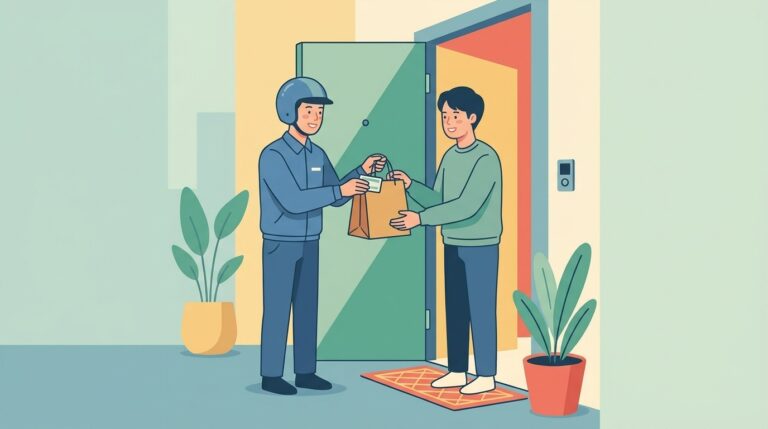
Master Food Delivery in Korea: How to Pay Like a True Local
안녕하세요! Welcome back to another edition of Daily Hangul, your premium guide to real-life Korean language and culture. I’m your chief editor and 10-year local culture navigator.
Have you ever ordered a delicious midnight snack (야식) in Korea, only to freeze when the delivery app asks you how to pay, or when the delivery driver suddenly stands in front of you? We’ve all been there! Trying to figure out payment terms in another language under pressure is a major pain point for many learners. But don’t worry! Today, we are diving deep into the world of Korean Food Delivery Payment (결제하기). By the end of this guide, you will be ordering and paying for your fried chicken or tteokbokki with absolute confidence!
Phase 2: Core Expressions Deep Dive
1. 만나서 결제할게요 (man-na-seo gyeol-je-hal-gae-yo)
- Pronunciation: mahn-nah-suh gyul-jeh-hal-geh-yo (Sounds like “man-na-seo” + “gyul-jae” + “hal-gae-yo”)
- Meaning: I will pay in person (literally: “Let’s meet and pay”).
- K-Culture Moment: You often see this in K-Dramas when the main character runs down to the lobby in comfortable pajamas to swipe their card on the driver’s portable terminal.
- Editor’s Insight: Use this when you don’t have your payment card registered in the app and want to pay the driver directly at your door.
- Situation Spectrum:
- Casual: ✅ | Semi-formal: ✅ | Formal: ⚠️
- 🤔 Think About It: In many Western countries, prepaying online is almost mandatory. Why do you think cash or card payment at the door remains so popular and trusted in Korea?
2. 카드로 할게요 (ka-deu-ro hal-gae-yo)
- Pronunciation: kah-deu-roh hahl-geh-yo (Rhymes with “card-o-rah” + “hal-gae-yo”)
- Meaning: I’ll pay by card.
- K-Culture Moment: The moment the delivery driver holds out the small, wireless card reader (단말기) and you hand over your card with polite excitement.
- Editor’s Insight: This is the most natural and shortest way to tell the driver you want to swipe a credit or debit card instead of paying cash.
- Situation Spectrum:
- Casual: ✅ | Semi-formal: ✅ | Formal: 🚫
- 🤔 Think About It: Koreans rarely carry cash nowadays. Notice how seamlessly card readers are integrated into almost every mobile service!
3. 문 앞에 두고 벨 눌러주세요 (mun ap-e du-go bel nul-reo-ju-se-yo)
- Pronunciation: moon ahp-eh doo-goh bell nuhl-ruh-joo-seh-yo
- Meaning: Please leave it at the door and ring the bell.
- K-Culture Moment: This is the ultimate introverted delivery option! It’s widely used by busy students, remote workers, and anyone wearing their loungewear.
- Editor’s Insight: This is only possible if you chose “선결제” (pre-payment) in the app. It’s safe, convenient, and incredibly fast.
- Situation Spectrum:
- Casual: ✅ | Semi-formal: ✅ | Formal: ⚠️
- 🤔 Think About It: Leaving expensive food outside a door unattended shows a high level of social trust in Korean neighborhoods. What does food delivery look like in your hometown?
Phase 3: Textbook Korean vs. Real Korean
Situation 1: Telling the driver how you want to pay
- 📖 Textbook Korean: “신용카드로 지불하겠습니다.” (sin-yong-ka-deu-ro ji-bul-ha-gess-seup-ni-da. – “I will make a payment with a credit card.”)
- 🗣️ Real Korean: “카드로 결제할게요.” (ka-deu-ro gyeol-je-hal-gae-yo. – “I’ll pay by card.”)
- 💡 Why the difference? The textbook phrase sounds like an official financial report! Real Koreans prefer short, active verbs like “할게요” (I’ll do) or “결제할게요” (I’ll pay) to keep the interaction brief and natural.
Situation 2: Declining the physical paper receipt
- 📖 Textbook Korean: “영수증은 필요하지 않습니다.” (yeong-su-jeung-eun pil-yo-ha-ji ans-seup-ni-da. – “A receipt is not necessary.”)
- 🗣️ Real Korean: “영수증은 안 주셔도 돼요.” (yeong-su-jeung-eun an ju-syeo-do dwae-yo. – “You don’t have to give me the receipt.”)
- 💡 Why the difference? Since payments are recorded digitally on apps, paper receipts are often seen as waste. Saying “안 주셔도 돼요” is a polite, soft way to say “no thank you” without sounding cold.
Phase 4: K-Culture Deep-Dive & Non-Verbal Manners
4-1. Nunchi (눈치) & Hand Gestures
When interacting with delivery workers in Korea, respect is shown through subtle body language:
* The Two-Hand Rule: Always hand over your card or cash and receive the food bag using both hands. If you must use one hand, place your other hand lightly under your elbow or on your chest as a sign of respect.
* The Head Bow: A slight, quick nod of the head along with a smile goes a long way.
4-2. The Golden Age of Baemin (배달의민족)
Korea has arguably the most advanced delivery system in the world. Apps like 배달의민족 (Baemin) and 요기요 (Yogiyo) let you order almost anything 24/7—even to public parks! The cultural speed of “Ppalli-Ppalli” (빨리빨리 – fast-fast) means drivers are highly efficient. Being ready with your card at the door is the best way to respect their busy schedule.
Phase 5: Real-Life Roleplay Scenario
Setting: You are at your Airbnb in Seoul. You just ordered a steaming hot bowl of Jajangmyeon (짜장면) and chose “만나서 결제” (pay in person). The doorbell rings!
- 배달원 (Driver): (Knocks on the door) 배달 왔습니다!
(bae-dal wat-seup-ni-da!)
🎭 Delivery is here! -
나 (You): (Opens the door politely) 아, 감사합니다!
(ah, gam-sa-ham-ni-da!)
🎭 Oh, thank you! -
배달원 (Driver): 만나서 결제 맞으시죠?
(man-na-seo gyeol-je ma-jeu-si-jyo?)
🎭 Pay in person, correct? -
나 (You): 네, 카드로 할게요.
(ne, ka-deu-ro hal-gae-yo.)
🎭 Yes, I will pay by card. -
배달원 (Driver): (Hands over the card terminal) 네, 여기 카드 꽂아주세요.
(ne, yeo-gi ka-deu kko-ja-ju-se-yo.)
🎭 Okay, please insert your card here. -
나 (You): (Inserts the card) 여기요. 됐나요?
(yeo-gi-yo. dwaet-na-yo?)
🎭 Here you go. Is it done? -
배달원 (Driver): 네, 결제 끝났습니다. 영수증 드릴까요?
(ne, gyeol-je kkeun-nat-seup-ni-da. yeong-su-jeung deu-ril-kka-yo?)
🎭 Yes, payment is finished. Would you like a receipt? -
나 (You): 아니요, 괜찮아요. 수고하세요!
(an-i-yo, gwaen-chan-ah-yo. su-go-ha-se-yo!)
🎭 No, it’s okay. Thank you for your hard work!
🔀 Interactive Choice Point
The driver asks: “결제 어떻게 하실 거예요?” (How would you like to pay?)
- Choice A: “카드로 할게요.” (ka-deu-ro hal-gae-yo)
- Choice B: “돈 여기 있어요.” (don yeo-gi is-seo-yo) while tossing the cash onto the table.
- Choice C: “현금 영수증 해주세요.” (hyeon-geum yeong-su-jeung hae-ju-se-yo) when paying by credit card.
Feedback:
- Choice A (Best): Perfect! It’s polite, clear, and makes the transaction fast and smooth.
- Choice B (Bad): While grammatically understandable, tossing money or speaking too casually (“반말”) can come across as highly impolite to the driver.
- Choice C (Risk): “현금 영수증” is a cash receipt for tax deduction purposes. Asking for this when paying by credit card will confuse the driver because it only applies to cash payments!
Phase 6: 10-Second Emotion Shadowing Drill
Let’s practice speaking naturally with the correct emotional rhythm. Pause briefly at the / marks!
- “카드로 / 결제할게요!”
- [😊 Friendly & Ready] ka-deu-ro / gyeol-jae-hal-gae-yo!
- “영수증은 / 괜찮아요!”
- [👋 Polite & Waving off gently] yeong-su-jeung-eun / gwaen-chan-ah-yo!
- “문 앞에 / 두고 가세요!”
- [🤫 Quiet & Courteous whisper] mun ap-e / du-go ga-se-yo!
Phase 7: K-Culture Mini-Dictionary
- 배달 (baedal) | Delivery
- Korea’s massive food delivery culture. You can order everything from coffee to raw fish.
- 선결제 (seon-gyeol-je) | Pre-payment
- Paying online through the app beforehand. Highly recommended for contactless delivery.
- 만나서 결제 (man-na-seo gyeol-je) | Pay in person
- Selecting this option lets you pay with cash or a physical card directly to the driver.
- 단말기 (dan-mal-gi) | Card reader / Terminal
- The small handheld machine the delivery person carries to process card payments.
Phase 8: Survival Kit for Travelers
Survival Phrases TOP 3
- “봉투에 넣어주세요.” (bong-tu-e neo-eo-ju-se-yo) – Please put it in a plastic bag.
- “현금으로 할게요.” (hyeon-geum-eu-ro hal-gae-yo) – I will pay with cash.
- “맛있게 드세요!” (mas-it-ge deu-se-yo) – Enjoy your meal! (Usually said by the driver to you, so you can respond with “감사합니다!”).
📌 Editor’s Travel Note:
To download the most popular local map and payment apps in Korea, search for the official Naver Map App or look up the delivery apps in your app store. Note: Most domestic apps require local phone verification to use in-app pre-payment, so foreign travelers often find “만나서 결제” (paying the driver card/cash in person) to be the easiest option! (Information current as of mid-2024).
Phase 9: “A Step Deeper” (Reflections on Korean Society)
In Korea, food delivery is not just a convenient service; it’s a social fabric. The language used in these short interactions highlights the values of 공동체 (community) and mutual respect. Even in a 5-second interaction at the door, using polite endings like “~요” and bowing slightly shows that you respect the driver’s hard work. It’s a small window into the warm heart of Korean society.
💬 Your Turn: Do you prefer contactless delivery (선결제) or interacting directly with delivery drivers? Leave a comment below and let’s discuss!
Phase 10: FAQ & Common Mistakes
Q: Can I pay with cash when the delivery driver arrives?
A: Yes! When ordering, select “만나서 결제” (pay in person) and prepare your physical Korean Won notes. It is helpful to have exact or close change.
Q: Do I need to tip the delivery driver in Korea?
A: No! Tipping is not a part of Korean culture. The delivery fee (배달팁) is already calculated and paid through the app or added to your total bill.
Q: What should I say if I want the driver to leave the food in the lobby?
A: You can write “로비에 놔주세요” (ro-bi-e nwa-ju-se-yo – Please leave it in the lobby) in the delivery request section.
🚨 Common Mistakes Alert!
- Using “계산해요” (gye-san-hae-yo) at the door: While “계산” means calculation/bill, “결제할게요” (I will make payment) is much more natural when referring to cards/terminals.
- Handing the card with one hand: Handing over your card with one hand can seem disrespectful. Use both hands!
- Shouting “여기요!” excessively: Only use “여기요” politely when handing over your card, not to shout or rush the driver.
Phase 11: Action Missions
- 🥉 Bronze Mission: Practice saying “카드로 결제할게요” out loud 5 times in front of your mirror!
- 🥈 Silver Mission: Share this post on your social media with your favorite Korean food recommendation and tag us!
- 🥇 Gold Mission: The next time you order delivery in Korea, use the phrase “문 앞에 두고 가세요” (Leave it at the door) in your order note!
- 🎮 K-Culture Mission: Watch a modern K-Drama scene featuring food delivery. See if you can spot the two-handed card exchange!
Phase 12: Interactive Quiz Challenge
Try this quick quiz to check your progress!
Q1. Which expression means “I will pay in person”?
1) 선결제할게요
2) 만나서 결제할게요
3) 카드 여기 있어요
Q2. Fill in the blank: “영수증은 __________.” (I don’t need a receipt/You don’t have to give it to me)
Q3. True or False: Tipping delivery drivers is mandatory in Korea.
🎉 Click here to reveal the Answers & Explanations!
- A1 Answer: 2) 만나서 결제할게요 (man-na-seo gyeol-je-hal-gae-yo) is the correct term for paying in person.
- A2 Answer: “안 주셔도 돼요” (an ju-syeo-do dwae-yo) or “괜찮아요” (gwaen-chan-ah-yo).
- A3 Answer: False! Tipping is not practiced in Korea. Doing so might actually confuse the driver!
See you in the next lesson! 맛있는 시간 되세요 (Have a delicious time)!







