

Speak Like an Insider: Mastering Korea’s Hottest Consumer Trend, ‘Value Consumption’
Phase 1: Empathy (스토리 몰입형 오프닝)
안녕하세요! 매일한글(Daily Hangul)의 수석 에디터입니다.
Imagine you are sitting in a stylish cafe in Seongsu-dong (성수동), the hip epicenter of Seoul’s trendsetters. You notice the person next to you holding a unique tumbler. On their laptop, they are reading an article about a small bakery that was recently “punished with money” (돈쭐나다) by passionate netizens after donating bread to local orphans. You want to join the conversation and express your admiration for this ethical consumer phenomenon, but your mind blanks. You know the words for “buying” (구매) and “good” (착한), but how do you articulate complex consumer psychographics, discuss corporate social responsibility (CSR), and call out greenwashing like a sophisticated C2-level native speaker?
This is a common bottleneck for advanced learners. You can navigate daily life flawlessly, but when it comes to expressing nuanced stances on Value Consumption (착한 소비 / 가치 소비) and analyzing how corporate Korea responds to these trends, the textbook vocabulary feels frustratingly dry.
This guide was built specifically based on feedback from our premium C2 learners who wanted to transition from “functional Korean speakers” to “highly articulate, culturally fluent intellectual companions.” Let’s dive deep into the psychology of modern Korean consumers!
Phase 2: 핵심 표현 3선 심층 분석
1. 돈쭐내다 (Don-jjul-nae-da)
- Pronunciation: [Don-jjul-nae-da] (rhymes with “bone-jool-nae-da”)
- Meaning: To punish a business with money (i.e., to deliberately buy out their stock to support their ethical actions; the positive opposite of a boycott).
- K-Culture Moment: In K-Dramas, when a small restaurant owner quietly feeds underprivileged children for free, netizens find out, share the location, and initiate a massive campaign to 돈쭐내다 the store until the owner has to temporarily close due to lack of ingredients!
- Editor’s Insight: This is a brilliant portmanteau of 돈 (money) and 혼내다 (to scold/punish). It showcases the witty, community-driven nature of Korean consumer activism. Instead of merely praising a good deed, Koreans jokingly say, “Let’s teach this owner a lesson with our wallets!”
- Situation Spectrum: Casual (✅) / Semi-formal (✅) / Formal (⚠️ – use ‘소비 운동’ or ‘구매 촉진 운동’ in academic papers)
- 🤔 Think About It: In many Western individualistic societies, ethical consumption is often a personal choice. In Korea, why does it so quickly morph into a collective, viral internet movement?
2. 위장 환경주의 (Wi-jang hwang-gyeong-ju-ui) / 그린워싱 (Geu-rin-wo-sing)
- Pronunciation: [Wi-jang hwang-gyeong-ju-ui] / [Geu-rin-wo-sing]
- Meaning: Greenwashing / Pseudo-environmentalism.
- K-Culture Moment: When a famous Korean cosmetics brand released a “Paper Bottle” product that actually concealed a plastic bottle inside, netizens called them out for 위장 환경주의, forcing the brand to issue an official apology.
- Editor’s Insight: While 그린워싱 is widely used, C2-level speakers who use 위장 환경주의 (literally “disguised environmentalism”) during formal discussions, debates, or corporate meetings immediately project a highly professional, academic aura.
- Situation Spectrum: Casual (✅) / Semi-formal (✅) / Formal (✅)
- 🤔 Think About It: How does your home country’s legal system regulate greenwashing compared to Korea’s highly active netizen-led monitoring?
3. 가치 소비 (Ga-chi so-bi)
- Pronunciation: [Ga-chi so-bi] (sounds like “gah-chee soh-bee”)
- Meaning: Value-based consumption / Belief-driven purchasing.
- K-Culture Moment: This term is a staple in Korean business news, lifestyle magazines, and trendy reality shows where guests visit upcycled fashion boutiques in Seoul.
- Editor’s Insight: Do not confuse this with 착한 소비 (benevolent consumption). While 착한 소비 sounds slightly nostalgic and purely altruistic, 가치 소비 emphasizes the modern consumer’s active projection of their personal values, political stances, and unique identity through their purchases.
- Situation Spectrum: Casual (✅) / Semi-formal (✅) / Formal (✅)
- 🤔 Think About It: Why has expressing personal political and ethical values through everyday products become the ultimate status symbol for the Korean MZ generation?
Phase 3: 교과서 한국어 vs 진짜 한국어
Scenario 1: Expressing your preference for eco-friendly brands
- 📖 교과서 한국어: “저는 환경을 보호하기 위해 친환경 제품을 구매합니다.”
(I purchase eco-friendly products to protect the environment.) - 🗣️ 진짜 한국어: “저는 이왕이면 지구에도 덜 미안한 가치 소비를 지향하는 편이에요.”
(If possible, I tend to pursue value consumption that makes me feel less guilty toward the planet.) - 💡 왜 다를까? C2-level speakers use nuances like 이왕이면 (since we are making a choice anyway) and metaphorical expressions like 지구에 덜 미안한 (being less apologetic to the Earth) instead of dry, robotic verbs.
Scenario 2: Calling out a company’s deceptive marketing campaign
- 📖 교과서 한국어: “그 기업은 거짓으로 친환경 마케팅을 하고 있습니다.”
(That company is doing fake eco-friendly marketing.) - 🗣️ 진짜 한국어: “그 브랜드, 알맹이 없는 보여주기식 마케팅으로 그린워싱 하다가 소비자들에게 제대로 역풍 맞았잖아요.”
(That brand faced a severe backlash from consumers after greenwashing with a hollow, show-off marketing campaign.) - 💡 왜 다를까? Idioms like 알맹이 없는 (hollow / without substance), 보여주기식 (for display only / show-off style), and 역풍을 맞다 (to hit a headwind / face a severe backlash) are what elevate your Korean from upper-intermediate to native-level mastery.
Phase 4: K-Culture 딥다이브 & 비언어적 매너
4-1. 눈치 (Nunchi) & 제스처 (Gestures)
When discussing sensitive topics like corporate boycotts or accusing a brand of greenwashing in a Korean professional setting, raw confrontation is avoided.
* The Softened Hand: When expressing skepticism about a brand’s ethics, do not point fingers. Instead, raise your hand slightly with your palm facing upward, tilting your head about 5 degrees while saying, “글쎄요, 제 생각에는…” (Well, in my opinion…).
* The Head Tilt and Sigh: To show disappointment in a brand you once loved, a subtle sigh accompanied by a slow shake of the head conveys a deep sense of betrayal (뒤통수 맞은 느낌) without sounding overly aggressive.
4-2. 문화 코드 분석 (Culture Code)
In Korea, the rapid transition to digital delivery services (배달 문화) during the pandemic created a massive sense of collective guilt regarding plastic waste. This gave rise to the 용기내 챌린지 (Yong-gi-nae Challenge). This is a brilliant pun! 용기 means both “courage” and “container.” The movement encourages consumers to “take courage” and bring their own reusable “containers” to restaurants and cafes. High-level speakers who understand this cultural pun can instantly connect with environmentally conscious locals.
Phase 5: 실전 롤플레이 시나리오
🎭 Characters:
- 민호 (Min-ho): Brand Manager of a major cosmetics company in Seoul. Pragmatic, but highly sensitive to consumer trends.
- 지원 (Ji-won): An experienced C2-level Global ESG Consultant (You!). Insightful, articulate, and culturally fluent.
Scenario:
Meeting at a corporate lounge in Gangnam to discuss the brand’s new sustainable packaging strategy.
- 민호: 지원 씨, 요즘 MZ 세대를 타겟으로 친환경 패키지를 준비 중인데, 솔직히 단가가 너무 올라서 고민이에요. 꼭 이렇게까지 해야 할까요?
- 지원:
🎭 (잔잔하게 미소를 지으며 잔을 내려놓는다)요즘 소비 트렌드를 보면 가치 소비가 단순히 일시적인 유행이 아니라 하나의 문화로 자리 잡았거든요. 단가 걱정은 이해하지만, 장기적으로 보면 필수적이에요. - 민호: 하지만 제품력이 좋으면 소비자들은 결국 사지 않을까요? 굳이 패키지에 친환경을 입힐 필요가 있나 싶어서요.
- 지원:
🎭 (눈을 맞추며 부드럽게 고개를 젓는다)그렇지 않아요. 요즘 스마트한 소비자들은 브랜드의 진정성을 소비하거든요. 만약 단순히 매출만을 위해 ‘보여주기식’ 마케팅을 했다간 금방 그린워싱으로 낙인찍힐 수 있어요. - 민호: 그린워싱이요? 저희는 나름대로 종이 튜브를 쓰려고 계획 중인데요?
- 지원:
🎭 (진중한 표정으로 목소리 톤을 낮춘다)종이 튜브 안쪽에 비닐 코팅을 두껍게 처리한다면, 그게 바로 위장 환경주의의 전형적인 사례가 되는 거죠. 소비자들이 배신감을 느끼는 순간, 순식간에 불매운동으로 이어질 수 있습니다. - 민호: 아… 역시 겉모양만 친환경으로 꾸미는 건 리스크가 너무 크겠네요.
- 지원:
🎭 (신뢰감 주는 미소를 지으며 고개를 끄덕인다)맞습니다. 오히려 정직하게 과정을 공개하고 진정성 있게 소통하면, 소비자들이 자발적으로 ‘돈쭐’을 내주는 든든한 아군이 되어줄 거예요.
🔀 인터랙티브 분기점 (Interactive Choice)
How should Ji-won respond to Min-ho’s next question: “그럼 구체적으로 첫 단추를 어떻게 꿰어야 할까요?” (Then, how should we take the first step?)
- Option A: “최대한 비싼 친환경 소재를 쓰고 가격을 대폭 올리세요.” (Use the most expensive eco-friendly materials and raise the price significantly.)
- Option B: “환경 이슈는 민감하니 그냥 안전하게 조용히 아무 마케팅도 하지 마세요.” (Environmental issues are sensitive, so play it safe and do no marketing at all.)
- Option C: “생산 공정의 한계를 솔직히 인정하되, 단계별 플라스틱 감축 로드맵을 투명하게 공유하세요.” (Honestly admit the limitations of the production process, but transparently share a step-by-step plastic reduction roadmap.)
💡 Feedback & Analysis:
- Option A [Bad]: This leads to consumer backlash regarding price-gouging. In Korea, ethical products should still remain accessible; otherwise, they are perceived as elitist.
- Option B [Risk]: Doing nothing means losing market share to highly proactive ESG competitors.
- Option C [Best!]: Excellent choice! Modern Korean consumers value 진정성 (authenticity). Admitting realistic limits while showing a transparent plan builds long-term trust and invites “돈쭐” culture.
Phase 6: 10초 감정 섀도잉 드릴
Practice these natural intonations. The / indicates a minor pause for emotional impact.
- “이왕 돈을 쓸 거라면, / 사회에 선한 영향력을 주는 기업을 / 제대로 돈쭐내야죠!”
- Emotion:
[😊 Enthusiastic & Proud] - Meaning: If we are spending money anyway, we should properly support companies that bring a positive influence to society!
- Emotion:
- “친환경이라고 해서 비싸게 샀는데, / 알고 보니 그린워싱이라니 / 뒤통수 제대로 맞은 기분이에요.”
- Emotion:
[🥺 Betrayed & Disappointed] - Meaning: I bought it at a high price because they said it was eco-friendly, but finding out it’s greenwashing makes me feel utterly betrayed.
- Emotion:
Phase 7: K-Culture 미니 사전 (핵심 키워드 4개)
- 내돈내산 [Nae-don-nae-san]: “My own money, my own purchase.” Used by consumers and influencers to prove they were not sponsored by a brand, ensuring an honest, unbiased review.
- 선한 영향력 [Seon-han yeong-hyang-ryeok]: “Positive/Good Influence.” The philosophical driver behind value consumption; the desire to make the world better through individual micro-choices.
- 가심비 [Ga-sim-bi]: “Heart-to-cost ratio.” Paying a premium for psychological, emotional satisfaction (e.g., buying ethical goods), as opposed to 가성비 (cost-to-performance ratio).
- 바이콧 [Ba-i-kot]: Buycott. The active purchasing of a brand’s products to support their socially responsible corporate policies.
Phase 8: 여행자를 위한 생존 키트 (Traveler’s Survival Kit)
Survival Phrases for the Eco-Conscious Traveler in Seoul:
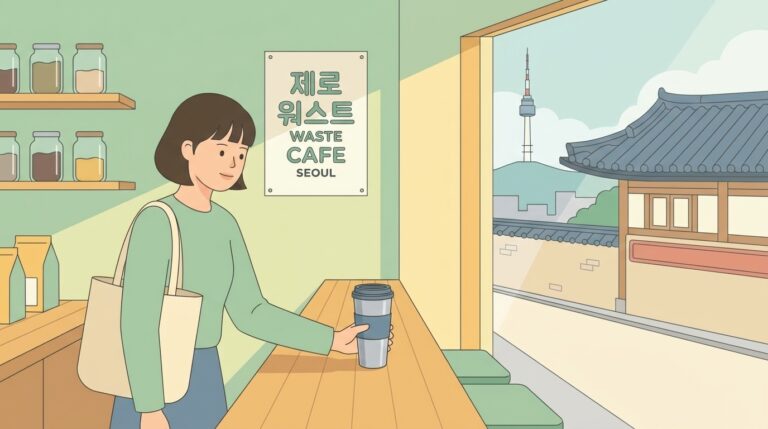
- “텀블러에 담아 주시면 할인되나요?”
- [Teom-beul-reo-e dam-a ju-si-myeon hal-in-doe-na-yo?]
- Pro Tip: Many major Korean cafes like Starbucks, A Twosome Place, and local third-wave coffee shops offer a 300 to 500 KRW discount for reusable cups!
- “빨대는 빼 주세요.”
- [Ppal-dae-neun ppae ju-se-yo.]
- Pro Tip: Say this at the counter if you want to avoid plastic or paper straws entirely.
- “장바구니가 있어서 봉투는 안 주셔도 돼요.”
- [Jang-ba-gu-ni-ga is-seo-seo bong-tu-neun an ju-syoe-do dway-yo.]
- Pro Tip: In Korea, convenience stores and supermarkets legally charge for plastic/paper bags. Bringing your own shopping bag is standard practice.
Editor’s Travel Note:
When exploring Seoul’s green lifestyle, we highly recommend checking out zero-waste hubs in neighborhoods like Mangwon-dong or Yeonnam-dong. Use the 네이버 지도 앱 (Naver Map App) to search for “제로웨이스트 샵” (Zero-waste shops). Note: Operating hours and plastic bag regulations are subject to change depending on local district policies.
Phase 9: 한 발 더 깊이 (생각 질문)
Korea’s rapid transformation from a developing nation to a global cultural powerhouse has created a unique psychological dynamic. While traditional Korean culture emphasizes 우리 (uri – we/us/our community), the hyper-competitive modern society has pushed individual expression to the forefront. “Value Consumption” is the beautiful intersection of these two forces: it allows the individual to express their unique taste and values, while simultaneously participating in a collective movement to protect the community. It is consumerism with a soul.
💬 Your Turn
What is one ethical brand in your home country that you would love to 돈쭐내다 (punish with money)? Share your thoughts in the comments below using your newly learned Korean words!
Phase 10: FAQ & 오해 방지 (FAQ Schema)
Q: Can I use “돈쭐내다” in a formal presentation or a business contract?
A: No. “돈쭐내다” is a highly popular internet slang. While perfectly acceptable in casual conversations, media articles, or semi-formal branding brainstorms, you should replace it with terms like “윤리적 소비 운동” (ethical consumption movement) or “자발적 구매 유도” (inducing voluntary purchases) in formal contracts or academic theses.
Q: What is the difference between “가성비” (Ga-seong-bi) and “가심비” (Ga-sim-bi)?
A: 가성비 (Price-to-performance) focuses strictly on the physical utility and cost efficiency of a product. 가심비 (Price-to-heart satisfaction) prioritizes psychological comfort, emotional joy, and ethical alignment over the actual price tag.
Q: Do Koreans really care about Greenwashing, or is it just corporate buzz?
A: Extremely so. Because of the hyper-connected nature of Korean internet culture, news of a brand’s hypocrisy spreads nationwide in hours, leading to immediate boycotts. Authentic environmental sincerity is crucial for long-term survival in the Korean market.
🚨 흔한 실수 (Common Mistakes) 경고판
- Using “용기내” incorrectly: If you shout “용기내!” (Yong-gi-nae!) at a server without holding a container, they will think you are telling them to “Be brave!” physically. Make sure your context or physical container makes it clear!
- **Confusing







