

Master the Art of Second-Hand Chatting in Korea: Chat Like a True Local!
안녕하세요! (Annyeonghaseyo!) Welcome back to Daily Hangul! It’s your favorite Korean best friend and editor here, ready to guide you through the real, bustling streets of Korean daily life.
Have you ever browsed through Karrot Market (당근마켓)—Korea’s ultra-popular second-hand trading app—and found the perfect vintage jacket or a rare K-pop album, only to freeze when it came to sending the first message?
“What if I sound too robotic?”
“What if I accidentally sound rude?”
“How do locals actually talk in these chats?”
If these questions have crossed your mind, you are not alone! Many of our learners at the A2 level feel confident with textbook greetings but get intimidated by the casual, friendly, yet polite world of online trading. Today, we are going to fix that. By the end of this guide, you will be typing like a friendly Seoul neighbor and locking down those amazing deals with ease. Let’s dive in!
Phase 2: Core Expressions Deep Dive
To make a great first impression, you only need three magic phrases. Let’s break them down!
1. 혹시 아직 판매 중인가요? (Hoksi ajik panmae jung-in-gayo?)
- Pronunciation: Hok-shee ah-jeek pan-mae joong-een-gah-yo? (Sounds like “Hawk-see” + “Ah-jeek”)
- Meaning: Is this by any chance still available for sale?
- K-Culture Moment: This is the ultimate icebreaker. Even if the listing doesn’t say “reserved,” starting with this polite inquiry is the standard way to show interest without being pushy.
- Editor’s Insight: The word 혹시 (hoksi – by any chance) is like magic dust in Korean. It instantly softens your tone and makes you sound incredibly polite and considerate!
- Situation Spectrum: Casual ⚠️ / Semi-formal ✅ / Formal 🚫
- 🤔 Think About It: Why do you think Korean culture values starting questions with “by any chance” rather than just asking directly? How does this compare to your culture?
2. 네고 가능한가요? (Nego ganeunghangayo?)
- Pronunciation: Neh-go gah-neung-han-gah-yo? (Like “neh-go” from negotiation + “gah-neung-hang-gah-yo”)
- Meaning: Is price negotiation possible?
- K-Culture Moment: Bargaining is a fun part of second-hand deals, but doing it politely is key. Asking this first shows you respect the seller’s boundaries.
- Editor’s Insight: 네고 (nego) is a Konglish (Korean-English) word derived from “negotiation.” It is widely used in second-hand trading apps.
- Situation Spectrum: Casual ⚠️ / Semi-formal ✅ / Formal 🚫
- 🤔 Think About It: In Korea, asking for a discount too aggressively can label you as a “Chat Villain” (빌런). How do people bargain politely in your home country?
3. 어디서 직거래 가능하세요? (Eodiseo jikgeorae ganeunghaseyo?)
- Pronunciation: Eo-dee-seo jeek-guh-rae gah-neung-hah-seh-yo? (Like “Uh-dee-suh” + “Jeek-gaw-reh”)
- Meaning: Where can we meet for a face-to-face transaction?
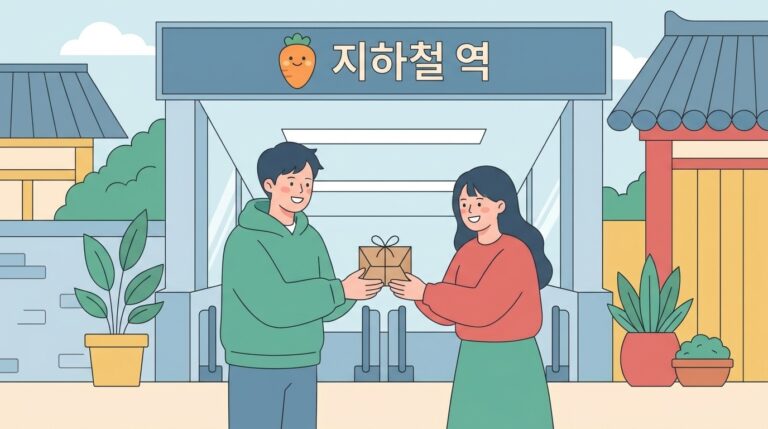
- K-Culture Moment: Most Koreans prefer to meet in public, highly visible spaces—usually right outside specific subway station exits (e.g., “Hongdae Station Exit 9”).
- Editor’s Insight: 직거래 (jikgeorae) literally means “direct transaction.” It saves shipping costs and builds trust!
- Situation Spectrum: Casual 🚫 / Semi-formal ✅ / Formal ⚠️
- 🤔 Think About It: Meeting strangers at a subway exit for a $10 trade is a unique aspect of Korea’s high-safety, community-oriented culture. Would this feel normal in your city?
Phase 3: Textbook Korean vs. Real-Life Korean
Let’s see how school textbook Korean compares to the vibrant phrases locals actually type!
Situation 1: Expressing your wish to buy
- 📖 Textbook Korean: 이것을 사고 싶습니다. (Igeoseul sago sipseumnida.)
- “I want to buy this.”
- 🗣️ Real-Life Korean: 저 구매하고 싶어요! (Jeo gumaehago sipeoyo!)
- “I’d love to purchase this!”
- 💡 Why the difference? The textbook version sounds incredibly stiff, almost like a military command. Using “구매하고 싶어요” with a friendly exclamation mark makes you sound warm and enthusiastic.
Situation 2: Wrapping up the deal
- 📖 Textbook Korean: 감사합니다. 안녕히 계십시오. (Gamsahamnida. Annyeonghi gyesipsio.)
- “Thank you. Please stay well.”
- 🗣️ Real-Life Korean: 감사합니다! 좋은 하루 보내세요~ (Gamsahamnida! Joeun haru bonaeseyo~)
- “Thank you! Have a great day~”
- 💡 Why the difference? In chat rooms, adding a wave tilde (~ ) at the end of a sentence stretches the vowel and conveys a warm, smiling expression. It shows you had a pleasant experience trading with them!
Phase 4: K-Culture Deep Dive & Chatting Etiquette
4-1. The “Nunchi” (눈치) of Texting: Emoji Power
In Korean digital spaces, texting without emojis or Korean keyboard symbols can make you seem cold, angry, or uninterested. To maintain a high “Manner Temperature,” always sprinkle in some friendly indicators:
* ^^ : Happy eyes (the classic Korean smiley).
* ㅠㅠ or ㅜㅜ : Crying eyes (used to show polite regret, e.g., “Oh no, I’m a bit late ㅠㅠ”).
* ㅎㅎ or ㅋㅋ : Soft laughter (makes your tone lighter).
* 😊, 👍, 🙏 : These universal emojis are highly appreciated!
4-2. The “Manner Temperature” (매너온도)
On the Karrot Market app, every user has a “Manner Temperature” that starts at the average human body temperature of 36.5°C. If you are polite, show up on time, and leave good reviews, your temperature rises. If you ghost sellers or bargain rudely, it drops. Koreans take pride in keeping their temperature high—some even reach over 50°C!
Phase 5: Real-Life Roleplay Scenario
Imagine you are trying to buy a cute, barely-used toaster from Minji (민지), a friendly university student selling her items near Hongdae.
🎭 Let’s Practice Chatting!
- You (Buyer): 안녕하세요! 혹시 토스터기 아직 판매 중인가요? 😊
- (Annyeonghaseyo! Hoksi toseuteogi ajik panmae jung-in-gayo?)
- “Hello! By any chance, is the toaster still available for sale?”
- Minji (Seller): 네, 아직 판매 중이에요! 구입하실래요?
- (Ne, ajik panmae jung-i-eyo! Guiphasillaeyo?)
- “Yes, it is still available! Would you like to buy it?”
- You (Buyer): 네! 혹시 조금 네고 가능한가요? 🥺
- (Ne! Hoksi jogeum nego ganeunghangayo?)
- “Yes! By any chance, is a small discount possible?”
- Minji (Seller): 음… 1,000원 깎아드릴게요! 14,000원 어떠세요?
- (Eum… cheon-won kkakka-deurilgeyo! Yeol-ne-cheon-won eotteoseyo?)
- “Hmm… I can take off 1,000 KRW! How about 14,000 KRW?”
- You (Buyer): 와, 감사합니다! 어디서 직거래 가능하세요?
- (Wa, gamsahamnida! Eodiseo jikgeorae ganeunghaseyo?)
- “Wow, thank you! Where can we meet for a direct transaction?”
- Minji (Seller): 홍대입구역 9번 출구 앞 어떠세요? 오늘 저녁 6시에 시간 괜찮으세요?
- (Hongdae-ipgu-yeok gu-beon chulgu ap eotteoseyo? Oneul jeonyeok yeoseot-sie sigan gwaenchanheuseyo?)
- “How about in front of Hongdae Station Exit 9? Are you free at 6 PM tonight?”
- You (Buyer): 네, 좋습니다! 오늘 저녁 6시에 뵐게요. 👍
- (Ne, joseumnida! Oneul jeonyeok yeoseot-sie boelgeyo.)
- “Yes, that sounds great! I’ll see you tonight at 6 PM.”
- Minji (Seller): 네, 이따 봬요! 감사합니다.
- (Ne, itta bwaeyo! Gamsahamnida.)
- “Okay, see you later! Thank you.”
🔀 Interactive Choice Point
You arrived at Hongdae Station Exit 9, but you are running 5 minutes late due to a subway delay. What do you text Minji?
- A) “나 늦어요. 기다려요.” (Na neujeoyo. Gidaryeoyo.)
- B) “죄송해요 ㅠㅠ 지하철 때문에 5분 정도 늦을 것 같아요!” (Joesonghaeyo… jihacheol ttaemune obun jeongdo neujeul geot gatayo!)
- C) No text. Just run as fast as possible without saying anything.
💡 Feedback:
- Selecting A (Bad): This is written in informal language (반말) and sounds like a commanding order: “I’m late. Wait.” This will instantly freeze your transaction and ruin your Manner Temperature!
- Selecting B (Best!): Perfect! It uses polite language, explains the reason gently, uses the “ㅠㅠ” emoji to show genuine regret, and gives a clear estimate of the delay. Minji will happily wait!
- Selecting C (Risk): Ghosting or showing up late without notice is the number one taboo in Korean second-hand trading. You might get reported or receive a bad rating.
Phase 6: 10-Second Emotion Shadowing Drill
Practice reading these aloud with the correct rhythm, pauses (/), and emotional tones!
- [😊 Expressing Hope & Bright Energy]
저 / 구매하고 싶어요! / 혹시 / 아직 / 판매 중인가요?
(Jeo / gumaehago sipeoyo! / Hoksi / ajik / panmae jung-in-gayo?) -
[🥺 Polite & Cute Bargaining]
혹시… / 조금만 / 네고 / 가능한가요? / ㅠㅠ
(Hoksi… / jogeum-man / nego / ganeunghangayo? / u-u) -
[🤝 Warm Agreement]
네! / 좋습니다! / 오늘 / 저녁에 / 뵐게요! / 좋은 하루 보내세요~
(Ne! / Joseumnida! / Oneul / jeonyeok-e / boelgeyo! / Joeun haru bonaeseyo~)
Phase 7: K-Culture Mini Dictionary
-
당근 (Danggeun)
- Literal Meaning: Carrot.
- Real Usage: Short for “당신 근처” (Near You), the name of the top trading app. It is also used as a verb: “당근하다” (to do a second-hand trade).
- 쿨거래 (Kool-georae)
- Literal Meaning: Cool Transaction.
- Real Usage: A fast, smooth trade where the buyer doesn’t ask too many questions or negotiate, but just pays immediately. Highly praised by sellers!
- 택포 (Taek-po)
- Literal Meaning: Shipping fee included.
- Real Usage: Short for “택배비 포함” (taegbaebi poham). If a listing says “30,000원 (택포),” it means the seller pays for the shipping.
- 미개봉 (Mi-gaebong)
- Literal Meaning: Unopened.
- Real Usage: A brand new, sealed product in its original packaging. Usually sold at a slight discount from retail price.
Phase 8: Traveler’s Survival Kit
If you are visiting Korea and want to trade, keep these expressions in your pocket!
- 택배 거래 되나요? (Taegbae georae doenayo?)
- “Is it possible to ship it by mail?”
- 반값택배 가능한가요? (Ban-gap-taegbae ganeunghangayo?)
- “Can you send it via ‘Half-Price Convenience Store Delivery’?” (A super popular, cheap shipping method in Korea!)
- 네고는 정중히 사양합니다. (Negoneun jeongjung-hi sayang-hamnida.)
- “I politely decline negotiations.” (Watch out for this on listing descriptions so you don’t ask for a discount unnecessarily!)
💡 Editor’s Travel Note:
To experience local life, make sure to install the 당근마켓 어플리케이션 다운로드 (Karrot Market App). You can easily find unique local items near your Airbnb, but remember that you will need a active Korean phone number to verify your location!
Phase 9: One Step Deeper (Reflections on Korean Trust)
In many global cities, meeting a stranger from the internet to trade items can feel scary or risky. However, in Korea, “Danggeun Market” has revitalized the traditional concept of “이웃 사촌” (Iut Sachon – Neighbors who are like cousins).
Because Korea has high public safety and closely-knit neighborhood subways, people trust each other to trade high-value electronics, clothing, and even give away free baby items. It represents a digital return to the warm, communal village culture of old Korea.
💬 Your Turn: Would you feel comfortable trading second-hand goods at a subway station in your city? Why or why not? Let us know in the comments below!
Phase 10: FAQ & Common Mistakes
Q: Can I use “반말” (informal Korean) when chatting on Karrot Market since it is peer-to-peer?
A: Absolutely not! Even if the seller looks younger than you in their profile picture, second-hand chatting is between strangers. Always use 존댓말 (polite Korean ending in -요 or -습니다) to show respect and avoid getting your account suspended.
Q: What does “일괄” (ilgwal) mean in K-pop photo card listings?
A: It means “all together” or “as a bundle.” If a seller writes “일괄 판매,” they want to sell all the photo cards together, not individually.
Q: How do I pay the seller in person?
A: You can pay with cash, but most modern Koreans prefer to do a quick 계좌이체 (gyeojwa-iche – mobile bank transfer) right on the spot once they inspect the item.
🚨 Common Mistakes Alert!
- Mistake 1: Writing “깎아줘” (Kkakka-jwo – Give me a discount).
- Why it’s wrong: It is extremely blunt and informal.
- Correct Action: Use “혹시 네고 가능할까요?” (Hoksi nego ganeunghalkkayo?).
- Mistake 2: Not showing up and not texting back.
- Why it’s wrong: This is called “잠수” (diving/ghosting) and will heavily damage your profile rating.
- Correct Action: If you cannot make it, text at least 1 hour early: “개인 사정으로 못 가게 되었어요. 정말 죄송합니다.”
Phase 11: Action Missions!
- 🥉 Bronze Mission: Open your notepad app and practice typing: “안녕하세요! 혹시 아직 판매 중인가요?” five times without looking at the Romanization!
- 🥈 Silver Mission: Go to your social media or share in the comments section below one item you want to “당근” (trade) if you visited Korea today.
- 🥇 Gold Mission: Next time you watch a K-Drama and see a character doing a second-hand deal, listen closely for the words “직거래” or “당근”!
Phase 12: Interactive Quiz Challenge!
Test your skills and unlock your trading badge!
1. Which of the following is the most polite way to ask for a small price cut?
- A) 돈 깎아줘.
- B) 혹시 조금 네고 가능하세요? 😊
- C) 네고 해주세요.
2. Fill in the blank:
“I want to meet up in person near the station.”
-> “역 근처에서 ________ 하고 싶어요!”
3. True or False:
On Korean trading apps, you do not need to use polite emojis (like ^^ or 👍), and typing very dry sentences with periods makes you look highly professional. (T/F)
🎉 Click here to reveal the answers and explanations!
Answers:
- B is correct! It uses the softening “혹시” (by any chance) and the polite “-세요” ending along with a warm emoji.
- 직거래 (jikgeorae). The full sentence is “역 근처에서 직거래 하고 싶어요!” (I want to do a direct transaction near the station!)
- False! While not strictly forbidden, dry texting in Korea can make you sound cold or angry. Adding friendly emoticons is standard digital etiquette for a smooth trade!







