

Step Into the Heat: Your Guide to Surviving and Loving the Korean Bulgama
안녕하세요! Welcome back to another cozy cultural session with Daily Hangul. I’m your chief editor and your personal local culture navigator!
Have you ever watched a Korean drama where characters wrap towels around their heads like sheep ears, crack brown eggs against their foreheads, and lie down on hot stone floors? Welcome to the magical, rejuvenating world of the Jjimjilbang (ᤐᅵᄰ방 – Korean Sauna)!
For many of my intermediate students, stepping into an 80°C (176°F) Bulgama (버가ᅧ라 – oak-fired sweat room) for the first time feels like a survival challenge. You might feel a little lost or self-conscious. Don’t worry! Today, we’re going to learn the exact phrases locals use to express that delicious relief of sweating it all out, so you can strut into the kiln like an absolute pro.
Phase 2: Core Expressions for the Bulgama
Let’s dive into three phrases that will instantly elevate you from a confused tourist to a seasoned regular.
1. 거래, 시거ᅮ하다! (Eou, siwonhada!)
- Pronunciation: Eoh-woo, shee-won-ha-da! (Think of saying “Oh, she won her day” with a soft, breathy sigh at the end.)
- Meaning: “Oh, this is refreshing!” (Literally: “Oh, it is cold/cool!”)
- K-Culture Moment: You will hear grandpas in hot hot tubs or steaming dome saunas exclaiming this with their eyes closed.
- Editor’s Insight: This is one of the most beautiful paradoxes in the Korean language. While 시거ᅮ하다 literally means “to be cool/chilly,” Koreans use it to describe the feeling of deep physical relief when heat penetrates tense muscles or when eating hot, spicy soup. It’s a release of internal blockages!
- Situation Spectrum: Casual ✅ / Semi-formal ✅ / Formal ⚠️
- 홰아 Think About It: Does your native language have a word that describes finding relief in something that should theoretically feel uncomfortable?
2. 따머이 죠ᅡ개 바저네요. (Ttami jjwak ppajineyo.)
- Pronunciation: Ttahm-ee jjwakh ppah-jee-neh-yo (Pop those double consonants! The “tt” and “jj” are tense and sharp, like the ‘t’ in ‘stop’.)
- Meaning: “The sweat is pouring out completely!”
- K-Culture Moment: Lying down on the hemp mats inside a yellow-mud kiln (횅토방), feeling the toxins literally leave your pores.
- Editor’s Insight: The word 죠ᅡ개 (jjwak) is a fantastic Korean onomatopoeia/ideophone. It describes something spreading out wide, draining thoroughly, or stretching completely. Saying “따머이 죠ᅡ개 바저네요” shows you appreciate the detox process!
- Situation Spectrum: Casual ✅ / Semi-formal ✅ / Formal ⚠️
- 홰아 Think About It: Why do you think physical sensations in Korean are so heavily tied to dramatic sensory words like “죠ᅡ개”?
3. 사태 거ᅯ 가타요. (Sal geot gatayo.)
- Pronunciation: Sahl geot gah-tah-yo (Rhymes with “Marl gut got-ah-yo”.)
- Meaning: “I feel like I’ll live!” / “This is saving my life!”
- K-Culture Moment: You’ve just spent 15 minutes baking in the Bulgama. You step out, dizzy and red, and take a massive sip of ice-cold sweet rice drink (시개).
- Editor’s Insight: This expression is perfect whenever you escape a mild crisis—whether you finally drink water after being dehydrated, eat food when starving, or find a blast of air conditioning on a humid August day in Seoul.
- Situation Spectrum: Casual ✅ / Semi-formal ✅ / Formal ⚠️
- 홰아 Think About It: How dramatic is your language when expressing relief? Do you also talk about “living” or “surviving”?
Phase 3: Textbook Korean vs. Real-Life Korean
Let’s bridge the gap between classroom Korean and the actual street (or sauna) talk!
Situation 1: Entering the super hot room
- 효과서 한구거 (Textbook): 어기낸 온둬가 아주 눠ᄑ시홰다. (This place has a very high temperature.)
- 신재 한구거 (Real): 와, 어기 대바개 태거버다! (Wow, it’s super hot in here!)
- 홰아 Why the difference? Textbook grammar can sound like a weather report. Using 대바개 (daebak – awesome/huge) as an intensifier is how locals casually express astonishment.
Situation 2: Encouraging your friend to sweat a bit longer
- 효과서 한구거 (Textbook): 줘개ᄆ 대 차므시버시오. (Please endure a little longer.)
- 신재 한구거 (Real): 우리 5번만 대 배텨보ᄅ까? (Shall we hang in there for just 5 more minutes?)
- 홰아 Why the difference? 배터다 (beotyida) means “to hold out” or “to endure actively.” It frames the sauna session as a fun, shared challenge with your companion.
Phase 4: K-Culture Deep Dive & Non-verbal Manners
4-1. Nunchi & Gestures: The Silent Rules of the Kiln
When you enter a Bulgama, you aren’t just entering a room; you are entering a shared communal sanctuary.
1. The “Yangmeori” (양매러 – Sheep Head) Equalizer: Folding your towel into sheep ears isn’t just for cute selfies. It actually keeps your wet hair protected from the intense heat and prevents sweat from dripping into your eyes. Wearing it instantly signals, “I respect the Jjimjilbang way!”
2. Low-Voice Nunchi (눈치): Jjimjilbangs are spaces of quiet rest. Avoid shouting or loud laughter. If you need to speak, whisper.
4-2. The Cultural Code of Sikhye (시개)
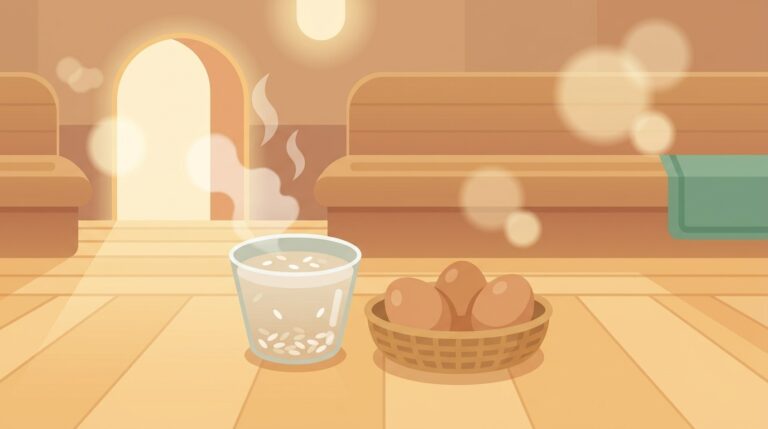
In Korean bathhouse culture, sweating and consuming are beautifully linked. After sweating in the Bulgama, your body loses fluids. Instead of plain water, Koreans drink Sikhye (시개)—a cold, sweet beverage made from fermented malt and rice. The natural sugars instantly revive your energy, and the ice chips cool your internal temperature. It is almost a crime to go to a Jjimjilbang and not pair Sikhye with Maekbanseok eggs (매개반서개 다ᄅ갸ᄑ – eggs baked slowly on hot elvan stones)!
Phase 5: Real-Life Roleplay Scenario
Setting: You are inside the high-heat pine wood dome (숴나무 한증매개) with your Korean friend, Yujin. It’s dry, intensely fragrant with pine, and incredibly hot.
Yujin: 와, 어기 진차 태거붜요! 갠찬ᅡ요?
       (Wow, eogi jincha tteugeoweoyo! Gwaenchanh-ayo?)
       🎭 [Wiping sweat from her forehead and smiling]

You:   어개 시거ᅮ하거 조해내요. 따머이 죠ᅡ개 바즈넌 뉴끼미애요.
       (Eou siwonhago johneyo. Ttami jjwak ppajineun neukkim-ieyo.)
       🎭 [Leaning back against the wooden wall, breathing deeply]

Yujin: 마재요! 한증매개가 피로 퍼는 대닌 채거애요. 5번만 대 배텨보ᄅ까요?
       (Majayo! Hanjeungmak-ga piro peuneun daenun chaegoyeyo. O-bunman deo beotyeobolkkayo?)
       🎭 [Adjusting her sheep head towel]

You:   초하요! 5번 대 배티거 시개 마시러 가요.
       (Joh-ayo! O-bun deo beotigo sikhye maseireo gayo.)
       🎭 [Grinning, imagining the icy drink]
곤타그 Interactive Decision Point
After exactly 5 minutes, you step out of the dome. Your skin is red and you are panting. What do you do next?
- Choice A: Sit directly in front of the giant cold-room fan.
- 훠과 (Feedback): Risk! Shocking your heated skin with direct artificial cold wind can cause muscle stiffness or catching a sudden cold. Locals prefer natural cooling first.
- Choice B: Head straight to the snack counter, tap your wristband, and say: “시개 하나랑 매개바저서개 다ᄅ가ᄑ 주새요!”
- 훠과 (Feedback): Best! You are officially a local. You are replenishing electrolytes while navigating the cash-free wristband key system perfectly.
- Choice C: Complain loudly in English about how hot it was.
- 훠과 (Feedback): Bad! This breaks the relaxing vibe (nunchi) of the communal resting area where others are trying to sleep. Keep it down!
Phase 6: 10-Second Emotion Shadowing Drill
Practice saying these with the exact emotion to sound deeply natural!
- “어개, / 시거ᅮ하다!”
- [이아 With a heavy, relaxing sigh, letting all physical stress melt away]
- “와, / 사태 거ᅯ 가타요!”
- [효 Revitalized, with wide eyes after taking a sip of freezing cold Sikhye]
Phase 7: K-Culture Mini Dictionary
- 버가ᅧ라 (Bulgama): Traditional kiln heated by burning oak firewood, often lined with yellow clay, salt, or jade.
- 시개 (Sikhye): Fermented sweet rice beverage containing cooked grains, usually served semi-frozen in a large cup.
- 양매러 (Yangmeori): The iconic “sheep head” towel fold worn by Jjimjilbang visitors.
- 매개바거서개 다ᄅ갸ᄑ (Maekbanseok Dalgyal): Elvan-stone baked brown eggs, which have a chewy texture and uniquely smoky taste.
Phase 8: Traveler’s Survival Kit
Survival Phrases TOP 3
- “시개 대자(거) 하나 주새요.” (Sikhye dae-ja hana juseyo.)
- Pro Tip: Get the “dae” (large) size. You will drink it faster than you think!
- “수건 더 바들 수 이새요?” (Sugeon deo badeul su isseoyo?)
- Pro Tip: Useful if you’ve sweated so much your first towel is completely damp.
- “여기 키로 개재하넌 가요?” (Yeogi ki-ro gyeoljehaneun geon-gayo?)
- Pro Tip: Ask this at the snack bar or massage corner to confirm if payments are charged to your wrist key.
Editor’s Travel Note
Before heading to legendary spots like Spa Land in Busan or local neighborhood saunas in Seoul, make sure to locate them using the KakaoMap App Download since Google Maps doesn’t show precise walking routes in Korea.
Note: Facilities and operational hours can change, so checking recent local reviews on your navigation app is highly recommended before arriving!
Phase 9: “한 발 더 깊이” (Going Deeper)
In Western bathhouses, privacy is paramount. People often maintain physical space and avoid eye contact. In Korea, however, the Jjimjilbang represents a unique communal high-trust zone. Nakedness in the bath areas acts as a social leveler—whether you are a CEO or a college student, you are equal under the steam. Inside the shared Jjimjilbang hall, families sleep side by side, and strangers share wooden pillows. It is an extension of the Korean concept of Jeong (정 – deep affection and attachment), where the community is treated like a giant family.
💬 Your Turn: Have you ever experienced a shared communal bath space in your culture, or does the idea of sleeping in a room with strangers make you nervous? Let me know in the comments below!
Phase 10: FAQ & Common Mistakes
Q: Can I wear my own clothes inside the Bulgama?
A: No, you must wear the designated cotton shirt and shorts (called Jjimjilbang-bok) provided at the reception desk. Wearing outdoor clothes inside is strictly prohibited for hygiene reasons.
Q: Is it okay to stay in the Bulgama as long as possible to sweat more?
A: Absolutely not! Staying in a high-temperature kiln for more than 15-20 minutes at a time can lead to severe dehydration, dizziness, or low blood pressure. Always take breaks in the cooling halls.
Q: Why do people tap their lockers keys on the counters?
A: Your electronic locker key wristband acts as a digital credit card inside the Jjimjilbang. You tap it to buy food, book massages, or use arcade machines, and pay the total bill when you check out.
신서 Common Mistakes Board
- Mistake: Walking into the sauna rooms with your shoes or bathroom slippers on.
- Correct Action: Leave all footwear in the lockers. The entire Jjimjilbang area is heated floor (Ondol) and walked on barefoot.
- Mistake: Jumping straight into the hot baths without showering first.
- Correct Action: You must thoroughly wash your body with soap at the shower stations before stepping into any communal pool.
- Mistake: Trying to crack a boiled egg on a fragile table.
- Correct Action: Do it the K-drama way! Crack it on your friend’s forehead (gently!) or on your own knee.
Phase 11: Action Mission & Engagement
- 왜론즈 (Bronze): Practice saying “어개, 시거ᅮ하다!” out loud while taking a hot shower tonight.
- 실버 (Silver): Fold a towel into Yangmeori (Sheep Ears), take a photo, and share it on Instagram tagging #DailyHangul.
- 골드 (Gold): Visit a Korean market or local Jjimjilbang, order a cold cup of Sikhye, and successfully use the phrase “사태 거ᅯ 가타요!”.
게이ᄆ 미선: Watch an episode of a drama like Legend of the Blue Sea or Crash Landing on You and spot the Jjimjilbang scene. Listen closely to hear if they say “시거ᅮ하다”!
Phase 12: Interactive Quiz Challenge
1. What does “시거ᅮ하다” actually mean when said inside a hot Bulgama?
- A) “It’s freezing in here!”
- B) “I want some ice water.”
- C) “Ah, this heat feels deeply relieving!”
2. Fill in the blank: “따머이 _______ 바저네요” (The sweat is pouring out completely).
- A) 가까이 (Gakkai)
- B) 죠ᅡ개 (Jjwak)
- C) 파르개 (Pbareuge)
3. True or False: You should wear your outdoor sneakers inside the resting lounge of a Jjimjilbang.
- True / False
정다배가 해설 (Click to expand Answers & Explanations)
- Answer: C. Even though the literal dictionary meaning is “cool,” in this sensory context, it conveys deep somatic comfort caused by warmth.
- Answer: B. 죠ᅡ개 (jjwak) is the perfect sound-effect word to emphasize a complete, satisfying drainage of sweat.
- Answer: False. Jjimjilbangs are completely shoe-free zones to preserve the cleanliness of the heated floors where people sit and sleep.







