

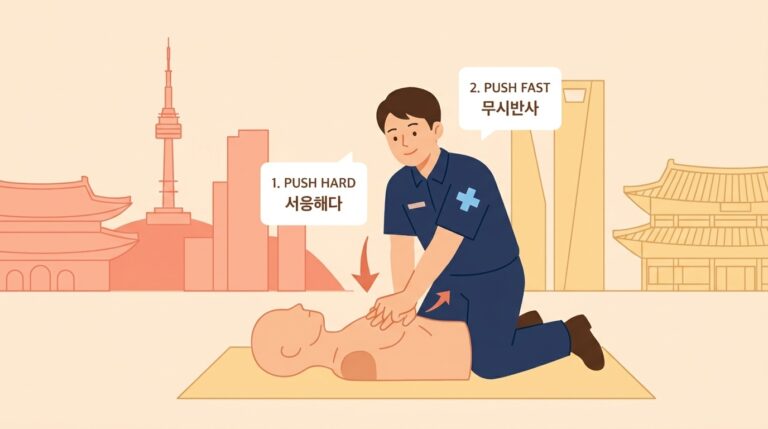
Emergency in Seoul! How to Explain and Perform CPR in Korean (B2 Guide)
Phase 1: Empathy (An Unexpected Hero on the Streets of Seoul)
안녕하세요! (An-nyeong-ha-se-yo!) Welcome back to Daily Hangul. I’m your chief editor, your trusty Korean bestie and cultural navigator.
Imagine this: You are walking through the buzzing streets of Hongdae, hummed by street musicians and neon lights. Suddenly, a person collapses right in front of you. A crowd gathers, but everyone looks frozen in shock—an occurrence psychologists call the “bystander effect.” You know CPR, but how do you instruct someone or call for help in Korean under extreme pressure?
Many intermediate Korean learners (B2 level) can talk about their hobbies or debate society trends, but when panic strikes, formal textbook vocabulary vanishes. Today, we’ll arm you with life-saving Korean expressions. This guide is built on real-world safety manuals and feedback from foreigners who survived high-pressure emergencies in Korea. Let’s learn how to be a hero when seconds count!
Phase 2: Deep Dive into 3 Core Expressions
When a life is on the line, clear, authoritative Korean is non-negotiable. Here are the three most vital expressions you need.
1. 심폐소생술을 실시해 주세요. (Sim-pye-so-saeng-sul-eul sil-si-hae ju-se-yo)
- Pronunciation: Sim-pyeh-so-saeng-sool-eul sil-see-hae joo-seh-yo (Think of “Sim” like the game, “Pye” like the letter P, and “So-saeng-sul” as soul-reviving technique)
- Meaning: “Please administer CPR.”
- K-Culture Moment: You will hear this phrase shouted passionately in medical K-Dramas like Hospital Playlist (슬기로운 의사생활) or Dr. Romantic (낭만닥터 김사부).
- Editor’s Insight: While the verb “하다” (to do) is fine, in a clinical or emergency setting, “실시하다” (to administer/implement) sounds professional and commands immediate action.
- Situation Spectrum: Casual (🚫) | Semi-formal (⚠️) | Formal (✅)
- 🤔 Think About It: In your native language, do you use medical terms or casual verbs during an emergency? Korean relies on Sino-Korean medical terms (심폐소생술) to maintain clarity and authority.
2. 가슴 압박을 서른 번 해주세요. (Ga-seum ap-bak-eul seor-un-beon hae-ju-se-yo)
- Pronunciation: Gah-seum ap-bahk-eul seor-oon-beon hae-joo-seh-yo
- Meaning: “Please do 30 chest compressions.”
- Editor’s Insight: Notice the use of the Pure Korean number “서른” (seor-un – 30) instead of the Sino-Korean “삼십” (sam-sip). When counting physical repetitions in Korean, native speakers almost instinctively use Pure Korean numbers (한 번, 두 번… 서른 번).
- Situation Spectrum: Casual (⚠️) | Semi-formal (✅) | Formal (✅)
3. 자동심장충격기(AED) 좀 가져다주세요. (Ja-dong-sim-jang-chung-gyeok-gi jom ga-jeo-da-ju-se-yo)
- Pronunciation: Jah-dong-seem-jang-choong-gyuok-gee jom gah-jeoh-dah-joo-seh-yo
- Meaning: “Please bring the AED (Automated External Defibrillator).”
- Editor’s Insight: In Korean public spaces (subways, offices), the AED is officially called “자동심장충격기” (literally: automatic heart shocker). Adding “좀” (jom – please/slightly) here doesn’t weaken your command; instead, it makes the urgent request flow naturally to native ears, prompting faster action.
- Situation Spectrum: Casual (⚠️) | Semi-formal (✅) | Formal (✅)
Phase 3: Textbook Korean vs. Real Korean
Textbook Korean is polite and descriptive, but emergency Korean is fast and direct.
- Situation 1: Ordering someone to call emergency services
- 📖 Textbook Korean: “119에 전화하여 구급차를 불러주십시오.” (Please call 119 and call an ambulance.)
- 🗣️ 진짜 (Real) Korean: “거기 빨간 옷 입으신 분, 119에 신고 좀 해주세요! 빨리요!” (You there in the red shirt, please report to 119! Quickly!)
- 💡 Why it’s different: In real life, pointing out a specific person’s clothing prevents bystander paralysis, and “신고하다” (to report/alert) is much more common than “전화하다” (to call).
- Situation 2: Checking for responsiveness
- 📖 Textbook Korean: “환자의 의식 상태를 확인하십시오.” (Check the patient’s state of consciousness.)
- 🗣️ 진짜 (Real) Korean: “정신 좀 차려보세요! 제 말 들리세요?” (Wake up! Can you hear me?)
- 💡 Why it’s different: “의식” (consciousness) is a clinical term. In the heat of the moment, shouting “정신 차리다” (to regain consciousness/focus) is what a native speaker would do.
Phase 4: K-Culture Deep Dive & Non-verbal Manners
4-1. Breaking “Nunchi” in an Emergency
Korea is a culture heavily reliant on Nunchi (눈치 – situational reading) and maintaining personal boundaries. Generally, touching strangers or speaking loudly in public is avoided. However, in a medical emergency, you must break this social code.
To avoid the bystander effect, make direct, piercing eye contact, point your finger directly at someone, and specify their clothing: “파란색 남방 입으신 분, 자동심장충격기 가져다주세요!” (You in the blue button-down, bring the AED!)
4-2. The “Golden Time” (골든타임) in Korea
In K-Dramas like Golden Time or Voice, you’ll constantly hear the term “골든타임” (Golden Time). This refers to the critical 4 minutes before brain damage occurs during cardiac arrest. Koreans highly value quick, structured emergency responses, which is why AEDs are legally mandated in all public transit hubs.
Phase 5: Real-Life Roleplay Scenario
Setting: Gangnam Subway Station platform. An elderly man suddenly collapses. You and Minjun (a helpful station agent) rush to assist.
- 민준 (Minjun): (당황하며) 어떡하지? 저 할아버지가 갑자기 쓰러지셨어요!
(Oh no, what do we do? That elderly man suddenly collapsed!) - Learner: 🎭 (단호한 표정으로 할아버지의 어깨를 두드리며) 어르신, 정신 좀 차려보세요! 제 말 들리세요?
(Tapping the elderly man’s shoulders firmly: Sir, please wake up! Can you hear me?) - 민준 (Minjun): 대답이 없으세요. 숨도 안 쉬는 것 같아요!
(He isn’t replying. I don’t think he’s breathing!) - Learner: 🎭 (민준을 똑바로 쳐다보며) 민준 씨, 빨리 119에 신고하고 구급차를 불러주세요!
(Looking straight at Minjun: Minjun, quickly call 119 and request an ambulance!) - 민준 (Minjun): 네, 지금 바로 전화할게요! 저는 뭘 하면 될까요?
(Yes, calling right now! What else should I do?) - Learner: 🎭 (가슴 중앙을 가리키며) 제가 심폐소생술을 실시할 테니, 역사 안의 자동심장충격기(AED) 좀 빨리 가져다주세요!
(Pointing to the chest center: I will administer CPR, so please bring the station’s AED quickly!) - 민준 (Minjun): 알겠습니다! 금방 가져올게요!
(Understood! I will bring it right away!) - Learner: 1초가 급해요. 가슴 압박을 서른 번 실시합니다! 하나, 둘, 셋…
(Every second counts. Commencing 30 chest compressions! One, two, three…)
🔀 Interactive Choice Points
What do you do when the AED arrives?
* A: Ask Minjun to apply the pads immediately.
* B: Wipe the patient’s wet chest and apply the pads while telling everyone to step back.
* C: Turn off the AED and wait for the paramedics.
- Feedback:
- Choice A (Risk): Good, but you must ensure the patient’s chest is dry first and no one touches them during the shock.
- Choice B (Best): Excellent! In Korean, you should shout “모두 물러나세요!” (Everyone step back!) before the shock is delivered.
- Choice C (Bad): Turning off the machine stops the “Golden Time” support. Keep the AED active until paramedics arrive!
Phase 6: 10-Second Emotional Shadowing Drill
In emergencies, flat intonation fails. Practice these with extreme urgency!
- “정신 좀 / 차려보세요! / 제 말 / 들리세요?”
- [🥺 Desperate & Loud] Jeong-sin jom / cha-ryeo-bo-se-yo! / Je mal / deul-li-se-yo?
- “거기 빨간 옷 / 입으신 분! / 119에 / 신고해 주세요!”
- [🗣️ Commanding & Clear] Geo-gi ppal-gan ot / ib-eu-sin bun! / Il-il-gu-e / sin-go-hae ju-se-yo!
Phase 7: K-Culture Mini-Dictionary
- 심폐소생술 (Sim-pye-so-saeng-sul) | CPR
- Essential medical term used universally across Korean health apps and public guidelines.
- 자동심장충격기 (Ja-dong-sim-jang-chung-gyeok-gi) | AED
- Literally means “Automatic Heart Shocker.” Look for these yellow boxes in every Korean subway station.
- 구급대원 (Gu-geup-dae-won) | Paramedic / EMT
- The professionals who arrive when you call 119.
- 인공호흡 (In-gong-ho-heup) | Artificial Respiration / Rescue Breaths
- Used during CPR cycles if trained (30 compressions to 2 rescue breaths).
Phase 8: Survival Kit for Travelers
Survival Phrases TOP 3
- 도와주세요! (Do-wa-ju-se-yo!) – Help me!
- 여기 사람 쓰러졌어요! (Yeo-gi sa-ram sseu-reo-jyeos-seo-yo!) – Someone collapsed here!
- 119 좀 불러주세요! (Il-il-gu jom bul-leo-ju-se-yo!) – Please call 119!
📌 Editor’s Travel Note
If you ever need to direct paramedics, always download the Naver Map App or KakaoMap App beforehand. They show your precise coordinate address in Korean, which you can read directly to the 119 operator.
(Note: While 119 provides foreign language translation services, knowing these basic terms can expedite response times. Emergency procedures and app features may vary over time.)
Phase 9: “One Step Deeper” (Reflective Thought)
In Korea, there is a deep-seated cultural sentiment known as Jeong (정)—a form of collective empathy and warmth toward others. This often prompts bystanders to step in and help immediately during accidents. However, fear of legal repercussions sometimes causes hesitation. Thankfully, South Korea’s “Good Samaritan Law” (응급의료에 관한 법률) protects those who administer emergency CPR in good faith. Knowing this, you can act boldly without fear.
💬 Your Turn: Have you ever seen an AED in a Korean subway station? Let us know in the comments below!
Phase 10: FAQ & Mistake Prevention
Q: What is the emergency phone number in South Korea?
A: The main emergency number for fire, medical, and rescue services is 119. For police, it is 112.
Q: Do I need to speak fluent Korean to call 119?
A: No. If you speak English, say “영어 통역 부탁드립니다” (Yeong-eo tong-yeok bu-tak-deu-rim-ni-da – English translation, please). The dispatcher will connect you with an interpreter.
Q: Can I use the English word ‘AED’ when asking for help?
A: Yes, most modern Koreans recognize “AED,” but shouting “자동심장충격기” (Ja-dong-sim-jang-chung-gyeok-gi) is much more effective in public crowds.
🚨 Common Mistakes Warning Board
- Mistake 1: Shouting “살려주세요!” (Sal-lyeo-ju-se-yo) when you mean to say “도와주세요” (Do-wa-ju-se-yo).
- Correction: “살려주세요” means “Save my life” (often used in violent threats). If you want general assistance, use “도와주세요!” (Help me!).
- Mistake 2: Mixing up Sino-Korean and Pure Korean numbers when counting compressions.
- Correction: Count as “하나, 둘, 셋…” (Pure Korean) instead of “일, 이, 삼…” (Sino-Korean).
Phase 11: Action Mission & Engagement
- Bronze Medal: Memorize “여기 사람 쓰러졌어요!” and practice shouting it in a firm voice.
- Silver Medal: Find a picture of a Korean AED station online and read the instructions written on it.
- Gold Medal: Watch a medical K-Drama episode and write down at least three emergency phrases you recognize.
Phase 12: Interactive Quiz Challenge
Test your emergency Korean readiness!
- Which phrase is the most natural way to ask someone to bring the AED in an emergency?
- A) 자동심장충격기를 사주세요.
- B) 자동심장충격기 좀 가져다주세요.
- C) 자동심장충격기 보고 싶어요.
- True or False: In Korea, calling 112 will bring a medical ambulance.
Click for Answers & Explanations!
- Correct Answer: B (A means “Buy me an AED,” and C means “I want to see the AED.”)
- Correct Answer: False (112 is for the Police. You must call 119 for medical emergencies and ambulances!)







