

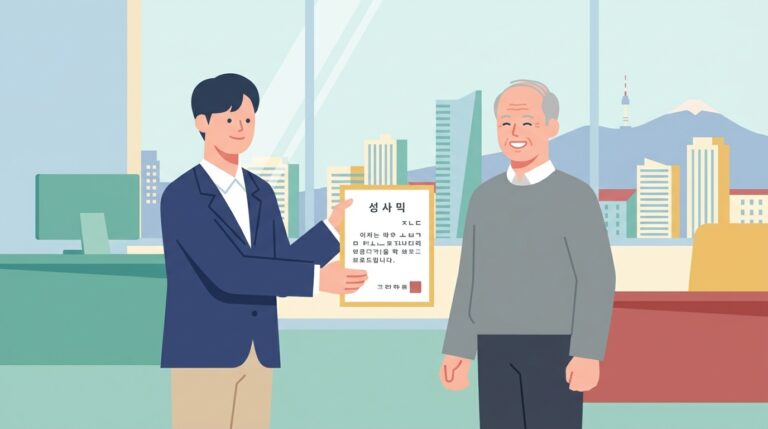
Mastering Office Korean: How to Report to Your Boss Like a K-Drama Pro
안녕하세요! (An-nyeong-ha-se-yo!) Hello! I am your lead editor and your personal cultural navigator from Daily Hangul.
If you’ve ever watched K-Dramas like Misaeng: Incomplete Life or Business Proposal, you’ve probably seen office workers standing nervously in front of their manager’s desk, holding a folder with both hands. In a Korean office, the way you update your boss is more than just passing information—it is a beautiful dance of respect, timing, and politeness.
Many of our beginner learners tell us: “I know how to say basic things, but I freeze when I have to tell my boss I finished my work!” Today, we are going to break down those barriers. By the end of this guide, you will know exactly what to say, how to stand, and when to speak so you can sound like a natural, respectful team player.
Phase 2: 3 Core Expressions Deep Dive
1. 보고 드리겠습니다 (Bo-go deu-ri-get-seum-ni-da)
- Pronunciation: Bo-go deu-ri-get-seum-ni-da. (Think of “Bo-go” like the word ‘go-go’ but with a ‘B’, and “deu-ri-get” like ‘dream’ without the ‘m’ followed by ‘get’).
- Meaning: “I will give you a report” (Literal) vs. “Let me update you on this” / “Here is my report” (Actual Nuance).
- K-Culture Moment: You will hear this in almost every office drama when an employee approaches a manager’s desk with a tablet or paper document.
- Editor’s Insight: The word 보고 (bo-go) means “report,” and 드리다 (deu-ri-da) is the humble form of “to give.” By using this phrase, you instantly show that you respect the office hierarchy and take your tasks seriously.
- Situation Spectrum: Casual 🚫 | Semi-formal ⚠️ | Formal ✅
- 🤔 Think About It: In your culture, do you use different words when talking to your boss versus your coworkers? Why do you think Korean has a whole set of special words just for showing respect?
2. 완료했습니다 (Wan-ryo-haet-seum-ni-da)
- Pronunciation: Wan-ryo-haet-seum-ni-da. (Pronounce “Wan” like ‘one’, and “ryo” like ‘Rio’ in Rio de Janeiro).
- Meaning: “I have completed it” (Actual Nuance).
- K-Culture Moment: When a project is finished and the team is ready to celebrate with a K-BBQ dinner, this is the official green-light phrase!
- Editor’s Insight: While beginners often learn 다 했습니다 (da haet-seum-ni-da – “I did it all”), 완료했습니다 is much more professional and polished for an office environment.
- Situation Spectrum: Casual 🚫 | Semi-formal ⚠️ | Formal ✅
- 🤔 Think About It: How does using precise business vocabulary change the way people look at you at work?
3. 확인 부탁드립니다 (Hwa-gin bu-tak-deu-rim-ni-da)
- Pronunciation: Hwa-gin bu-tak-deu-rim-ni-da. (“Hwa-gin” sounds like ‘wah’ + ‘gin’ like the drink. “Bu-tak” sounds like ‘boo’ + ‘tack’).
- Meaning: “Please check this” (Literal) vs. “Please review this at your convenience” (Actual Nuance).
- K-Culture Moment: This is the most common sign-off phrase in Korean business emails and instant messages (like KakaoWork or Slack).
- Editor’s Insight: It is polite because it doesn’t sound like a command. It asks for the manager’s check as a favor (부탁 – bu-tak).
- Situation Spectrum: Casual 🚫 | Semi-formal ✅ | Formal ✅
- 🤔 Think About It: Why is asking for a “favor” (부탁) considered polite in professional settings?
Phase 3: Textbook Korean vs. Real Korean
Situation 1: Letting your boss know you finished a task
- 📖 Textbook Korean: 저는 일을 끝냈습니다. (Jeo-neun ireul kkeun-naet-seum-ni-da. – “I finished the work.”)
- 🗣️ Real Korean: 보고서 작성 완료했습니다. (Bo-go-seo jak-seong wan-ryo-haet-seum-ni-da. – “I have completed writing the report.”)
- 💡 Why? The textbook version sounds robotic and a bit childish. The real Korean version specifies what you finished (보고서 작성 – report writing) and uses the elegant business term 완료했습니다.
Situation 2: Asking your boss to read your draft
- 📖 Textbook Korean: 이거 보세요. (I-geo bo-se-yo. – “Look at this.”)
- 🗣️ Real Korean: 한 번 확인 부탁드립니다. (Han beon hwa-gin bu-tak-deu-rim-ni-da. – “Please take a look at this once.”)
- 💡 Why? “이거 보세요” can sound demanding, like you are ordering your boss around. Adding “한 번” (once/briefly) softens the request, making it sound very polite.
Phase 4: K-Culture Deep Dive & Non-verbal Manners
4-1. Nunchi (눈치) & The Hand Gesture
In Korea, Nunchi (눈치)—the art of reading the room—is your ultimate survival tool. Before approaching your boss’s desk, observe their body language. Are they typing furiously? Are they on the phone? If yes, wait!
When you do approach:
1. Stand at a polite distance (don’t lean over their desk).
2. The Two-Hand Rule: When handing over a document, tablet, or business card, always hold it with both hands. It shows immense respect.
3. Give a slight nod of the head (about 15 degrees) as you start speaking.
4-2. The K-Drama Workplace Vibe
In dramas like What’s Wrong with Secretary Kim, you see employees standing straight, looking slightly down or making soft eye contact, and responding with a crisp “예! (Ye! – Yes!)”. In Korean office culture, showing humility through posture is just as important as the words you say.
Phase 5: Real-life Roleplay Scenario
Meet the Characters:
- Manager Kim (김 부장님): The busy, experienced head of marketing. Highly professional but appreciates polite junior staff.
- Ji-woo (지우): A new team member (A2 Level) eager to make a good impression.
Scenario: Ji-woo needs to hand in the weekly marketing plan to Manager Kim.
- Ji-woo: (Approaches the desk politely with a folder held in both hands) 🎭
[부장님, 잠시 시간 괜찮으십니까?](Bu-jang-nim, jam-si si-gan gwaen-chan-eu-sim-ni-ka? / Manager, do you have a moment?) - Manager Kim: (Looks up and smiles) 🎭
[네, 지우 씨. 무슨 일이에요?](Ne, Ji-woo ssi. Mu-seun ir-i-e-yo? / Yes, Ji-woo. What’s going on?) - Ji-woo: (Hands the folder over using both hands) 🎭
[이번 주 마케팅 계획 보고 드리겠습니다.](I-beon ju ma-ke-ting gye-hoek bo-go deu-ri-get-seum-ni-da. / I will report the weekly marketing plan.) - Manager Kim: (Takes the folder) 🎭
[아, 벌써 다 준비했어요?](Ah, beol-sseo da jun-bi-haet-seo-yo? / Oh, you prepared it already?) - Ji-woo: (Nods slightly) 🎭
[네, 기획서 작성 완료했습니다.](Ne, gi-hoek-seo jak-seong wan-ryo-haet-seum-ni-da. / Yes, I have completed the planning draft.) - Manager Kim: (Flips through the pages) 🎭
[수고 많았어요. 제가 읽어볼게요.](Su-go man-at-seo-yo. Je-ga il-geo-bol-ge-yo. / Great job. I will read it.) - Ji-woo: (Smiles politely) 🎭
[감사합니다. 확인 부탁드립니다!](Gam-sa-ham-ni-da. Hwa-gin bu-tak-deu-rim-ni-da! / Thank you. Please check it!) - Manager Kim: (Nods warmly) 🎭
[좋아요. 확인하고 이따 얘기해요.](Jo-a-yo. Hwa-gin-ha-go i-tta yae-gi-hae-yo. / Sounds good. Let’s talk after I review it.)
🔀 Choose Your Next Move!
How should Ji-woo respond to Manager Kim’s last line?
- A) “응! 이따가 봐.” (Eung! I-tta-ga bwa.)
- B) “네, 알겠습니다. 감사합니다!” (Ne, al-get-seum-ni-da. Gam-sa-ham-ni-da!)
- C) “빨리 읽어주세요.” (Ppal-li il-geo-ju-se-yo.)
Feedback:
- Best Choice – B: Perfect! “네, 알겠습니다” (Yes, I understand/acknowledged) is the most respectful way to close a conversation with a superior.
- Risk Choice – A: Danger! “응” is casual language (반말 – ban-mal). Using this with your boss could get you into serious trouble!
- Bad Choice – C: Too pushy! Asking your boss to “read it quickly” is considered impolite unless it is an extreme emergency.
Phase 6: 10-Second Emotion Shadowing Drill
Practice saying these out loud with natural pauses (/) and real emotions!
[😊 Polites and Confident]- Korean: 부장님, / 보고 드리겠습니다.
- Romanization: Bu-jang-nim, / bo-go deu-ri-get-seum-ni-da.
[💪 Proud and Clear]- Korean: 기획서 작성 / 완료했습니다!
- Romanization: Gi-hoek-seo jak-seong / wan-ryo-haet-seum-ni-da!
[🙏 Respectful and Kind]- Korean: 바쁘시겠지만, / 확인 부탁드립니다.
- Romanization: Ba-ppeu-si-get-ji-man, / hwa-gin bu-tak-deu-rim-ni-da.
Phase 7: K-Culture Mini Dictionary
- 부장님 (Bujang-nim) | Department Manager
- The standard title for a middle-manager. Always add “-님” (nim) to show respect.
- 보고서 (Bogo-seo) | Report / Document
- Any written document you submit to your boss for evaluation.
- 결재 (Gyeol-jae) | Approval
- The official system where a manager signs off on your work. Very common in Korean dramas!
- 야근 (Ya-geun) | Overtime Work
- Working late at night, a very common concept in traditional Korean office culture.
Phase 8: Survival Kit for Travelers
Even if you’re just visiting Korea or visiting a business partner, keep these ready:
- Survival Phrase 1: 명함 여기 있습니다. (Myeong-ham yeo-gi is-seum-ni-da. – “Here is my business card.”)
- Survival Phrase 2: 도와주셔서 감사합니다. (Do-wa-ju-seo-seo gam-sa-ham-ni-da. – “Thank you for helping me.”)
- Survival Phrase 3: 화장실이 어디예요? (Hwa-jang-sil-i eo-di-yeo-yo? – “Where is the restroom?”)
✈️ Editor’s Travel Note
If you are visiting a partner company in Seoul, don’t rely only on global maps. Download the local navigation apps like KakaoMap App Download or Naver Map App Download. They provide precise paths inside major business districts like Gangnam or Yeouido.
Phase 9: “Go Deeper” (Korean Social Mindset)
In Korea, communication is collective. When you say “완료했습니다” (I have completed it), it implies you have done your part so that the team can move forward. Honorifics (높임말 – nop-im-mal) are not meant to make you feel lower than your boss; instead, they are a structural system designed to maintain peace and respect within a shared community.
💬 Your Turn: How does your office culture handle reports? Leave a comment below and share your thoughts with the Daily Hangul family!
Phase 10: FAQ & Common Mistakes
Q: Can I use “수고하셨습니다” (Su-go-ha-syeot-seum-ni-da) to my boss when I finish work?
A: No! This is a very common mistake. “수고하셨습니다” means “You worked hard,” but culturally, it is used by a higher person to a lower person. Instead, say “감사합니다” (Gam-sa-ham-ni-da) or “먼저 들어가겠습니다” (Meon-jeo deu-reo-ga-get-seum-ni-da – I am leaving first).
Q: What if I make a mistake in my report?
A: Apologize quickly using “죄송합니다. 다시 확인하겠습니다” (Joe-song-ham-ni-da. Da-si hwa-gin-ha-get-seum-ni-da – “I am sorry. I will check again.”).
Q: Can I use KakaoTalk to report things?
A: Yes, but only if your company uses it for work. Always use polite, complete sentences, ending with “~습니다” or “~요”.
🚨 Common Mistakes Alert!
- Mistake 1: Handing documents with one hand. (Fix: Always use two hands!)
- Mistake 2: Saying “다 했어” (Da haet-eo – Casual). (Fix: Use “완료했습니다”).
- Mistake 3: Not looking at your boss when they speak. (Fix: Maintain soft, attentive eye contact and nod slightly).
Phase 11: Action Mission
- 🥉 Bronze Mission: Practice saying “보고 드리겠습니다” out loud in front of a mirror 3 times.
- 🥈 Silver Mission: Write a mock business email in the comments section below using “확인 부탁드립니다”!
- 🥇 Gold Mission: Watch one episode of a K-office drama and spot at least one character saying “완료했습니다”.
Phase 12: Interactive Quiz Challenge
Let’s test your office vocabulary!
1. Which phrase is the best way to say “I have completed writing the report”?
- A) 보고서 다 했어.
- B) 보고서 작성 완료했습니다.
- C) 보고서 보세요.
Click to see the answer!
Correct Answer: B
Explanation: B is formal, professional, and uses precise workplace terms.
2. True or False: It is polite to tell your boss “수고하셨습니다” (Su-go-ha-syeot-seum-ni-da) at the end of the day.
Click to see the answer!
Correct Answer: False
Explanation: This phrase is used by superiors to commend juniors. Say “먼저 들어가겠습니다” (I will leave first) instead!
“, block.







