

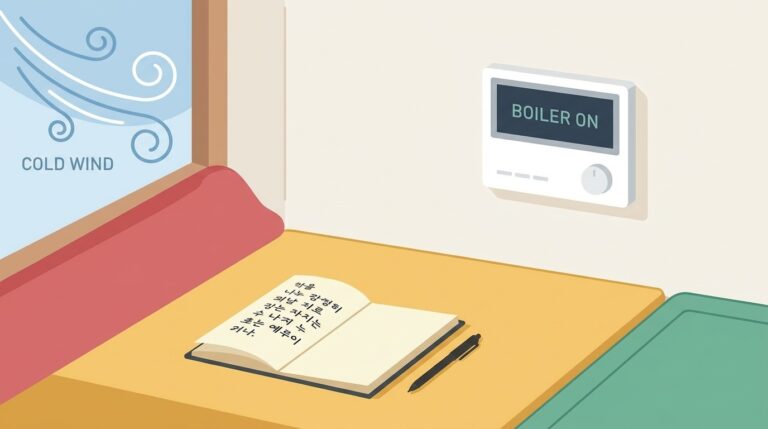
Brrr! How to Survive a Broken Korean Boiler and Ask for Hot Water
Phase 1: Empathy (Welcome to the Real Korea!)
안녕하세요! (An-nyeong-ha-se-yo!) Welcome back to Daily Hangul, your cozy corner for learning real, street-smart Korean. I’m your chief editor and resident cultural navigator.
Picture this: It’s a freezing January morning in Seoul. The temperature outside is -10°C. You shiver out of bed, step into the shower, and turn on the tap. You wait… and wait… but instead of a steamy paradise, you get hit with a blast of ice-cold water! Your teeth are chattering, and you realize: 보일러가 고장 났어요 (The boiler is broken).
If you live in an officetel, a one-room (원룸), or are staying in an Airbnb, dealing with boiler issues is a rite of passage for almost every expat in Korea. When this happens, you can’t just freeze in silence! Today, we are going to learn exactly how to report this problem to your landlord (집주인) or host politely but effectively. This guide is built based on real-life feedback from our B1-level students who successfully saved themselves from freezing winters. Let’s dive in!
Phase 2: Deep Dive into 3 Essential Expressions
When your floor heating or water is cold, these are the top three sentences you need to memorize. Let’s look at their nuance, pronunciation, and cultural contexts.
1. 보일러가 고장 난 것 같아요 (Boiler-ga go-jang nan geot gat-a-yo)
- Pronunciation: bo-il-ruh-gah go-jang nahn guht gaht-ah-yo (Think of “boiler” said with a Korean accent: bo-il-ruh).
- Meaning: “I think the boiler is broken.”
- K-Culture Moment: You will hear this expression in almost every winter-themed K-Drama when characters move into a cheap rooftop room (옥탑방) and the heating suddenly dies, forcing them to share a blanket.
- Editor’s Insight: Koreans rarely say “보일러가 고장 났어요” (The boiler is broken) directly to a landlord because it sounds too accusatory. Adding “-것 같아요” (I think/It seems like) softens the tone, making you sound extremely polite and cooperative.
- Situation Spectrum:
- Casual (to friends): 보일러 고장 난 것 같아. (⚠️)
- Semi-formal (to landlord): 보일러가 고장 난 것 같아요. (✅ – Best choice!)
- Formal (to a technician): 보일러가 고장 난 것 같습니다. (✅)
- 🤔 Think About It: Why does Korean culture value softening statements with “I think” (-것 같아요) even when you are 100% sure something is broken? How does this compare to your native language?
2. 찬물만 나와요 (Chan-mul-man na-wa-yo)
- Pronunciation: chahn-mool-mahn nah-wah-yo (Make sure to emphasize the man which means “only”).
- Meaning: “Only cold water is coming out.”
- K-Culture Moment: In reality TV shows like I Live Alone (나 혼자 산다), you often see celebrities shivering in their bathrooms while yelling this exact phrase to their friends.
- Editor’s Insight: “찬물” means cold water, and “만” means only. This is the most crucial piece of information to convey. It lets the landlord know this is an emergency that needs immediate attention.
- Situation Spectrum:
- Casual: 찬물만 나와. (⚠️)
- Semi-formal: 찬물만 나와요. (✅)
- Formal: 찬물만 나옵니다. (✅)
3. 따뜻한 물이 안 나와요 (Tta-tteut-han mul-i an na-wa-yo)
- Pronunciation: ttah-tteut-hahn mool-ee ahn nah-wah-yo (Pop the double ‘t’ sound slightly like the ‘t’ in “stop”).
- Meaning: “Warm/hot water isn’t coming out.”
- K-Culture Moment: This is the universal phrase used at public bathhouses (목욕탕) or pensions when the hot water supply runs low.
- Editor’s Insight: While “찬물만 나와요” focuses on the presence of freezing water, this phrase focuses on the absence of warmth. You can use both phrases together to make your situation crystal clear!
- Situation Spectrum:
- Casual: 따뜻한 물 안 나와. (⚠️)
- Semi-formal: 따뜻한 물이 안 나와요. (✅)
- Formal: 따뜻한 물이 나오지 않습니다. (✅)
Phase 3: Textbook Korean vs. Real-Life Korean
Let’s compare what textbooks teach you versus how native Koreans actually handle this cold situation.
Situation 1: Asking the landlord to check the boiler
- 📖 Textbook Korean: “보일러를 수리해 주십시오.” (Bo-il-reo-reul su-ri-hae ju-sip-si-o. – Please repair the boiler.)
- 🗣️ Real-Life Korean: “보일러가 잘 안 되는데 한 번 봐 주실 수 있나요?” (Bo-il-reo-ga jal an doe-neun-de han beon bwa ju-sil su in-na-yo? – The boiler isn’t working well, could you take a look?)
- 💡 Why is it different? Direct commands like “수리해 주십시오” sound demanding and aggressive in Korean. Asking “한 번 봐 주실 수 있나요?” (Could you take a look?) shows respect and invites them to help you naturally.
Situation 2: Explaining that the water temperature won’t rise
- 📖 Textbook Korean: “온수의 온도가 낮습니다.” (On-su-ui on-do-ga nat-seum-ni-da. – The temperature of the hot water is low.)
- 🗣️ Real-Life Korean: “물이 전혀 안 따뜻해져요.” (Mul-i jeon-hyeo an tta-tteut-hae-jyeo-yo. – The water isn’t getting warm at all.)
- 💡 Why is it different? “온수” (hot water) and “온도” (temperature) are Sino-Korean words often reserved for technical documents. In daily life, saying “물이 안 따뜻해져요” is much more natural and expressive.
Phase 4: K-Culture Deep Dive & Non-Verbal Manners
4-1. The Art of “Nunchi” (눈치) and Polite Gestures
When dealing with a landlord in Korea, your delivery is just as important as your words.
* The Head Scratch & Shrug: When explaining your problem, slightly tilt your head and look a bit helpless. This non-verbal cue signals that you are not trying to cause trouble, but genuinely need help.
* The Double-Handed Point: If you are showing the landlord the boiler control panel (조절기), point with both hands or with your palm open facing up. Never point with a single index finger, as it can look rude.
4-2. The Cozy History of “Ondol” (온돌)
In Korea, heating isn’t just about hot air; it’s about floor heating, known as Ondol (온돌). Historically, smoke from the kitchen fire was channeled under masonry floors to heat the home. Today, modern boilers pump hot water through pipes beneath your floor. This is why when the boiler breaks, both your floor (바닥) and your shower water go cold. It is the ultimate double whammy! Understanding Ondol explains why Koreans love sitting and sleeping on the floor, especially in the winter.
Phase 5: Real-Life Roleplay Scenario
Here is a realistic conversation between you (민우 – Minwoo) and your friendly but busy landlord (집주인 아주머니 – Landlord Ajumoni).
- Setting: You meet the landlord in the hallway on a freezing winter morning.
-
민우: 아주머니, 안녕하세요! 추운데 잘 지내셨어요?
(Min-woo: Landlord, hello! Have you been well in this cold weather?)
🎭 Smiling warmly despite freezing. - 집주인: 아이구, 민우 씨! 날씨가 너무 춥죠? 무슨 일 있어요?
(Landlord: Oh, Minwoo! The weather is so cold, right? Is something going on?) - 민우: 다름이 아니라, 방에 보일러가 고장 난 것 같아서요.
(Min-woo: Actually, I think the boiler in my room is broken.)
🎭 Scratching the back of his head politely. - 집주인: 어머, 정말요? 어제까지는 괜찮았잖아요.
(Landlord: Oh, really? It was fine until yesterday.) - 민우: 네, 그런데 오늘 아침부터 찬물만 나와요.
(Min-woo: Yes, but starting this morning, only cold water is coming out.) - 집주인: 아이고, 추운데 온수도 안 나오고 고생했겠네. 조절기는 확인해 봤어요?
(Landlord: Oh dear, you must have suffered in this cold with no hot water. Did you check the control panel?) - 민우: 네, 온수 버튼을 눌렀는데도 따뜻한 물이 안 나와요.
(Min-woo: Yes, I pressed the hot water button, but warm water still won’t come out.) - 집주인: 그래요? 알겠어요. 내가 지금 바로 열쇠 가지고 올라가서 볼게요.
(Landlord: Really? Okay. I will bring the keys and go up to check right now.) - 민우: 네, 정말 감사합니다! 천천히 조심히 오세요.
(Min-woo: Thank you so much! Please take your time and come safely.)
🔀 Interactive Choice: How do you respond if the landlord asks to enter your room while you are out?
- Choice A: “안 돼요, 지금 바빠요.” (No, I’m busy now.)
- Choice B: “괜찮으시면 비밀번호 알려드릴 테니까 들어가서 봐 주시겠어요?” (If it’s okay, I’ll give you the passcode so could you go in and check?)
- Choice C: “나중에 오세요.” (Come back later.)
Feedback:
- Choice A (Bad): Extremely blunt and sounds aggressive. This might hurt your relationship with the landlord.
- Choice B (Best): Super practical! In Korea, it is very common to trust your landlord with your digital door lock passcode for urgent repairs.
- Choice C (Risk): While polite, it delays fixing your heating, meaning you’ll have to endure another cold shower tonight!
Phase 6: 10-Second Emotion Shadowing Drill
To speak like a native, you need to feel the cold and show the urgency! Practice these sentences with the correct pauses (/) and emotions.
- [🥺 Shivering & Pleadingly]
“보일러가 / 고장 났는지 / 찬물만 나와요.”
(Bo-il-reo-ga / go-jang nan-neun-ji / chan-mul-man na-wa-yo.) - [😊 Relieved & Grateful]
“와 주셔서 / 정말 감사합니다! / 이제 따뜻해요.”
(Wa ju-syeo-seo / jeong-mal gam-sa-ham-ni-da! / i-je tta-tteut-hae-yo.)
Phase 7: K-Culture Mini Dictionary
- 보일러 (Bo-il-reo) | Boiler: The water heating system that heats both your floor (Ondol) and tap water.
- 온수 (On-su) | Hot Water: Literally translates to “warm water.” Essential for your bathroom sink and shower.
- 조절기 (Jo-jeol-gi) | Control Panel: The small wall-mounted device inside your apartment used to adjust floor temperature and hot water options.
- 외출 모드 (Oe-chul mo-deu) | Outing/Away Mode: A setting on your boiler controller. It keeps the pipes from freezing while saving electricity when you go out. Pro tip: Never turn off your boiler completely in winter; always set it to 외출 모드!
Phase 8: Traveler’s Survival Kit
Survival Expressions TOP 3
- 따뜻한 물 나와요? (Tta-tteut-han mul na-wa-yo?)
- Does hot water come out? (Ask this before booking an old pension or guesthouse!)
- 보일러 어떻게 켜요? (Bo-il-reo eo-tteoh-ge kyeo-yo?)
- How do I turn on the boiler? (Perfect for Airbnbs with confusing controllers.)
- 방이 너무 추워요. (Bang-i neo-mu chu-wo-yo.)
- The room is too cold.
📝 Editor’s Travel Note
If you are struggling to understand your boiler controller, open your camera and use Google Lens to translate the buttons. If you need to buy a portable space heater because your boiler is completely dead, search for a local hardware store using the 네이버 지도 앱 다운로드 (Naver Map app) and type in “철물점” (cheol-mul-jeom).
Phase 9: “Go One Step Deeper” (Thought Essay)
In western countries, heating often relies on warm air blown through vents. In Korea, however, heating is intimately tied to the floor. This structural difference shapes how Koreans live: they sit on the floor to eat, study on floor desks, and sleep on thick futons (이불). There is a unique Korean word, 정 (Jeong), which represents deep affection and community warmth. During freezing winters, sharing a warm Ondol floor with loved ones is the ultimate expression of “Jeong.”
💬 Your Turn: Does your home country use floor heating, or do you rely on radiators and vents? How does this affect your lifestyle at home? Let us know in the comments below!
Phase 10: FAQ & Avoiding Common Mistakes
Q: Why is cold water coming out even though my heating is on?
A: Many Korean boiler controllers have separate settings for floor heating (난방) and hot water (온수). Make sure the “온수” button is illuminated or turned on. If it’s on “난방 전용” (heating only), your floor will be warm, but your water will be freezing!
Q: What is “외출” (Away) mode, and when should I use it?
A: “외출” (oe-chul) means “leaving the house.” Use this when going out for the day in winter. It keeps the water flowing at a minimum temperature to prevent the pipes from freezing (동파). Turning your boiler completely off in winter can lead to frozen pipes, which cost thousands of dollars to repair!
Q: How do I ask the landlord to call a repair technician?
A: You can say: “기사님 좀 불러주실 수 있나요?” (Gi-sa-nim jom bul-leo-ju-sil su in-na-yo? – Could you please call a technician?)
🚨 Common Mistakes Alert!
- Mistake 1: Turning off the boiler completely when traveling during winter. (Result: Frozen pipes and a flooded room!)
- Mistake 2: Complaining aggressively to the landlord. (In Korea, polite cooperation gets problems fixed much faster.)
- Mistake 3: Not knowing where the boiler control panel is located. (Always ask your host on day one!)
Phase 11: Action Mission & Participation
🏆 Your 3-Step Challenge
- Bronze: Locate the boiler controller in your room and identify the words 온수 (hot water) and 난방 (heating).
- Silver: Practice saying “보일러가 고장 난 것 같아요” out loud 3 times using our Shadowing Drill.
- Gold: If you ever run into a heating issue, send a polite text message to your host using the template from Phase 5!
🎮 K-Culture Mission: The next time you watch a K-Drama set in winter, count how many times characters complain about “추위” (the cold) or look at their wall-mounted boiler controller!
Phase 12: Interactive Quiz Challenge
Test your knowledge to make sure you’re ready to face the Korean winter!
1. What is the most natural way to tell your landlord the boiler is broken?
- A) 보일러 고쳐!
- B) 보일러가 고장 난 것 같아요.
- C) 보일러가 죽었습니다.
Reveal Answer
Correct Answer: B
Explanation: ‘보일러가 고장 난 것 같아요’ (I think the boiler is broken) is the most polite, natural, and standard way to report the issue. A is too rude, and C is grammatically incorrect (“the boiler died”).
2. What button should you press on your boiler controller to get hot shower water?
- A) 외출 (Oe-chul)
- B) 온수 (On-su)
- C) 예약 (Ye-yak)
Reveal Answer
Correct Answer: B
Explanation: ‘온수’ means hot water. ‘외출’ is away mode, and ‘예약’ is timer mode.
3. True or False: You should turn off your boiler completely when going on a weekend trip in January.
- A) True
- B) False
Reveal Answer
Correct Answer: B (False)
Explanation: You should use ‘외출’ (Away) mode to keep the pipes from freezing and bursting during freezing Korean winters!







