

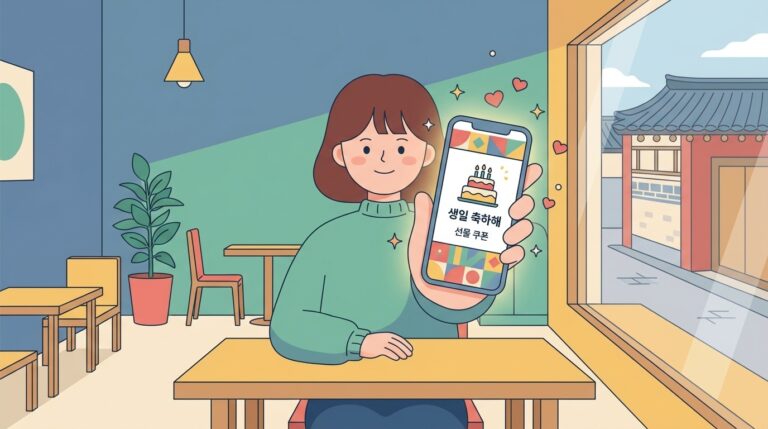
Master the Art of Korean Birthday Gifting: The Ultimate ‘Gifticon’ Guide for B2 Learners
Phase 1: Empathy (An Warm Welcome from Your Korean Best Friend)
안녕하세요! I’m your Daily Hangul Senior Editor. Let’s paint a picture: It’s your Korean friend’s birthday. You want to show them some love, but you are miles away, or perhaps you just can’t meet up on the exact day. In many Western cultures, a simple “Happy Birthday!” text or a Facebook wall post does the trick. But in Korea? There’s a digital revolution of affection happening right in the palm of your hand, and it’s called the Gifticon (기프티콘).
Imagine sending your friend a text, and poof!—a barcode for a warm Starbucks Sweet Potato Latte or a crispy bhc Fried Chicken appears on their screen. That is the magic of Korean digital gifting. Many intermediate learners tell us: “I want to send a Gifticon through KakaoTalk, but I don’t know what to write without sounding like a cold textbook!” Don’t worry. Today, we are going to unlock the exact conversational keys, cultural nuances, and real-world etiquette to make you sound like a thoughtful, natural Korean local. Let’s dive in!
Phase 2: 3 Key Expressions Deep Dive
1. 생선 뭐 갖고 싶어? (Saeng-seon mwo gat-go sipeo?)
- Pronunciation: Saeng-seon (sounds like “sang-sun” but with a soft ‘o’ as in ‘soft’) mwo gat-go sipeo?
- Meaning: “What do you want for your birthday present?”
- K-Culture Moment: You will hear this phrase constantly in casual K-Dramas like Hospital Playlist or Reply 1988 when close friends are preparing for a birthday bash.
- Editor’s Insight: This is a classic B2-level slang contraction! 생선 (saeng-seon) literally means “fish” in standard Korean. However, in modern casual slang, it is short for 생일 선물 (saeng-il seon-mul / birthday present). Asking this directly shows you are close enough to bypass formal hesitation.
- Situation Spectrum:
- Casual (Close Friends): ✅ (Highly recommended!)
- Semi-formal (Co-workers): ⚠️ (Use “생일 선물로 받고 싶으신 거 있으세요?” instead)
- Formal (Seniors/Bosses): 🚫
- 🤔 Think About It: In your culture, is it considered polite or rude to ask someone directly what gift they want for their birthday?
2. 기프티콘으로 보낼게. (Gi-peuti-kon-euro bonael-ge.)
- Pronunciation: Gi-peu-ti-kon-eu-ro bo-nael-ge.
- Meaning: “I’ll send it to you via Gifticon.”
- K-Culture Moment: Used extensively on KakaoTalk chats. Instead of carrying physical boxes, modern Koreans exchange these digital vouchers for everything from coffee to luxury cosmetics.
- Editor’s Insight: The word 기프티콘 is a portmanteau of “Gift” and “Icon.” It has become a proprietary eponym in Korea (like Kleenex or Xerox). Even if you send a coupon from other platforms, everyone calls it a “Gifticon.”
- Situation Spectrum:
- Casual: ✅
- Semi-formal: ✅ (Change the ending to “기프티콘으로 보낼게요.”)
- Formal: ⚠️ (Seniors might prefer physical gifts, but a high-end Gifticon is becoming acceptable.)
- 🤔 Think About It: Why has digital gifting become more popular than physical gifting in busy metropolitan societies like Seoul?
3. 맛있는 거 먹고 좋은 하루 보내! (Mas-it-neun geo meok-go joeun haru bonae!)
- Pronunciation: Mas-it-neun (sounds like “ma-shi-neun”) geo meok-go jo-eun ha-ru bo-nae!
- Meaning: “Eat something delicious and have a great day!”
- K-Culture Moment: This is the gold standard of casual Korean birthday wishes. Koreans show deep care through food, so wishing someone a delicious meal is a direct expression of love.
- Editor’s Insight: Instead of just saying “Happy Birthday,” adding a line about eating well makes your message feel incredibly warm and authentic.
- Situation Spectrum:
- Casual: ✅
- Semi-formal: ✅ (Use “맛있는 거 드시고 좋은 하루 보내세요!”)
- Formal: 🚫 (Use “기쁜 날, 행복하고 건강한 하루 되시기를 바랍니다.”)
- 🤔 Think About It: Why do you think food plays such a central role in Korean greetings and celebrations?
Phase 3: Textbook Korean vs. Real Korean
Let’s compare the dry, unnatural sentences from old textbooks with what native speakers actually use when celebrating birthdays digitally.
Scenario A: Wishing a close friend a happy birthday
- 📖 Textbook Korean: “생일을 축하합니다. 선물을 준비했습니다.” (Happy birthday. I prepared a gift.)
- 🗣️ 진짜 한국어: “생일 축하해! 작지만 내 마음이니까 맛있게 먹어~!” (Happy birthday! It’s small, but it’s from my heart, so eat it well~!)
- 💡 Why is it different? The textbook version sounds like a robot presenting a tax document. Real Korean uses emotive particles like “~니까” (because it is…) and “~해” casual endings, expressing warmth and humility (“작지만 내 마음” – though it’s small, it’s my heart).
Scenario B: Sending a coffee coupon
- 📖 Textbook Korean: “이것은 커피 쿠폰입니다. 커피를 마시십시오.” (This is a coffee coupon. Please drink coffee.)
- 🗣️ 진짜 한국어: “오늘 커피는 내가 쏜다! 피곤할 때 수분+카페인 충전해!” (Today’s coffee is on me! Recharge your hydration and caffeine when you’re tired!)
- 💡 Why is it different? The slang verb 쏘다 (sso-da) means “to shoot” but is widely used as “to treat/to pay for.” Phrases like “카페인 충전” (caffeine recharge) show a deep, empathetic understanding of Korean work/study culture.
Phase 4: K-Culture Deep Dive & Non-verbal Etiquette
4-1. The Midnight Rush & “Nunchi” (눈치)
In Korea, timing is everything. If you are very close with someone, sending your birthday message and Gifticon exactly at 12:00 AM (midnight) as their birthday begins is the ultimate sign of devotion.
If you miss the midnight window, don’t worry! Sending it during lunchtime (12:00 PM – 1:00 PM) with a message like “점심 맛있게 먹고 힘내!” (Eat a good lunch and find strength!) is also highly appreciated. Sending a Gifticon late at night is considered slightly rude unless you are best friends.
4-2. The “Return Gift” Code: 품앗이 (Pum-assi)
Korea has a historic communal sharing concept called 품앗이 (pum-assi), which translates to mutual exchange of labor and gifts. In the digital age, this means if someone sends you a ₩10,000 Starbucks Gifticon on your birthday, you should ideally send them a Gifticon of similar value (around ₩10,000 to ₩15,000) on their birthday. KakaoTalk actually saves your transaction history, making it easy to check what you received so you can match the gesture!
Phase 5: Real-Life Roleplay Scenario
The Setup
- Background: You are texting your Korean college friend, Ji-hoon (지훈), on his birthday. He is currently studying hard for midterms at a cafe.
- Characters:
- You (민우/Min-woo): A thoughtful foreign friend living in Seoul.
- Ji-hoon (지훈): A busy, appreciative Korean university student.
The Dialogue
- 지훈: (Posting a picture of textbooks on his Instagram story with a sigh)
- 민우: 🎭 (Typing quickly with a smile)
지훈아! 생일 축하해! 오늘 시험공부 하느라 고생이 많네.
(Ji-hoon! Happy birthday! You’re working so hard studying for exams today.) - 지훈: 🎭 (Replying immediately with crying emojis)
앗, 민우야 고마워! ㅠㅠ 오늘 생일인 것도 깜빡할 뻔했어.
(Ah, Min-woo, thank you! T_T I almost forgot it was even my birthday today.) - 민우: 🎭 (Sending a Starbucks Coffee & Cake Gifticon)
공부하다가 당 떨어질 때 이거 먹고 힘내! 기프티콘 보냈어.
(When your sugar drops while studying, eat this and gain strength! I sent a Gifticon.) - 지훈: 🎭 (Surprised and touched)
헐, 대박! 내가 제일 좋아하는 초코 케이크네! 진짜 고마워, 잘 먹을게!
(Heol, daebak! It’s my favorite chocolate cake! Thank you so much, I’ll enjoy it!) - 민우: 🎭 (Waving warmly)
응응, 시험 잘 보고 나중에 우리 맛있는 거 먹으러 가자!
(Yeah yeah, do well on your exams and let’s go eat something delicious later!) - 지훈: 🎭 (Nodding enthusiastically)
좋아! 시험 끝나자마자 바로 모이자. 내가 맛있는 거 살게!
(Sounds good! Let’s meet up as soon as exams are over. I’ll buy something delicious!) - 민우: 🎭 (Sending a thumbs-up sticker)
약속! 열공해~!
(It’s a promise! Study hard~!)
🔀 Interactive Choice Points
Your friend replies: “기프티콘 너무 고마워! 진짜 감동이야!” (Thank you so much for the Gifticon! I’m so touched!) How do you respond?
- Option A: “별거 아니야, 맛있게 먹어!” (It’s nothing, eat well!)
- Option B: “아니에요. 맛있게 드십시오.” (No, it is not. Please eat deliciously.)
- Option C: “나중에 꼭 비싼 걸로 갚아라! ㅋㅋㅋ” (Make sure to pay me back with something expensive later! Hahaha)
💡 Feedback & Analysis
- Best Choice: Option A
- Why: It’s casual, warm, and highly natural for close friends. “별거 아니야” (It’s nothing major) keeps the interaction lighthearted and friendly.
- Bad Choice: Option B
- Why: This uses extremely formal honorifics (“~하십시오”). To a close friend, this sudden shift in politeness feels cold and creates artificial distance.
- Risk Choice: Option C
- Why: While close Korean friends do make jokes about returning gifts, saying “꼭 비싼 걸로 갚아라” (Make sure to pay me back with something expensive) can sound greedy or transactional if your relationship isn’t 100% solid yet. Use with caution!
Phase 6: 10-Second Emotion Shadowing Drill
To sound like a native, you need the correct intonation and emotional pauses. Practice speaking these sentences out loud, paying attention to the pauses (/) and the emotional cues!
[😊 Bright and excited]
“생일 축하해! / 맛있는 거 많이 먹고 / 오늘 하루 / 최고로 행복하게 보내!”
(Happy birthday! / Eat lots of delicious food / and today / spend it the happiest!)-
[🥺 Sweet and supportive]
“요즘 많이 바쁘지? / 커피 기프티콘 보냈으니까 / 잠깐 쉬면서 해~!”
(Are you busy lately? / I sent a coffee gifticon, so / take a little break while doing it~!)
Phase 7: K-Culture Mini Dictionary
- 생축 (Saeng-chuk)
- Meaning: Short for 생일 축하 (saeng-il chuk-ha). Widely used in text messages and internet comments among Gen-Z and Millennials.
- 단톡방 (Dan-tok-bang)
- Meaning: KakaoTalk Group Chatroom. If you share a group chat with the birthday person, it is polite to wish them happy birthday there so everyone can join in the celebration.
- 선물하기 (Seonmul-hagi)
- Meaning: The “Gifting” feature inside KakaoTalk. This is the main highway where almost all Gifticons are purchased and delivered.
- 인증샷 (In-jeung-syat)
- Meaning: “Proof Shot” or verification photo. When your friend finally goes to Starbucks and redeems your Gifticon, they will almost always take a photo of the coffee and send it to you with a message: “잘 먹었어! (I ate well!)”
Phase 8: The Traveler’s Survival Kit
Survival Expressions for Using Gifticons in Korea
- “이거 기프티콘 쓸 수 있어요?” (I-geo gi-peu-ti-kon sseul su isseo-yo?)
- Pro Tip: Use this at the counter of a cafe or bakery while holding up your phone to ask: “Can I use this Gifticon?”
- “바코드 찍어주세요.” (Ba-ko-deu jjig-eo-ju-se-yo.)
- Pro Tip: “Please scan the barcode.” Useful when the cashier is looking at your screen.
- “다른 메뉴로 변경 가능한가요?” (Da-reun me-nyu-ro byeon-gyeong ga-neung-han-ga-yo?)
- Pro Tip: “Is it possible to change to a different menu?” In Korea, you can swap the item on your Gifticon for any other menu item of equal or higher value (you just pay the difference!).
Editor’s Travel Note 🗺️
If you are visiting Korea, make sure to download the 카카오톡 (KakaoTalk) app. It’s not just for chatting; it is the ultimate lifestyle tool. You can purchase and redeem Gifticons at almost any major convenience store chain like GS25 or CU.
(Note: App features and international payment methods inside KakaoTalk may vary depending on your app store country and phone carrier verification).
Phase 9: “A Step Deeper” (Cultural Reflection)
In Western societies, gifts are often highly individualized and wrapped in mystery. In Korea, the digital transition of gifting represents a fascinating blend of ancient collectivism and ultra-modern convenience.
Sending a Gifticon is more than just a transaction; it is a digital manifestation of 정 (Jeong)—the Korean concept of deep connection, affection, and mutual obligation. It says: “Even though we are too busy to meet, I am thinking of your daily well-being.” By participating in this digital ritual, you aren’t just sending a coffee; you are active in maintaining the delicate, beautiful web of Korean social relationships.
💬 Your Turn!
How does digital gifting work in your country? Do you use apps to send coffee, or do you prefer physical cards? Let us know in the comments below!
Phase 10: FAQ & Common Mistakes
FAQ
Q: Can I use a Gifticon after the expiration date passes?
A: Generally, no. However, KakaoTalk allows the recipient to extend the expiration date (유효기간 연장) by 90 days with a simple tap inside the app before it expires. If they don’t use it, 90% of the value is refunded to the sender or recipient depending on settings.
Q: What is an appropriate budget for a casual friend’s Gifticon?
A: For a casual friend or acquaintance, a coffee coupon with a small dessert (around ₩5,000 to ₩10,000) is perfect. For close friends, a chicken coupon (₩20,000 – ₩30,000) is standard. Going over ₩50,000 for a casual friend can actually make them feel burdened (부담스럽다).
Q: Can I send Gifticons to my boss or teacher?
A: Yes, but be careful! In Korea, there are strict anti-graft laws (김영란법) regarding public officials and teachers. For corporate bosses, a premium tea set or high-quality fruit Gifticon is acceptable, but ensure you use polite, formal text.
🚨 The “Common Mistakes” Warning Board
- Mistake: Sending a Gifticon without any accompanying text.
- Why it’s bad: It looks like a robotic automated message or spam.
- Correct Action: Always write at least 1-2 warm sentences alongside the coupon.
- Mistake: Sending pork/beef options to friends with dietary restrictions.
- Why it’s bad: Chicken and meat Gifticons are default options in Korea, but it shows a lack of personalization if they don’t eat certain meats.
- Correct Action: Send a versatile Starbucks voucher instead so they can choose their own menu.
- Mistake: Asking your friend to send an “인증샷” (proof shot) of the gift.
- Why it’s bad: Asking for it directly makes it feel like you are demanding proof of their gratitude.
- Correct Action: Wait patiently. Koreans naturally send proof shots when they use the coupon as a matter of politeness!
Phase 11: Action Mission
- 🥉 BRONZE MISSION: Write a casual Korean birthday message in your personal journal using “생축!” and “맛있는 거 먹어!”.
- 🥈 SILVER MISSION: Find a Korean friend’s social media or KakaoTalk, and send them a warm message using the exact phrases from Phase 6.
- 🥇 GOLD MISSION: The next time you are in Korea, purchase a Gifticon and successfully redeem it at a local cafe using our Phase 8 survival expressions!
Phase 12: Interactive Quiz Challenge
Test your knowledge of Korean birthday and Gifticon culture!
1. Situation-Based Question
Your Korean partner’s birthday starts tomorrow. When is the most culturally impactful time to send your birthday message?
* A) Exactly at 12:00 AM on their birthday.
* B) At 4:00 AM because you are in a different time zone.
* C) Three days before so they can prepare.
View Answer & Explanation
Correct Answer: A
In Korea, sending a birthday greeting exactly at midnight (12:00 AM) shows that you were waiting eagerly for their special day to begin. It’s the ultimate expression of care for close relationships!
2. Fill in the Blank
Complete this natural intermediate sentence:
“공부하다가 ________ 떨어질 때 이거 먹고 힘내!”
* Hint: It means “sugar drops” (getting low on energy).
View Answer & Explanation
Correct Answer: 당 (Dang)
The full slang phrase is







